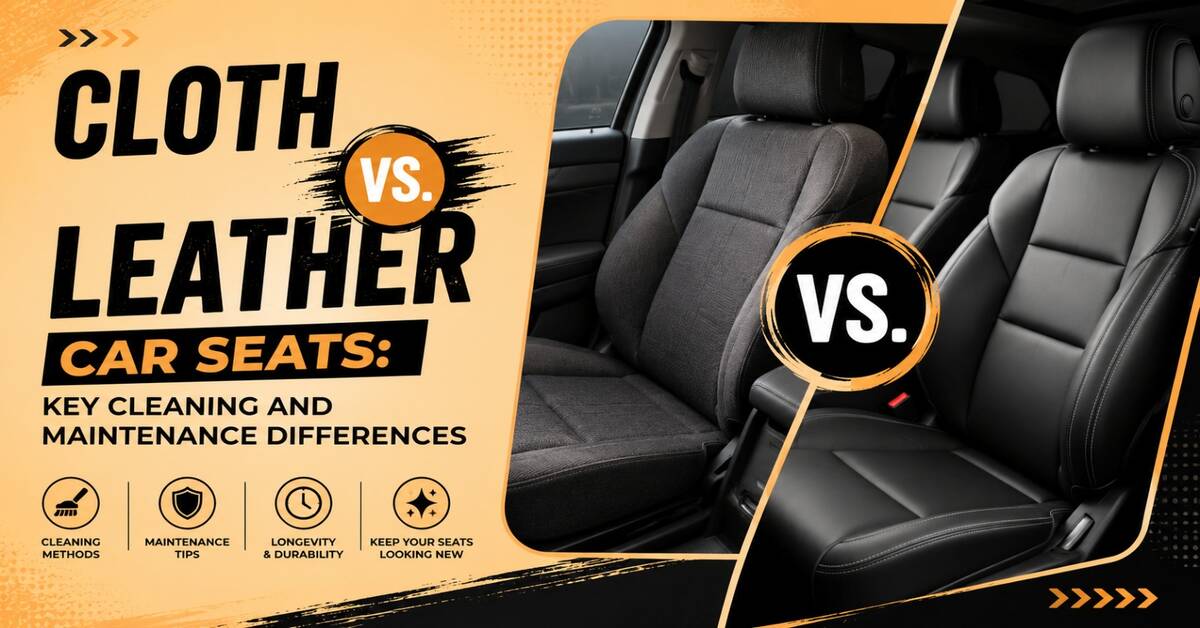
Pigmented leather car seats win for families and high-traffic drivers due to absolute liquid resistance and easy daily wipe-downs, preventing costly deep extractions. Cloth car seats win for budget-conscious commuters facing intense sun, offering superior temperature stability and zero conditioning requirements, though they demand immediate intervention for liquid spills.
Quick Verdict by Persona
- For families with young kids: Pigmented Leather.
- For ride-share/Grab drivers: Leather (or Synthetic PU Leather).
- For budget-focused daily commuters: Cloth.
- For pet owners: Mixed (Cloth for heavy scratch resistance; Leather for shedding control).
1. Master Comparison: The Critical Criteria
The table below breaks down the exact maintenance requirements and typical Singapore market prices (SGD) for standard passenger vehicles.
| Criterion | Quality Cloth Seats (Nylon/Polyester) | Coated Leather Seats (Pigmented) |
| DIY Chemical Costs | $7 – $20 per bottle (Foam/Stain remover) | $14 – $40 per bottle (Cleaner + Conditioner) |
| Pro Deep Clean Cost | ~$160 (Hot water extraction) | $90 – $280 (Clean + Condition package) |
| Spill Response Window | < 60 seconds before foam absorption | Hours (Liquids bead on the polymer coating) |
| Annual Labor Time | ~4 hours (Weekly vacuuming + spot treating) | ~2 hours (Weekly wipe-downs + bi-annual conditioning) |
| Climate Vulnerability | High mold risk if dried improperly in 80%+ humidity | High UV cracking risk without quarterly protectants |
| Repair Cost (Minor) | $50 – $100 (Patching or re-stitching) | $7 – $30 (DIY color/filler kits) |
2. Immediate Spill & Biological Stain Recovery
The most stressful maintenance events involve organic spills—coffee, milk, vomit, or pet accidents.
Cloth seats utilize a porous woven surface over open-cell polyurethane foam. When liquid hits fabric, gravity pulls it through the weave into the foam within seconds. Surface wiping only addresses 20% of the spill. Recovering a milk spill on cloth requires a wet-vac or professional hot-water extraction (costing around $160) to prevent souring and bacterial growth.
Leather seats in modern cars are heavily pigmented and coated with a clear polymer layer. This creates a non-porous barrier. A spilled latte will literally pool on the surface of the leather seat. You can wipe it away 30 minutes later with a microfiber towel and a mild pH-neutral cleaner, leaving zero trace in the foam underneath.
Criterion Verdict: Leather car seats decisively win for spill recovery because the polymer coating prevents liquids from penetrating the underlying foam.
3. Annual Maintenance Costs & Labor Time
Cloth is the “save money, work harder later” option. Day-to-day, cloth requires zero chemical intervention—just a strong vacuum to pull dust from the weave. You never have to “feed” fabric. However, buying chemical foaming agents like Motul or Sonax costs $7–$20, and the manual labor to agitate and blot out mud stains takes heavy physical effort.
Leather requires a strict, recurring chemical regimen. The natural hide beneath the polymer coating loses moisture in hot car cabins. To prevent irreversible cracking, owners must apply a dedicated leather cleaner and conditioner (like Weiman or Chemical Guys, costing $14–$40) every 6 to 12 months. A professional interior detail for either material ranges from $200 to $240, but leather requires this less frequently if daily wipe-downs are maintained.
Criterion Verdict: Cloth car seats win for total annual maintenance cost due to zero conditioning requirements, while leather wins for minimizing physical labor time.
4. Climate Tolerance: UV Degradation vs. Mold Risk
In high-heat, high-humidity environments (like Singapore’s baseline 80–90% humidity), both materials face distinct environmental threats.
Fabric seats breathe easily, ensuring they never burn you in the summer or freeze you in the winter. However, fabric is a sponge. If you enter the car soaked from rain, or if you shampoo the seats and fail to dry them with high-velocity fans, mold colonizes the damp foam within 24 to 48 hours.
Leather absorbs vast amounts of UV radiation and heat. In direct sunlight, leather surface temperatures can exceed 70°C (158°F). Without the regular application of UV-blocking conditioners, the heat rapidly evaporates the leather’s essential oils, causing the bolsters to harden, shrink, and crack.
Criterion Verdict: Cloth car seats win for temperature stability and UV resistance, provided the cabin is kept dry to prevent fungal growth.
5. Odor & Allergen Retention
Cloth fibers act as a net. They mechanically trap pet dander, pollen, smoke particles, and gym sweat. Over time, these particles embed deep into the foam layer, creating a permanent stale odor that standard surface sprays cannot neutralize. Only thermal sanitization (60°C+ hot water extraction) removes these embedded allergens.
Leather acts as a wall. Because the surface is sealed, smoke, dust mites, and pet dander simply sit on top of the seat. A basic interior wipe-down removes 99% of surface allergens, making leather the undisputed champion for allergy sufferers.
Criterion Verdict: Leather car seats win for odor and allergen control because their non-porous surface blocks particles from embedding in the cushion.
Which Should You Choose?
For Families with Young Children
Choose Leather Seats. The ability to instantly wipe up spilled milk, juice, or biological messes without it soaking into the foam is invaluable. Cloth seats in a family car inevitably develop a permanent “sour milk” smell that leather entirely avoids.
For Pet Owners
Choose a Mixed Approach. If you own heavy dogs with sharp claws, lean toward Cloth. Fabric provides grip so pets don’t slide, and it resists punctures far better than taut leather. If you own heavy-shedding dogs (like Huskies or Corgis), lean toward Leather, as vacuuming woven fabric to remove embedded pet hair is a nightmare, whereas hair wipes right off leather.
For Budget-Conscious Commuters
Choose Cloth Seats. It is significantly cheaper to buy upfront on the trim level and requires zero recurring chemical costs to maintain. You completely bypass the recurring $14–$40 cost of leather conditioners and the risk of expensive upholstery replacement due to sun-cracking.
For High-Mileage & Ride-Share Drivers
Choose Leather Seats (or commercial-grade vinyl/PU leather). The volume of passengers guarantees spills and body odors. Leather allows you to sanitize the back seat with an antibacterial wipe in 60 seconds between fares, keeping the car smelling fresh and maintaining high rider ratings.
Honest Limitations: What Nobody Tells You
- “Leather” is usually plastic. Most modern sub-$60k vehicles do not feature raw, porous Aniline leather. They use heavily pigmented, urethane-coated leather (or synthetic bonded leather). You are essentially cleaning and conditioning a thin layer of plastic. Over-conditioning coated leather just leaves a greasy, dust-attracting residue on the surface.
- Perforated leather is a maintenance trap. If you opt for ventilated leather seats, the material is full of tiny cooling holes. If a child spills yogurt or milk, it will get trapped inside those hundreds of microscopic perforations, requiring hours of tedious detailing with a toothpick or compressed air to remove.
- Cloth bolster wear is inevitable. No matter how much you vacuum, the friction of your jeans sliding across the raised side bolster of a driver’s seat will eventually fray and flatten the cloth fibers. Leather wears away its dye in these spots, but cloth structurally degrades.
Frequently Asked Questions on Cloth vs. Leather Car Seats: Key Cleaning and Maintenance Differences
Can I use household cleaners on cloth car seats?
Yes, but sparingly. Mild dish soap diluted in warm water works for spot-treating fabric, but avoid saturating the seat. Too much water will soak into the foam, leading to mold and mildew if it doesn’t dry within 24 hours.
How do I fix a cigarette burn on a cloth vs. leather seat?
Leather seats require a color-matched liquid leather filler kit ($7–$30) that cures into a flexible patch. Cloth seats are harder to DIY; burns usually require a professional upholsterer to cut out the damaged weave and glue in replacement fibers.
Does leather actually increase the resale value of my car?
Yes, pristine leather interiors command a premium on the used market. However, poorly maintained, cracked leather depreciates a car’s value faster than mildly stained cloth seats, as fixing cracked leather requires expensive panel replacement.
Why do my leather seats look shiny?
Shiny leather is dirty leather. Factory-fresh automotive leather has a matte finish. The shine is caused by a buildup of body oils, sweat, and cheap silicone-based interior dressings polishing the grain flat. A dedicated leather cleaner and a boars-hair brush will restore the matte look.