There are few moments quite as frustrating as turning the ignition key or pushing the start button, only to be met with complete silence or a weak, struggling engine. Your car is a complex machine relying on dozens of interconnected systems, but everything grinds to a halt without a reliable source of electrical energy. If you have ever found yourself stranded in a parking lot wondering how to know if my car battery is dead, you are far from alone. Battery failure is one of the most common reasons drivers require roadside assistance worldwide.
Fortunately, your vehicle usually does not give up without a fight. Long before a battery completely packs up and leaves you stranded, it drops subtle and sometimes glaring hints that its days are numbered. Recognizing these early symptoms can save you time, money, and the immense stress of an unexpected breakdown. Whether you are dealing with sluggish morning starts, flickering interior lights, or an engine that refuses to cooperate entirely, understanding the state of your power source is an essential skill for every vehicle owner. In this comprehensive guide, we will break down the exact signs of battery failure, how to perform accurate diagnostic tests using professional tools, and when it is finally time to invest in a replacement.
Listen to the Engine: The First Audio Warning Signs
When evaluating vehicle health, your ears are often your first and best line of defense. The starter motor requires an immense surge of electrical current drawn directly from the battery to spin the engine and ignite the combustion process. When your battery begins to lose its capacity or holds an insufficient charge, the engine sound changes dramatically. Paying close attention to these auditory cues reveals a lot about what is happening under the hood.
Rapid Clicking or Ticking Sounds
If you turn your key or press the ignition button and hear a rapid series of clicks or ticks, your battery likely has enough residual power to run low draw systems like your dashboard lights or radio, but it completely lacks the high amperage required to turn the heavy starter motor. The clicking sound you hear is actually the starter solenoid engaging and disengaging rapidly because the voltage drops sharply the moment the starter tries to pull current. This is a textbook sign that your battery is severely discharged or nearing the end of its useful lifespan.
Slow and Sluggish Engine Crank
Have you ever noticed your engine struggling to turn over, sounding like it is wading through heavy mud, especially on freezing winter mornings? A slow or sluggish crank is a clear warning sign. Cold temperatures slow down the chemical reactions inside a traditional lead acid battery, reducing its cranking power precisely when your engine oil is thicker and harder to move. If your engine sounds lazy and takes several seconds longer than usual to start, your battery is likely struggling to hold a proper charge or suffering from internal degradation.
Absolute Silence and Total Power Loss
Perhaps the most alarming symptom is absolute silence. When you turn the key and nothing happens, meaning no dashboard lights, no starter noise, and no clicking, your battery is completely dead, or you are dealing with a severe electrical disconnection. In these cases, the internal voltage has dropped so low that even basic accessories cannot function. It could mean the battery is completely shorted out internally, or your battery terminals are so corroded that electrical flow is entirely blocked.
Check Electrical Components: Interior and Exterior Red Flags
While the engine provides the primary audio clues, your vehicle’s electrical accessories serve as a secondary diagnostic panel. Modern vehicles rely heavily on stable voltage to power everything from safety computers to entertainment screens. When battery health degrades, these systems begin to act erratically.
Dim or Flickering Headlights
Your headlights draw power directly from the electrical system. If you notice your headlights look significantly dimmer than usual while the engine is idling, or if they brighten noticeably the moment you step on the gas pedal, your battery is struggling to supplement the alternator. A healthy battery acts as a voltage stabilizer. When it fails, voltage fluctuates wildly, causing exterior lights to dim or flicker when accessories are turned on.
Malfunctioning Accessories and Electronics
Pay close attention to how your power accessories behave. Are your power windows rolling up at a fraction of their normal speed? Does your radio reset its preset stations every time you start the car? Do your seat heaters take forever to warm up or fail to engage? These are classic indicators that your battery is failing to maintain a consistent charge. Because comfort features draw substantial power, they are often the first to suffer when a battery loses its efficiency.
The Check Engine and Battery Warning Lights
Do not ignore your dashboard warning cluster. Modern vehicles are equipped with sophisticated computer modules that continuously monitor electrical output. If system voltage drops below safe operational thresholds, the computer will trigger a dedicated battery warning light or a general check engine light. In some cases, a failing battery can cause erratic sensor readings across the entire vehicle network, throwing false trouble codes that ultimately trace back to low system voltage.
Perform a Physical Inspection: Visual and Olfactory Clues
Popping the hood and conducting a visual inspection is one of the most effective ways to confirm battery failure without fancy equipment. Human senses are remarkably adept at identifying physical damage, chemical leaks, and structural wear.
Severe Terminal Corrosion
Look closely at the metal posts where your battery cables connect. If you notice a fluffy, powdery substance resembling blue, green, or white moss accumulating around the terminals, you are looking at battery corrosion. While a small amount of corrosion is normal over time due to hydrogen gas escaping from the chemical reaction inside, heavy buildup creates high electrical resistance. This resistance prevents your alternator from properly recharging the battery and blocks current from reaching the starter.
Swelling, Bloating, or Leaking Casing
Automotive batteries are sealed units containing lead plates suspended in liquid or AGM electrolyte solutions. If you notice that the plastic casing of your battery looks bloated, swollen, or misshapen, or if you see wet chemical residue staining the sides, the battery has suffered internal structural failure. Swelling is typically caused by extreme internal heat, overcharging by a failing alternator, or freezing temperatures that caused trapped water inside the casing to expand. A swollen battery is a severe safety hazard and must be replaced immediately.
The Rotten Egg Sulfur Smell
Your nose can often detect a dead or dying battery before your eyes do. If you catch a pungent, sulfuric odor reminiscent of rotten eggs whenever you open your hood or step out of your vehicle, you are likely smelling leaking hydrogen sulfide gas. This occurs when a damaged or shorted battery overheats and boils its internal acid electrolyte solution. If you notice this smell, avoid open flames or sparks near the battery and arrange for an immediate replacement.
Use a Digital Multimeter for an Exact Voltage Reading
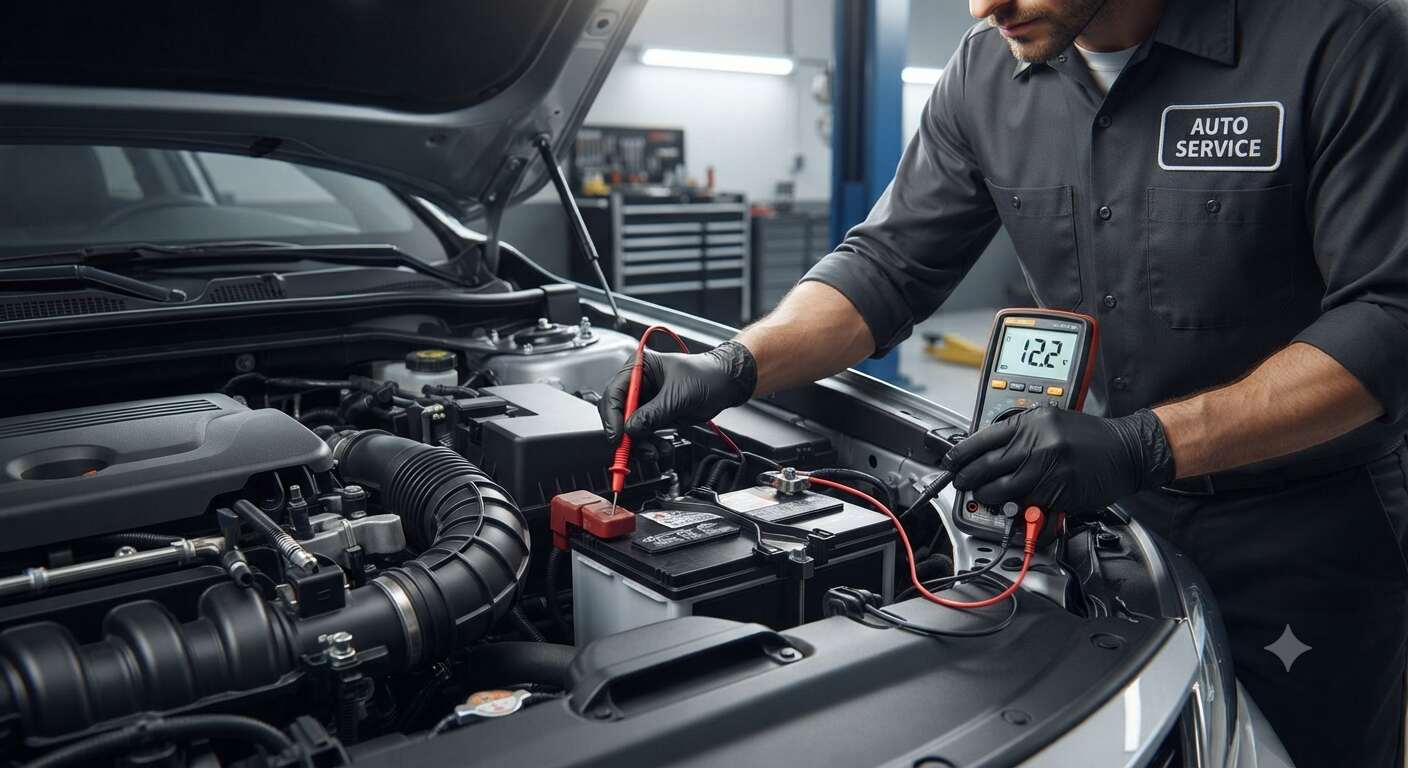
While listening, observing, and smelling provide strong circumstantial evidence, measuring exact voltage provides undeniable proof. Every vehicle owner should keep an inexpensive digital multimeter in their toolbox. Testing your battery state of charge takes less than two minutes and eliminates all guesswork.
Step-by-Step Multimeter Testing Guide
- Turn off your vehicle completely and ensure all doors, lights, and accessories are switched off.
- Set your digital multimeter to measure DC Voltage, typically indicated by a capital V with a straight line above a dashed line, set to a range of 20 volts.
- Take the red positive probe of the multimeter and press it firmly against the positive terminal of the battery, which is usually marked with a plus sign and covered by a red plastic cap.
- Take the black negative probe and press it against the negative terminal, marked with a minus sign.
- Read the digital display on the multimeter screen.
Interpreting Your Multimeter Voltage Readings
Understanding what the numbers on your screen mean is crucial for diagnosis. Here is how to interpret your voltage measurements:
- 12.6 Volts or Higher: Your battery is fully charged and in healthy condition.
- 12.4 Volts: Your battery is healthy, sitting at roughly seventy five percent charge.
- 12.2 Volts: Your battery is about fifty percent discharged and may need a recharge via driving or a dedicated battery charger.
- 12.0 Volts or Lower: Your battery is essentially dead, deeply discharged, or damaged. It may refuse to hold a charge even if you successfully jump start the vehicle.
Check the Battery Age and Manufacturing Date
Even if a battery appears to work for the moment, time is the ultimate enemy of automotive chemistry. Most standard car batteries have a functional lifespan ranging between three and six years, depending on climate, driving habits, and maintenance quality. Extreme heat breaks down internal components and evaporates fluids rapidly, while extreme cold forces the battery to work twice as hard.
To find out how old your battery is, look for a small round sticker or stamp on the top or side casing. Manufacturers use an alphanumeric code to indicate production dates. For example, a code reading 10/23 indicates the battery was manufactured in October 2023. If your battery is past its expected lifespan and exhibiting any of the warning signs discussed above, replacement is the safest and most reliable course of action to prevent getting stranded.
Car Battery Diagnostics Quick Reference Guide
Let’s organize the essential diagnostic data into a quick reference table for easy review.
| Diagnostic Method | What to Look For | Meaning / Result |
|---|---|---|
| Engine Audio | Rapid clicking or ticking | Sufficient power for lights, low amperage for starter. |
| Engine Audio | Slow, sluggish crank | Battery losing capacity or struggling with cold weather. |
| Electricals | Dim headlights & slow accessories | Low system voltage, alternator not supported properly. |
| Visual Inspection | Fluffy blue/white powder on terminals | High electrical resistance due to heavy corrosion. |
| Visual Inspection | Swelling casing or rotten egg smell | Internal structural damage or boiling electrolyte. |
| Multimeter Test | Reading of 12.0 Volts or lower | Battery is dead, deeply discharged, or failing. |
| Battery Age | Older than 3 to 6 years | End of expected operational lifespan. |
Frequently Asked Questions
Can a completely dead car battery be recharged?
It depends entirely on why the battery died. If the battery died because you accidentally left your headlights or interior lights on overnight, a standard wall charger or a successful jump start followed by a long drive can often restore it to working order. However, if the battery died due to old age, internal short circuits, or sulfation from sitting uncharged for months, attempting to recharge it will be unsuccessful. In many cases, deeply discharged batteries permanently lose their ability to hold a proper charge.
How long does a jump start last?
A jump start is a temporary emergency measure, not a permanent repair. Once your vehicle starts, the engine’s alternator takes over powering the electrical system while simultaneously sending a charge back into the battery. If your battery is healthy and simply drained from an accessory left on, a thirty minute drive should restore enough charge for normal operations. However, if your battery is failing internally, turning off the car after a jump start will likely leave you stranded again because the battery cannot retain the charge.
Does cold weather actually kill car batteries?
Cold weather does not technically kill a healthy battery, but it severely exposes its hidden weaknesses. Low temperatures slow down the chemical and electrochemical reactions required to produce electricity inside the battery. At the same time, freezing temperatures thicken engine oil, making the engine much harder for the starter motor to turn over. A battery that has enough power to start your car smoothly in warm summer weather may completely fail when winter temperatures drop below freezing.
How do I prevent my car battery from dying prematurely?
Preventing premature battery failure comes down to simple maintenance habits. Avoid running your radio, headlights, or climate fan while the engine is turned off. Periodically clean any corrosion buildup from your battery terminals using a wire brush and a mixture of baking soda and water. If you plan on leaving your vehicle parked for an extended period, investing in a smart trickle charger or battery maintainer ensures your battery stays fully charged without overcharging.
Conclusion
Knowing how to identify a failing or dead car battery can save you from costly towing fees, missed appointments, and the frustration of being stranded on the roadside. By paying close attention to your engine sounds, monitoring interior electronics, performing regular visual inspections, and utilizing a digital multimeter for exact voltage checks, you can stay ahead of battery failure before it lets you down. Always prioritize safety when working around automotive electrical systems, wear protective eyewear, and do not hesitate to replace an aging battery before it lets you down.