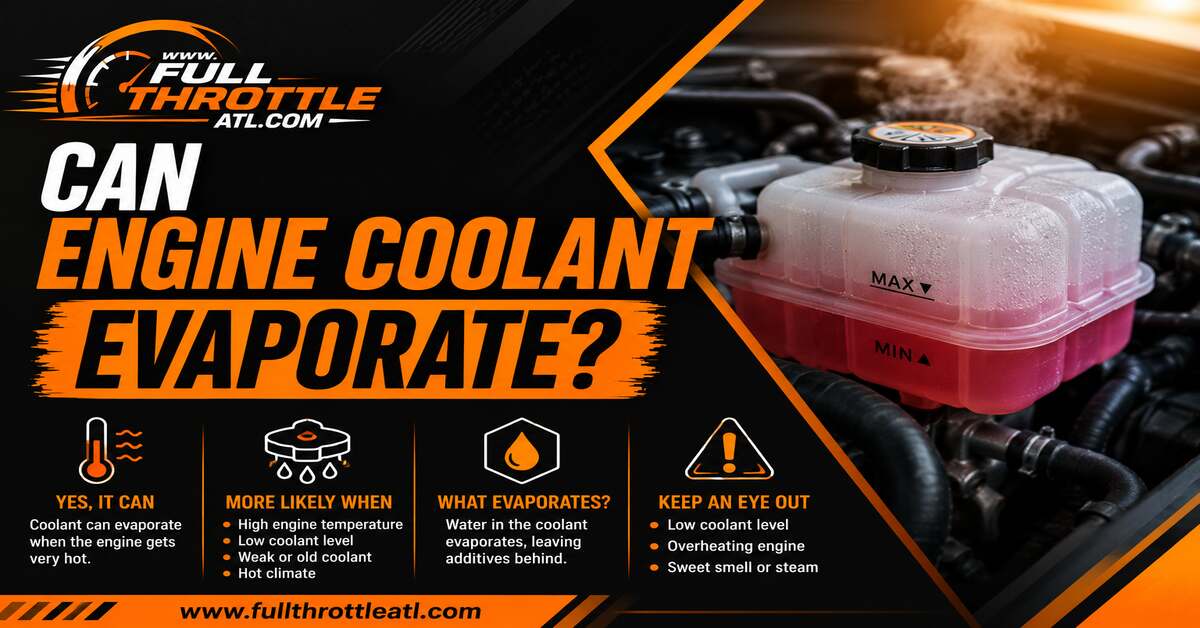
Engine coolant can evaporate, but it does not evaporate significantly under normal conditions because it operates within a pressurized, closed-loop thermal management system. True environmental evaporation is limited to less than 500 mL every 3 to 6 months, escaping strictly through the overflow reservoir vent via differential distillation. Any rapid, noticeable drop in fluid level indicates a mechanical leak, a failing pressure cap, or an internal engine compromise rather than standard evaporation.
Key Facts At a Glance
- Normal Evaporation Rate: Less than 500 mL (approx. 0.5 quarts) every 3 to 6 months through the expansion tank vent.
- System Operating Pressure: Maintained at 15 to 16 PSI by a spring-loaded radiator cap to elevate boiling points.
- Boiling Point Threshold: A standard 50:50 ethylene glycol and water mixture boils at roughly $129^\circ\text{C}$ ($265^\circ\text{F}$) under 15 PSI pressure.
- Primary Evaporative Component: Water evaporates preferentially due to its lower boiling point ($100^\circ\text{C}$) compared to ethylene glycol ($197^\circ\text{C}$).
- Primary Indicator of Trouble: Losing more than 1 inch of fluid in the reservoir per month signifies a physical leak or boiling event, not normal evaporation.
What Is Engine Coolant Made Of?
Engine coolant (antifreeze) is a specialized thermal-exchange fluid engineered to regulate internal engine operating temperatures, prevent freezing in sub-zero winters, and resist boiling in extreme summer conditions.
The fluid consists of two primary bulk components mixed in a precise 50:50 ratio, supplemented by a minor chemical package:
- Base Fluid (50%): Typically Ethylene Glycol ($C_2H_6O_2$, offering high thermal efficiency but toxic to mammals) or Propylene Glycol ($C_3H_8O_2$, less toxic but slightly less thermally efficient).
- Demineralized Water (50%): Ultra-pure distilled or deionized water maximizing specific heat capacity and preventing mineral scale precipitation.
- Inhibitor Package ($<5\%$): Organic acids, silicates, phosphates, and anti-foaming agents designed to stop cavitation, electrochemical corrosion, and scale buildup across diverse engine metals (aluminum, cast iron, copper, brass).
How Does Cooling System Pressure Prevent Boiling?
Cooling system pressure directly suppresses evaporation by elevating the boiling point of the liquid through increased atmospheric constraint.
As an engine reaches its optimal running temperature ($90^\circ\text{C}$ to $105^\circ\text{C}$ / $195^\circ\text{F}$ to $220^\circ\text{F}$), the thermal energy attempts to vaporize the water component of the fluid. Because pure water boils at $100^\circ\text{C}$ ($212^\circ\text{F}$) at standard sea-level atmospheric pressure ($14.7\text{ PSI}$), an unpressurized engine would boil dry within minutes of highway driving.
By sealing the system with a spring-loaded radiator cap rated at 15 to 16 PSI, the boiling point of a standard 50:50 mixture is elevated by roughly $3\text{°C}$ ($5\text{°F}$) for every 1 PSI of pressure, reaching an effective boiling threshold of $129^\circ\text{C}$ ($265^\circ\text{F}$). This suppression keeps the fluid in a dense liquid state capable of continuous thermal transfer.
How Much Coolant Naturally Evaporates Over Time?
Natural coolant evaporation is strictly limited to minor vapor loss through the overflow or expansion reservoir vent, amounting to less than 500 mL every 3 to 6 months.
This process occurs via differential distillation. As the engine cycles through heat-up and cool-down phases, fluid expands into the plastic overflow tank. Because this tank is vented to the atmosphere to prevent over-pressurization, the water fraction of the coolant slowly vaporizes into the surrounding air over weeks and months. Ethylene glycol remains behind because its boiling point is significantly higher ($197^\circ\text{C}$ / $387^\circ\text{F}$).
If this water loss is left unchecked for years without top-ups, the coolant becomes hyper-concentrated with glycol, shifting viscosity profiles and risking additive drop-out or gel formation.
Why Is Your Coolant Disappearing Rapidly?
Rapid coolant loss is driven by mechanical system failures, faulty hardware components, or localized boiling events rather than normal environmental evaporation.
When an engine loses a quart or more of fluid over a single week, it follows one of three distinct failure pathways:
- External Leaks: Cracks in the radiator core, degraded rubber hoses, loose worm-gear clamps, or a failing water pump shaft seal (weep hole) allow liquid to escape under pressure, often leaving crusty white, pink, or green residue trails.
- Pressure Cap Failure: If the internal spring inside the radiator cap weakens and fails to hold 15 PSI, the coolant boils at a lower temperature, creating localized vapor pockets that force large volumes of fluid past the cap into the overflow tank and out onto the ground.
- Internal Combustion Leaks: A breached head gasket, warped cylinder head, or cracked engine block allows combustion gases to pressurize the cooling system or permits liquid coolant to slip directly into the combustion chambers, where it vaporizes into sweet-smelling white exhaust smoke.
What Happens When You Top Up Coolant With Tap Water?
Topping up a cooling system with ordinary tap water introduces dissolved minerals-primarily calcium and magnesium-that precipitate out of solution when exposed to engine jacket temperatures exceeding $100^\circ\text{C}$.
These minerals form a hard crust (scale) across internal aluminum and cast-iron passages. Because mineral scale acts as an effective thermal insulator, it creates localized hot spots inside the cylinder head, warping metal tolerances and inducing premature engine pre-ignition or gasket failure. Always top up low coolant levels with either a pre-mixed 50:50 solution or pure distilled water.
Frequently Asked Questions
Can antifreeze evaporate if left out in an open container?
Yes, the water content in open antifreeze will evaporate completely over several weeks or months when exposed to room air. However, the heavy ethylene or propylene glycol base fluid will remain behind as a thick, viscous syrup or gel because its vapor pressure is extremely low at ambient temperatures.
How can you tell the difference between evaporation and a leak?
Evaporation is extremely slow (under 500 mL every 3 to 6 months) and leaves no physical puddles, damp spots, or crusty residue under the hood. A leak produces rapid fluid drops, visible wet spots on hoses or the radiator, sweet chemical smells upon parking, or puddles of colored fluid underneath the vehicle.
Does hot weather increase coolant evaporation rates?
Hot ambient summer temperatures increase the frequency at which the cooling system expands past the radiator cap into the overflow tank, slightly accelerating water vapor loss through the tank vent. However, a healthy, sealed system will still restrict this loss to negligible baseline amounts.
Does high altitude affect coolant evaporation?
High altitude reduces atmospheric barometric pressure, which marginally lowers the boiling point of liquids. While this increases the thermal load on the cooling system and can trigger earlier coolant overflow into the expansion tank, it does not cause chemical evaporation to spike outside of normal closed-loop venting parameters.
What should you do if your coolant reservoir is constantly empty?
A constantly emptying reservoir indicates an active system breach that requires immediate pressure-testing. Stop driving, check the engine oil for milky contamination (indicating an internal head gasket leak), inspect all hose junctions for wet stains, and have a mechanic perform a cooling system pressure test to locate the point of failure.