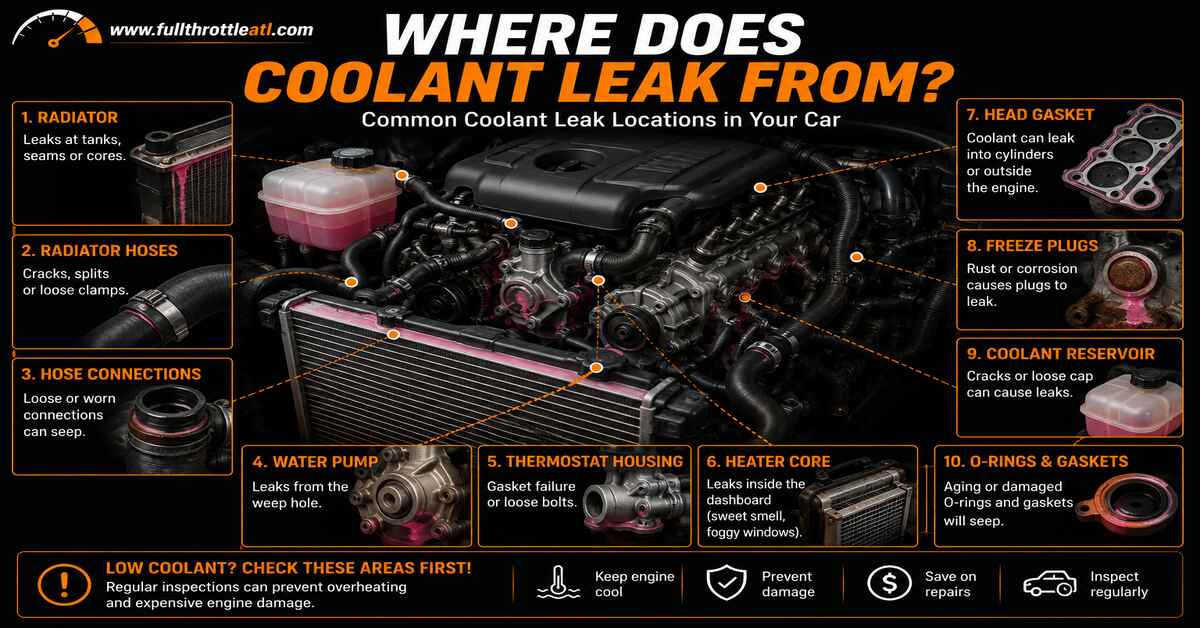
An automotive coolant leak most commonly originates from the radiator core, water pump weep hole, thermostat housing, or connected rubber hoses due to extreme pressure and thermal cycling. Modern cooling systems operate under 13 to 16 PSI of pressure at temperatures between 88°C and 105°C, turning even microscopic weak points into active fluid loss zones.
At a Glance
- Radiator leaks typically occur along the plastic-to-aluminum crimp seams or from physical stone punctures.
- Water pump failures reveal themselves through a steady drip or crusty buildup near the bearing snout weep hole.
- A sweet maple syrup smell inside the passenger cabin points directly to a failing interior heater core.
- Internal leaks bypass driveway puddles entirely, dumping coolant directly into engine oil or combustion chambers.
- Driving with an unpressurized cooling system lowers boiling thresholds and rapidly warps aluminum cylinder heads.
Why is my coolant low, but I see absolutely no puddles?
An engine consuming coolant without leaving puddles is experiencing an internal leak caused by a blown head gasket, a cracked cylinder head, or a failed intake manifold gasket. Under these conditions, the engine burns the coolant inside the combustion chambers, turning it into invisible or sweet-smelling white exhaust vapor. Mechanics recommend pulling the oil dipstick immediately; if the oil resembles a chocolate milkshake, coolant is actively leaking into the crankcase and destroying engine bearings.
What causes a car to lose coolant with no visible leaks?
Coolant can vanish silently due to rapid evaporation from high-pressure engine misting, internal EGR cooler cracks, or capture by under-engine aerodynamic splash shields. When a hairline crack sprays microscopic mist onto an exhaust manifold exceeding 500 degrees Celsius, the fluid vaporizes instantly before hitting the ground. Similarly, plastic under-engine trays collect slow drips, allowing the liquid to evaporate completely before ever forming a driveway puddle.
Are stop-leak products safe to use for a permanent fix?
Chemical stop-leak additives and sealant pellets are strictly emergency, temporary fixes and should never be used as a permanent repair. While sealing polymers can temporarily plug a microscopic radiator pinhole, they also circulate through the entire cooling system and clog the microscopic tubes inside the cabin heater core and radiator fins. This restricted flow inevitably causes localized overheating and permanent engine damage.
Why does my car smell like maple syrup inside the cabin?
A sweet maple syrup or candy smell inside the car indicates a leaking heater core located inside the dashboard HVAC assembly. As the core’s internal matrix fails, glycol-based coolant drips onto the passenger-side floorboard and fills the ventilation ducts. When the defroster is engaged, this aerosolized coolant coats the inside of the windshield with an oily film that smears when wiped.
Is it safe to drive with a minor coolant leak if I keep topping it off?
Driving with an active coolant leak—even if you constantly top off the reservoir—is highly risky because an unpressurized cooling system cannot prevent localized boiling. When pressure drops below the standard 13 to 16 PSI threshold, steam pockets form around the hottest parts of the combustion chambers. These steam pockets rapidly warp aluminum cylinder heads and destroy head gaskets long before the dashboard temperature gauge reflects an overheat condition.
How much pressure should a cooling system hold during a test?
A healthy automotive cooling system should comfortably hold between 13 and 16 PSI of static pressure for at least 10 to 15 minutes without dropping. If the gauge needle declines during a mechanical pressure test, an external or internal leak is present. Technicians pressurize the system when the engine is completely cold to force hidden cracks or failing hose clamps to reveal themselves via active drips.
What is the “Cold Leak” paradox and why do mechanics miss it?
The “cold leak” paradox occurs when hose clamps and rubber seals contract and lose tension only when temperatures drop below freezing, causing leaks that stop entirely once the engine warms up. As metal components expand with operating heat during a daytime shop visit, the gaps seal themselves shut. This leaves no physical trace of fluid behind, often leading inexperienced technicians to mistakenly declare a cooling system completely healthy.
Why does coolant leak only at high RPMs or highway speeds?
High-RPM coolant leaks happen when water pump seals or hairline radiator cracks open up exclusively under maximum water pump speed and system vibration. At idle, the water pump spins slowly and generates minimal internal stress, but sustained highway driving spikes flow pressure. The escaping fluid atomizes into a high-pressure mist that vaporizes on hot metal before it can accumulate into a drip.
How do you diagnose an internal EGR cooler coolant leak?
Diagnosing an internal Exhaust Gas Recirculation (EGR) cooler leak requires checking for persistent coolant loss accompanied by dense white exhaust smoke and sweet-smelling tailpipe emissions. In turbocharged and diesel engines, the EGR cooler uses engine coolant to lower exhaust gas temperatures; if its internal matrix cracks, the engine sucks coolant directly into the intake tract. Mechanics confirm this failure by using a cooling system pressure tester while observing the exhaust ports or performing a chemical exhaust gas test on the coolant reservoir.
What causes turbocharger coolant line leaks?
Turbocharger coolant line leaks are caused by extreme radiant heat exceeding 500°C that bakes copper crush washers, O-rings, and braided lines until they turn brittle. Because these hard lines and banjos are tucked tightly behind thermal heat shields, the resulting leaks usually present as intermittent fluid loss and burnt chemical smells without an obvious ground puddle.
How do under-engine splash shields hide coolant leaks?
Modern aerodynamic plastic undertrays catch and retain dripping coolant, acting as hidden basins that prevent fluid from ever reaching the pavement. The trapped liquid sits on top of the plastic shield and evaporates via engine bay airflow, masking major radiator hose or water pump leaks until the pool overflows or the plastic fasteners rot away.
What is the difference between a failing radiator core and a plastic end tank leak?
A radiator core failure involves physical punctures or micro-fractures in the thin aluminum cooling fins, whereas a plastic end tank leak involves failure of the rubber gasket compressed between the aluminum core and the plastic header. Core leaks usually spray liquid directly onto surrounding engine components, while end tank leaks seep slowly along the mechanical crimp seams during thermal expansion cycles.
How do you test for a blown head gasket when a pressure test passes?
A head gasket can pass a standard 15 PSI shop pressure test because combustion chamber pressures routinely exceed 500 to 1,000 PSI during normal operation. To catch this specific failure, technicians use a combustion leak detector (a block tester) to check for exhaust gases present inside the coolant reservoir, or they perform a cylinder leak-down test to find pressurized air escaping into the cooling jacket.
Why does the coolant reservoir drop while the radiator stays full?
A coolant reservoir that drops while the radiator remains completely full indicates a blocked, pinched, or air-leaking overflow hose connecting the two components. As an engine cools down, it must create a vacuum to draw fluid back from the overflow tank into the radiator core; an obstructed hose breaks this siphon effect, trapping coolant in the expansion tank permanently.
The Bottom Line
Locating an automotive coolant leak requires looking beyond simple driveway puddles to account for high-pressure misting, internal engine consumption, and hidden plastic splash shields. Because even minor pressure drops lower the boiling point of antifreeze and risk catastrophic engine warp, leaks demand immediate, targeted mechanical diagnosis rather than temporary chemical fixes. Addressing the exact root component—whether a crimped radiator seam or a warped thermostat housing-protects your engine from terminal overheating.