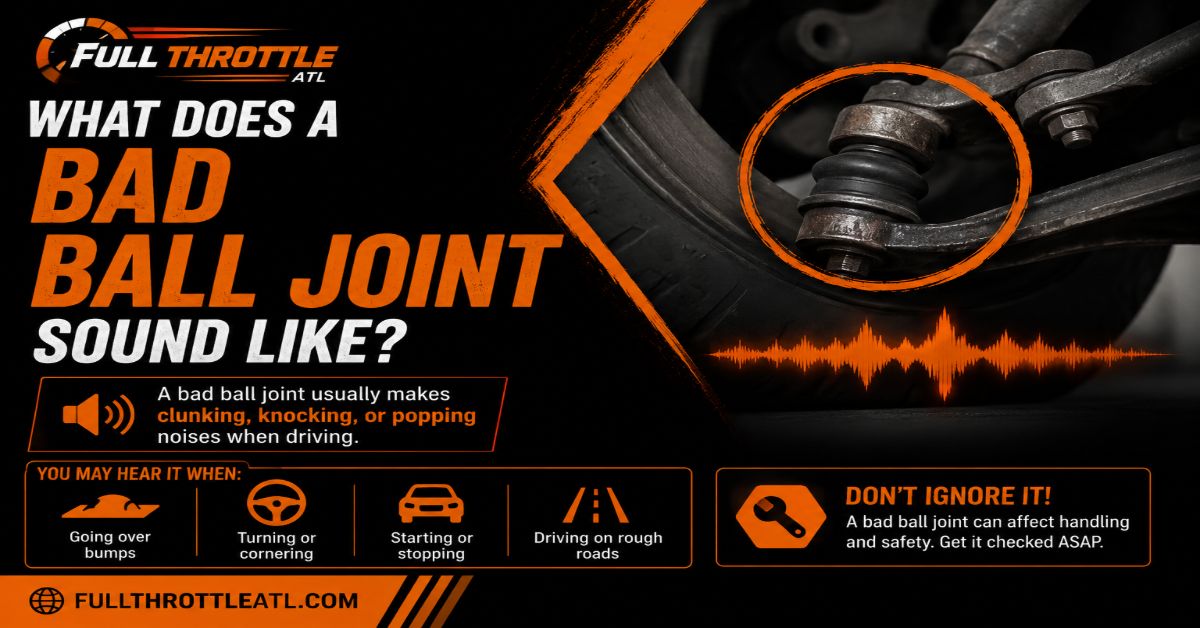
A bad ball joint produces a distinct metal-on-metal clunk, knock, or pop when driving over bumps, potholes, or turning the steering wheel. This acoustic warning occurs because the protective rubber boot tears, letting grease escape and moisture enter, causing the internal steel ball and socket to grind directly against each other.
At a Glance: Key Ball Joint Failure Facts
- Primary Sound: A heavy low-speed clunk or thud occurring between 5 and 20 miles per hour over rough surfaces.
- Failure Limit: Any radial or axial movement exceeding 0.050 inches requires immediate replacement.
- The Silent Danger: Some worn joints fail entirely under heavy load without making any preceding noise.
- Component Mimics: Sway bar end links and strut mounts create nearly identical noises that often confuse inexperienced DIYers.
- Replacement Rule: Ball joints must always be replaced in axle pairs due to symmetrical wear patterns.
Why Do Worn Ball Joints Make Clunking and Popping Noises?
Suspension components generate acoustic shockwaves when mechanical tolerances are violated. Inside a healthy suspension system, a tight ball joint maintains continuous tension within a greased socket. When the internal bearing surface wears down, an empty gap forms.
When the vehicle strikes a bump, the control arm forces the control spindle upward. The loose ball slams against the upper or lower socket wall, creating a sharp acoustic impact known as a clunk.
When turning the steering wheel, the binding of a dry or deformed socket creates rotational tension. When that tension overcomes friction, the joint violently snaps back into place, generating a loud pop audible inside the cabin.
What Are the Acoustic Frequency Ranges of Suspension Noises?
Suspension noises occupy specific acoustic bandwidths that reveal the nature of the mechanical failure. Heavy structural impacts and low-speed clunks resonate between 20 and 60 Hz. These low frequencies travel directly through the vehicle chassis and are felt through the floorboards as much as they are heard.
High-pitched squeaks and groans sit between 300 and 500 Hz. These higher frequencies occur when dry metal rubs against dry metal without large structural gaps, creating friction similar to an un-lubricated hinge or an old mattress spring.
What Is the Exact Mechanical Play Tolerance for a Failing Ball Joint?
Professional technicians rely on precise mechanical measurements rather than subjective sounds to condemn a suspension component. The maximum allowable radial (side-to-side) or axial (up-and-down) movement for standard factory ball joints is 0.050 inches, which is approximately 1.27 millimeters. Any movement beyond this threshold compromises structural safety.
Modern precision aluminum suspensions often feature zero-tolerance or pre-loaded joints. These specialized components tolerate 0.000 inches of play. If a technician detects any perceptible movement under a dial indicator, the joint is legally and mechanically failed.
How Can You Test a Ball Joint at Home Using a Floor Jack and Pry Bar?
Testing a ball joint at home requires lifting the vehicle safely with a hydraulic floor jack and securing it with heavy-duty jack stands. The exact jacking point depends on whether the vehicle features a loaded or floating suspension design.
Place a long pry bar underneath the tire and apply upward leverage while an assistant watches the control arm and steering knuckle. Alternatively, grab the tire at the 12 o’clock and 6 o’clock positions and rock it back and forth.
Excessive play or a visible gap opening between the ball joint housing and the stud confirms failure. If the suspension is spring-loaded against the lower control arm, you must place the jack directly under the control arm to unload the spring before prying.
What Is the Difference Between Upper and Lower Ball Joint Failure Symptoms?
Lower ball joints carry the primary weight of the vehicle and experience continuous vertical loads, making them far more prone to catastrophic failure. When a lower ball joint fails, the vehicle usually drops sharply on that corner, and steering becomes heavily restricted or completely unresponsive.
Upper ball joints primarily stabilize steering alignment and maintain wheel geometry during cornering. A failing upper joint typically generates a sharper popping sound when turning the steering wheel at low speeds, accompanied by wandering steering on highway straights, but rarely results in the immediate collapse of the suspension corner.
Can a Bad Ball Joint Make Noise Without Any Physical Play?
A ball joint can be completely ruined without displaying loose mechanical play during a standard hand inspection. This phenomenon occurs when internal corrosion seizes the ball tightly inside the socket rather than wearing it loose.
When the steering or suspension moves, the frozen joint forces the control arm to twist abnormally. This creates a loud, alarming snapping noise during turns even though the joint feels tight when shaken by hand. These seized joints can snap without warning once thermal expansion breaks the internal rust weld.
Why Do Ball Joints Squeak More Loudly in Freezing Weather?
Temperature fluctuations drastically alter the viscosity of suspension grease. During freezing winter conditions where temperatures drop below 32 degrees Fahrenheit, remaining petroleum grease stiffens into a semi-solid paste.
This hardened grease fails to coat the bearing surfaces adequately, causing high-pitched squeaking and groaning over minor bumps. As ambient temperatures rise or friction warms the metal during extended driving, the grease liquefies, and the squeak temporarily vanishes.
What Is the Loaded Suspension Illusion During Vehicle Inspection?
The loaded suspension illusion tricks many DIY mechanics into missing a dangerous failure. On vehicles equipped with a short-long arm suspension where the coil spring rests directly on the lower control arm, the lower ball joint is under immense downward tension.
When you lift the vehicle by the frame with a standard hydraulic jack, the lower control arm hangs downward, keeping the ball joint heavily loaded against its socket. Shaking the wheel by hand will reveal zero play, masking the severe wear inside. Mechanics must place a jack stand directly under the lower control arm to compress the spring before testing for play.
How Do You Distinguish a Bad Ball Joint From a Failed Sway Bar Link?
Sway bar end links produce a low-speed clunk over bumps that sounds identical to a bad ball joint, making misdiagnosis common. To differentiate the two components, observe how the vehicle reacts to uneven versus even terrain.
Sway bar links connect the sway bar to the strut or control arm. If you drive over a square speed bump where both front wheels hit the obstacle at the exact same time, a failed sway bar link will remain quiet because both sides rise evenly. A bad ball joint will clunk regardless of whether one wheel or both wheels strike the bump.
How Do Strut Mounts Differ From Ball Joint Noises?
A failing upper strut bearing creates a sharp popping or binding sound when turning the steering wheel, mimicking a bad ball joint. The primary differentiator is the acoustic origin point inside the vehicle cabin.
Strut mount noises resonate upward through the body panels, sounding as though the noise originates from the top of the dashboard or under the hood near the windshield. Ball joint noises resonate downward through the lower control arm, sounding and feeling like they are happening directly beneath your feet on the floorboard.
Should Ball Joints Always Be Replace in Pairs?
Suspension components must always be replaced in axle pairs. Driver-side and passenger-side ball joints experience identical mileage, road salt exposure, potholes, and mechanical stress cycles.
If the driver-side ball joint has worn out and developed excessive play, the passenger-side joint has experienced the exact same operational fatigue and is typically on the verge of failure. Replacing them simultaneously ensures balanced handling, uniform tire wear, and prevents a second repair bill a few months later.
How Long Can You Safely Drive on a Noisy Ball Joint?
You cannot safely drive on a ball joint that is actively clunking or popping. Once a ball joint reaches the stage of making structural noise, internal metal-on-metal wear has compromised its structural integrity.
Total separation can occur at any moment during a sharp turn or hard bump. If a ball joint separates entirely, the wheel folds outward, destroying the CV axle, slicing brake lines, and causing immediate, irreversible loss of steering control.
What Happens If a Ball Joint Breaks Completely at Highway Speeds?
When a ball joint breaks completely at highway speeds, the steering knuckle disconnects from the control arm on that corner. The liberated wheel instantly turns outward or inward independently of the steering wheel due to aerodynamic and frictional forces.
The front end of the vehicle drops, causing the metal control arm to dig violently into the asphalt. This triggers a sudden, severe loss of vehicle control, often resulting in a spin, departure from the roadway, or rollover collision.
Will a Bad Ball Joint Ruin Your Tires and Wheel Alignment?
Excessive play in a ball joint alters the vehicle wheel alignment dynamically while driving, destroying tires rapidly. As the wheel shifts under acceleration and braking, the camber and toe angles drift outside factory specifications.
This continuous angular instability causes severe, uneven tire wear patterns, most notably feathering or cupping on the inner shoulder of the tread. Additionally, the steering wheel will often sit noticeably off-center when driving straight.
Should You Replace Just the Ball Joint or the Entire Control Arm Assembly?
The correct repair method depends heavily on how the ball joint is secured to the vehicle control arm. On many modern passenger cars and trucks, factory ball joints are permanently pressed into stamped steel or aluminum control arms using hydraulic factory presses, and are not sold separately by original equipment manufacturers.
If your vehicle features a bolt-in or riveted ball joint, you can replace just the individual joint component. If the joint is pressed-in and the surrounding control arm bushings are worn, replacing the entire control arm assembly saves labor time and restores both the ball joint and bushings simultaneously.