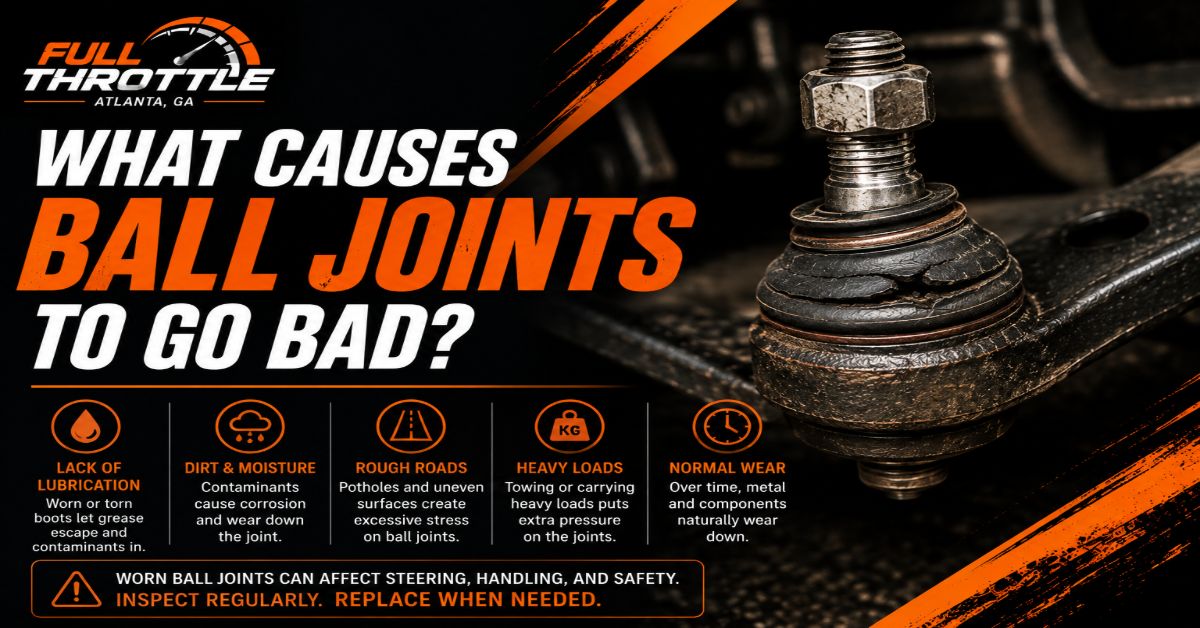
Ball joints primarily go bad due to friction-induced wear, lubrication loss, and environmental contamination, which degrade the internal steel ball-and-socket mechanism over time. Road impacts, torn rubber dust boots, and extreme thermal cycles accelerate this breakdown, eventually introducing dangerous mechanical play into the vehicle suspension.
At a Glance
- Lifespan Range: Factory-installed ball joints typically last between 70,000 and 150,000 miles under normal driving conditions.
- Failure Threshold: Passenger vehicle ball joints are mechanically and legally failed once radial or axial play exceeds 0.050 inches or 1.27 mm.
- The Boot Factor: A torn rubber dust boot results in 100% grease loss within 500 to 1,000 miles, accelerating internal wear by up to ten times.
- Diagnostic Trap: Lifting a vehicle with a loaded suspension design makes a worn joint feel tight, hiding dangerous play until the control arm is safely propped.
- Replacement Rule: Ball joints on the same axle must always be replaced in pairs because they experience identical road stress and wear rates.
How long do factory ball joints typically last?
Factory ball joints typically last between 70,000 and 150,000 miles under standard driving conditions on paved roads. This mileage range assumes the vehicle operates within standard weight limits and encounters minimal severe potholes or corrosive road salts.
Real-world variables frequently shorten this lifespan. Driving habits, regional climate extremes, and unpaved road usage introduce heavy shock loads. For instance, a vehicle driven daily on rough gravel roads may experience total ball joint degradation in under 40,000 miles. Conversely, highway commuter vehicles often reach the upper limit of 150,000 miles without requiring suspension intervention.
What are the early warning signs of a failing ball joint?
Early warning signs of a failing ball joint include low-frequency clunking noises when driving over bumps, a vague steering feel, and uneven front tire wear. These symptoms indicate that the internal socket has developed excessive clearance, allowing the wheel assembly to shift independently of the control arm.
Drivers should monitor the vehicle for a rhythmic metallic knock during low-speed turns into driveways or parking lots. As the internal stud begins to rattle within its housing, steering wander becomes apparent. The vehicle may require constant minor corrections to maintain a straight line on the highway. Ignoring these initial indicators leads to rapid progression into severe mechanical failure.
Can a bad ball joint cause an alignment to change?
Yes, even a tiny amount of play exceeding 0.040 inches changes the camber and toe angles of the wheel while driving. This dynamic geometric shift prevents the vehicle from holding a proper wheel alignment, resulting in rapid tire destruction and hazardous handling characteristics.
When a ball joint loses structural integrity, the wheel tilts out of specification under cornering and braking forces. This manifests as severe feathering or cupping on the inside or outside edges of the front tires. Mechanics frequently find that performing a wheel alignment on a car with worn ball joints is impossible because the steering angles shift the moment the vehicle rolls back onto the asphalt.
Is it safe to drive with a squeaking ball joint?
No, it is unsafe to drive with a squeaking ball joint because the sound signifies active metal-on-metal friction. Lubrication is entirely gone, and the polished steel ball is grinding directly against the internal socket housing, risking catastrophic structural separation.
Total structural failure occurs when the joint pulls apart completely, causing the wheel to tuck under the fender and the front corner of the car to drop to the pavement. This type of failure during high-speed transit results in an immediate, violent loss of steering control. Any vehicle producing a high-pitched squeak or chirp from the front suspension during steering inputs must be parked immediately.
Why does a ball joint feel fine on a lift but fail on the ground?
On certain suspension designs like older Ford trucks or short-long arm setups, the vehicle weight heavily loads the ball joint when the wheels are hanging off the ground. If a mechanic shakes the wheel while the suspension hangs unsupported, the weight pinches the joint tight and hides dangerous internal play.
Accurate testing requires the mechanic to place a hydraulic jack directly underneath the lower control arm and lift the vehicle just enough to unload the spring pressure. Only when the tension is removed from the joint can a pry bar reveal the true extent of wear. Many failing ball joints escape detection during routine inspections simply because the vehicle was lifted incorrectly.
How do you properly test a ball joint for play?
Properly testing a ball joint requires lifting the specific control arm with a jack, placing a heavy-duty pry bar beneath the tire, and lifting upward while an assistant watches the joint housing for movement. Alternatively, a dial indicator measures exact linear displacement against the housing.
Step 1: Park the vehicle on a flat, level surface and engage the emergency brake.
Step 2: Position a floor jack securely under the lower control arm as close to the ball joint as possible.
Step 3: Raise the wheel a few inches off the ground to take the tension off the internal spring.
Step 4: Place a long pry bar under the center of the tire tread and leverage the wheel up and down while checking the ball joint stud.
Step 5: Attach a dial indicator to the control arm with the plunger resting on the steering knuckle to verify if play exceeds the maximum 0.050-inch limit.
What happens when a ball joint seizes instead of getting loose?
If a ball joint loses its internal lubrication without picking up abrasive dirt, the steel components bind together and seize completely instead of wearing loose. This frozen joint prevents the steering knuckle from pivoting smoothly during turns.
A seized ball joint makes no clunking noise, which frequently fools drivers into thinking the suspension is healthy. However, it severely stiffens the steering wheel and prevents it from returning to the center position automatically after a turn. This places extreme rotational stress on the steering rack, tie rods, and steering shaft universal joints.
Why do ball joints on lifted trucks wear out so fast?
Installing a suspension lift kit changes the factory working angle of the ball joint, forcing components designed to operate within a 15-degree arc to function at 25 degrees or more. This geometric bind accelerates wear and reduces component lifespan to as little as 5,000 miles.
When control arms are dropped or modified without correcting the spindle angle, the ball joint stud hits the internal travel limits of its socket during normal suspension articulation. This constant binding chips the internal bearing surface and tears the rubber dust boots. Lifted truck owners must install aftermarket upper control arms with corrected geometry to restore proper operating angles.
Does a parked car ruin its ball joints?
Vehicles left sitting idle for years suffer from dry rot of the rubber dust boots caused by atmospheric oxidation and humidity cycles. Moisture gets trapped inside the housing, causing the polished steel ball to rust, pit, and destroy internal nylon bearing races without the car ever turning a wheel.
The low-mileage garage queen exception catches many classic car restorers by surprise. Even though the odometer reads low, environmental degradation compromises the protective grease seal. The moment the vehicle drives down the road, the rusted, pitted ball acts like sandpaper against the socket, leading to immediate structural failure despite zero driving mileage.
Should ball joints be replaced in pairs?
Yes, ball joints on the same axle must always be replaced in pairs because they experience identical road conditions, environmental exposure, and mileage accumulation. If the front-left ball joint fails, statistical data confirms the front-right joint is near the end of its operational life.
Replacing both sides simultaneously saves vehicle owners money on labor and alignment costs. Performing a wheel alignment is mandatory after ball joint replacement. Doing the job twice due to a staggered failure means paying for alignment services twice, making paired replacement the most economical and safe strategy.
Are greasable aftermarket ball joints better than sealed units?
Greasable aftermarket ball joints offer superior longevity compared to factory sealed-for-life units only if the owner strictly maintains a regular lubrication schedule every 3,000 to 5,000 miles. If neglected or filled with the wrong grease type, greasable joints wear out faster than sealed components.
Performance enthusiasts often prefer greasable units because they allow fresh lithium or molybdenum-disulfide grease to flush out moisture and metallic debris. However, sealed factory units perform better for drivers who skip routine maintenance, because factory synthetic grease is engineered to last the entire lifespan of the component without external intervention.
Why does a new ball joint feel stiff after installation?
High-quality replacement ball joints feature a high initial socket preload engineered to compensate for early wear and ensure long-term durability. This tight internal tolerance causes the steering to feel heavy or slow to return to the center position immediately after installation.
This stiffness is entirely normal and typically resolves itself within the first 500 to 1,000 miles of driving as the internal polymer bearing races and steel studs undergo their initial break-in period. Installers should inform drivers of this temporary resistance so they do not mistake a normal, heavy-duty replacement part for a defective or seized component.
What are the total repair costs if a ball joint fails completely?
Replacing a standard passenger vehicle ball joint costs between $200 and $500 including labor and alignment. However, if a ball joint fails completely on the road, secondary damage to the fender, axle shaft, brake lines, and control arm can push total repair bills past $1,500.
Labor constitutes the largest portion of the expense because many modern vehicles require pressing old joints out of stamped steel control arms using specialized hydraulic adapters. If the control arm itself sustains damage from a separated stud, mechanics must replace the entire control arm assembly, increasing parts costs significantly.
The Bottom Line
Ball joints fail primarily due to environmental contamination, friction wear, and lubrication loss inside the steel housing. While standard units last up to 150,000 miles, aggressive driving, lift kits, and torn rubber boots trigger premature failure. Drivers must prioritize regular suspension inspections, test joints while unloaded on a jack, and always replace them in pairs to ensure safe vehicle handling.