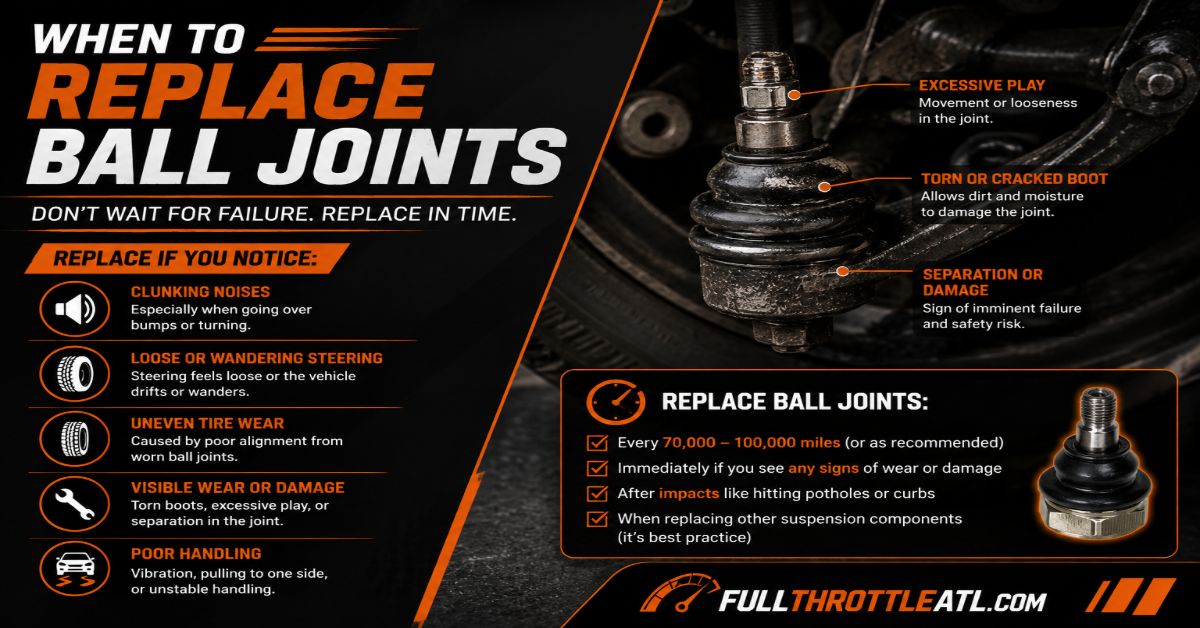
Vehicle ball joints must be replaced immediately when physical play exceeds manufacturer wear limits, typically between 0.020 inches and 0.050 inches, or when structural damage occurs. While standard joints typically last between 70,000 and 150,000 miles, mileage alone should never dictate replacement.
At a Glance: Core Facts About Ball Joints
- Wear Limit: Axial or radial play exceeding 0.020 to 0.050 inches requires immediate replacement.
- Lifespan: Standard factory joints last 70,000 to 150,000 miles, but inspection results override mileage.
- Inspection Interval: Inspect suspension components every 12,000 miles or annually.
- Replacement Rule: Always replace ball joints in axle pairs to maintain balanced handling.
- Alignment Requirement: A professional wheel alignment is mandatory immediately following replacement.
What is the Maximum Allowable Play for Ball Joints?
For most passenger vehicles, the service manual limit for maximum allowable axial or radial play is between 0.020 inches and 0.050 inches, which translates to roughly 0.5 mm to 1.27 mm. Any movement readable on a dial indicator beyond these specific thresholds requires immediate mechanical replacement. Mechanics measure this play using a magnetic base dial indicator attached to the control arm while leveraging the wheel assembly. If the inner socket wall has enlarged past this tolerance, the joint can pop out of its housing entirely under heavy steering loads.
How Often Should Vehicle Ball Joints Be Inspected?
Automotive technicians recommend physical suspension testing every 12,000 miles or during routine annual safety inspections. High-performance aftermarket units, such as QA1 low-friction ball joints, require strict manual inspections every 2,000 to 3,000 miles due to tighter tolerances and aggressive operating environments. Routine oil changes present an ideal window to visually scan rubber boots for tears, even if full dial indicator measurements only occur annually.
What Are the Early Warning Signs of a Failing Ball Joint?
Failing ball joints typically announce themselves through rhythmic clunking, snapping, or popping noises when turning the steering wheel or driving over low-speed bumps. Drivers may also notice vague steering feedback, wandering on the highway, or a steering wheel that refuses to center itself smoothly after a turn. Ignoring these acoustic and tactile warnings allows the internal stud to loosen further, leading to complete structural detachment.
Can You Drive Safely With a Bad Ball Joint?
Driving with a compromised ball joint poses an extreme safety hazard and risks catastrophic steering failure at highway speeds. Once a joint develops play beyond manufacturer specs, the constant hammering of road impacts accelerates internal wear exponentially. If the ball pulls completely out of the socket, the wheel drops, rendering the vehicle completely uncontrollable and often causing severe body damage.
Do You Need to Replace a Ball Joint That Has Surface Wetness or Grease Seepage?
Never replace a ball joint strictly because it has surface wetness or minor grease seepage. Unless there is audible noise, a completely torn boot, or measurable physical play, a sweating ball joint remains fully functional and structurally sound. Many factory joints weep small amounts of assembly lubricant during extreme temperature shifts without compromising the internal bearing surface.
What Happens When Ball Joints Are Permanently Integrated Into the Control Arm?
On many modern lightweight vehicles featuring aluminum suspension components, the ball joint is permanently integrated into the control arm. Technicians cannot press the worn joint out of its seat; therefore, the entire control arm assembly must be replaced as a single unit. While this increases parts costs, it ensures that worn control arm bushings are renewed simultaneously, restoring factory handling geometry.
How Should Suspension Components Be Checked After a Severe Pothole Impact or Accident?
If a vehicle impacts a deep pothole, strikes a curb, or sustains collision damage, the ball joint may suffer hidden internal micro-fractures. It must be checked immediately by a professional and then re-inspected exactly six months later, as impact damage often takes months of thermal cycling and load stress to manifest as measurable physical play.
Why Does Standard Wheel Shaking Fail to Detect Worn Ball Joints on Some Vehicles?
Standard advice instructs drivers to jack up the car, shake the wheel at the 12 and 6 o’clock positions, and look for play, but this method fails in several specific scenarios. If you jack up a vehicle by the frame on a double-wishbone suspension, the heavy coil spring remains loaded against the lower control arm. This extreme tension completely locks up the ball joint, masking severe internal wear.
How Do You Properly Unload a Suspension to Check Ball Joints?
To accurately find hidden play, you must place the floor jack directly under the lower control arm to compress the spring and completely unload the joint. For vehicles with upper and lower ball joints, technicians use specialized load-measuring tools or pry bars strategically between the spindle and control arm. Unloading the suspension removes pre-load pressure, allowing worn tolerances to become immediately visible and measurable.
How Do You Distinguish Between a Bad Ball Joint and a Failed Wheel Bearing?
Shaking a wheel at the 12 and 6 o’clock positions tests both the ball joints and the wheel bearings simultaneously. If you do not visually verify where the movement is occurring by watching the joint stud relative to the control arm, you risk replacing a perfectly healthy ball joint when you actually have a failed wheel bearing. Wheel bearing failure typically accompanies a constant humming or growling noise that changes pitch with vehicle speed, whereas ball joints click or clunk over impacts.
Why Are Tension-Loaded Lower Ball Joints on Older Toyota Trucks Uniquely Dangerous?
Certain older multi-link setups found in older Toyota Tacomas and 4Runners utilize a tension-loaded lower ball joint design. These specific configurations are notorious for showing virtually zero warning play or noise before completely snapping and dropping the vehicle onto its brake rotor. For these specific vehicles, proactive replacement around 100,000 miles is highly recommended regardless of current inspection results.
Do You Need to Replace Ball Joints on Both Sides at the Same Time?
Technically, you only have to replace the faulty joint, but industry best practice dictates replacing them in pairs per axle. Because both sides experience identical road wear, potholes, and mileage, the opposite side usually fails shortly after the first replacement. Replacing them as a set saves on duplicate labor charges and redundant wheel alignment costs.
Do You Need a Professional Wheel Alignment After Replacing a Ball Joint?
Replacing a ball joint fundamentally alters the steering knuckle and suspension geometry. Failing to get a professional wheel alignment immediately after installation causes rapid, uneven tire wear and erratic, dangerous handling characteristics. Alignment technicians adjust toe, camber, and caster to bring the vehicle back to factory specifications.
Can You Fix a Noisy Ball Joint by Pumping Fresh Grease Into It?
If a ball joint is already clunking, popping, or exhibiting physical play, the internal metal sphere or polymer socket is structurally degraded. Adding fresh grease will temporarily quiet the noise, but it will not fix the underlying structural play, leaving the vehicle unsafe to drive. Grease only lubricates healthy surfaces; it cannot rebuild worn metal.
How Much Does It Cost to Replace Ball Joints?
Replacing standard press-in ball joints typically costs between 150 and 350 dollars per side including labor. When ball joints are integrated into the control arm, costs rise to between 300 and 700 dollars per side because the entire arm assembly must be replaced. Labor rates and regional alignment fees will cause these total repair expenses to vary.
The Bottom Line
Replacing ball joints at the right time prevents catastrophic steering failure and expensive secondary tire damage. Always rely on physical measurement limits and professional suspension inspections rather than mileage milestones alone. Address worn components in axle pairs, and always finish the repair with a professional wheel alignment to keep your vehicle safe and stable on the road.