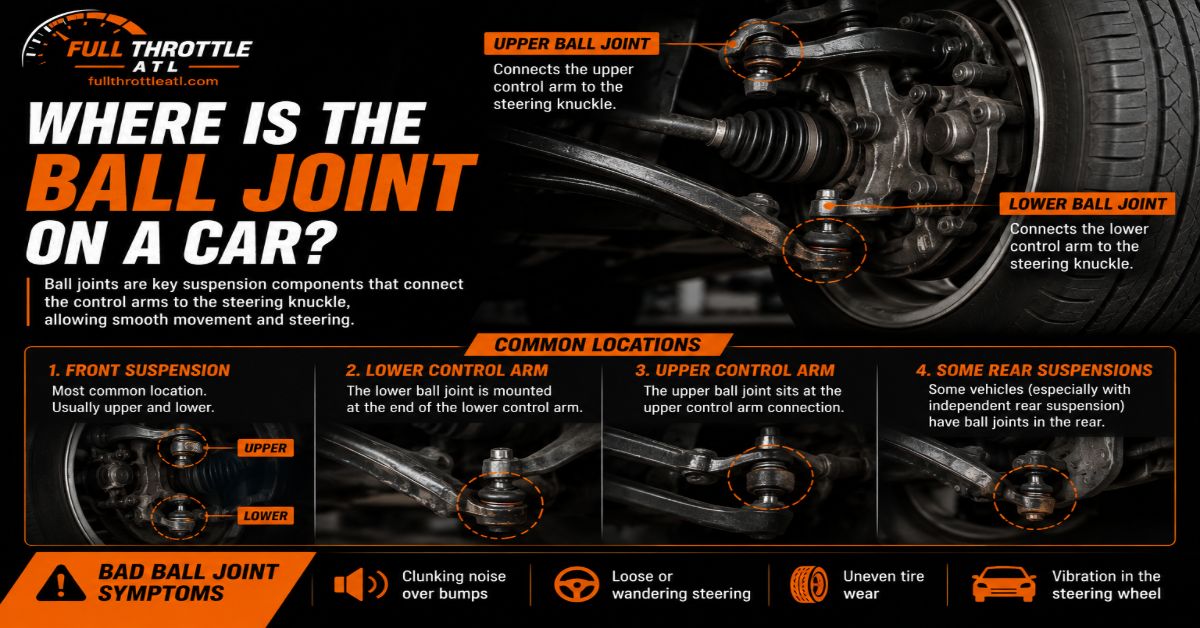
The ball joint is located directly between the steering knuckle and the control arm in a vehicle suspension system. It serves as the primary pivot point connecting the wheels to the chassis, allowing smooth steering articulation and vertical wheel movement while absorbing dynamic road forces during daily driving.
At a Glance: Essential Ball Joint Facts
- Primary Location: Positioned between the lower control arm and the steering knuckle on each front wheel.
- Quantity: Most passenger vehicles contain between two and four ball joints total depending on the suspension architecture.
- Core Function: Acts as a spherical bearing that links control arms to steering spindles, enabling multi-directional movement.
- Failure Symptom: Generates a distinct metallic clunking noise when driving over bumps or turning the steering wheel.
- Critical Risk: A complete failure results in instant loss of steering control and structural suspension collapse.
How many ball joints does a car have?
The total number of ball joints on a passenger vehicle ranges from two to four, governed entirely by the engineering design of the front suspension system. Vehicles equipped with simplified MacPherson strut assemblies feature two total ball joints, whereas vehicles utilizing double wishbone or multi-link setups feature four or more joints to manage complex wheel geometry.
Understanding this count matters because replacement intervals and maintenance costs scale directly with the number of pivot points installed on the chassis. For example, a compact sedan like a Toyota Corolla uses two lower ball joints, while a heavy pickup truck like a Ford F-150 utilizes four separate upper and lower joints.
What is the difference between MacPherson strut and double wishbone layouts?
MacPherson strut suspensions utilize two total ball joints, featuring exactly one lower ball joint per front wheel connecting the bottom of the steering knuckle to the lower control arm. Double wishbone suspensions utilize four total ball joints, featuring both an upper and a lower ball joint on each front wheel assembly.
In a MacPherson setup, the top of the steering knuckle bolts directly to a structural shock strut, eliminating the need for an upper control arm. In a double wishbone setup, two independent control arms clamp the steering knuckle from above and below, distributing cornering loads across two distinct pivot points per wheel.
How do multi-link suspension systems arrange ball joints?
Multi-link suspension systems replace traditional solid control arms with three to five individual aluminum or steel links, placing between two and four independent ball joints or ball sockets on each wheel assembly. Premium European performance cars like the Audi A4 or BMW 3 Series employ this design to isolate ride comfort from handling precision.
Because each individual link handles a specific vector of force, a single corner of the vehicle may feature multiple active ball sockets. When suspension play develops in a multi-link layout, technicians must isolate the exact failing link rather than assuming a single traditional control arm assembly is at fault.
Are there ball joints in the rear suspension of a car?
Independent rear suspension systems on select luxury, sports, and heavy-duty vehicles utilize rear ball joints instead of traditional rubber bushings to handle high cornering loads or rear-wheel steering. Vehicles such as certain BMW 5 Series models, older Honda Prelude generations, and heavy-duty towing SUVs feature these rear joints.
Rear ball joints manage camber and toe alignment changes during aggressive acceleration or cornering. While traditional solid rear axle configurations have zero ball joints, modern independent rear setups require rear joint inspection during routine wheel alignments.
What is the difference between load-carrying and follower ball joints?
In double wishbone suspension architectures, one joint carries the weight of the vehicle as a load-carrying joint, while the opposing joint merely guides steering alignment as a follower joint. If a vehicle features a coil spring or torsion bar mounted directly to the lower control arm, the lower ball joint bears the full static weight of the vehicle and wears out significantly faster.
Follower joints experience less vertical load and rely on spring tension to keep internal bearing surfaces seated. Identifying whether a failing component is a load-carrying or follower joint dictates the exact mechanical procedure required to unload the suspension safely before unbolting the component.
How do I know if my ball joint is bad while driving?
The most distinct sign of a bad ball joint while driving is a metallic clunking, popping, or snapping noise when traveling over speed bumps, pulling into steep driveways, or turning the steering wheel. Drivers often experience steering wander, where the vehicle drifts erratically across lanes or fails to track straight without constant steering corrections.
If a failing joint has completely lost its internal grease lubrication and protective rubber boot, it will produce an audible squeaking or grinding sound that intensifies during slow speed maneuvers. Ignoring these acoustic warnings accelerates metal-on-metal wear inside the socket.
How can I physically test a ball joint for wear?
To physically test a ball joint for wear, jack up the vehicle until the wheel clears the ground, place your hands at the 12 o’clock and 6 o’clock positions on the tire, and rock the assembly firmly in and out. If you observe physical play, structural slack, or hear a metallic click, the ball joint has excessive internal clearance and requires replacement.
For vehicles equipped with load-carrying lower ball joints, you must place a hydraulic floor jack directly underneath the lower control arm to compress the suspension spring before shaking the wheel. Failing to load the control arm during this test can mask severe vertical play by allowing the suspension to hang loosely.
What causes a car ball joint to fail prematurely?
Premature ball joint failure is caused primarily by torn rubber dust boots that allow road salt, water, and abrasive grit to contaminate the internal spherical bearing socket. Once moisture breaches the boot, corrosion washes away the factory high-pressure grease and scores the polished metal stud.
Other leading causes include aggressive driving over deep potholes, running oversized wheels with heavy offset weights that alter factory suspension geometry, and skipping chassis lubrication during routine oil changes on serviceable aftermarket suspension parts.
How much does it cost to replace a car ball joint?
Replacing a car ball joint costs between one hundred fifty and four hundred dollars per side for parts and professional labor combined. If the vehicle features an integrated control arm design where the ball joint cannot be pressed out separately, repair costs increase to three hundred to eight hundred dollars because the entire control arm assembly must be replaced.
Independent shops typically bill one to three hours of labor per side depending on whether the joint is bolted, pressed into the arm, or secured with a stubborn structural pinch bolt. Additional costs for a mandatory post-repair wheel alignment should be factored into the total budget.
How long do car ball joints typically last?
Car ball joints typically last between seventy thousand and one hundred fifty thousand miles under normal driving conditions on paved roadways. Vehicles driven frequently on unpaved dirt roads, salted winter highways, or rough terrain may experience complete ball joint failure in as little as forty thousand miles.
Quality plays a major factor in longevity, as factory original equipment manufacturer parts often outlast cheap aftermarket replacements by tens of thousands of miles. Periodic visual inspections during tire rotations help catch boot tears long before structural failure occurs.
Can you drive with a squeaking ball joint?
Driving with a squeaking ball joint is extremely dangerous because a persistent squeak indicates that the internal socket has lost all protective lubrication and is experiencing high friction metal-on-metal grinding. This friction rapidly generates excessive heat, causing the metal ball stud to seize inside its housing or snap entirely.
Drivers should treat a squeaking suspension component as an emergency warning sign requiring immediate mechanical inspection rather than cosmetic maintenance. Applying temporary spray lubricant to the exterior boot offers zero internal protection if the joint is already worn out.
How do you remove a stuck pinch bolt ball joint?
Removing a stuck pinch bolt ball joint requires completely extracting the horizontal clamping bolt from the steering knuckle before attempting to wedge the joint free, as failing to remove this bolt will crack or destroy the aluminum knuckle casting. Once the pinch bolt is extracted, technicians insert a wedge tool or specialized spreading bit into the relief slot to release the straight ball stud.
Never use a heavy hammer directly on delicate aluminum steering knuckles or drive a traditional pickle fork into the joint without caution, as torn rubber boots and bent control arms frequently result from improper tool selection during DIY repairs.
Is an alignment necessary after replacing a ball joint?
A professional four-wheel wheel alignment is strictly required after replacing any suspension ball joint to restore proper camber, caster, and toe settings. Removing and replacing control arms or steering knuckles alters factory wheel geometry, which causes rapid tire wear and unpredictable handling if left uncorrected.
Skipping the alignment after a ball joint replacement will destroy a new set of front tires within a few thousand miles due to severe feathering or scrubbing against the pavement. Always budget for an alignment alongside suspension hardware purchases.
Can a bad ball joint cause a catastrophic accident?
Yes, a bad ball joint can cause a catastrophic accident if the joint separates completely while the vehicle is in motion at highway speeds. When separation occurs, the steering knuckle detaches from the control arm, causing the wheel to instantly fold outward or tuck underneath the vehicle frame.
This structural failure results in an immediate, irreversible loss of steering control, often sending the vehicle spinning across lanes or rolling over. Routine physical testing of suspension components prevents this dangerous scenario.
Should I replace ball joints in pairs?
Replacing ball joints in pairs across both sides of the vehicle is strongly recommended by professional technicians because components on the left and right sides experience identical mileage, road hazards, and load stresses. If the left side has failed due to fatigue, the right side is typically operating at the exact same wear threshold and will fail shortly thereafter.
Replacing both sides simultaneously also saves money and time by avoiding a duplicate wheel alignment fee, ensuring balanced steering feedback, and restoring symmetrical handling across the front axle.
The Bottom Line
The ball joint is located between the control arm and steering knuckle, acting as the critical pivot point for your car wheels and steering system. Most vehicles feature two to four joints distributed across MacPherson strut, double wishbone, or multi-link architectures. Recognizing early warning signs like clunking noises, testing for play at the twelve and six o’clock positions, and replacing worn components in pairs prevents catastrophic steering failures on the road.