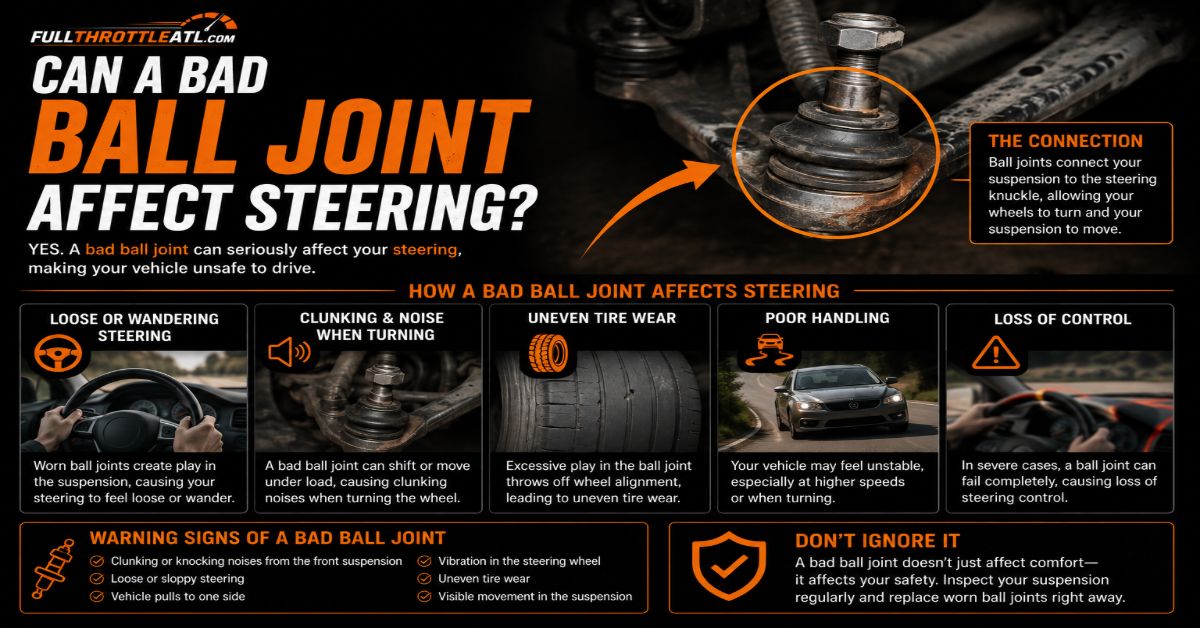
Yes, a bad ball joint severely disrupts steering performance by creating loose handling, erratic pulling, and alignment shifts. As the critical pivot points connecting your vehicle steering knuckles to the control arms, worn ball joints destroy the exact geometric precision required for safe directional control.
At a Glance
- Steering Play: A worn joint often produces 2 to 3 inches of dead zone at the wheel before tires respond.
- Tolerances: Maximum allowable radial or axial play is strictly between 0.5 mm and 1.5 mm (0.02 to 0.06 inches).
- Lifespan: Factory ball joints typically endure 70,000 to 150,000 miles, but harsh conditions reduce this to under 30,000 miles.
- Safety Risk: A completely failed load-bearing joint causes immediate wheel collapse and catastrophic loss of control.
- Alignment Need: Every ball joint replacement requires an immediate professional wheel alignment to correct toe and camber angles.
How Does a Bad Ball Joint Affect Your Steering?
A bad ball joint compromises steering by allowing unwanted mechanical play within the front suspension system. When the internal spherical bearing and socket wear down, the connection between the control arm and the steering knuckle becomes sloppy. This looseness translates into a delayed steering response, wandering on the highway, and unpredictable steering wheel centering after executing a turn.
Dynamic forces while driving exacerbate this issue. When you brake or accelerate, the loose joint shifts out of alignment, causing the car to pull sharply to one side without any input from the driver. If the joint suffers from dry binding instead of looseness, the steering wheel becomes exceptionally heavy, stiff, and refuses to return to the center position automatically.
What Are the Acceptable Play Tolerances for Ball Joints?
Most automotive manufacturers specify a maximum allowable radial or axial play of 0.5 mm to 1.5 mm (0.02 to 0.06 inches) for standard suspension ball joints. Anything beyond these micro-tolerances mandates immediate component replacement to prevent dangerous handling instability.
When measuring play, technicians use a dial indicator mounted directly to the control arm while prying the wheel assembly. A severely worn joint allows camber or caster angles to fluctuate by 1 to 2 full degrees during normal driving. This constant geometric shift ruins directional stability, accelerates tire wear, and places excessive stress on adjacent steering components like tie rod ends and rack and pinion assemblies.
What is the Difference Between Strut and Double-Wishbone Failures?
Suspension design dictates how catastrophic a ball joint failure will be based on whether the joint is follower-loaded or load-bearing.
- MacPherson Strut (Follower-Loaded): In this setup, the upper mount carries the vehicle weight while the lower ball joint primarily handles steering rotation. If it fails, the steering becomes incredibly sloppy and noisy, but the suspension rarely collapses immediately because the strut supports the vertical load.
- Double-Wishbone (Load-Bearing): In this setup, the lower ball joint physically supports the weight of the vehicle. If a load-bearing joint fails, the weight of the car forces the socket apart, leading to immediate wheel separation, fender damage, and catastrophic loss of vehicle control.
Why Do Modern Sealed Ball Joints Fail Silently?
Modern vehicles frequently utilize sealed-for-life ball joints that lack grease zerks, meaning they fail silently without traditional warning signs like loud squeaking or persistent groaning. Over time, road debris and thermal cycles degrade the synthetic rubber dust boot. Once the boot tears, moisture and abrasive road salt infiltrate the internal socket while washing away the factory lubrication.
This contamination causes rapid internal metal-on-metal friction. Instead of wearing out gradually to create loose steering play, these dry joints frequently experience sudden binding. Drivers notice an unnaturally stiff steering wheel that catches or jerks mid-turn before they ever hear a mechanical warning noise.
Why Does a Wheel Alignment Machine Miss a Worn Ball Joint?
A wheel alignment machine often reads completely within factory specifications because the vehicle sits in a static, unloaded position on a flat alignment rack. Static testing fails to replicate dynamic real-world forces.
The moment you drive the car on an uneven road surface, braking inputs, acceleration torque, and centrifugal cornering forces push the worn ball joint out of alignment. This phenomenon creates a ghost alignment issue where your car drives straight on a smooth flat shop floor but pulls violently to the left or right the second you apply the brakes at highway speeds. Technicians must perform physical suspension load tests rather than relying solely on computer alignment printouts.
Can I Drive Your Car with a Bad Ball Joint?
No, you should never drive a vehicle with a diagnosed bad ball joint. While a vehicle with early-stage wear may temporarily remain controllable on smooth streets, a completely compromised joint will eventually pull apart under stress.
Driving on a failing joint risks sudden wheel separation at speed. If the joint shears or pops out of its socket while driving on a highway, you will experience an immediate and total loss of steering control. This scenario frequently results in severe rollover accidents, severe body damage, and collisions with oncoming traffic.
How Can You Test a Ball Joint at Home?
You can test a ball joint at home using a heavy-duty floor jack, jack stands, and basic hand tools by following this step-by-step diagnostic procedure:
- Elevate the Vehicle: Securely lift the front of the vehicle using a floor jack and support it with rated jack stands so the front tires hang completely off the ground.
- Perform the 12-and-6 O’Clock Shake: Place your hands at the 12 o’clock and 6 o’clock positions on the tire and rock the wheel firmly inward and outward.
- Inspect for Movement: Ask an assistant to watch the lower control arm and ball joint while you shake the wheel. If you see vertical play or hear a distinct clicking sound, the joint is worn out.
- Use a Pry Bar: Insert a sturdy pry bar between the lower control arm and the steering knuckle rim, applying gentle upward pressure to check for vertical play exceeding manufacturer specifications.
Should You Always Replace Ball Joints in Pairs?
Yes, professional mechanics highly recommend replacing ball joints in pairs across the same axle. Ball joints on the driver and passenger sides experience identical mileage, weather conditions, thermal cycling, and road impacts over their operational lifespans.
If the driver-side ball joint has worn out to the point of affecting your steering, the passenger-side joint is structurally fatigued and very close to complete failure. Replacing both sides simultaneously restores balanced handling symmetry, ensures uniform tire wear, and saves you from paying redundant labor fees for a secondary failure a few months later.
Do You Need an Alignment After Replacing a Ball Joint?
Yes, a professional wheel alignment is mandatory immediately after replacing any ball joint. Installing a new joint alters the precise physical position of the steering knuckle relative to the control arm and subframe.
Even a microscopic fraction of a millimeter difference changes your vehicle toe, caster, and camber angles. Neglecting this alignment step causes rapid, uneven tire feathering, wandering steering behavior, and a crooked steering wheel while driving straight.
What Causes a Ball Joint to Seize Instead of Loosening?
A ball joint seizes instead of loosening when internal lubrication completely vanishes due to a torn dust boot, allowing friction and corrosion to weld the ball stud inside the housing socket.
Unlike loose joints that create steering slop and clunking noises over bumps, a seized ball joint makes your steering exceptionally heavy, stiff, and unresponsive. When you complete a turn, the steering wheel refuses to slide back to the center automatically, forcing you to manually crank the wheel back to straighten the vehicle.
How Do Lifted Trucks Accelerate Ball Joint Wear?
Modifying a vehicle with a suspension lift kit forces factory ball joints to operate outside their engineered geometric angles. Extreme lift heights tilt the control arms downward, pushing the ball stud tight against the inner edge of its housing socket even when the wheels point straight ahead.
This constant angular binding accelerates internal wear and vastly increases structural stress during articulation. Lifted trucks frequently require aftermarket uniball joints or heavy-duty replacement arms with corrected geometry to prevent premature steering failure.
What Are the Replacement Costs for Ball Joints?
- Parts Cost: Standard replacement ball joints range from $30 to $150 per side, depending on whether the joint is press-in, bolt-on, or integrated into the entire control arm assembly.
- Labor Cost: Professional installation ranges from $150 to $400 per side, requiring 1.5 to 3 hours of labor due to the need for hydraulic presses, pickle forks, and alignment adjustments.
- Total Expense: A complete front ball joint replacement job including parts, labor, and a four-wheel alignment typically totals between $350 and $900.
How to Distinguish a Bad Ball Joint from a Bad Wheel Bearing?
You can differentiate a bad ball joint from a bad wheel bearing by analyzing the noise characteristics and the physical reaction during a suspension shake test.
A bad wheel bearing produces a constant, loud humming or roaring sound that increases in pitch with vehicle speed, often changing tone when you gently weave the car side-to-side on a highway. In contrast, a bad ball joint generates sharp metallic clunks, snaps, or pops when driving over speed bumps or turning sharply at low speeds, with no high-speed highway humming. Additionally, a bad wheel bearing shows play when rocking the wheel at any angle, whereas ball joint play is specifically isolated to vertical 12-and-6 o’clock movement or observed directly at the joint socket.
What Are the Early Warning Signs Before Steering Play Develops?
Early-stage ball joint degradation manifests as subtle symptoms long before noticeable steering wheel play or dangerous looseness occurs.
Drivers should watch for a faint, intermittent metallic ticking or clicking noise when backing out of a driveway or turning into a parking spot at low speeds. Another early indicator is slight vibration transmitted through the floorboards over minor road imperfections. Catching these subtle warning signs during routine oil changes prevents sudden catastrophic failure and expensive secondary damage to your steering rack and tires.
The Bottom Line
A bad ball joint directly threatens your steering safety by destroying vital suspension geometry and introducing dangerous mechanical play. Whether a failing joint results in loose, wandering steering or a sudden dry seizure, prompt inspection and replacement are non-negotiable. Always replace these critical safety components in pairs, verify your vehicle handling with a physical suspension check rather than relying solely on static alignment racks, and follow up every installation with a professional four-wheel alignment.