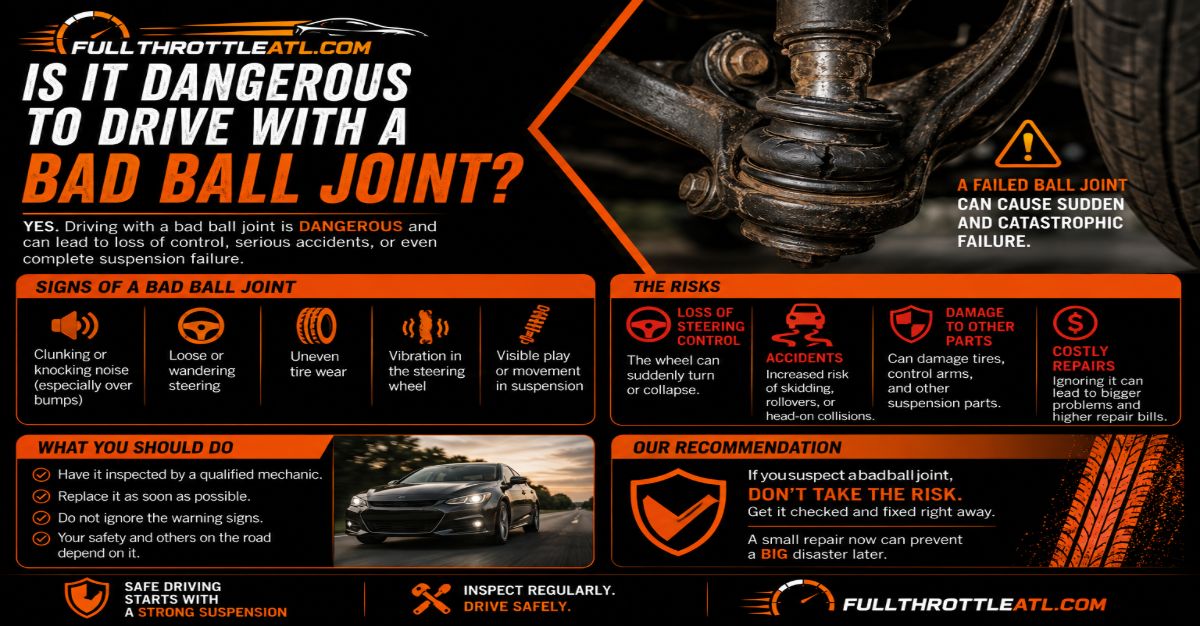
Driving with a bad ball joint is extremely dangerous and carries a critical safety risk of sudden mechanical failure. If a ball joint snaps completely while the vehicle is in motion, the wheel can detach from the suspension, resulting in an immediate loss of steering control and a severe collision.
At a Glance
- Zero Grace Period: Once a ball joint makes clicking or snapping noises, driving should stop immediately.
- Failure Window: A worn joint has an absolute maximum structural grace period of 500 to 1,000 miles before catastrophic separation.
- Speed Threshold: Failures occurring above 30 to 40 miles per hour frequently result in vehicle rollovers or major crashes.
- Repair Cost Delta: Replacing a single joint costs $200 to $500, whereas a complete structural snap can exceed $2,000 in collateral damage.
- No Warning Exception: High-road-salt corrosion or unbranded aftermarket parts can cause sudden failure with zero prior warning noises.
How do I know if my vehicle has a bad ball joint?
Recognizing early diagnostic symptoms prevents catastrophic suspension failure on the highway. Drivers should listen for a metallic clunking or popping noise when turning the steering wheel or rolling over speed bumps. The steering wheel may also feel loose, wander across lanes, or drift persistently to one side while maintaining a straight path on smooth asphalt.
Suspension wear translates directly into tactile feedback. If the vehicle feels unstable or unsettled during moderate braking, or if you notice uneven wear patterns concentrated strictly on the inner or outer edges of the front tires, a compromised ball joint is a primary suspect.
What is the physical at-home test for loose ball joints?
The standard manual inspection requires safely lifting the vehicle using a hydraulic floor jack until the front tire clears the ground completely. Grab the tire firmly at the twelve o’clock and six o’clock positions and rock it back and forth aggressively. Play, movement, or a distinct knocking feeling indicates a loose wheel bearing or a failing ball joint.
To isolate the ball joint specifically from the wheel bearing, an assistant should watch the control arm and steering knuckle connection point while you shake the tire. If the stud moves independently inside the socket, the ball joint has excessive internal clearance and requires immediate replacement.
What is the safe mileage and timeline limit before failure?
There is zero safe distance to drive once a ball joint begins clicking, snapping, or showing visible play during an inspection. The absolute maximum structural grace period after initial faint creaking or minor wear symptoms begin is between 500 and 1,000 miles before catastrophic failure becomes highly probable.
Operating a vehicle past this window gambles with structural integrity. Friction inside the worn socket generates heat and metal fatigue, wearing down the internal stud until it pulls cleanly out of the housing under normal vertical loads.
At what speed does a ball joint failure become fatal?
The critical velocity threshold is 30 to 40 miles per hour. Below this speed range, a sudden separation usually causes the corner of the vehicle to drop onto the pavement, destroying the fender and stopping the car with minimal kinetic energy transfer.
Above 40 miles per hour, the detached wheel turns sideways due to lost steering linkage connection, acting as an anchor. This sudden directional shift causes immediate loss of control, sending the vehicle across oncoming traffic lanes, into roadside barriers, or into a violent rollover sequence.
What is the difference between load-carrying and follower ball joints?
Vehicles equipped with traditional double-wishbone suspensions utilize one load-carrying ball joint and one follower ball joint per side. The load-carrying joint bears the primary weight of the vehicle and endures constant vertical compression forces from spring tension.
A failing load-carrying joint represents an immediate structural emergency because it supports static weight. Conversely, a worn follower joint maintains proper alignment orientation but does not bear vertical vehicle weight, meaning it degrades handling progressively rather than snapping instantly under static loads.
Why do some bad ball joints snap without giving any warning signs?
Standard automotive advice states that drivers always receive loud warning sounds before suspension components fail completely. This advice fails entirely in regions that use heavy road salt during winter months, where aggressive structural rust weakens the steel ball joint stem invisibly from the outside.
Corrosion-induced snapping occurs when rust pits the metal shaft, causing it to fracture cleanly while hitting a routine pothole, despite exhibiting zero loose play or audible clunking prior to the event. Budget unbranded aftermarket parts and high-offset wheels also bypass standard wear phases, failing abruptly under unexpected lateral stress.
How do oversized tires and suspension lift kits cause premature failure?
Installing heavy oversized tires and aggressive lift kits dramatically alters factory suspension leverage geometry. The increased mass of large tires increases the unsprung weight, while deep negative wheel offsets push the tire centerline outward away from the steering axis.
This outward shift multiplies the moment arm and creates massive lateral shear forces on the ball joint stud. Factory components engineered for stock specifications fatigue rapidly under these amplified loads, leading to premature boot tearing and joint destruction within a fraction of normal service life.
What happens to the vehicle if a lower ball joint breaks versus an upper joint?
A lower ball joint failure is far more catastrophic than an upper joint failure because the lower arm supports the weight of the vehicle and controls wheel vertical positioning. When a lower joint separates, the suspension collapses instantly, dropping the fender onto the tire and locking the steering completely.
An upper ball joint failure still causes severe handling loss, but the lower control arm typically keeps the wheel upright and contained within the wheel well. This allows the driver a slim margin of directional control to brake safely to the shoulder of the road.
Can I replace just a single ball joint or must I do both sides?
You can technically replace just a single ball joint if the opposing side passes a rigorous physical inspection with zero play. However, because suspension components on both sides experience identical mileage, road salt exposure, and stress cycles, the opposite side usually fails shortly after the first repair.
Professional mechanics strongly recommend replacing ball joints in axle pairs to maintain balanced handling, even tire wear, and uniform suspension geometry across the front end.
Will a bad ball joint destroy my front tires?
Yes, a compromised ball joint alters the steering geometry constantly while the vehicle is in motion, preventing the front tires from maintaining a stable contact patch. This constant shifting induces severe feathering, cupping, or rapid bald spots along the inner or outer tread edges.
Replacing the ruined tire without fixing the underlying bad ball joint results in the new tire suffering the exact same destructive wear pattern within a few hundred miles of driving.
Does a worn ball joint automatically cause wheel alignment failure?
Worn ball joints create shifting physical play within the front suspension, directly altering caster, camber, and toe angles dynamically. Attempting to perform a professional wheel alignment while a bad ball joint remains installed is entirely pointless because the wheel position changes continuously during movement.
Technicians will always refuse to align a vehicle with loose suspension components. The alignment must occur only after installing new ball joints to lock the suspension geometry back into factory specifications.
Can a greasable ball joint be temporarily saved with high-pressure grease?
Older or heavy-duty truck suspension designs feature greasable ball joints equipped with zerk fittings. If these joints begin to squeak due to minor lubrication starvation, injecting high-pressure chassis grease can flush out contaminants and temporarily silence the noise.
Greasing is strictly a short-term band-aid designed for low-speed travel directly to a repair facility. If the internal nylon bearing race or metal socket walls are already physically worn or scored, grease offers zero structural restoration and the joint remains prone to failure.
Will a car pass a safety inspection with a bad ball joint?
Vehicles registered in states or countries with mandatory annual safety inspections will automatically fail if the technician detects any perceptible play in the ball joints. Inspectors use pry bars and lift inspections specifically to check for vertical and horizontal movement.
Even if the vehicle steers adequately on smooth pavement, excessive joint play violates baseline vehicle safety codes, requiring immediate repair before registration renewal can be finalized.
How much does it cost to replace a ball joint versus repairing crash damage?
Replacing a single standard ball joint by a professional mechanic costs between $200 and $500, including parts and labor. If the ball joint is permanently integrated into the control arm assembly, the entire arm must be swapped, which slightly alters the parts cost.
Failing to make this repair and driving until the joint snaps increases repair bills to $2,000 to $5,000 or more. A catastrophic snap typically destroys the CV axle, brake lines, fender, control arm, wheel rim, and tire simultaneously.
How long does a professional mechanic take to complete the replacement?
A skilled technician using a hydraulic press tool can typically replace a pressed-in ball joint in 1 to 2 hours of labor. If the vehicle design uses a bolt-in ball joint or requires replacing the entire control arm assembly, the operation often takes less than an hour per side.
Always schedule a professional four-wheel alignment immediately following any ball joint replacement to restore proper handling dynamics and prevent premature tire destruction.
The Bottom Line
Driving with a bad ball joint presents an unacceptable safety hazard that can lead to catastrophic steering loss at highway speeds. Recognizing symptoms early, respecting the thousand-mile structural limit, and replacing worn components in pairs protects both your physical safety and your financial investment.