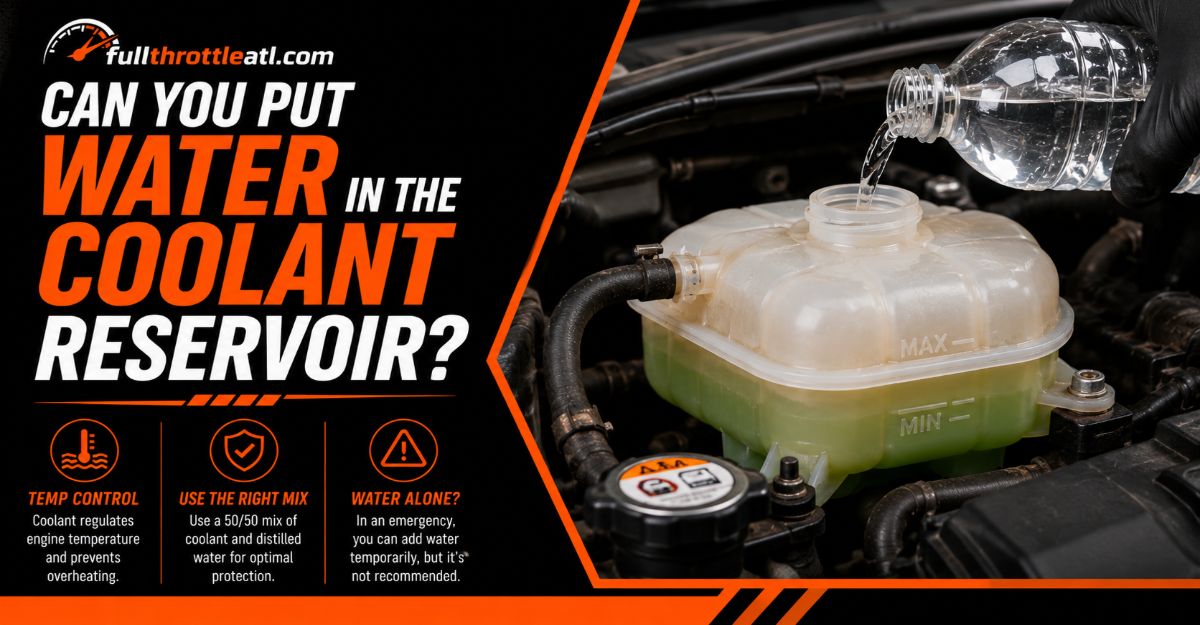
Yes, you can put water in the coolant reservoir, but only as a temporary emergency measure. Using pure water alters the boiling and freezing points of the cooling system and removes corrosion protection. Driving long-term on water causes internal engine rust, water pump failure, and severe overheating damage.
At a Glance
- Emergency Use Only: Pure water is a short-term fix to prevent catastrophic engine failure from dry overheating.
- Water Type Matters: Always use distilled or deionized water; tap water leaves mineral scale that clogs cooling passages.
- Thermal Limits: Pure water boils at 100°C (212°F) and freezes at 0°C (32°F), whereas a 50/50 coolant mix protects from -37°C (-35°F) up to 129°C (265°F) under pressure.
- Safety First: Never open a hot cooling system reservoir—scalding steam and thermal shock can cause severe burns or cracked engine metal.
- System Flush Required: Any system topped off with tap or mineral water must be flushed and refilled with proper antifreeze as soon as possible.
What Happens When You Mix Water with Engine Coolant?
Mixing water with engine coolant dilutes the concentration of ethylene or propylene glycol and chemical inhibitors within the system. At a standard 50/50 ratio, coolant raises the boiling point of the fluid, lowers its freezing point, lubricates the water pump seal, and protects internal metals from electrolysis and rust.
Adding water shifts this chemical balance closer to pure water. Minor top-offs with distilled water barely alter protection levels, but repeatedly adding water lowers the overall boiling threshold and weakens rust inhibitors. If the fluid mixture drops below 40% coolant concentration, internal corrosion accelerates, and the risk of localized boiling around the cylinder heads increases significantly.
What Is the Difference Between an Overflow Reservoir and an Expansion Tank?
An overflow reservoir is a unpressurized plastic bottle that catches excess fluid as the engine warms up, whereas an expansion tank is a fully pressurized component of the cooling system.
+-----------------------------------------------------------------------------------+
|                              COOLING SYSTEM RESERVOIRS                            |
+------------------------------------------+----------------------------------------+
| UNPRESSURIZED OVERFLOW TANK              | PRESSURIZED EXPANSION TANK             |
| - Plastic cap with dipstick/flip-top     | - Threaded pressure cap (rated in psi) |
| - Holds excess expanded fluid            | - Part of active pressurized loop      |
| - Safe to top off when mildly warm       | - EXTREME RISK when opened hot         |
+------------------------------------------+----------------------------------------+
Knowing which type your vehicle uses is critical before adding water:
- Unpressurized Overflow Tanks: These systems utilize a standard radiator cap on the radiator itself and a plastic snap-cap on the reservoir. Fluid moves into and out of this tank via atmospheric pressure and vacuum as the engine heats and cools.
- Pressurized Expansion Tanks: Common in modern European and domestic vehicles, these tanks feature a heavy-duty, threaded pressure cap (typically rated between 15 and 22 psi). The reservoir is an active, pressurized part of the cooling loop. Opening this type while hot will cause explosive boiling and steam discharge.
Is Pure Water Better or Worse at Cooling an Engine Than Antifreeze?
Pure water is actually superior to glycol at transferring heat, but it is much worse as an overall engine coolant due to its narrow operating temperature window and lack of anti-corrosive properties.
+-----------------------+------------------------+----------------------------------+
| Property              | Pure Distilled Water   | 50/50 Antifreeze / Water Mix     |
+-----------------------+------------------------+----------------------------------+
| Heat Transfer Rate    | Higher (1.0 Btu/lb°F)  | Lower (~0.85 Btu/lb°F)           |
| Freezing Point        | 0°C (32°F)             | -37°C (-35°F)                    |
| Boiling Point (15 psi)| ~121°C (250°F)         | ~129°C (265°F)                   |
| Corrosion Protection  | None                   | High (Silicates, OAT, or HOAT)   |
| Lubrication           | None                   | Water pump mechanical seal safe  |
+-----------------------+------------------------+----------------------------------+
Modern internal combustion engines run at normal operating temperatures between 90°C and 105°C (194°F–221°F). Because pure water boils at 100°C (212°F) at atmospheric pressure, it relies entirely on system pressure to stay liquid. If a minor pressure leak occurs, pure water instantly flashes into steam pockets, causing rapid engine overheating.
What Type of Water Is Safe to Pour into a Cooling System?
Distilled water or deionized water is the only safe type of water to pour into a cooling system. Distilled water has undergone steam distillation to remove 99.9% of minerals, dissolved solids, and trace metals.
Using distilled water ensures that no inorganic compounds enter the cooling loop. If you purchase concentrated coolant (rather than pre-mixed 50/50 coolant), always use pure distilled water to dilute it. Deionized water is equally acceptable because it lacks the charged mineral ions that accelerate galvanic corrosion between dissimilar engine metals, such as an aluminum head attached to a cast-iron block.
Can You Put Bottled or Tap Water in Your Radiator During an Emergency?
Yes, you can put bottled drinking water or tap water in your radiator if you are stranded and your coolant reservoir is completely empty. Running an engine dry causes warped cylinder heads and blown head gaskets within minutes; running on mineralized water prevents total destruction.
Emergency Roadside Hierarchy:
[Best] Pre-mixed 50/50 Coolant
  └──> [Good] Distilled / Deionized Water
        └──> [Acceptable Emergency] Bottled Spring Water
              └──> [Last Resort] Tap / Well Water
However, tap, well, and spring bottled water contain calcium, magnesium, and chloride ions. When exposed to internal engine heat exceeding 90°C, these minerals precipitate out of solution, forming hard scale deposits inside the radiator core tubes. Treat tap or bottled water as a temporary patch: drive to safety, fix the leak, and perform a complete system flush.
How Long Can You Drive a Car with Only Water in the Cooling Loop?
You should drive no more than a few days or a maximum of 50 to 100 miles with only water in your cooling loop, provided the ambient outdoor temperature remains well above freezing.
Driving for extended periods on pure water inflicts three distinct forms of damage:
- Water Pump Wear: Engine coolant contains specific lubricants for the mechanical face seal of the water pump. Pure water strips this lubrication, causing seal failure and fluid weeping.
- Rapid Oxidation: Cast iron components begin rusting within hours of exposure to heated, oxygenated water.
- Cavitation Erosion: Impeller blades in the water pump create high-pressure micro-bubbles in pure water that collapse against metal surfaces, pitting and eroding the internal pump housing.
Should You Add Water When the Engine Is Hot or Cold?
You must only add water when the engine is completely cold to avoid severe physical injury and catastrophic engine block damage.
                                  +-----------------------+
                                  |   IS THE ENGINE HOT?  |
                                  +-----------+-----------+
                                              |
                        +---------------------+---------------------+
                        |                                           |
                     [ YES ]                                     [ NO ]
                        |                                           |
         +--------------v--------------+             +--------------v--------------+
         |     DO NOT OPEN SYSTEM!     |             |      SAFE TO TOP OFF        |
         | Risk 1: Scalding steam spray|             | Remove cap, add distilled   |
         | Risk 2: Thermal shock crack |             | water to FULL line.         |
         +-----------------------------+             +-----------------------------+
Adding water to a hot engine carries two massive risks:
- Thermal Shock: Pouring room-temperature or cold water into a scorching, overheated engine block causes rapid localized thermal contraction. This sudden temperature gradient frequently cracks cast-iron blocks or warps aluminum cylinder heads instantly.
- Pressurized Steam Burns: Opening a hot pressure cap releases stored pressure, causing the boiling liquid inside to instantly turn into a geyser of scalding steam and boiling water.
Rule of thumb: Wait at least 30 to 45 minutes after turning off the engine until the top radiator hose is cool to the touch before opening the reservoir cap.
What Is the Correct Ratio of Water to Coolant for Daily Driving?
The standard correct ratio for daily driving is a 50/50 mixture of antifreeze concentrate and distilled water. This specific balance delivers optimal freeze protection down to -37°C (-35°F) and boil-over protection up to 129°C (265°F) under a standard 15 psi cap.
           MINIMUM ALLOWABLE          OPTIMAL DAILY             MAXIMUM ALLOWABLE
            [40/60 Mixture]          [50/50 Mixture]            [70/30 Mixture]
         40% Coolant / 60% Water  50% Coolant / 50% Water  70% Coolant / 30% Water
         -----------------------  -----------------------  -----------------------
Freeze:      -24°C (-11°F)            -37°C (-35°F)            -64°C (-83°F)
Boil:*        126°C (259°F)            129°C (265°F)            132°C (270°F)

*Note: Boiling protection values calculated using a standard 15 psi radiator cap.
Operating parameters must stay within explicit boundaries:
- Minimum Limit: Never drop below a 40% coolant / 60% water ratio. Below this point, corrosion inhibitors become too dilute to protect internal metals.
- Maximum Limit: Never exceed a 70% coolant / 30% water ratio. Pure ethylene glycol freezes at a much higher temperature (-12°C / 10°F) than when mixed with water and retains heat poorly.
Why Does Tap Water Destroy Engine Radiators Over Time?
Tap water destroys radiators because heat forces dissolved minerals—primarily calcium carbonate and magnesium—to separate from the liquid and form hard limescale along internal walls.
Tap Water Minerals (Calcium/Magnesium) + High Heat (>90°C)
                        │
                        ▼
   Limescale Build-Up Inside Core Tubes
                        │
                        ▼
   Restricted Flow + Thermal Insulation Barrier
                        │
                        ▼
     Radiator Clogging & Engine Overheating
Radiators pass coolant through dozens of tiny, razor-thin aluminum tubes designed to shed heat rapidly. Limescale coats the inside of these tubes, acting as an insulator that prevents heat from escaping into the cooling fins. Over time, these mineral deposits flake off, plugging the small passages entirely and creating localized hot spots inside the engine.
Will Adding Water to Your Coolant Freeze and Crack the Engine Block?
Adding excessive water to your coolant reservoir will freeze and crack the engine block if the resulting mixture’s freezing point rises above the ambient winter temperature.
When water freezes into ice, its molecular structure expands by approximately 9%. Inside a sealed engine block, this expansion exerts thousands of pounds of pressure per square inch against cast iron or aluminum walls.
If the expansion pressure exceeds the yield strength of the metal:
- The internal cooling jackets tear open.
- The freeze plugs (expansion plugs) may pop out of the block side.
- The engine block, heater core, or radiator seams crack open, causing total engine failure.
When Do Race Cars and Track Vehicles Use 100% Water Legally?
Race cars and track-day vehicles run 100% distilled water mixed with a dedicated corrosion inhibitor (such as Red Line WaterWetter or VP Stay Frosty) because glycol-based antifreeze is banned on most competitive racetracks.
Glycol is a slick, oil-like substance that does not evaporate quickly. If a race car drops coolant on a track, it creates an extremely hazardous oil-slick surface for following vehicles. Distilled water evaporates quickly off track surfaces and cleans up easily. Because track cars are stored in temperature-controlled trailers or drained before winter freezing, they do not require freeze protection.
How Do You Flush the Cooling System After Adding Tap Water in An Emergency?
Flush your cooling system as soon as possible after using tap water by draining the diluted fluid, flushing the system with clean water, and refilling it with the correct 50/50 mixture.
1.Let the Engine Cool Completely:Prerequisite safety check.
Park the vehicle on a level surface, shut off the ignition, and wait a minimum of 45 minutes. Verify that the upper radiator hose is cold and pliable before proceeding.
2.Drain the Contaminated Fluid:Properly dispose of old fluid.
Place a drain pan beneath the radiator petcock (drain valve). Open the valve and remove the reservoir or radiator cap to drain all contaminated fluid into the pan.
3.Perform a Distilled Water Flush:
Close the drain petcock. Fill the cooling system with pure distilled water. Start the engine, turn the heater to HIGH, and run the engine for 10 to 15 minutes until it reaches normal operating temperature to circulate the water through the heater core.
4.Drain and Refill with Correct Coolant Mix:
Shut off the engine, let it cool completely, and drain the flush water. Close the petcock and fill the system with the exact OEM-recommended 50/50 pre-mixed coolant (or concentrate mixed with distilled water).
5.Bleed Air from the Cooling System:Prevents air-pocket overheating.
Leave the reservoir cap off, start the engine, and let it idle until air bubbles stop rising to the top of the reservoir. Top off to the “FULL” line and secure the cap.
What Are the Warning Signs That Water Has Diluted Your Coolant Too Much?
Diluted coolant displays distinct visual, mechanical, and temperature indicators before total failure occurs.
Look for these four symptoms:
- Discolored or Cloudy Fluid: Clear fluid or rusty brown fluid in the reservoir indicates that water has diluted the original green, pink, or orange dye and rust inhibitors are failing.
- Higher Operating Temperatures: The engine temperature gauge sits consistently higher than normal, or the electric cooling fan runs continuously.
- Chirping Water Pump Noise: A squeaking or dry mechanical grinding noise near the front engine belt suggests the water pump shaft seal lacks proper glycol lubrication.
- Visible Scale or Floaties: White flakes or dark sediment floating in the expansion tank indicate mineral precipitation and internal radiator corrosion.
The Bottom Line
Putting water in your coolant reservoir is an effective emergency fix to reach safety, but pure water should never remain in your cooling loop permanently. Always use distilled water when topping off, and ensure your final fluid mixture stays between 40% and 70% antifreeze concentrate for adequate boiling, freezing, and anti-corrosion protection. If you were forced to use tap or bottled water during a roadside breakdown, perform a complete cooling system flush and refill with fresh 50/50 coolant as soon as possible.