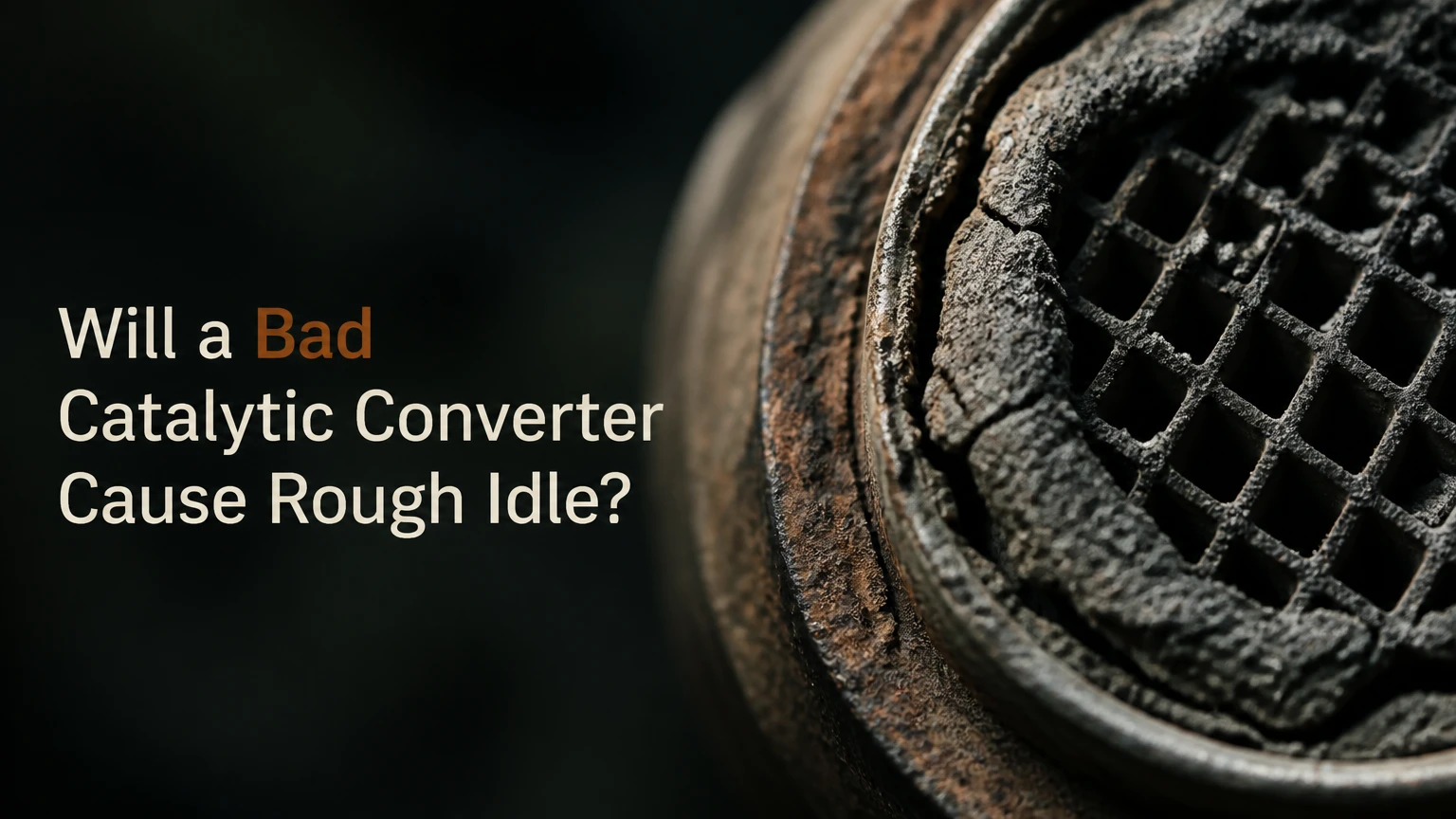
Yes, a bad catalytic converter will cause a rough idle. When internal ceramic substrates melt, fracture, or clog with deposits, exhaust backpressure rises above the normal threshold of 1.5 PSI at idle. This backpressure prevents spent exhaust gases from exiting the cylinders, diluting incoming air-fuel mixtures and triggering engine misfires, erratic RPMs, and severe idle instability.
Key Facts at a Glance
- Primary Failure Mechanism: Exhaust backpressure restricts cylinder scavenging, diluting fresh intake charges with residual inert exhaust gas.
- Normal vs. Clogged Pressure: Normal idle backpressure is under 1.5 PSI; a severely clogged converter spikes backpressure to 3.0–7.0+ PSI.
- Temperature Delta: A healthy, active converter runs $100^\circ\text{F}$ to $200^\circ\text{F}$ hotter at its outlet than its inlet. Equal temperatures indicate a dead substrate.
- Diagnostic Fault Codes: OBD-II diagnostic trouble codes P0420 and P0430 signal low catalyst efficiency, often accompanied by random misfire codes P0300–P0308.
- Misdiagnosis Risk: Up to 30% of catalytic converters are replaced unnecessarily due to failing oxygen sensors, exhaust leaks, or unresolved engine misfires.
How Does a Clogged Catalytic Converter Cause Engine Misfires and Rough Idle?
A clogged catalytic converter causes a rough idle by disrupting the engine’s volumetric efficiency and combustion chemistry. An internal combustion engine acts as a large air pump: it draws in fresh air and fuel, ignites the mixture, and expels the combusted exhaust through the exhaust manifold, catalytic converter, and tailpipe.
+-------------------------------------------------------------------+
|                     NORMAL EXHAUST FLOW                           |
| Engine Cylinders --> Exhaust Manifold --> Converter --> Tailpipe  |
| Backpressure: < 1.5 PSI at Idle                                   |
+-------------------------------------------------------------------+

+-------------------------------------------------------------------+
|                     RESTRICTED EXHAUST FLOW                       |
| Engine Cylinders --> Exhaust Manifold --> [CLOGGED CAT] X Tailpipe|
| Backpressure: 3.0 to 7.0+ PSI  (Spent gases pushed back)          |
+-------------------------------------------------------------------+
When a converter’s internal honeycomb structure collapses, melts from excess unburnt fuel, or becomes coated in oil/ash deposits, the path for exhaust gases narrows significantly. This restriction creates severe exhaust backpressure that cascades through the entire powertrain:
- Combustion Dilution: During the valve overlap phase—when both intake and exhaust valves are briefly open—high backpressure prevents spent exhaust gases from escaping the cylinder. The residual inert exhaust mixes with the incoming fresh air and fuel charge.
- Combustion Instability: Diluting the intake air-fuel mixture lowers its flame speed and spark combustibility. At idle speeds, where engine RPM is low and airflow is minimal, this gas dilution starves the cylinder of oxygen, causing incomplete burns and engine misfires (P0300–P0308).
- Vacuum Loss and ECU Confusion: Increased backpressure reduces manifold vacuum (dropping below the healthy $17\text{–}22\text{ inHg}$ threshold). The Engine Control Unit (ECU) attempts to compensate by adjusting fuel trim and idle air control (IAC) valve positions, creating a surging, hunting, or stumbling engine idle.
What Are the Key Symptoms of a Failing Catalytic Converter?
A failing catalytic converter manifests distinct mechanical, sensory, and electrical symptoms. Because rough idle can stem from multiple engine components, recognizing the complete symptom network allows you to isolate a converter issue quickly.
| Symptom | Physical Manifestation | Underlying Mechanical Cause |
| Rough or Erratic Idle | Engine vibrates heavily at red lights, RPM bounces between 500–900 RPM, or engine stalls completely. | Exhaust backpressure causes cylinder exhaust gas recirculation (EGR) effect, disrupting combustion stability. |
| Severe Loss of Acceleration | Car feels bogged down; pushing the accelerator produces noise but negligible acceleration above 30–40 MPH. | Engine cannot ingest fresh air because exhaust gases cannot escape (choked pump phenomenon). |
| Sulfur or “Rotten Egg” Smell | A pungent chemical sulfur odor is detectable near the tailpipe or inside the vehicle cabin. | Hydrogen sulfide ($H_2S$) in fuel is not properly oxidized into odorless sulfur dioxide ($SO_2$) due to inactive catalyst metals. |
| Glowing Red Converter Housing | The metal body of the converter glows red hot under the vehicle after short drives. | Excess raw unburnt fuel entering the converter ignites inside the honeycomb, pushing internal temperatures past $1,800^\circ\text{F}$. |
| Rattling Noise Under Vehicle | Metallic clattering or marbles shaking inside a can sound, especially during idle or light acceleration. | Thermal shock or impact has fractured the internal ceramic substrate, causing broken chunks to bounce against the outer shell. |
| Check Engine Light (MIL) | Illuminates continuously or flashes during heavy misfire events. | ECU detects downstream $O_2$ sensor voltage mimicking upstream sensor activity (Codes P0420/P0430). |
What Is Inside a Catalytic Converter and How Does It Work?
A catalytic converter is an emissions control device positioned between the exhaust manifold and the muffler. Its job is to chemically convert hazardous exhaust gases—carbon monoxide ($CO$), unburnt hydrocarbons ($HC$), and nitrogen oxides ($NO_x$)—into harmless nitrogen ($N_2$), carbon dioxide ($CO_2$), and water vapor ($H_2O$).
Raw Exhaust (NOx, HC, CO)
       │
       ▼
┌─────────────────────────────────────────┐
│ REDUCTION STAGE (Rhodium / Platinum)   │ ──> Removes Nitrogen Oxide (NOx -> N2 + O2)
└─────────────────────────────────────────┘
       │
       ▼
┌─────────────────────────────────────────┐
│ OXIDATION STAGE (Palladium / Platinum) │ ──> Burns Hydrocarbons & CO (HC + CO -> CO2 + H2O)
└─────────────────────────────────────────┘
       │
       ▼
Cleaned Exhaust (N2, CO2, H2O)
The Three-Way Chemical Process
Modern automotive converters use a three-way catalytic conversion process executed inside a ceramic honeycomb substrate coated with precious metals:
- Reduction Catalyst (Nitrogen Oxide Elimination):
- Metals Used: Platinum (Pt) and Rhodium (Rh).
- Reaction: Converts harmful $NO_x$ compounds into stable molecules by stripping nitrogen atoms from oxygen molecules.$$2NO_x \rightarrow xO_2 + N_2$$
- Oxidation Catalyst (Hydrocarbon and Carbon Monoxide Burning):
- Metals Used: Platinum (Pt) and Palladium (Pd).
- Reaction: Burns remaining unburnt fuel ($HC$) and poisonous carbon monoxide ($CO$) using residual oxygen.$$2CO + O_2 \rightarrow 2CO_2$$$$C_xH_{2x+2} + \left[\frac{3x+1}{2}\right]O_2 \rightarrow xCO_2 + (x+1)H_2O$$
- Closed-Loop Feedback Control:The vehicle’s Engine Control Unit (ECU) relies on an Upstream $O_2$ Sensor (before the converter) to manage fuel injection and a Downstream $O_2$ Sensor (after the converter) to measure catalytic conversion efficiency.
What Are the Main Types of Catalytic Converters?
Catalytic converters vary by flow design, internal chemistry, and regional legal compliance. Choosing the correct type is essential for proper fitment, performance, and vehicle inspection passage.
By Internal Design and Engine Application
- Two-Way Converters: Standard on pre-1981 vehicles. They feature oxidation catalysts only ($CO$ and $HC$), leaving $NO_x$ emissions untreated.
- Three-Way Converters: Universal on gasoline vehicles since 1981. Simultaneously manages $NO_x$ reduction alongside $CO$ and $HC$ oxidation.
- Diesel Oxidation Catalysts (DOC): Specifically formulated for diesel powertrains. They utilize excess oxygen in diesel exhaust to neutralize particulate matter and soluble organic fractions.
By Legal Certification and Manufacturing Standard
+----------------------------------------------------------------------------------------+
|                               OEM vs. AFTERMARKET FITMENT                              |
+--------------------------+----------------------------------+--------------------------+
| Metric                   | OEM (Original Equipment)         | Aftermarket (Direct-Fit) |
+--------------------------+----------------------------------+--------------------------+
| Precious Metal Density   | High (100k+ mile longevity)      | Low-Moderate (30k-50k mi)|
| Compliance               | EPA + CARB 50-State Legal        | Regional (EPA vs CARB)   |
| Price Range              | $1,000 - $3,500+                 | $300 - $900              |
| Failure Rate             | < 1% out of box                  | 5-12% on sensitive ECUs  |
+--------------------------+----------------------------------+--------------------------+
How Do You Diagnose a Bad Catalytic Converter Step-by-Step?
Executing a systematic physical and diagnostic test sequence prevents unnecessary replacement costs and confirms whether an exhaust restriction is causing your rough idle.
                          [START DIAGNOSIS]
                                  │
                                  ▼
                       Connect OBD-II Scanner
                                  │
                  ┌───────────────┴───────────────┐
                  ▼                               ▼
            P0420 / P0430                   No Cat Codes
            Codes Present                   Only Misfires
                  │                               │
                  ▼                               ▼
       Check Downstream O2 Signal          Perform Vacuum Test
       (Is signal fluctuating?)            (17-22 inHg at idle)
                  │                               │
         ┌────────┴────────┐             ┌────────┴────────┐
         ▼                 ▼             ▼                 ▼
       Active            Steady         Low Drop         Steady
     Waveform           0.6-0.8V       on Rev          Healthy
         │                 │             │                 │
         ▼                 ▼             ▼                 ▼
     Bad Cat /        Healthy Cat    Restricted        Check Ignition/
     O2 Sensor        (Check Exhaust) Converter         Fuel Systems
Step 1: Perform OBD-II Scan and Live Data Analysis
Plug an OBD-II scanner into the port beneath your steering column.
- Look for Primary Codes:
P0420(Catalyst System Efficiency Below Threshold – Bank 1) orP0430(Bank 2). - Look for Secondary Drivability Codes:
P0300(Random/Multiple Misfire),P0171/P0174(System Too Lean), orP0172/P0175(System Too Rich). - Graph Downstream $O_2$ Sensor Live Data: At warm idle, a healthy downstream oxygen sensor shows a steady voltage line between $0.6\text{ V}$ and $0.8\text{ V}$. If the downstream voltage mirrors the upstream sensor (rapidly switching between $0.1\text{ V}$ and $0.9\text{ V}$), the converter’s chemical substrate has failed.
Step 2: The Physical Rubber Mallet Knock Test
- Allow the exhaust system to cool completely to ambient air temperature.
- Safely elevate the vehicle on jack stands or an automotive lift.
- Lightly strike the body of the catalytic converter using a rubber mallet.
- Diagnostic Result: A loud metallic rattling or marble-like noise confirms that the internal ceramic substrate has fractured into loose pieces, causing exhaust blockage and rough idle.
Step 3: Infrared Temperature Test
- Start the engine and drive until the vehicle reaches normal operating temperature ($180^\circ\text{F}\text{–}200^\circ\text{F}$ engine coolant temp).
- Park on a level surface, leave the engine idling, and apply the parking brake.
- Aim an infrared non-contact thermometer at the inlet pipe (where exhaust enters the converter) and record the temperature.
- Aim the thermometer at the outlet pipe (where exhaust exits the converter) and record the temperature.
- Diagnostic Result: A healthy converter runs $100^\circ\text{F}$ to $200^\circ\text{F}$ hotter at the outlet than the inlet due to active exothermic oxidation reactions. If the inlet is hotter than the outlet, or if temperatures are identical, the converter is dead or severely fouled.
Step 4: Exhaust Backpressure Gauge Test
- Unscrew the upstream (front) $O_2$ sensor from the exhaust manifold or pipe.
- Thread a specialized exhaust backpressure gauge directly into the $O_2$ sensor port.
- Start the engine and note the pressure gauge reading at idle.
- Increase engine speed to a steady $2,500\text{ RPM}$ and note the reading.
- Diagnostic Result:
- Normal Reading: $< 1.5\text{ PSI}$ at idle; $< 2.0\text{ PSI}$ at $2,500\text{ RPM}$.
- Clogged Reading: $> 3.0\text{ PSI}$ at idle; $> 4.0\text{–}7.0+\text{ PSI}$ at $2,500\text{ RPM}$. High readings confirm an exhaust blockage.
What Primary Engine Failures Destroy a Catalytic Converter?
Catalytic converters are non-wear items engineered to last the operating lifetime of a vehicle ($150,000+\text{ miles}$). They rarely fail on their own. Instead, they are destroyed by upstream mechanical faults that dump unburnt fuel, engine oil, or coolant into the exhaust stream.
Upstream Failure Mechanism ──> Exhaust Contaminant ──> Catalyst Destruction Mode
──────────────────────────────────────────────────────────────────────────────────
Severe Ignition Misfire    ──> Raw Unburnt Fuel    ──> Substrate Meltdown (>1,800°F)
Worn Valve Seals/Rings     ──> Phosphorous/Engine Oil──> Substrate Ash Fouling
Blown Head Gasket          ──> Silicates/Coolant   ──> Substrate Glass Contamination
Rich Fuel Injection        ──> Soot / Carbon       ──> Substrate Blockage
1. Unburnt Fuel Misfires (Thermal Meltdown)
When a spark plug, ignition coil, or fuel injector fails, unburnt gasoline enters the red-hot catalytic converter. The platinum and palladium catalysts attempt to oxidize this massive fuel charge, pushing internal substrate temperatures beyond $1,800^\circ\text{F}\text{–}2,200^\circ\text{F}$. At these temperatures, the ceramic honeycomb structure melts, deforms, and fuses into a solid block, blocking exhaust flow and causing a rough idle.
2. Engine Oil Consumption (Phosphorus Poisoning)
Worn piston rings, degraded valve stem seals, or a failed PCV valve allow engine oil to burn in the combustion chamber. The phosphorus and zinc additives present in motor oil deposit an ash layer over the precious metal washcoat, blinding the catalyst and preventing chemical conversion.
3. Coolant Leaks (Silicone Poisoning)
A cracked cylinder head or blown head gasket allows ethylene glycol coolant to seep into the combustion chambers. As coolant burns, silicates form a glassy, impenetrable coating over the converter substrate, destroying its conversion capability and throwing persistent P0420 codes.
Crucial Rule: Replacing a destroyed catalytic converter without first repairing the upstream misfire, oil leak, or coolant leak will melt or poison your new converter within a few hundred miles.
How Can You Tell a Bad Catalytic Converter from a Failing Oxygen Sensor?
Up to 30% of catalytic converter replacements are misdiagnosed cases caused by faulty oxygen sensors or minor exhaust leaks. Installing an expensive new converter when a $60 sensor is at fault is a common repair mistake.
+------------------------------------------------------------------------------------------+
|                          CATALYTIC CONVERTER VS. O2 SENSOR DIAGNOSIS                     |
+-----------------------+----------------------------------+-------------------------------+
| Diagnostic Diagnostic | Bad Catalytic Converter          | Failing Upstream/Downstream O2|
+-----------------------+----------------------------------+-------------------------------+
| Physical Acceleration | Severe power drop above 30 MPH   | Normal engine power           |
| Engine Vacuum         | Drops continuously at 2500 RPM   | Holds steady at 17-22 inHg    |
| Downstream O2 Signal  | Mirrors upstream (0.1V - 0.9V)   | Frozen flatline or erratic 0V |
| Backpressure Test     | Exceeds 3.0 to 7.0+ PSI          | Normal (< 1.5 PSI)            |
| Exhaust Sound/Smell   | Rotten egg smell, rattling shell | Normal exhaust smell/sound    |
+-----------------------+----------------------------------+-------------------------------+
How Much Does Catalytic Converter Replacement Cost in 2026?
Catalytic converter replacement costs depend heavily on your vehicle’s engine size, precious metal market pricing (Platinum, Palladium, Rhodium), and state emissions compliance requirements.
Comprehensive Cost Breakdown
+------------------------------------------------------------------------------------+
|                         REPAIR COST MATRIX (PARTS & LABOR)                         |
+----------------------------+-----------------------+-------------------------------+
| Component / Fee Type       | Typical Cost Range    | Notes / Cost Drivers          |
+----------------------------+-----------------------+-------------------------------+
| Professional Diagnostic    | $50 - $150            | Applied toward total repair   |
| Aftermarket Direct-Fit Part| $300 - $900           | EPA compliant; 3-5 yr life    |
| CARB-Compliant Part        | $600 - $1,400         | Required in CA, NY, MA, etc.  |
| OEM Factory Part           | $1,000 - $3,500+      | Maximum life; high precious metal|
| Professional Labor (1-3 hrs)| $150 - $450           | Higher if hardware is rusted  |
+----------------------------+-----------------------+-------------------------------+
| TOTAL REPAIR COST RANGE    | $500 - $4,000+        | Depends on path chosen below  |
+----------------------------+-----------------------+-------------------------------+
Strategic Action Plans by Persona
The Budget-Conscious Commuter (Older Vehicle)
- Strategy: Choose an EPA-compliant direct-fit aftermarket converter ($300–$600 part cost).
- Action: Avoid paying OEM prices on a car valued under $5,000. Ensure your technician replaces aging spark plugs or ignition coils during the same visit to protect the replacement converter.
The Strict-Emissions State Resident (California, New York, Maine, etc.)
- Strategy: You must select a CARB-compliant unit verified by Executive Order (EO) number.
- Action: Inspect the Emissions Control Information label under your hood. Installing a standard federal EPA unit in a CARB-enforced state causes an immediate test failure and potential dashboard warning illumination.
The DIY Mechanic
- Strategy: Purchase a direct-fit replacement unit rather than a universal weld-in model to avoid custom metal fabrication.
- Action: Apply heavy penetrating oil (such as PB Blaster or Liquid Wrench) to all exhaust flange bolts 24 hours prior to work. Exhaust hardware undergoes extreme thermal cycling and is prone to rusting, seizing, and snapping off during removal.
Frequently Asked Questions
Can you drive with a bad catalytic converter?
Driving with a chemically dead catalytic converter that passes exhaust gas is possible for short distances, though it pollutes heavily. However, driving with a physically clogged or melted converter will cause engine overheating, severe misfires, internal engine damage, and engine stalling while driving.
Will a catalytic converter clean itself if you drive on the highway?
A catalytic converter will not clean itself if the substrate has melted, collapsed, or suffered chemical poisoning from oil or coolant. Chemical cleaning additives added to the fuel tank can only remove light carbon and soot deposits if the core structure remains physically intact.
How do I know if my rough idle is caused by a catalytic converter or a vacuum leak?
A vacuum leak typically causes a rough idle that smooths out when engine RPM increases because additional air intake offsets the leak. A clogged catalytic converter causes a rough idle that grows worse as engine RPM increases due to exhaust backpressure buildup.
Why does a bad catalytic converter smell like rotten eggs?
A bad catalytic converter produces a rotten egg smell because failing fuel combustion or overloaded reduction catalysts cannot convert hydrogen sulfide ($H_2S$) gas into odorless sulfur dioxide ($SO_2$). This allows raw sulfur gas to escape directly through the tailpipe.
What is code P0420, and does it always mean I need a new catalytic converter?
Code P0420 stands for “Catalyst System Efficiency Below Threshold (Bank 1).” It does not always mean the converter is bad; exhaust manifold leaks, failing downstream oxygen sensors, or inaccurate air-fuel ratio sensors can trick the ECU into triggering code P0420 when the catalytic converter is functional.