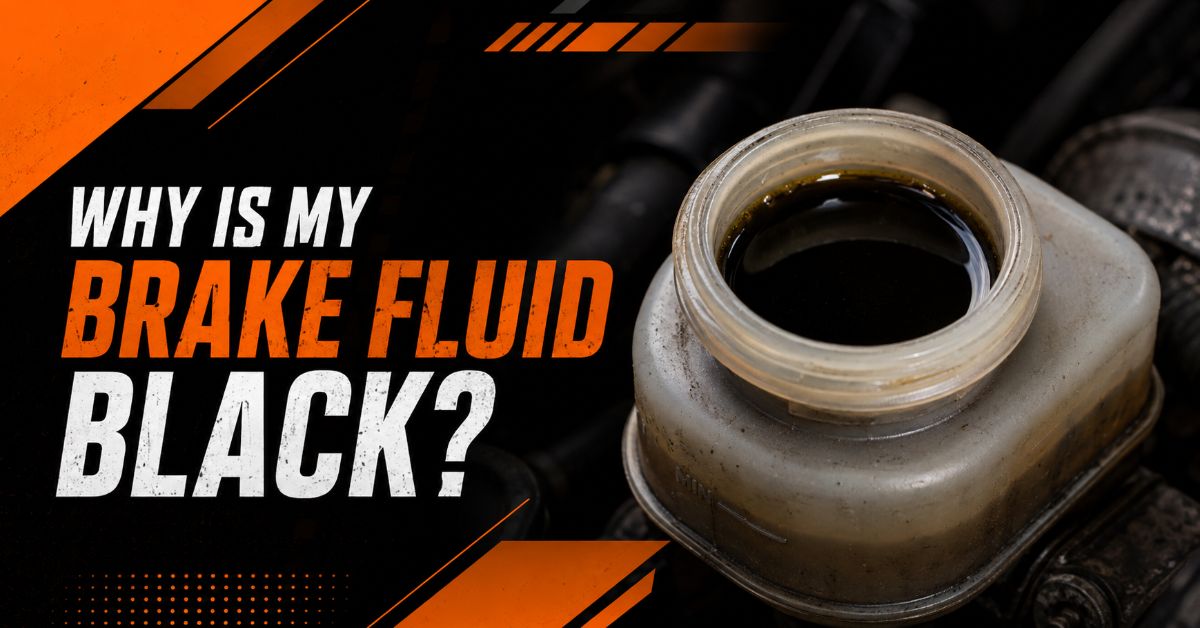
Brake fluid turns black primarily because it has absorbed atmospheric moisture, dissolved microscopic rubber from degrading brake lines, and oxidized copper brazing within metal lines. This darkening signals chemical degradation, reducing the fluid’s boiling point and exposing critical braking components to internal corrosion and potential vapor lock failure.
At a Glance
- Primary Causes: Atmospheric moisture saturation, rubber seal wear, and internal copper line corrosion.
- Safety Risk: Black fluid lowers boiling points, risking sudden pedal fade under heavy braking.
- Key Threshold: Fluid with $\ge 3\%$ water content or $>200\text{ ppm}$ copper requires an immediate full system flush.
- Common Trap: A clear appearance does not guarantee safety; clear fluid can still harbor dangerous moisture levels.
- Manual Vehicles: Shared brake/clutch reservoirs darken much faster due to clutch lining wear debris.
What Does Healthy Brake Fluid Look Like vs. Black Fluid?
Healthy brake fluid is virtually clear with a slight amber or yellow tint, resembling olive oil or white wine. As brake fluid ages, it transitions from light amber to dark brown, eventually turning opaque black as it accumulates moisture, metal particles, and dissolved rubber solids.
| Fluid Condition | Appearance | Primary Cause | System Status |
| New / Healthy | Clear or pale amber | Fresh glycol ether formulation | Safe; full heat resistance |
| Aged / Service Due | Light brown / Tea color | Normal thermal cycles & minor moisture absorption | Schedule routine flush |
| Contaminated | Dark brown / Opaque | High moisture content ($>2\%$), early line oxidation | Flush recommended |
| Failed / Dangerous | Inky black / Sludgy | Rubber seal breakdown, $>200\text{ ppm}$ copper, $\ge 3\%$ water | Danger: Flush immediately |
What Causes Brake Fluid to Turn Black and Dirty?
Brake fluid turns black due to three distinct degradation processes operating simultaneously: hygroscopic moisture absorption, rubber breakdown, and internal metal line oxidation.
┌─────────────────────────────────────────────────────────┐
│                     Atmospheric Moisture                │
└──────────────────────────┬──────────────────────────────┘
                           │ (Enters via cap/micro-seals)
                           ▼
┌─────────────────────────────────────────────────────────┐
│              1. Hygroscopic Saturated Fluid             │
└──────────────────────────┬──────────────────────────────┘
                           │ (Corrosive environment formed)
                           ▼
┌──────────────────────────┴──────────────────────────────┐
│                                                         │
▼                                                         ▼
┌────────────────────────────────┐        ┌────────────────────────────────┐
│   2. Rubber Hose Degradation   │        │     3. Copper Line Oxidation   │
│  (Microscopic black particles) │        │   (Stripped anti-corrosion)   │
└────────────────┬───────────────┘        └────────────────┬───────────────┘
                 │                                         │
                 └──────────────────┬──────────────────────┘
                                    │
                                    ▼
                     ┌──────────────────────────────┐
                     │ Opaque Black Sludge In Lines │
                     └──────────────────────────────┘
1. Hygroscopic Moisture Saturation
Standard glycol-based fluids (DOT 3 and DOT 4) are hygroscopic, meaning they naturally pull moisture out of the air through microscopic pores in rubber hoses and reservoir caps. As water mixes into the fluid, thermal degradation accelerates, darkening the mixture.
2. Microscopic Rubber Decomposition
High hydraulic pressures (often exceeding $1,000\text{ PSI}$) and extreme temperatures cause the inner lining of rubber brake hoses, caliper piston seals, and master cylinder cups to degrade. Microscopic carbon-black particles shed off these rubber parts, turning the fluid into a dark sludge.
3. Copper Line Oxidation
Metal brake lines are lined with copper brazing. Anti-corrosion additives in fresh brake fluid protect this copper. Once those additives break down, the acidic, wet fluid dissolves the copper brazing, releasing metal ions into the system that react with degraded rubber to darken the fluid.
Is Black Brake Fluid Dangerous to Drive On?
Black brake fluid is dangerous because its dark color indicates high moisture levels and thermal breakdown, which drastically lowers the fluid’s boiling point. Under hard braking conditions, wet, dirty fluid can boil into compressible gas bubbles, causing the brake pedal to sink completely to the floorboard without stopping the vehicle.
       HIGH BOILING POINT (Fresh Fluid ~401°F / 205°C)
  [  Hydraulic Fluid  ]  ---> [ Incompressible ] ---> Instant Stopping Power

───────────────────────────────────────────────────────────────────────────

       LOW BOILING POINT (Dirty/Wet Fluid <284°F / 140°C)
  [  Boiling Gas Bubbles  ] ---> [ Compressible ] ---> Pedal Hits Floor (Vapor Lock)
The primary risk metrics for degraded brake fluid include:
- Boiling Point Drop: Fresh DOT 3 fluid boils near $401^\circ\text{F}\ (205^\circ\text{C})$. At $3\%$ water contamination (“wet boiling point”), that threshold drops to $284^\circ\text{F}\ (140^\circ\text{C})$. Heavy mountain driving or rapid stops easily exceed $300^\circ\text{F}\ (149^\circ\text{C})$ at the wheel calipers.
- Corrosion Thresholds: Fluid with over $200\text{ ppm}$ of dissolved copper corrodes ABS valves and caliper pistons, causing expensive component failures long before total hydraulic loss occurs.
- The “Pedal Feels Fine” Fallacy: Black fluid operates normally during low-speed, light braking. Its failure mode is sudden: the pedal goes soft only when high temperatures cause vapor lock during emergency stops.
How Can I Test My Brake Fluid at Home?
You can test brake fluid at home using electronic moisture probes or chemical copper test strips to measure internal contamination levels beyond visual inspection.
                  ┌───────────────────────────────┐
                  │   Testing Method Selection    │
                  └───────────────┬───────────────┘
                                  │
         ┌────────────────────────┴────────────────────────┐
         ▼                                                 ▼
┌─────────────────────────────────┐       ┌─────────────────────────────────┐
│      Chemical Test Strips       │       │    Electronic Moisture Pen      │
└────────────────┬────────────────┘       └────────────────┬────────────────┘
                 │                                         │
  • Measures: Copper ppm (<50 safe)        • Measures: Water % (<2% safe)
  • Best for: Corrosion testing            • Best for: Boiling point check
  • Time: 60 seconds                       • Time: Instant digital readout
- Chemical Test Strips: Dip an automotive test strip into the master cylinder reservoir for one second. After 60 seconds, compare the strip color to the manufacturer’s chart. A reading above $30\text{ ppm}$ indicates worn additives, while a reading over $200\text{ ppm}$ requires an immediate flush.
- Electronic Digital Testers: Insert the metal prongs of a digital brake fluid pen into the reservoir. The device sends a small electrical current between the prongs to calculate conductivity, displaying the exact moisture percentage ($1\%-2\%$ is safe; $\ge 3\%$ requires replacement).
- The Reservoir Sampling Test: Draw fluid from the reservoir using a clean syringe or turkey baster. Dispense it onto a clean white paper towel. If the fluid runs clear amber on the towel, dark staining inside the plastic reservoir walls may be giving a false impression of dirty fluid.
Why Is My Brake Fluid Black After a Recent Flush?
Brake fluid turns black shortly after a flush if old, contaminated fluid was left inside the caliper lines, clutch slave cylinder, or ABS hydraulic unit during service.
If a technician performs a simple “turkey baster flush” (siphoning and refilling only the master cylinder) or fails to actuate the ABS valves during a fluid bleed, dirty fluid trapped deep in the brake lines immediately mixes back into the fresh fluid once the vehicle is driven.
Why Is My Brake Fluid Turning Black So Quickly in a Manual Car?
Brake fluid turns black rapidly in manual vehicles because many models share a single fluid reservoir between the brake master cylinder and the clutch master cylinder.
Clutch systems undergo hundreds of actuations per drive, generating high heat, friction wear, and rubber seal debris at a much faster rate than the brake system. This clutch wear debris flows directly into the shared reservoir, darkening the fluid within months without indicating a failure in the wheel brakes.
Is Clear Brake Fluid Always Safe to Use?
Clear brake fluid is not inherently safe because glycol fluid can absorb critical amounts of water ($>3\%$) while retaining its clear or light amber color. Moisture content cannot be detected visually; fluid that appears completely clean can still boil prematurely under heat, making chemical testing or time-based service intervals necessary for accurate evaluation.
Can You Just Siphon Out Black Brake Fluid and Top It Off?
Siphoning black fluid from the reservoir and topping it off is ineffective because it leaves contaminated fluid trapped down in the brake lines and calipers where heat and pressure are highest.
  [ Master Cylinder Reservoir ]  <--- Siphoning only cleans this top layer
               │
               │ (Old black fluid remains trapped in lines)
               ▼
  [ ABS Module & Metal Lines ]  <--- Contains high moisture & copper levels
               │
               ▼
   [ Calipers & Wheel Cylinders ] <--- Extreme heat zone (where vapor lock occurs)
Top-down replacement improves reservoir appearance but fails to eliminate low-boiling-point fluid or corrosive copper particles sitting near the wheel brakes. To fully remove contaminated fluid, the entire system must be pressure-bled or manually bled at all four wheel calipers.
How Often Should You Replace Brake Fluid to Prevent Contamination?
Brake fluid should be replaced every 2 years or 30,000 miles, whichever comes first, to prevent high moisture levels and copper buildup.
- Time Limit: 2 Years / 24 Months (Moisture enters regardless of mileage driven).
- Mileage Limit: 30,000–40,000 Miles (Thermal cycling breaks down corrosion inhibitors).
- Testing Triggers: Water content $\ge 3\%$ or copper concentration $>200\text{ ppm}$.
How Much Does a Full Brake Fluid Flush Cost?
A professional brake fluid flush typically costs between $100 and $220, depending on vehicle make, labor rates, and shop procedures.
- Standard Hydraulic Flush: $100 – $150 (Manual or pressure flush of all four brake lines).
- ABS Module System Flush: $150 – $220 (Requires scan-tool activation to cycle internal ABS valves).
- DIY Cost: $25 – $45 (Covers $2-3$ cans of high-grade DOT 3 or DOT 4 fluid and a basic bleeder kit).
How Do You Flush Black Brake Fluid Out of the Braking System?
Flushing black brake fluid requires pushing fresh fluid through the entire hydraulic line network until clean, bubble-free fluid exits every bleeder valve.
1.Extract Master Cylinder Fluid:Prevent old sludge from circulating down into the lines.
Remove the master cylinder cap and use a clean fluid syringe to draw out old, black fluid from the reservoir. Refill the reservoir to the MAX line with fresh, unopened DOT-approved brake fluid.
2.Prepare the Bleeder Valves:Work from furthest to closest wheel relative to the master cylinder.
Elevate the vehicle securely on jack stands. Start at the wheel furthest from the master cylinder (typically rear-passenger). Attach a clear plastic hose over the caliper bleeder valve and submerge the opposite end in a container partially filled with clean brake fluid.
3.Flush Hydraulic Lines:Requires a pressure bleeder or an assistant pumping the pedal.
Open the bleeder valve slightly. Have an assistant depress the brake pedal smoothly to the floor and hold it, or apply $10-15\text{ PSI}$ using a pressure bleeder. Close the valve before releasing the pedal. Repeat this process until the fluid running through the clear tube is clear amber with no air bubbles.
4.Repeat Across All Wheels and Check Fluid Levels:Never allow the master cylinder to run dry during service.
Repeat the flushing process at the remaining wheels in sequence (typically: Rear-Right, Rear-Left, Front-Right, Front-Left). Periodically check and top off the master cylinder reservoir with clean fluid to prevent air from entering the system.
The Bottom Line
Black brake fluid indicates moisture contamination, degraded rubber seals, and internal copper corrosion that compromise braking safety. While dark fluid lowers boiling thresholds and increases vapor lock risk, clear fluid can also harbor hidden moisture, making test-strip evaluations essential. To ensure system reliability and protect ABS components, perform a full system flush at all four calipers every two years or 30,000 miles.