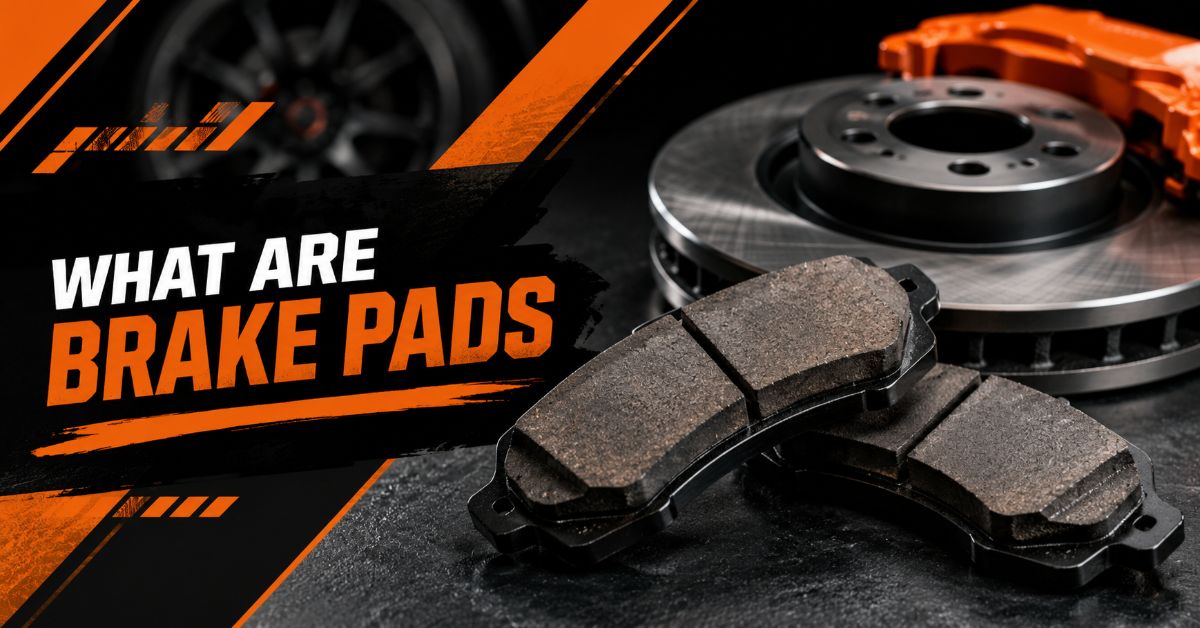
Brake pads are the removable friction components in a vehicle’s disc brake system, consisting of a steel backing plate bonded to a thick layer of high-friction material. When the driver depresses the brake pedal, the brake caliper clamps two opposing pads against the spinning metal rotor, converting kinetic energy into thermal energy to slow or stop the vehicle.
At a Glance:
- New Pad Thickness: Brand-new friction material measures 10 mm to 12 mm thick.
- Replacement Threshold: Pads must be replaced at 3 mm, and are legally unsafe below 1.5 mm.
- Average Lifespan: A set of standard brake pads lasts between 30,000 and 70,000 miles (48,000 to 112,000 km).
- Primary Formulations: Available in Organic (NAO), Semi-Metallic, and Ceramic compounds.
- Coefficient of Friction: Typical consumer brake pads operate at a coefficient of friction ($\mu$) between 0.35 and 0.45.
How Do Brake Pads Stop a Vehicle?
Brake pads slow a vehicle by pressing directly against both sides of a rotating brake rotor to generate mechanical friction. Pushing the brake pedal pressurizes hydraulic fluid inside the brake lines, forcing the caliper piston forward. This action clamps the brake pads tightly onto the spinning metal disc attached to the wheel, transforming kinetic energy into intense frictional heat and bringing the vehicle to a controlled stop.
During a routine stop, friction forces surface temperatures on the pad to rise between 150°C and 350°C (300°F to 660°F). Under severe driving conditions like heavy-duty towing or track driving, temperatures can exceed 550°C (1,000°F).
How Thick Are Brake Pads and When Should They Be Replaced?
Brand-new passenger car brake pads typically feature 10 mm to 12 mm (0.39 to 0.47 inches) of friction material, excluding the metal backing plate. The universal industry threshold for a strongly recommended brake pad replacement is 3 mm (0.11 inches), which is the depth where built-in mechanical wear indicators (metal squealers) or electronic sensors trigger alerts.
+-------------------------------------------------------------+
| 10 mm - 12 mm  | Brand New Friction Thickness               |
| 3.0 mm         | Recommended Replacement Threshold          |
| 1.5 mm - 1.6 mm| Absolute Legal Minimum (Hazardous / Failed)|
+-------------------------------------------------------------+
Operating brake pads below the 1.5 mm (0.06 inch) legal minimum risk catastrophic failure. At this depth, the remaining friction layer can sheer off the steel backing plate entirely, resulting in direct metal-on-metal rotor damage, sudden hydraulic fluid overheating, and severe loss of stopping force.
How Long Do Brake Pads Last on Average?
A standard set of automotive brake pads lasts between 30,000 and 70,000 miles (48,000 to 112,000 km) under normal operating conditions. Exact lifespan depends heavily on driving environment, vehicle weight, caliper maintenance, and friction material compound.
| Driving Environment / Style | Typical Expected Lifespan | Primary Wear Factors |
| City Stop-and-Go Driving | 25,000 – 35,000 miles | Frequent thermal cycles, low airflow cooling |
| Highway / Commuter | 60,000 – 80,000 miles | Sustained speeds, minimal friction engagement |
| Heavy Towing / Hauling | 15,000 – 25,000 miles | High thermal mass, accelerated abrasive wear |
What Are the Main Types of Brake Pad Materials?
Brake pads are manufactured using three primary friction material formulations: Organic (NAO), Semi-Metallic, and Ceramic. Each formulation uses distinct raw elements to balance friction performance, operating noise, rotor degradation, and dust output.
| Feature / Metric | Organic (NAO) | Semi-Metallic | Ceramic |
| Primary Base Material | Rubber, glass, Kevlar, resin | 30%–70% steel, iron, copper | Ceramic fibers, non-ferrous filler |
| Friction Level ($\mu$) | Low–Moderate (~0.30–0.35) | High (~0.38–0.45) | Moderate–High (~0.36–0.42) |
| Thermal Ceiling | Low (~300°C / 570°F) | Very High (~650°C+ / 1200°F) | High (~500°C / 930°F) |
| Rotor Wear Level | Very Low (sacrificial pad) | High (abrasive on discs) | Low (gentle polishing action) |
| Noise & Dust Output | Quiet / Dark heavy dust | Squeals easily / Dark metallic dust | Silent / Light-colored dust |
Organic (Non-Asbestos Organic)
Non-Asbestos Organic pads rely on soft materials bound by temperature-resistant resins. They offer smooth, quiet braking for light commuters, but degrade quickly under high heat.
Semi-Metallic
Semi-Metallic pads contain 30% to 70% iron, steel, and alloy fibers by weight. They offer high structural rigidity, excellent heat dissipation, and resistance to thermal fade, making them ideal for heavy loads and performance applications.
Ceramic
Ceramic pads combine dense ceramic compounds with fine copper or non-ferrous filaments. They provide quiet operation, stable friction across standard temperature ranges, and minimal light-colored dust.
How Do You Choose the Right Brake Pad Material for Your Vehicle?
Select your brake pad material based on your vehicle type, operating weight, and climate conditions rather than price or brand popularity alone. Premium materials like ceramic do not offer superior performance in all scenarios.
       [What is your primary driving priority?]
                         |
        +----------------+----------------+
        |                                 |
 [Maximum Towing & Heat]       [Quiet & Clean Wheels]
        |                                 |
  Choose: SEMI-METALLIC           Choose: CERAMIC
  (High friction grip,           (Low dust, low noise,
   handles heavy thermal load)    gentle on rotors)
- Select Ceramic Pads for daily commuters, luxury sedans, and passenger SUVs operating in standard weather where noise reduction and clean wheels are primary requirements.
- Select Semi-Metallic Pads for trucks, commercial vans, vehicles used for heavy towing, or track driving. Ceramic pads lack the initial “cold bite” and heat absorption required to stop heavy loads safely in extreme cold (-15°C / 0°F) or under heavy downhill strain.
- Select Organic Pads for budget-focused replacements on light, low-mileage compact cars.
Why Do Inner Brake Pads Wear Out Faster Than Outer Pads?
Inner brake pads wear out 1 mm to 3 mm faster than outer pads because single-piston floating calipers—found on roughly 80% of consumer vehicles—apply hydraulic force directly against the inner pad first. The piston presses the inboard pad against the rotor surface before the floating caliper pulls the outboard pad into contact.
           [ SINGLE-PISTON FLOATING CALIPER ]

              Hydraulic Piston Force
                     =====>
 [ Caliper Body ] -> [ Inner Pad ] | ROTOR | [ Outer Pad ]
                           ^
             (Receives initial contact & heat)
If the caliper slide pins lack grease or become corroded, the caliper fails to slide smoothly across its mounting bracket. This pins the inboard pad against the spinning rotor continuously, causing rapid unilateral pad destruction. Visual checks through wheel spokes only inspect the outer pad, creating a dangerous blind spot during routine maintenance.
What Is Brake Pad Glazing and How Does It Cause Failure?
Brake pad glazing is a destructive condition where the friction material’s binding resins melt under excessive heat, surface-crystallize, and harden into a smooth, glassy finish. Glazed brake pads maintain their original thickness, but lose their ability to generate friction against the rotor disc.
Glazing occurs when a driver rides the brakes continuously down long mountain declines or drives with a sticking caliper piston. The friction layer hardens to a point where even maximum foot pressure on the brake pedal results in severe pedal stiffness, poor stopping distances, and burning chemical odors. Glazed pads must be removed and sanded down or completely replaced.
What Happens If Directional or Asymmetrical Brake Pads Are Installed Incorrectly?
Installing directional or asymmetrical brake pads backward or on the wrong side of the vehicle causes extreme brake chatter, uneven wear patterns, localized thermal pockets, and screeching noises. Directional pads feature specific curved chamfers, offset crescent cutouts, or wear-indicator clips designed for a specific rotation direction.
    [ CORRECT ROTATION ]              [ INCORRECT ROTATION ]

      Rotor Motion                      Rotor Motion
          ||                                ||
          \/                                \/
    +------------+                    +------------+
    | \ Chamfer  |                    |   Flat     |  <-- Catches edge
    |  Friction  |                    |  Friction  |      Vibrates &
    |   Surface  |                    |   Surface  |      creates heat
    +------------+                    +------------+
When installed in reverse, the leading edge of the pad catches the spinning rotor face rather than sweeping over it smoothly. This improper engagement damages the rotor surface, creates intense high-frequency harmonics, and reduces total contact surface area.
Why Do Brand-New Brake Pads Squeak?
Brand-new brake pads squeak primarily due to high-frequency harmonic vibrations occurring between the steel backing plate and the caliper body, rather than issues with the friction face itself. As the pad clamps against the rotor, micro-vibrations oscillate through the mounting hardware, producing an audible high-pitched squeal.
To stop new brake pad squeaking, apply a thin coating of high-temperature synthetic silicone grease or rubberized anti-seize compound strictly to the back of the steel plate and slide pin contact points—never on the friction face. Squeaking can also occur if the pad’s anti-rattle shims are misaligned or if directional chamfers face the wrong way during installation.
Can You Replace Brake Pads Without Replacing the Rotors?
You can replace brake pads without replacing rotors—a practice known as a “pad slap”—only if the existing rotors meet minimum thickness specifications and are completely free of deep grooves, heat cracks, or thickness variations.
  [ Ideal Rotor Surface ]             [ Grooved / Worn Rotor ]
  =======================             =======================
  |   New Flat Pad      |             |   New Flat Pad      |
  =======================             =======================
  -----------------------             ~~~~~^~~~~~~~^~~~~~~~~~
  |   Smooth Rotor      |             |  Ridges Contact First|
  -----------------------             -----------------------
   100% Surface Contact                <50% Surface Contact
If you install flat brake pads onto grooved rotors, the new pad material contacts only the raised ridges of the damaged disc. This reduces active friction surface area by up to 50%, resulting in a soft brake pedal, increased stopping distances, and rapid uneven pad wear until the friction face grinds down to match the damaged rotor’s contours.
How Do You Bed In New Brake Pads Properly?
Bedding in brake pads is a controlled heat cycle process that transfers an even, microscopic layer of pad material onto the bare steel rotor face. Proper bedding prevents brake pedal pulsation and optimizes stopping grip.
1.Accelerate to 45 mph and decelerate hard:Perform 4 to 5 times in rapid succession.
Drive the vehicle up to 45 mph (72 km/h) and apply firm pressure to slow down rapidly to 10 mph (16 km/h). Do not come to a complete stop during these runs.
2.Accelerate to 60 mph and perform hard stops:Perform 3 to 4 times with higher energy input.
Increase vehicle speed to 60 mph (96 km/h) and brake aggressively down to 15 mph (24 km/h), engaging the thermal transfer layer without triggering ABS.
3.Cool down the braking system:Crucial phase: avoid holding the brake pedal down while stopped.
Drive for 5 to 10 minutes at highway speed with minimal brake use to allow airflow to cool the pads and rotors evenly. Do not set the parking brake while components are hot.
Why Does a Car Pull to One Side Only When Braking?
A vehicle pulling to one side during braking indicates uneven braking force across an axle, usually caused by a stuck caliper slide pin, a frozen hydraulic piston, or oil contamination on one set of pads.
       [ VEHICLE AXLE ]
   Left Wheel           Right Wheel
 [ Stuck Caliper ]    [ Normal Caliper ]
   Zero Braking         Full Friction
         \                   /
          \                 /
   Vehicle pulls hard to the RIGHT
If a front-left caliper piston freezes, only the front-right brake clamps onto its rotor when you press the pedal. This creates asymmetrical stopping force that pulls the vehicle’s steering geometry toward the working side. In inspecting the axle, the working side will often show heavy wear, while the frozen side remains untouched.
Why Are Copper Brake Pads Being Environmental Banned?
Copper in brake pads is restricted under state regulations—such as California’s SB 346 and Washington’s ECEB 6557 laws—which mandate that brake friction materials contain less than 0.5% copper by weight.
When drivers apply their brakes, microscopic particles of copper dust wear off the pads and collect on roadways. Rain flushes this toxic dust into watershed networks, streams, and marine environments. Dissolved copper is toxic to aquatic ecosystems, impairing the sensory systems and survival rates of salmon and other marine organisms. Modern formulations use synthetic graphite, Kevlar, and engineered ceramics to replace copper.
What Is ECE R90 Approval for Brake Pads?
ECE R90 is a mandatory European safety standard requiring all replacement brake pads and shoes to perform within $\pm15\%$ of Original Equipment (OE) parts across high-speed stopping, thermal fade, and cold friction tests.
              [ FRICTION PERFORMANCE SPECTRUM ]

    -15% Baseline                 OE Standard               +15% Baseline
  |<------ [ Permitted ECE R90 Compliance Zone ] ------->|

  [ Unregulated US Aftermarket ] -------------------------> (High Variance Risk)
In contrast to Europe, the United States market does not require mandatory baseline friction testing for general aftermarket brake pads. Consequently, uncertified budget pads sold in non-regulated markets can deviate significantly from factory performance, increasing stopping distances and altering pedal feel under heavy load.
The Bottom Line
Brake pads are safety-critical friction components that require replacement long before they wear down to their backing plates. For optimal driving safety and value, replace pads when they reach 3 mm in thickness, choose Semi-Metallic pads for heavy towing or Ceramic pads for quiet daily commuting, and always bed in new pads to ensure long-lasting performance.