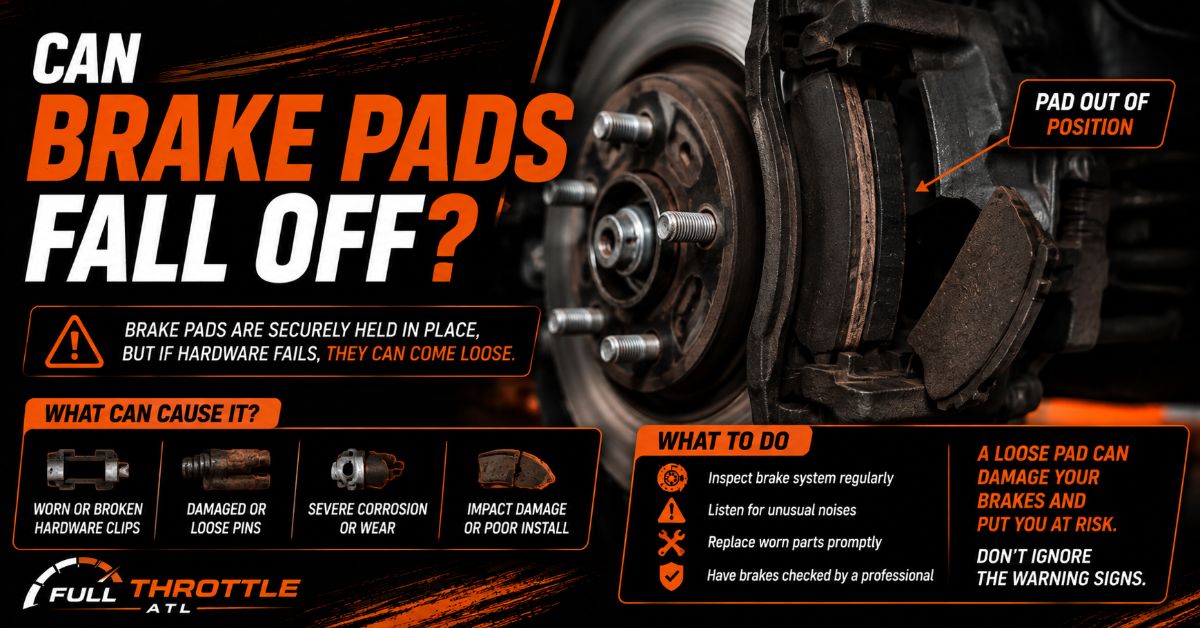
Brake pads can physically fall off a vehicle, but it is an extreme mechanical failure caused by severe wear neglect, mechanical delamination, or improper caliper installation. Under normal conditions, the brake caliper bracket securely traps the friction pad against the rotor, preventing it from escaping the braking assembly.
At a Glance: Key Brake Pad Drop-Out Facts
- Drop-Out Threshold: A brake pad can slip out when total friction material reaches 0 mm and the steel backing plate wears under 2 mm.
- Caliper Gap Tolerance: The physical clearance between a fully extended caliper piston and rotor face typically ranges from 4 mm to 6 mm.
- Primary Culprit: Severe mechanical neglect combined with rotor thinning creates the clearance necessary for pad ejection.
- Sudden Risk: Rust jacked pads or chemical bond failures can cause complete friction delamination instantly without prior grinding noise.
- Hydraulic Danger: A lost pad allows the caliper piston to over-extend, risking hydraulic fluid loss and complete brake failure.
What Is the Critical Wear Limit Before a Brake Pad Falls Out?
A brake pad reaches its critical drop-out point when the total thickness of the backing plate and friction material drops below the physical gap of the caliper bracket—typically 4 mm to 6 mm. Standard brake pads begin at 10 mm to 12 mm of friction material attached to a 5 mm steel backing plate.
| Component State | Friction Material Thickness | Backing Plate Thickness | Total Assembly Thickness | Safety Status |
| New Pad | 10 mm – 12 mm | 5 mm | 15 mm – 17 mm | Safe |
| Recommended Replacement | 3 mm | 5 mm | 8 mm | Maintenance Required |
| Wear Indicator Warning | 2 mm | 5 mm | 7 mm | Immediate Service |
| Critical Drop-Out Zone | 0 mm | < 2 mm | < 2 mm | Catastrophic Failure Risk |
When a vehicle owner ignores the 2 mm squeal pin warning, metal-on-metal grinding rapidly shaves down both the pad’s steel plate and the brake rotor. Once grinding reduces the combined plate and rotor profile below the 4 mm clearance threshold, hard braking torque forces the remaining slice of metal out of the bracket channel.
How Does Brake Rotor Thinning Accelerate Pad Loss?
Brake rotor thinning widens the physical escape gap inside the caliper assembly, allowing thin backing plates to slip out prematurely. Standard rotors feature a total wear tolerance of roughly 2 mm to 3 mm before reaching their designated discard thickness.
When metal-on-metal contact occurs, an unserviced backing plate acts as a lathe tool, shaving an additional 3 mm to 5 mm off the rotor face. This structural degradation expands the physical clearance between the caliper housing and the rotor wall. Consequently, even a partially intact backing plate can shift diagonally and slip through the expanded opening during high-stress stopping maneuvers.
Can Missing Caliper Clips or Hardware Cause a Pad to Fall Off?
Missing anti-rattle clips, guide pins, or abutment shims can cause a brake pad to shift, bind, and eject from the bracket during operation. Modern disc brake calipers rely on precise retention hardware to keep friction pads parallel to the rotor face.
If an installer omits abutment clips or reuses worn retention springs, the pad loses lateral stability. Vibrations cause the unsecured pad to cock diagonally inside the bracket channel. Under rotational wheel torque, the binding forces push the misaligned pad completely out of its slide track.
What Is Friction Delamination and How Does It Cause Instant Pad Loss?
Brake pad delamination is the structural failure of the adhesive or mechanical bond securing the friction material to its steel backing plate. When delamination occurs, the entire block of friction material shears off in one piece, instantly reducing pad thickness by up to 12 mm.
[ Normal Assembly ]      --> [ Delamination Event ]    --> [ Extended Gap Failure ]
Adhesive / Hook Matrix        Friction Block Shears Off     Backing Plate Slips Out
(Friction + Backing Plate)    (10-12mm Lost Instantly)      Through Caliper Clearance
Delamination stems primarily from “rust jacking”—a process where severe moisture and road salt corrode the steel plate beneath the friction material. As rust expands, it lifts the adhesive bond away from the metal base. Unlike gradual wear, delamination occurs instantly without warning, leaving an oversized gap that allows the remaining steel plate to drop out on the next brake application.
Can Installing the Wrong Brake Pad Model Cause It to Slip Out?
Installing incorrect brake pads engineered for different trim levels or vehicle model years creates internal fitment slack that allows the pad to drop out under stress. Dimensional variances as small as 1.5 mm in mounting tab width prevent proper lock-in within the caliper bracket channels.
Loose-fitting pads slide out of alignment during braking events. The resulting clearance lets the pad body twist horizontally inside the bracket, sliding free from the guide slots when the caliper piston relaxes.
Why Can an Outer Brake Pad Fall Off When Brake Pedal Feel Seems Normal?
An outer brake pad can wear through completely and drop out without altering brake pedal feel if the caliper slider pins are seized. Seized guide pins prevent the floating caliper housing from sliding, forcing the inner pad (driven by the hydraulic piston) to handle all stopping force while the outer pad drags continuously.
Because hydraulic pressure acts directly on the inner pad, the driver feels a firm pedal and adequate stopping power. Meanwhile, continuous friction destroys the outer pad material at double the normal rate. The driver receives no hydraulic warning—such as a soft or low pedal—until the outer pad wears thin enough to drop out completely.
What Happens Immediately When a Brake Pad Falls Off While Driving?
When a brake pad falls off, you will hear a loud mechanical clunk, followed by immediate brake pedal sinking and violent metal-on-metal grinding. The vehicle will pull hard toward the side with intact brakes due to asymmetric stopping force.
Brake Pad Ejection
  └── Caliper Piston Over-Extends
        └── Hydraulic Boot Seals Tear
              └── Loss of Brake Fluid Pressure
                    └── Total Hydraulic System Failure
The primary hazard is hydraulic decompensation. Without the thickness of the pad assembly, the caliper piston must extend far beyond its design stroke to reach the rotor face. This over-extension often tears the piston’s internal rubber dust boot and pressure seal, dumping brake fluid into the wheel well and causing total hydraulic system pressure loss.
Can a Lost Brake Pad Cause Complete Brake Failure and Crashes?
A lost brake pad can cause total hydraulic brake failure, drastically increasing stopping distances and collision risk. Beyond losing 25% to 50% of direct friction stopping power on the affected axle, a popped caliper piston releases hydraulic pressure across the entire brake circuit.
Modern split-circuit hydraulic master cylinders provide a safety reserve if one line fails, but emergency stopping power drops significantly. The sudden loss of pedal resistance combined with directional pulling forces makes directional vehicle control difficult at highway speeds.
Why Do Modern Luxury Car Cabins Increase the Risk of Pad Loss?
Modern luxury vehicles utilize heavy acoustic dampening glass, active noise-cancelling cabin technology, and insulated firewall bulkheads that mask early warning sounds of metal-on-metal brake wear. Acoustic indicators (wear tabs) produce a high-pitched 80 dB screech designed to penetrate standard cabin environments.
In heavily insulated cabins, drivers frequently miss these audible warnings. Consequently, severe pad wear progresses past the 2 mm threshold directly to structural disintegration and pad loss without the driver detecting the issue through sound alone.
What Should You Do If a Brake Pad Falls Off While Driving?
If a brake pad falls off while driving, stay calm and execute emergency stopping maneuvers to bring the vehicle to a controlled stop off the roadway.
1.Do Not Panic Pump the Brakes:Avoid pumping if pedal drops to the floor.
Pumping an over-extended caliper piston forces remaining fluid out through torn seals, accelerating system hydraulic failure. Apply steady, moderate pressure to utilize any remaining circuit pressure.
2.Engage the Mechanical Emergency Brake:Gradually apply the parking brake.
Pull or engage the mechanical parking brake steadily. Do not jerk the lever, as locking the rear wheels at speed can cause a spin.
3.Shift to a Lower Gear:Use engine braking to slow down.
Downshift the transmission manually into lower gears to let engine compression slow the vehicle’s momentum down to a manageable speed.
4.Steer Out of Traffic safely:Move to the shoulder or emergency lane.
Guide the vehicle toward a safe stopping zone, turn on emergency hazard lights, and bring the car to a full stop. Do not attempt to drive the vehicle further.
How Do You Prevent Brake Pad Ejection Beyond Visual Inspections?
Preventing brake pad ejection requires precise physical measurement of pad lining thickness and complete hardware replacement during every brake service.
- Measure Both Pads with a Gauge: Use a manual offset brake lining gauge during every 5,000-to-7,000-mile tire rotation. Measure both inner and outer friction pads directly, as outer pads can wear down while inner pads retain visible lining.
- Replace Mounting Hardware Every Service: Always install new anti-rattle clips, abutment springs, and slide pins during pad replacement. Never reuse tired stainless steel clips that have lost tension.
- Service Caliper Slider Pins: Clean, inspect, and lubricate caliper slide pins using high-temperature silicone or ceramic brake grease to prevent single-sided pad dragging and asymmetric wear.
- Torque Hardware to Specs: Torque caliper bracket bolts and guide pins to OEM foot-pound specifications to prevent hardware back-out caused by road vibration.
How Do You Measure Inner and Outer Brake Pad Thickness Accurately?
Accurately measuring pad thickness requires inspecting both sides of the rotor face using specialized mechanical tools rather than relying on visual glances through wheel rims.
1.Lift the Vehicle and Remove the Wheel:Secure vehicle on jack stands.
Loosen lug nuts, safely elevate the vehicle on jack stands, and remove the wheel assembly to gain unimpeded access to the brake caliper body.
2.Locate the Caliper Inspection Window:Inspect through the caliper view slot.
Position a light source behind the caliper inspection port to view the friction material edge mounted against the rotor face.
3.Apply a Color-Coded Mechanical Gauge:Take explicit millimeter readings.
Insert an offset brake lining gauge blade directly between the steel backing plate and the rotor surface. Record the exact millimeter thickness for both the inner pad (piston side) and outer pad (body side).
4.Check for Asymmetrical Variance:Compare inner vs. outer pad measurements.
If the variance between inner and outer pad thickness exceeds 1.5 mm, remove the caliper assembly immediately to inspect for sticky slide pins or a sticking caliper piston.
The Bottom Line
Brake pads can fall off a vehicle, but only when extreme wear, rotor thinning, missing hardware, or adhesive delamination creates clearance greater than the caliper bracket’s 4 mm to 6 mm opening. Preventing pad loss requires measuring both inner and outer pad thickness using an offset gauge every 5,000 to 7,000 miles, rather than relying solely on brake pedal feel or cabin audio warnings. Replacing anti-rattle clips and servicing caliper slide pins at every pad change eliminates the alignment failures and uneven wear conditions that lead to sudden pad ejection.