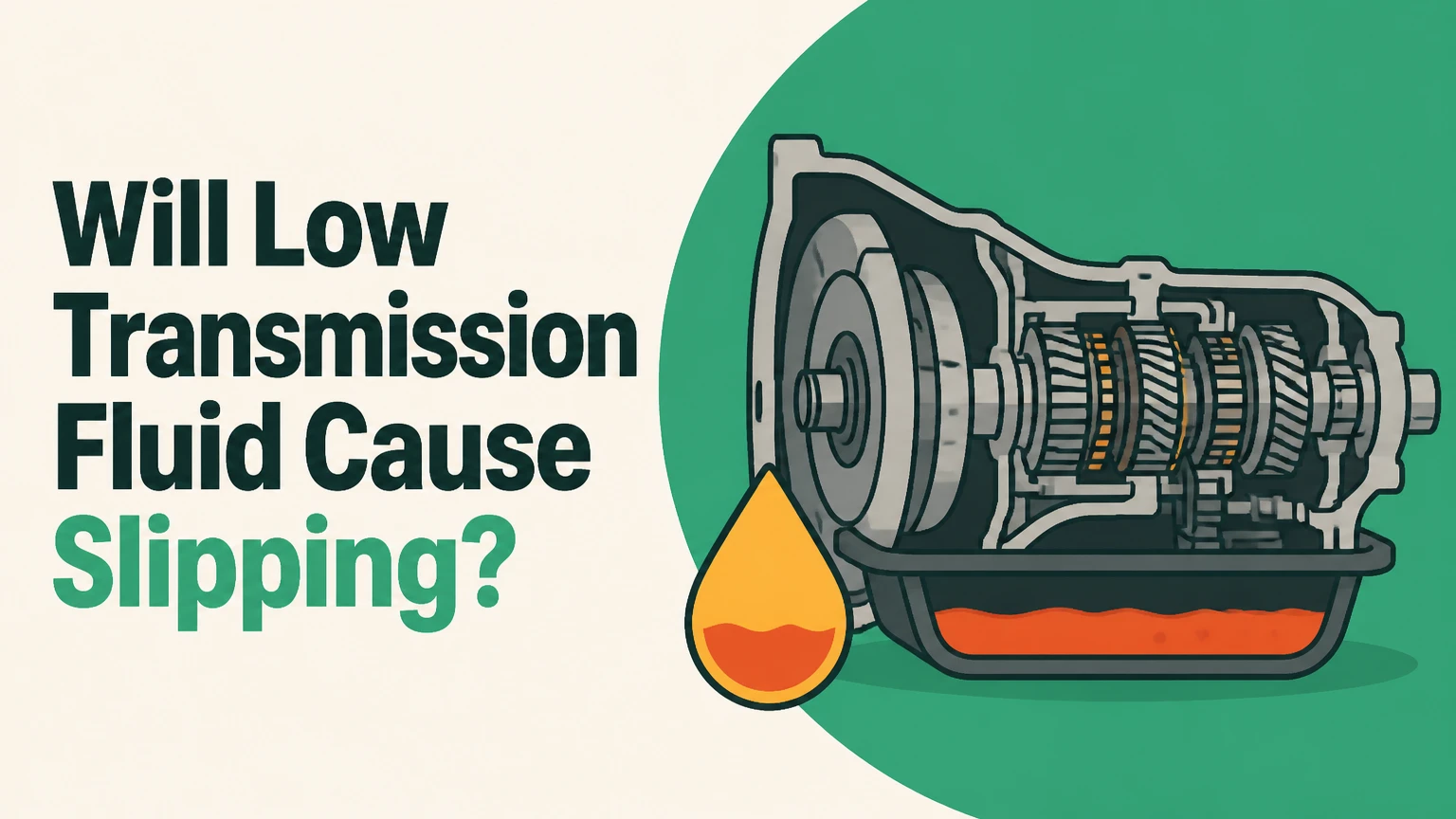
Yes, low transmission fluid directly causes transmission slipping. Automatic, CVT, and wet-dual-clutch transmissions rely on incompressible automatic transmission fluid (ATF) to generate hydraulic pressure. When fluid levels drop below operating thresholds, the hydraulic pump ingests air, causing pressure loss that prevents internal clutch packs, bands, and pulleys from fully clamping, allowing internal components to slide instead of lock.
Key Facts / At a Glance
- Root Cause: Low fluid introduces air into the hydraulic system, causing fluid aeration and line pressure drops below the required 60–300 PSI range.
- Primary Symptom: Engine RPM spikes (engine revs up) without a proportional increase in vehicle speed, often accompanied by delayed or harsh gear engagement.
- Thermal Risk: Operating a slipping transmission elevates fluid temperatures past $240^\circ\text{F}$ ($116^\circ\text{C}$), destroying friction lining materials in fewer than 10–20 miles.
- Diagnostic Clue: Fresh ATF is bright red/pink; dark brown or burnt-smelling fluid indicates permanent clutch friction material breakdown.
- Critical Distinction: Overfilling transmission fluid creates identical slipping symptoms due to fluid churning and aeration caused by the rotating assembly.
How Does Low Transmission Fluid Cause Slipping?
Automatic transmission fluid (ATF) serves four distinct roles simultaneously: it acts as a hydraulic fluid to engage clutches, a coolant to reject heat, a lubricant for planetary gears, and a friction modifier to manage smooth torque transfer.
When fluid volume drops below the minimum threshold, the primary hydraulic pump (gerotor or vane pump) draws a mix of fluid and air from the transmission pan. Liquid fluid is functionally incompressible, meaning when a control solenoid routes line pressure to a hydraulic piston, that pressure directly transfers force to clamp clutch friction plates together.
When air enters the circuit, it compresses under load. This compliance in the hydraulic system drops line pressure below the minimum force required to overcome clutch return springs and dynamic torque loads. The clutch plates—which consist of steel plates alternating with friction material plates bound by paper-graphite-phenolic resins—lose their clamping force. Instead of achieving a 1:1 static lockup, they slide continuously against one another. This mechanical sliding under torque load is what drivers experience as “slipping.”
[Low Fluid Level in Pan]
       │
       ▼
[Fluid Pump Sucks Air + Fluid]
       │
       ▼
[Fluid Aeration & Foaming]
       │
       ▼
[Line Pressure Drops (<60 PSI)]
       │
       ▼
[Piston Clamping Force Fails]
       │
       ▼
[Clutch Plates / Bands Slide]
       │
       ▼
[Transmission Slipping / RPM Spike]
What Happens Inside the Transmission During a Hydraulic Pressure Drop?
The mechanical connection between your vehicle’s engine and wheels relies on precise pressure equations inside the transmission valve body and clutch drums.
The formula governing clutch plate torque capacity is:
$$T = \mu \cdot F \cdot r \cdot n$$
Where:
- $T$ = Torque capacity of the clutch pack
- $\mu$ = Dynamic coefficient of friction of the ATF and clutch material
- $F$ = Clamping force applied by the hydraulic piston ($F = \text{Pressure} \times \text{Piston Area}$)
- $r$ = Mean radius of the friction disk
- $n$ = Number of friction surfaces
When fluid volume drops, hydraulic line pressure ($P$) collapses. Because clamping force ($F$) is directly proportional to line pressure, dropping line pressure from an operational 150 PSI down to 30 PSI reduces the torque capacity ($T$) of that gear pack by 80%. If engine torque output exceeds the diminished torque capacity of the clutch pack, the friction plates break static friction, transitioning to dynamic sliding friction.
+-------------------------------------------------------------------------+
|                         CLUTCH PACK ASSEMBLY                            |
|                                                                         |
|   Pressure Plate        Friction Discs (Splined to Hub)                 |
|       │                      │   Steel Discs (Splined to Drum)          |
|       ▼                      ▼       ▼                                  |
|     |███|                  |░░░|   |███|                                |
|     |███|<══ HYDRAULIC ═══>|░░░|   |███|  <-- LOW PRESSURE              |
|     |███|   PISTON FORCE   |░░░|   |███|      CAUSES SLIDING            |
|     |███|  (Inadequate)    |░░░|   |███|      & INTENSE HEAT            |
|                                                                         |
+-------------------------------------------------------------------------+
This dynamic sliding generates immediate localized heating. At normal lockup, zero relative motion exists between adjacent friction and steel plates. Under slip conditions, energy is converted directly into thermal energy at the friction interface, spiking surface temperatures beyond $600^\circ\text{F}$ ($315^\circ\text{C}$) within seconds, scorching the fluid and glazing the friction plates.
How Do Different Transmission Types React to Low Fluid Levels?
Not all transmissions use fluid in the exact same manner. The failure modes and tolerance limits for low fluid vary significantly depending on the transmission architecture:
| Transmission Architecture | Fluid Functionality | Low Fluid Failure Mode | Time to Catastrophic Failure |
| Traditional Step-Automatic (Torque Converter + Planetary Gears) | Line pressure for clutch bands, torque multiplication, valve body control, cooling. | Hydraulic pressure loss at clutches and bands; torque converter fluid cavitation; shift flare between gears. | 10–50 Miles (Clutch friction material burns off completely down to bare steel backing). |
| Continuously Variable Transmission (CVT) | Extreme pressure (up to 800+ PSI) to clamp drive pulleys onto the steel belt. | Pulleys fail to clamp the steel belt or chain; belt slips along smooth pulley sheaves. | 1–5 Miles (Steel-on-steel slipping scores pulleys, requiring full assembly replacement). |
| Dual-Clutch Transmission (DCT – Wet Clutch) | Actuates shift forks and provides continuous oil bath cooling for twin clutch packs. | Inadequate cooling leads to rapid overheating; actuator pressure drops cause improper gear selection. | 5–20 Miles (Thermal warp of twin clutch packs, severe shift chatter, electronic safe-mode engagement). |
| Dual-Clutch Transmission (DCT – Dry Clutch) | Gearbox lubrication only (clutches are air-cooled dry plates driven by electric actuators). | Low gearbox oil causes gear-set wear, bearing noise, and thermal buildup, but does not directly cause clutch slip. | Hundreds of Miles (Bearing fatigue and synchro damage occur before actual slipping). |
What Are the Key Warning Signs of Low Transmission Fluid Slipping?
Transmission slipping rarely happens without accompanying secondary symptoms. Recognizing these early prevents total mechanical failure:
+-------------------------------------------------------------------------+
|                  SYMPTOM PROFILE OF LOW TRANSMISSION FLUID               |
+------------------------------------+------------------------------------+
| MECHANICAL & AUDITORY              | SENSORY & OPERATIONAL              |
+------------------------------------+------------------------------------+
| • High RPM with delayed acceleration| • Burning smell (sweet or acrid)   |
| • Whining or buzzing from pump     | • Transmission light or Check Engine|
| • Harsh engagement (clunking)      | • Fluid puddle under center vehicle|
| • Gear slipping under heavy load   | • Transmission shifting to Limp Mode|
+------------------------------------+------------------------------------+
1. Engine Revs Up Without Acceleration (Shift Flare)
When stepping on the accelerator pedal, the engine’s tachometer needle jumps up rapidly (e.g., rising from 2,000 RPM to 4,000 RPM), but vehicle speed climbs sluggishly or stays constant. This disconnect indicates that engine torque is turning into heat within the slipping transmission components rather than kinetic energy at the drive wheels.
2. Whining, Buzzing, or Cavitation Noise
A low fluid level forces the pump to draw air along with fluid. As air bubbles pass through the high-pressure pump gears, they collapse violently—a process called cavitation. This produces a distinct high-pitched whining or buzzing sound that increases in frequency with engine RPM.
3. Delayed Gear Engagement
When shifting from Park to Drive or Reverse, a healthy transmission engages in less than 1 second. When fluid is low, building enough hydraulic line pressure to move the shift engagement valves and compress the clutch piston takes longer, resulting in a 2- to 5-second delay followed by a harsh “thump” or “clunk” as the gear finally catches.
4. Burnt Acrid Odor and Color Shift
As slipping clutch plates generate extreme localized friction heat, the fluid thermal breakdown accelerates. Fresh fluid is translucent pink/red. Aerated, slipping fluid quickly degrades to dark brown or black and emits a pungent, burnt-toast odor.
Key Critical Metrics: Pressure, Temperature, and Fluid Life
Understanding the exact operational thresholds of automatic transmission fluid highlights why even a minor drop in fluid volume is so dangerous to internal components:
OPERATING TEMPERATURE VS. FLUID LIFE EXPECTANCY

 Temp (°F)    Fluid Life
   175°F   [===================================================] 100,000 Miles
   195°F   [==============================Ranked Ideal=========]  50,000 Miles
   220°F   [======================]                               25,000 Miles
   240°F   [===========]                                          10,000 Miles
   260°F   [====]                                                  5,000 Miles
   300°F+  [=] Destroys seals, varnishes valves, burns fluid       <100 Miles
- Standard Operating Pressure: Line pressure in automatic transmissions operates between 60 PSI (idle, low load) and 300+ PSI (full throttle, heavy load). Low fluid aerates the system and drops dynamic line pressure below 30 PSI, where clamping force fails.
- Ideal Operating Temperature: ATF is engineered to operate between $175^\circ\text{F}$ and $200^\circ\text{F}$ ($79^\circ\text{C}$ to $93^\circ\text{C}$).
- The Thermal Oxidation Rule: For every $20^\circ\text{F}$ ($11^\circ\text{C}$) rise in operating temperature above $175^\circ\text{F}$, the operational lifespan of the transmission fluid is reduced by 50%.
- Critical Heat Threshold: When slipping causes fluid temperatures to breach $240^\circ\text{F}$ ($116^\circ\text{C}$), rubber lip seals harden and crack, organic friction linings lose their bonding resins, and internal varnish deposits lock up fine-tolerance spool valves inside the valve body.
How Do You Accurately Diagnose Low Transmission Fluid Slipping?
Diagnosing transmission slipping requires a methodical approach to differentiate between a simple low-fluid state and permanent mechanical destruction.
1.Check Fluid Level (Dipstick or Fill Plug Method):
Determine whether your vehicle uses a traditional dipstick or a sealed overflow check plug system.
- For Dipstick Systems: Park on level ground, leave the engine running at idle in Park (or Neutral per manufacturer specification), and ensure the transmission is warm. Pull the dipstick, wipe it clean with a lint-free cloth, reinsert it fully, and pull it again. Fluid must register within the “Hot” crosshatched band.
- For “Sealed” Systems: Raise the vehicle level on jack stands or a lift. With the engine running at idle and fluid warm ($95^\circ\text{F}–122^\circ\text{F}$ / $35^\circ\text{C}–50^\circ\text{C}$ read via scanner), remove the bottom fill/check plug. If no fluid drips out, the level is low.
Success Check: Fluid level reaches the “Hot” indicator mark, or a light, steady trickle exits the check plug on sealed units.
2.Inspect Fluid Paper Blotter Condition:
Drip fluid from the dipstick onto a clean white paper towel to perform a blotter check.
- Bright Red / Pink: Healthy fluid. Level correction will likely fix slipping if no mechanical damage occurred.
- Light Brown / Dull Red: Aged fluid. Needs replacement and a leak check, but clutches may still be intact.
- Dark Brown / Black with Specks: Burnt fluid with suspended friction material debris. The transmission clutches have sustained permanent physical wear.
Common Mistake: Adding fresh fluid to black, heavily burnt ATF often causes total drive loss because the suspended friction particles in the old fluid were providing the remaining friction needed to move the car.
3.Scan for Diagnostic Trouble Codes (DTCs):
Plug an OBD-II scanner capable of reading Transmission Control Module (TCM) codes into the vehicle’s diagnostic port. Look for diagnostic codes indicating slip conditions or pressure failures:
- P0700: Transmission Control System Malfunction (General code requesting illumination of Check Engine Light).
- P0730: Incorrect Gear Ratio (General mechanical slip detected by comparing input/output speed sensors).
- P0731 through P0736: Gear $N$ Incorrect Ratio (Identifies the exact gear where clutch slipping is occurring).
- P0840 / P0841: Transmission Fluid Pressure Sensor/Switch Circuit.
Success Check: Documenting specific codes narrows down whether slipping is isolated to a single clutch pack (gear-specific) or systemic across all gears (low overall line pressure).
4.Inspect Vehicle Exterior for Hydraulic Leaks:
Automatic transmission fluid does not burn off through normal operation because it is a closed hydraulic circuit. If fluid is low, a leak is present. Inspect four key leak paths:
- Transmission Pan Gasket: Seepage along the lower pan perimeter.
- Axle / Drive Shaft Output Seals: Reddish oil slung along the undercarriage frame.
- Cooler Lines & Fittings: Wetness near the radiator/external transmission oil cooler.
- Torque Converter Bell Housing Seal: Droplets emerging from the seam between the engine block and transmission housing.
What Mistakes Turn a Low Fluid Fix Into a Total Rebuild?
Avoiding critical operational mistakes when handling low transmission fluid can save thousands of dollars in unnecessary repair costs:
┌─────────────────────────────────────────────────────────────────────────┐
│                     CRITICAL MISTAKES TO AVOID                          │
├───────────────────────────────────┬─────────────────────────────────────┤
│ MISTAKE                           │ CONSEQUENCE                         │
├───────────────────────────────────┼─────────────────────────────────────┤
│ 1. Driving while slipping         │ Strips friction linings to bare     │
│                                   │ steel plates within miles.          │
├───────────────────────────────────┼─────────────────────────────────────┤
│ 2. Overfilling the fluid          │ Rotating gears whip fluid into foam,│
│                                   │ causing identical low-pressure slip.│
├───────────────────────────────────┼─────────────────────────────────────┤
│ 3. Using wrong fluid specification│ Incompatible friction modifiers     │
│                                   │ trigger persistent clutch shudder.  │
├───────────────────────────────────┼─────────────────────────────────────┤
│ 4. Power-flushing a burnt unit    │ Flushes away necessary friction     │
│                                   │ particles, causing immediate failure│
└───────────────────────────────────┴─────────────────────────────────────┘
Mistake 1: Attempting to “Drive Through” the Slipping
Continuing to drive a vehicle while the transmission is slipping degrades internal friction surfaces exponentially. When clutch plates slip, they create intense friction heat that melts the paper-resin lining off the steel carrier plates. Once the organic material burns away, bare steel rubs against bare steel, sending fine metallic particles through the valve body, destroying solenoids and requiring a complete transmission replacement rather than a simple seal repair.
Mistake 2: Overfilling Transmission Fluid
Adding too much fluid when correcting a low level is just as destructive as running low. When fluid levels are too high, the rotating planetary gear structures and differential ring gears submerge into the fluid pool in the pan. The high-speed rotation acts like a mechanical blender, whipping air into the liquid and creating a thick foam. Because foam is compressible air, the fluid pump sends aerated foam to the clutches, resulting in the exact same loss of hydraulic line pressure and slipping symptoms as low fluid.
Mistake 3: Pouring in Incompatible Fluid Specification
Automatic transmission fluids are carefully engineered mixtures with specific static-to-dynamic friction coefficients, viscosities, and additive packages. Pouring Mercon V into a system specifying Dexron VI, or using standard ATF in a CVT requiring high-shear belt friction modifiers, alters how clutches engage. Incompatible fluid causes clutch shudder, inconsistent shifting, and accelerated plate wear.
How Much Does It Cost to Fix Transmission Slipping?
Repair costs depend entirely on how early the low-fluid condition is caught and whether internal mechanical components sustained thermal damage during slipping:
| Repair Level | Scope of Work | Typical Cost Range | Typical Repair Time |
| Level 1: Fluid Top-Up & Leak Repair | Locate minor external leak (cooler line hose or pan bolt torque), top up 1–2 quarts of OEM fluid. | $50 – $200 | 1 Hour |
| Level 2: Pan Gasket, Filter & Fluid Service | Drop transmission pan, replace internal filter, replace pan gasket, refill fluid to specification. | $200 – $450 | 2 – 3 Hours |
| Level 3: Major Seal / Shaft Seal Replacement | Remove transmission or driveshaft to replace leaking front pump seal or axle shaft output seals. | $500 – $1,200 | 4 – 8 Hours |
| Level 4: Valve Body / Solenoid Pack Replacement | Replace damaged line pressure control solenoids or score-damaged valve body caused by heat. | $800 – $1,800 | 3 – 5 Hours |
| Level 5: Full Transmission Rebuild or Replacement | Pull transmission, strip completely, replace scorched clutch packs, steel plates, torque converter, and seals. | $3,500 – $7,000+ | 3 – 5 Days |
What Are Your Options for Fixing Low Fluid Slipping?
When facing a transmission that slips due to low fluid, evaluate three primary repair options based on cost, vehicle condition, and long-term reliability:
                             REPAIR OPTION MATRIX

                       ┌──────────────────────────────┐
                       │ Is Fluid Dark / Burnt Smell? │
                       └──────────────┬───────────────┘
                                      │
                      ┌───────────────┴───────────────┐
                     YES                              NO
                      │                               │
        ┌─────────────┴────────────┐    ┌─────────────┴────────────┐
        │ Deep Mechanical Damage   │    │ Hydraulics Intact        │
        └─────────────┬────────────┘    └─────────────┬────────────┘
                      │                               │
                      ▼                               ▼
        ┌──────────────────────────┐    ┌──────────────────────────┐
        │ Option C: Major Rebuild  │    │ Option A: Top-Up & Seal  │
        │ Cost: $3,500 - $7,000    │    │ Cost: $50 - $250         │
        └──────────────────────────┘    └─────────────┬────────────┘
                                                      │
                                                      ▼
                                        ┌──────────────────────────┐
                                        │ Option B: Filter Service │
                                        │ Cost: $200 - $450        │
                                        └──────────────────────────┘
Option A: Correct Fluid Level & Repair the External Leak
- Pros: Least expensive option; immediately restores hydraulic line pressure if internal clutch pack linings are undamaged.
- Cons: Does not remove heat-degraded fluid or fine metal debris already resting in the pan.
- Verdict: Best choice if slipping just started, the fluid remains translucent red, and the leak source is easily accessible (e.g., cooler line or pan gasket).
Option B: Transmission Pan Drain, Filter Replacement & Refill
- Pros: Cleans out suspended debris from the pan magnet, installs a clean filter to optimize fluid intake, and replenishes depleted anti-foaming additives.
- Cons: Replaces only 40%–60% of total system fluid (remainder stays in torque converter and cooler circuit); will not fix clutch material that has already stripped away.
- Verdict: The recommended maintenance step if fluid is discolored (light brown) but free of heavy burnt odor, and slipping occurred briefly under light load.
Option C: Mechanical Overhaul / Transmission Rebuild
- Pros: Restores vehicle performance to factory specifications; replaces all hardened seals, warped bands, scored drums, and burnt clutch friction disks.
- Cons: High financial cost; requires leaving vehicle at a transmission facility for multiple business days.
- Verdict: Mandatory option if the fluid is pitch black, smells intensely burnt, contains heavy metallic debris, or if the transmission continues slipping after topping off line pressure.
What Should You Do Based on Your Driving Situation?
Recommended actions vary based on your technical ability and how the vehicle is used:
The DIYer / Hands-On Owner
Check fluid level immediately using correct park/idle protocols. If low, top off with the exact OEM specification (e.g., Motorcraft LV, Dexron VI, Honda HCF-2). Clean the underside pan area with brake cleaner and locate the leak path. Monitor the level daily. If line pressure returns and slipping ceases, perform a pan-and-filter service to remove thermal degradation products.
The Commuter / Non-Technical Driver
Stop driving the vehicle as soon as slipping or gear flare is noticed. Do not attempt to drive to a distant shop; operating a slipping transmission for even 10 miles can elevate minor seal leaks into $5,000 mechanical rebuilds. Call a flatbed tow truck and have the vehicle transported directly to an independent transmission repair shop for a line pressure and leak diagnostic test.
The Heavy Hauler / Towing Vehicle
Towing heavy loads creates immense thermal stress on transmission fluid. If slipping occurs while towing a trailer, pull over safely and disengage the load immediately. Allow the engine to idle in Park to run the fluid pump through the external oil cooler. If low fluid is corrected, consider installing an aftermarket auxiliary transmission fluid cooler and a digital line-temperature gauge before resuming heavy towing duties.
Frequently Asked Questions
Can adding transmission fluid fix slipping immediately?
Adding transmission fluid fixes slipping immediately only if the slipping was caused solely by low hydraulic line pressure and the internal clutch friction material remains intact. If the transmission was operated while slipping long enough to burn off the friction linings down to bare steel plates, adding fluid will restore hydraulic pressure, but the clutches will still fail to grip, requiring a mechanical rebuild.
How far can you drive a car with low transmission fluid?
You should not drive a car with low transmission fluid once slipping occurs. If fluid is low but no slipping has started, you may drive a short distance (under 5 miles) directly to a service station at low throttle. Once slipping starts, continuous internal heat spikes can completely destroy clutch packs within 5 to 10 miles of driving.
Will low transmission fluid cause a delay in gear engagement?
Yes, low transmission fluid frequently causes delayed gear engagement when shifting from Park into Drive or Reverse. Without sufficient fluid volume, the hydraulic pump takes several seconds to pressurize the valve body passages and fill the clutch engagement drums, resulting in a distinct multi-second delay followed by a harsh clunk when the gear engages.
What causes transmission fluid levels to drop?
Transmission fluid levels drop exclusively due to external leaks or internal cooler failures, because automatic transmission fluid operates inside a closed, non-consuming hydraulic circuit. Common leak sources include leaking pan gaskets, worn axle/driveshaft output seals, dry-rotted rubber cooler lines, cracked torque converter seals, or an internal leak inside the radiator heat exchanger (which causes fluid to mix with engine coolant).
Can overfilling transmission fluid cause gear slipping?
Yes, overfilling transmission fluid causes gear slipping through aeration. Excess fluid reaches the height of rotating planetary gear assemblies, which whip the oil into a compressible foam. When the fluid pump draws foam instead of liquid fluid, hydraulic line pressure drops drastically, preventing clutch pistons from clamping plates together and producing the same slipping symptoms as low fluid.
The Bottom Line
Low transmission fluid causes slipping by allowing air into the hydraulic circuit, collapsing line pressure below the force required for internal clutch packs, bands, or CVT pulleys to lock. Catching a low-fluid state early—and resolving the underlying leak—can save your transmission. Continuing to operate a vehicle while the transmission slips generates extreme localized heat that destroys friction material in minutes, converting a low-cost fluid top-up into a complete transmission replacement.