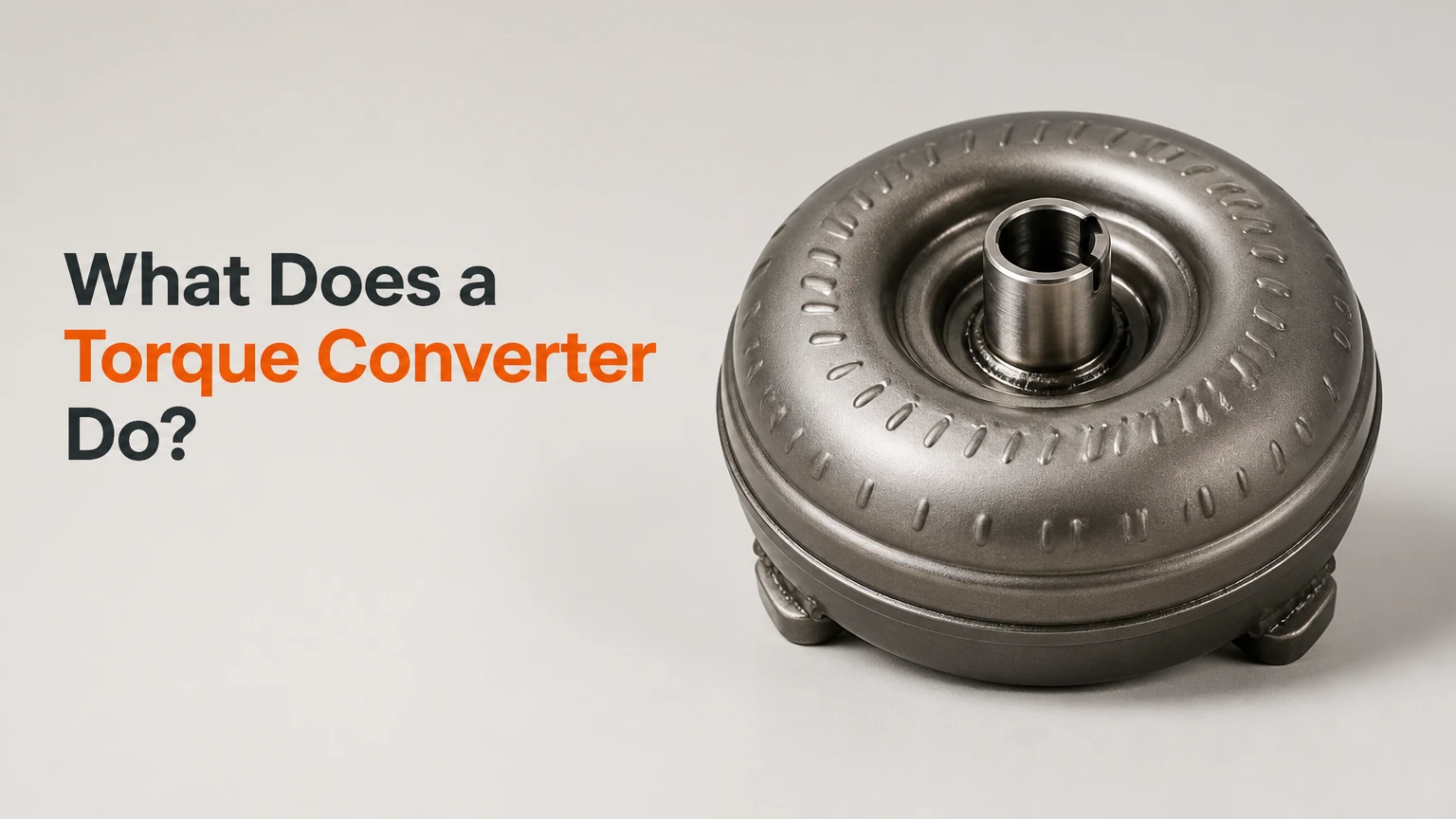
A torque converter is a fluid coupling device in automatic transmissions that transfers rotating mechanical power from an internal combustion engine to the transmission input shaft. It replaces the traditional manual clutch, allowing the vehicle’s engine to continue running smoothly while the drive wheels come to a complete stop.
At a Glance
- Primary Function: Connects the engine to the transmission using pressurized fluid rather than a solid mechanical connection.
- Torque Multiplication: Multiplies low-end engine torque by 1.8:1 to 2.5:1 during initial launch and heavy acceleration.
- Stall Operation: Enables the vehicle to idle at 600–800 RPM in gear without stalling the engine.
- Lock-Up Mode: Mechanically engages at highway speeds (40–45 mph+) to eliminate fluid slippage and boost fuel economy by 4% to 5%.
- Fluid Requirement: Relies strictly on clean Automatic Transmission Fluid (ATF) operating between 175°F and 200°F.
How Does a Torque Converter Work?
A torque converter operates by converting mechanical energy from the engine into hydraulic energy via automatic transmission fluid (ATF), then converting that fluid energy back into rotational force to turn the transmission input shaft. The system relies on hydrodynamic principles, using centrifugal force to launch fluid from an engine-driven pump into an opposing turbine.
What Are the Main Parts of a Torque Converter?
A torque converter consists of three primary fluid components and one mechanical clutch enclosed inside a sealed steel housing:
- The Impeller (Pump): Bolted directly to the engine’s flexplate (flywheel), the impeller spins at full engine RPM (600 RPM at idle to 6,000+ RPM at full throttle). Its curved internal fins sling ATF outward toward the outer circumference of the converter housing using centrifugal force.
- The Turbine: Positioned directly opposite the impeller, the turbine connects to the transmission’s spline input shaft. When pressurized ATF from the impeller hits the turbine blades, it forces the turbine to spin, turning the wheels. At a complete stop, turbine RPM is 0; at highway speeds, it reaches 90% to 95% of impeller speed prior to clutch lock-up.
- The Stator: Located between the impeller and turbine, the stator acts as the torque multiplier. It redirects fluid returning from the turbine back into the impeller in the direction of engine rotation rather than opposing it. Equipped with a one-way roller clutch, the stator remains locked during launch to multiply torque and spins freely once fluid speeds equalize at cruising speeds.
How Does the Lock-Up Clutch Improve Fuel Efficiency?
The Lock-Up Clutch (Torque Converter Clutch or TCC) improves fuel efficiency by creating a direct mechanical link between the engine flexplate and the transmission input shaft, reducing fluid slippage to 0%. Under normal fluid coupling, hydraulic friction inherently loses 5% to 10% of engine power as thermal loss.
+-----------------------------------------------------------------------+
|                         FLUID COUPLING PHASE                          |
| Engine Power ---> Impeller ---> Hydraulic Fluid ---> Turbine (5-10% Loss)|
+-----------------------------------------------------------------------+
                                   |
                                   v (Speeds > 40-45 mph)
+-----------------------------------------------------------------------+
|                           LOCK-UP TCC PHASE                           |
| Engine Power =========== Mechanical Lock Clutch ============ Turbine (0% Loss) |
+-----------------------------------------------------------------------+
When vehicle speed exceeds 40–45 mph (65–72 km/h) in higher gears (typically 4th gear and above), the transmission control unit (TCU) engages hydraulic pressure against a friction lining on the TCC plate. This mechanically locks the turbine shell directly to the converter housing. Eliminating rotational slippage lowers engine operating RPM, reduces fluid heat buildup, and yields an immediate 4% to 5% improvement in overall fuel economy.
What Is Torque Converter Stall Speed and Why Does It Matter?
Torque converter stall speed is the maximum engine RPM achievable under wide-open throttle (WOT) when the transmission output shaft is locked stationary (brakes fully applied). Stall speed dictates how quickly an engine can enter its optimal powerband from a dead stop.
| Application Type | Typical Stall Speed Range | Ideal Engine Powerband | Vehicle Characteristics |
| Factory Street Car | 1,800 – 2,500 RPM | Low-end torque (1,500+ RPM) | Smooth launch, low fluid heat, maximum fuel economy |
| Heavy Towing / Truck | 1,200 – 1,800 RPM | Immediate off-idle torque | High fluid coupling, low heat under heavy loads |
| Street / Strip Performance | 2,800 – 3,500 RPM | Mid-range power (3,000+ RPM) | Aggressive launch, requires upgraded ATF cooler |
| Drag Racing Dedicated | 3,500 – 6,000+ RPM | High-RPM peak powerband | Instant launch into peak HP; unsuited for street driving |
If a vehicle uses a stall speed that is too low for its engine camshaft profile, the vehicle will feel sluggish and bog off the line. Conversely, a stall speed set too high for a daily driver causes excessive slippage during normal city driving, elevating ATF temperatures beyond the safe 175°F–200°F window and degrading transmission components.
What Are the Symptoms of a Bad Torque Converter?
A failing torque converter typically manifests as slipping gears, abnormal noises, overheating transmission fluid, or erratic shift behavior. Recognizing these early indicators prevents catastrophic transmission destruction.
- Slipping and High RPM: The engine revs up high during acceleration, but the vehicle accelerates slowly, signaling worn turbine blades or internal fluid pressure loss.
- Overheating Fluid: ATF temperatures spike above 220°F (104°C), causing a burning fluid smell due to severe internal fluid shear or friction lining slippage.
- Whining or Grinding Noises: A distinct mechanical whining or rattling sound that varies with engine RPM, caused by worn needle bearings or damaged stator blades.
- Harsh Engagement or Delayed Gear Entry: A delay of several seconds when shifting from Park to Drive, accompanied by a heavy clunk as hydraulic pressure slowly builds.
What Is Torque Converter Shudder and How Is It Fixed?
Torque converter shudder is a harsh vibration that feels like driving over highway rumble strips, usually occurring between 30 mph and 50 mph under light acceleration. Shudder is caused by the Lock-Up Clutch (TCC) slipping rapidly as it attempts to engage against the converter housing.
The primary cause of TCC shudder is degraded, oxidized transmission fluid that has lost its friction-modifying additives, though worn TCC friction linings or low hydraulic line pressure can also trigger the issue. To fix shudder:
- Perform a complete transmission fluid exchange using manufacturer-recommended synthetic ATF.
- Add a specialized instant friction modifier (such as Lubegard Instant Shudder Fixx) to restore proper fluid dynamic grip.
- If shudder persists after fresh fluid and additive treatment, the friction lining on the internal lock-up plate is mechanically worn out, requiring full torque converter replacement.
What Happens When a Stator One-Way Clutch Fails?
When a stator’s internal one-way roller clutch fails, the vehicle’s driving behavior changes drastically depending on whether the clutch seizes (fails locked) or slips (fails freewheeling).
- Stator Fails Locked: The stator remains locked to its shaft at all times and cannot freewheel at highway speeds. The vehicle launches and accelerates normally from a dead stop, but hits a strict performance wall around 45–50 mph. At higher speeds, the stationary stator blades severely restrict fluid flow inside the housing, causing excessive drag, severe engine strain, and rapid fluid overheating.
- Stator Fails Freewheeling: The stator spins freely in both directions and fails to redirect returning fluid at low speeds. The vehicle suffers from extremely sluggish, weak acceleration from a standstill due to the complete loss of torque multiplication (1:1 ratio instead of 2.0:1). However, once the vehicle eventually reaches cruising speeds, it drives and cruises normally.
Can a Failing Torque Converter Damage the Transmission?
Yes, a failing torque converter will rapidly destroy an automatic transmission if not replaced promptly. When internal components like the stator clutch, needle bearings, or TCC friction plates break down, they release microscopic metallic debris and shredded friction material directly into the circulating fluid loop.
Contaminated fluid carries these sharp particulates straight into the transmission’s hydraulic valve body, sticking precision control valves, clogging fine fluid passages, and scoring delicate electronic solenoid seals. Furthermore, metallic grit circulating through the system acts as an abrasive compound that destroys clutch packs, bushings, and planetary gearsets throughout the main transmission case.
Do CVTs and Dual-Clutch Transmissions Have Torque Converters?
Dual-Clutch Transmissions (DCTs) do not use torque converters, while many Continuously Variable Transmissions (CVTs) rely on torque converters for smooth low-speed operation.
- Dual-Clutch Transmissions (DCTs): DCTs eliminate fluid couplings entirely in favor of two computer-controlled mechanical friction clutch packs (wet or dry). Because they lack fluid dampening at launch, DCT vehicles can occasionally exhibit slight low-speed jerkiness during slow stop-and-go parking maneuvers.
- Continuously Variable Transmissions (CVTs): While CVTs use adjustable pulleys and steel belts to vary gear ratios seamlessly, many modern CVTs (such as Nissan Xtronic or Honda CVT systems) incorporate a small torque converter between the engine and primary pulley. The converter handles launches from 0 to 10 mph to prevent engine stalling and ensure smooth roll-offs before locking up its TCC for efficiency.
Should You Upgrade to a High-Stall Torque Converter?
You should only upgrade to a high-stall torque converter if your engine modified with a high-duration performance camshaft, forced induction, or aftermarket gearing that shifts its powerband significantly higher than stock.
                                  HIGH-STALL DECISION MATRIX

                    Is your engine modified with a high-duration cam
                          or aftermarket forced induction?
                                         |
                       +-----------------+-----------------+
                       |                                   |
                     [ YES ]                             [ NO ]
                       |                                   |
        Does the vehicle operate primarily       Keep Stock Stall Converter
        at high RPM (Drag/Track focus)?          (High stall causes slippage,
                       |                         heat, and poor daily MPG)
            +----------+----------+
            |                     |
         [ YES ]               [ NO ]
            |                     |
     Install High-Stall     Select Mild Performance
    Converter (3,500+ RPM)   Stall (2,200-2,800 RPM)
    + Auxiliary ATF Cooler   + Auxiliary ATF Cooler
Installing a 4,000 RPM stall converter in a heavy, stock daily driver is a costly mistake. Because a stock engine produces peak torque at lower RPMs, a high-stall unit will constantly slip during normal street driving, creating excessive fluid heat above 220°F and making acceleration feel spongey and unresponsive.
Should You Flush Transmission Fluid if the Converter Is Worn?
No, you should not perform a high-pressure chemical transmission flush on an old, high-mileage vehicle with a severely worn torque converter lock-up clutch.
In neglected transmissions, friction material that has sloughed off worn TCC plates becomes suspended within the dirty, aged ATF. This suspended material often provides the necessary friction for worn clutch plates to retain minimal grip. Flushing the system with fresh, high-detergent fluid strips away these suspended friction particles, frequently causing the converter’s lock-up clutch to slip completely immediately after the service. Instead, perform a gentle pan drop and fluid exchange, or replace the worn converter unit directly.
The Bottom Line
A torque converter is a hydraulic power transmitter that enables smooth engine idling at stops while providing up to 2.5:1 torque multiplication during acceleration. At cruising speeds, its lock-up clutch engages mechanically to eliminate fluid slippage and maximize fuel efficiency. Proper fluid maintenance at 175°F–200°F remains the single most critical factor in preventing converter shudder, stator failure, and downstream transmission damage.