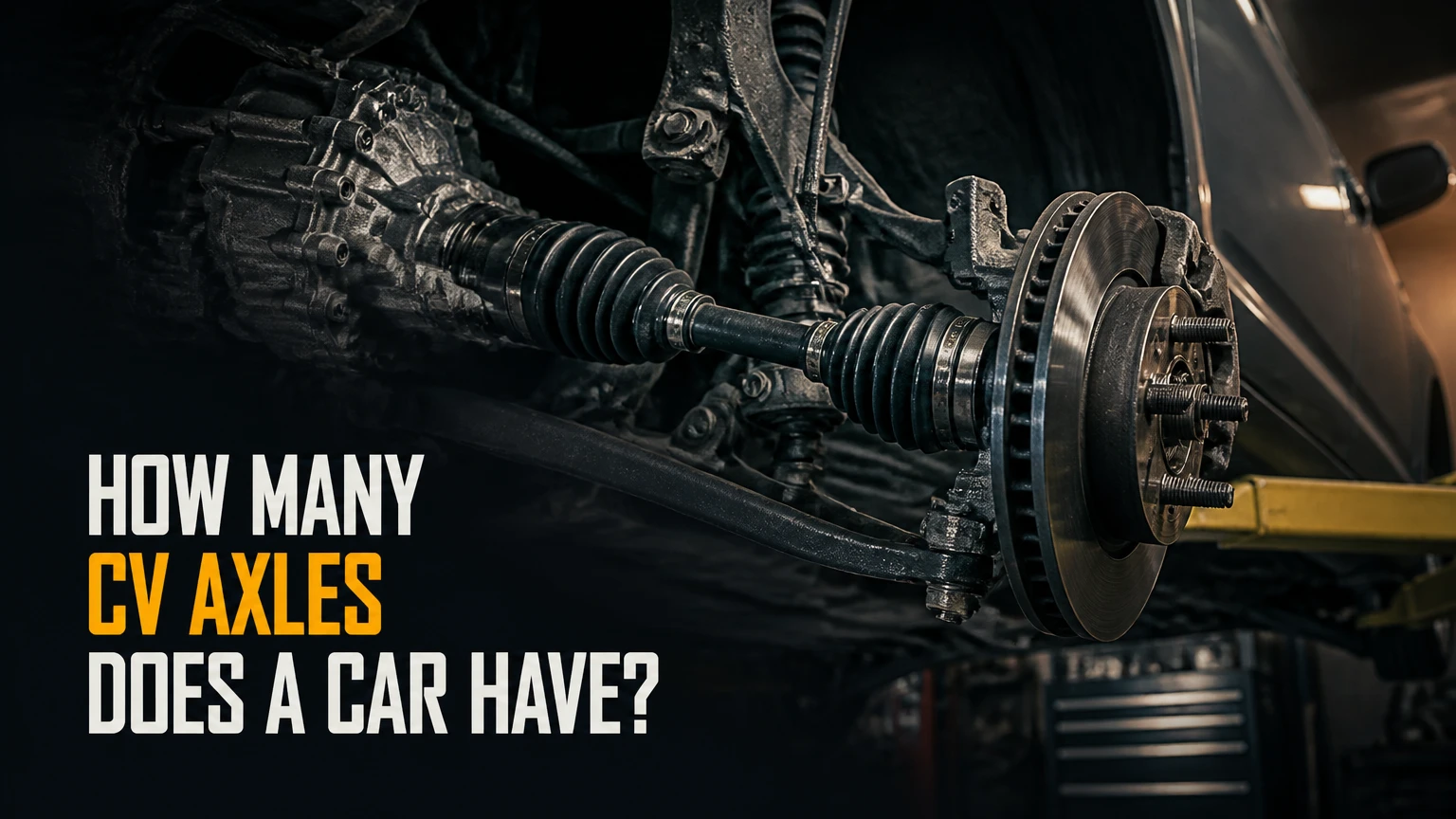
Most passenger cars have 2 or 4 CV (constant velocity) axles, determined entirely by the vehicle’s drivetrain and suspension setup. Front-wheel drive (FWD) cars use 2 CV axles in the front. All-wheel drive (AWD) and four-wheel drive (4WD) cars with independent suspension use 4 CV axles. Rear-wheel drive (RWD) cars have either 2 rear CV axles or none at all.
At a Glance
- Front-Wheel Drive (FWD): 2 CV axles (front wheels only).
- Rear-Wheel Drive (RWD): 2 CV axles if equipped with Independent Rear Suspension (IRS); 0 CV axles if equipped with a solid rear axle.
- All-Wheel Drive (AWD) & 4WD: 4 CV axles on most passenger cars, crossovers, and independent suspension trucks.
- Heavy-Duty 4WD Trucks: 0 CV axles if using solid front and rear live axles with universal joints (U-joints).
- Electric Vehicles (EVs): 2 CV axles for single-motor setups; 4 CV axles for dual-motor AWD setups.
What Is the Difference Between a CV Axle, a Driveshaft, and a Solid Axle?
A CV axle (constant velocity axle) is a flexible shaft assembly with jointed ends that transfers rotational power from a transmission or differential directly to an independently suspended wheel. Unlike rigid driveshafts or solid axle shafts, a CV axle bends up and down with road bumps and pivots side to side to allow front-wheel steering while maintaining continuous rotational speed.
                  ┌────────────────────────────────────────────────────────┐
                  │                    POWER SOURCE                        │
                  │             (Engine / Transmission)                    │
                  └───────────────────┬────────────────────────────────────┘
                                      │
           ┌──────────────────────────┴──────────────────────────┐
           │                                                     │
           ▼                                                     ▼
┌──────────────────────┐                              ┌──────────────────────┐
│   RIGID DRIVESHAFT   │                              │     CV AXLE          │
│ Transfers power      │                              │ Transfers power      │
│ lengthwise to front/ │                              │ laterally directly   │
│ rear differentials.  │                              │ to the wheels.       │
└──────────┬───────────┘                              └──────────┬───────────┘
           │                                                     │
           ▼                                                     ▼
┌──────────────────────┐                              ┌──────────────────────┐
│     SOLID AXLE       │                              │ INDEPENDENT WHEELS   │
│ Rigid beam housing   │                              │ Flexible joints allow│
│ straight inner shafts│                              │ vertical motion and  │
│ (no CV joints).      │                              │ steering angles.     │
└──────────────────────┘                              └──────────────────────┘
A driveshaft (or propeller shaft) runs longitudinally down the center of a vehicle to connect the transmission to a front or rear differential. A solid axle (or live axle) is a rigid steel housing enclosing straight axle shafts without flexible CV joints; when one wheel hits a bump, the entire solid axle beam tilts. Modern passenger vehicles utilize CV axles because independent suspension provides vastly superior ride comfort, tire contact, and handling stability compared to rigid solid axles.
How Many CV Axles Does a Front-Wheel Drive (FWD) Car Have?
A front-wheel drive (FWD) car has exactly 2 CV axles, both located on the front suspension assembly. These axles connect the transaxle (combined transmission and differential) to the front left and front right wheel hubs, powering the vehicle while simultaneously allowing the front wheels to steer left and right.
      [ Front-Wheel Drive Layout ]

      Front Left Wheel ─── [CV Axle] ───┐
                                        ├─── Transaxle
      Front Right Wheel ── [CV Axle] ───┘

      Rear Left Wheel  ─── [No CV Axle] (Free-rolling hub)
      Rear Right Wheel ─── [No CV Axle] (Free-rolling hub)
In an FWD system, the rear wheels are non-powered, free-rolling assemblies bolted to stub spindles or a dead axle beam. Consequently, FWD passenger cars never feature rear CV axles. Because FWD front axles must handle both engine torque output and high-angle steering articulation, their outer CV joints experience greater mechanical wear over time than non-steering rear CV axles found on other drivetrains.
How Many CV Axles Does a Rear-Wheel Drive (RWD) Car Have?
A rear-wheel drive (RWD) car has either 2 CV axles or 0 CV axles, depending entirely on its rear suspension design. RWD sports cars, sedans, and luxury vehicles equipped with Independent Rear Suspension (IRS) feature 2 rear CV axles extending from the chassis-mounted rear differential to the rear wheels.
               [ Rear-Wheel Drive Suspension Types ]

    Independent Rear Suspension (IRS)          Solid Rear Live Axle
          (2 CV Axles Total)                   (0 CV Axles Total)

   Rear Left ── [CV Axle] ──┐              Rear Left ───┐
                            ├── Diff                    ├── Solid Beam
   Rear Right ─ [CV Axle] ──┘              Rear Right ──┘
Conversely, traditional RWD muscle cars, full-size vans, and body-on-frame trucks with a rigid solid rear axle have zero CV axles. Solid rear axles enclose straight, rigid steel axle shafts inside a solid axle housing without constant velocity joints. If an RWD vehicle features an independent front suspension without front-wheel power, its front wheels rotate on unpowered wheel bearings, leaving the total CV axle count at zero for solid-rear models and two for IRS-equipped models.
How Many CV Axles Do AWD and 4WD Vehicles Have?
Most modern All-Wheel Drive (AWD) and Four-Wheel Drive (4WD) passenger vehicles have 4 CV axles—two on the front axle line and two on the rear axle line. This configuration allows engine power to reach all four wheels independently while accommodating wheel movement over road imperfections.
            [ All-Wheel Drive (AWD) Axle Map ]

  Front Left Wheel  ─── [CV Axle] ──┐          ┌── [CV Axle] ─── Front Right Wheel
                                    ├── Diff ──┤
  Rear Left Wheel   ─── [CV Axle] ──┘          └── [CV Axle] ─── Rear Right Wheel
Certain traditional 4WD off-road trucks and full-size SUVs (such as the Jeep Wrangler or Toyota 4Runner) alter this baseline:
- Independent Front & Rear Suspension AWD (e.g., Subaru Outback, Honda CR-V): Uses 4 CV axles.
- Independent Front / Solid Rear Axle 4WD (e.g., Ford F-150, Toyota Tacoma): Uses 2 front CV axles and 0 rear CV axles (uses solid rear axle shafts instead).
- Solid Front & Solid Rear Axle 4WD (e.g., Jeep Wrangler Rubicon): Uses 0 CV axles, employing universal-joint (U-joint) solid axles instead.
How Many CV Axles Do Electric Vehicles (EVs) and Rear-Engine Cars Have?
Single-motor rear-wheel drive electric vehicles (EVs) and rear-engine sports cars have 2 CV axles, while dual-motor or quad-motor AWD electric vehicles have 4 CV axles. Because electric motors sit close to the drive wheels, EVs do not use central driveshafts; instead, electric drive units route power directly to wheels via short CV axles.
| Vehicle Drive Type | Motor Configuration | Total CV Axles | Layout Details |
|---|---|---|---|
| Single-Motor RWD EV (e.g., Tesla Model 3 RWD) | 1 Rear Drive Unit | 2 | 2 rear CV axles; 0 front CV axles |
| Single-Motor FWD EV (e.g., Chevy Bolt EV) | 1 Front Drive Unit | 2 | 2 front CV axles; 0 rear CV axles |
| Dual-Motor AWD EV (e.g., Tesla Model Y Long Range) | 1 Front Unit + 1 Rear Unit | 4 | 2 front CV axles + 2 rear CV axles |
| Quad-Motor AWD EV (e.g., Rivian R1T) | 4 Dedicated Wheel Motors | 4 | 4 short, high-torque CV half-shafts |
| Rear-Engine Gas Sports Car (e.g., Porsche 911 Carrera RWD) | Rear-Mounted Gas Engine | 2 | 2 rear CV axles connected to transaxle |
Modern hybrid AWD systems (such as Toyota’s E-Four) also utilize 4 CV axles total: two driven by the front gas engine transaxle and two driven by an isolated rear electric motor, eliminating the need for a mechanical longitudinal driveshaft connecting front to rear.
Do Heavy-Duty Trucks and Multi-Axle Vehicles Use CV Axles?
Heavy-duty 4WD trucks (such as the Ford F-250, Ram 2500, or heavy commercial duallys) typically have 0 CV axles. These heavy vehicles utilize solid front and rear live axles equipped with open Universal joints (U-joints) or steering knuckles rather than CV joints because solid axles offer superior weight-bearing capacity and extreme durability under heavy payloads.
          [ Multi-Axle Commercial / Military Rigs ]

  6x6 All-Wheel Drive Rig (3 Axle Lines):  6 Total CV Axles
  8x8 Off-Road Transport (4 Axle Lines):   8 Total CV Axles
Specialized multi-axle commercial and military vehicles deviate significantly from standard passenger car counts:
- 6×6 All-Terrain Vehicles: Vehicles featuring independent suspension across three driven axle lines utilize 6 CV axles.
- 8×8 Heavy Expedition Rigs: Vehicles with four independent drive axles utilize 8 CV axles.
What Is an Intermediate Shaft, and Does It Count as an Extra CV Axle?
An intermediate shaft (also called a stub shaft, extension shaft, or jack shaft) is a rigid steel extension bar and is not counted as a CV axle. Manufacturers install intermediate shafts on front-wheel drive vehicles with off-center transmissions to ensure that the left and right CV axles remain identical in length.
       [ Unequal Length Setup ]                     [ Equalized Setup ]
    (Causes Severe Torque Steer)               (Uses Intermediate Extension)

  Left Axle [Short]   ─── Transaxle          Left Axle  ─── Transaxle
  Right Axle [Very Long] ── Transaxle        Right Axle ─── [Intermediate Shaft] ── Transaxle
When a transmission sits off-center, connecting axles directly to the wheels creates one short axle and one long axle. Under hard acceleration, uneven drive angles create “torque steer,” pulling the steering wheel to one side.
By bolting a rigid, solid-steel intermediate shaft to the engine block on the longer side, mechanics equalize the working angles and lengths of the actual CV axles. While some auto parts catalogs list an intermediate shaft alongside front axle kits, it lacks constant velocity flex joints and functions strictly as a stationary driveline extension.
How Long Do CV Axles Last on Average?
CV axles typically last between 80,000 and 150,000 miles under normal driving conditions. Unlike engine oil or brake pads, CV axles do not have a hard scheduled replacement interval; they remain functional as long as their protective rubber boots remain intact and internal grease stays uncontaminated.
                 [ CV Axle Lifespan Factors ]

  Normal Commuting (Clean Roads)   │  100,000 - 150,000 Miles
  Severe Climates / Dirt Roads     │  70,000 - 100,000 Miles
  Lifted / Lowered Suspension      │  30,000 - 60,000 Miles
Key factors that accelerate CV axle failure include:
- Suspension Modifications: Lifting or lowering a vehicle alters factory driveline angles, placing constant stress on inner and outer CV joints and causing boots to tear prematurely.
- Climatic Exposure: Exposure to road salt, extreme cold, or off-road debris degrades protective rubber boots faster, causing cracks within 70,000 to 90,000 miles.
- Aggressive Driving: Frequent hard acceleration while making sharp turns increases torque loading on outer CV joint bearings.
Why Do CV Axles Fail, and How Can You Prevent It?
Over 90% of CV axle failures are caused by a damaged rubber or thermoplastic grease boot. The boot seals synthetic high-pressure grease inside the joint while keeping road dirt, water, and grit out. When a boot tears or cracks from age, centrifugal force slings the protective grease outward, exposing precision steel bearings to friction and moisture.
┌─────────────────────────────────────────────────────────────────────────┐
│                      CV AXLE FAILURE SEQUENCE                           │
└─────────────────────────────────────────────────────────────────────────┘
   1. Rubber Boot Cracks/Tears  ──►  2. Grease Slings Out On Suspension
                                             │
                                             ▼
   4. Bearing Failure & Clicking ◄── 3. Dirt & Water Enter Joint
Preventative maintenance steps to maximize CV axle life include:
- Inspect Boots Every Oil Change: Visually inspect neoprene boots for grease splatter, hairline cracks, or loose clamping bands.
- Clean Off Road Debris: Wash away packed mud or road salt build-up around lower suspension arms and inner boot folds.
- Replace Cracked Boots Immediately: If you discover a split boot before clicking noises begin, installing a fresh boot kit with clean grease costs significantly less than replacing an entire damaged axle assembly.
What Does a Failing CV Axle Sound and Feel Like?
A failing CV axle produces a distinct metallic clicking, popping, or snapping sound that grows louder and faster when accelerating through sharp turns. This acoustic symptom directly indicates that the outer CV joint bearings are worn down and grinding inside their steel cages.
             [ Acoustic Diagnostic Matrix ]

  Clicking / Popping during sharp turns  ──► Outer CV Joint Failure
  Rhythmic Clunking during acceleration  ──► Inner CV Joint Failure
  Side-to-side wobble under heavy load   ──► Pitted Inner Tripod Housing
Common physical and auditory symptoms of a bad CV axle include:
- Rhythmic Clicking on Turns: Heard during low-speed maneuvers like parallel parking, U-turns, or turning at intersections.
- Clunking on Acceleration/Deceleration: Occurs when transitioning from braking to hitting the gas pedal, caused by excessive rotational play (backlash) in the inner joint.
- In-Cabin Vibration at Highway Speeds: Pitted inner CV tripod joints cause side-to-side shakes or wobbles under acceleration that disappear when you coast in neutral.
- Grease Splattered Inside Wheel Well: Dark, sticky grease sprayed across the inner tire sidewall, brake caliper, or lower control arm.
How Do You Tell Whether an Inner or Outer CV Joint Is Bad?
To determine whether an inner or outer CV joint is failing, analyze when the symptom occurs and how the vehicle behaves during steering inputs. A single CV axle contains two distinct joint types: an inner joint (tripod style near the transmission) and an outer joint (ball-and-cage style near the wheel hub).
  [Inner CV Joint]                                        [Outer CV Joint]
  • Plunge movement (in/out)                              • High steering angles
  • Near transmission                                     • Near wheel hub
  • Symptom: Vibration under load                         • Symptom: Clicking on turns

  [TRANSMISSION] ═══( Inner )═══════════════════( Outer )═══ [WHEEL HUB]
| Symptom / Behavior | Inner CV Joint Failure | Outer CV Joint Failure |
|---|---|---|
| Primary Sound | Heavy clunking or knocking when shifting gears | Loud, fast clicking or snapping |
| Primary Sensation | Side-to-side cabin shudder under heavy acceleration | Minimal vibration; sound dominates |
| Steering Impact | Noise/vibration occurs straight ahead | Noise intensifies during sharp turns |
| Mechanical Role | Accommodates suspension plunging (in/out travel) | Accommodates high-angle steering turns |
Can You Safely Drive a Car With a Damaged CV Axle?
No, you should not drive a vehicle with a severely damaged or clicking CV axle. While a car may remain driveable for a short distance when an outer joint first begins clicking, driving on a dry, degraded CV joint risks total mechanical breakdown.
If a CV axle snaps completely while driving:
- Complete Loss of Drive Power: In standard open-differential vehicles, all engine torque routes to the broken, spinning axle shaft, leaving the car stranded without propulsion even if in gear.
- Severe Collateral Damage: A snapped CV axle spins wildly under the vehicle, tearing through hydraulic brake lines, shredding ABS sensor wiring, cracking aluminum transmission housings, and damaging control arms.
- Wheel Seizure Risk: In extreme cases, a disintegrated outer joint can bind the front hub, locking up the wheel at high speed and causing an immediate loss of steering control.
Should You Replace CV Axles in Pairs?
No, you do not need to replace CV axles in pairs unless both individual axle boots show visible cracking, tearing, or joint wear. Unlike shocks, struts, or brake pads, CV axles do not wear down at identical rates; an axle on one side can easily outlast the opposite side by tens of thousands of miles.
       [ Single vs. Pair Replacement Decision Tree ]

           Is the non-damaged axle boot intact?
                      /           \
                     /             \
                  [YES]           [NO]
                   /                 \
        Replace ONLY broken       Replace BOTH axles
        axle (Save $200-$500)     to prevent double labor
You should replace only the damaged CV axle if:
- Only one axle boot has torn and the remaining axle shows clean, crack-free rubber boots.
- The failure was caused by road debris impact or isolated mechanical damage.
You should replace both CV axles simultaneously if:
- The vehicle has over 120,000 miles and both rubber boots show dry-rot weathering or micro-cracks.
- The repair requires removing components (such as subframes or differential fluid) where changing the second side adds minimal labor cost.
How Much Does CV Axle Replacement Cost?
The average cost to replace a CV axle ranges between $300 and $1,200 per axle, depending on vehicle make, labor rates, and part type (OEM vs. aftermarket).
┌─────────────────────────────────────────────────────────────────────────┐
│                    AVERAGE COST BREAKDOWN PER AXLE                      │
├───────────────────────────────┬─────────────────────────────────────────┤
│ Parts (Aftermarket Shaft)     │ $90 – $250                              │
│ Parts (OEM Factory Shaft)     │ $300 – $700                             │
│ Labor (1.5 to 3.0 Hours)      │ $200 – $500                             │
├───────────────────────────────┼─────────────────────────────────────────┤
│ TOTAL ESTIMATE (Standard Car) │ $300 – $800                             │
│ TOTAL ESTIMATE (Luxury/EV)    │ $700 – $1,200+                          │
└───────────────────────────────┴─────────────────────────────────────────┘
Budget-friendly commuter cars (such as a Honda Civic or Toyota Corolla) sit at the lower end ($300–$550), while luxury vehicles, heavy AWD crossovers, and electric vehicles requiring specialized disassembly cost $700–$1,200+ per axle. Installing a remanufactured or aftermarket complete axle assembly is standard practice across independent repair shops because buying a complete pre-assembled axle costs less in total labor than paying a technician to rebuild individual internal joint bearings.
The Bottom Line
A standard passenger car carries 2 CV axles (in FWD setups) or 4 CV axles (in AWD setups), while RWD vehicles have 2 or zero depending on whether they use an independent rear suspension or a solid live axle. Always replace an axle assembly promptly if you detect sharp turning clicks or torn boots, but avoid paying for unnecessary paired replacements if the opposite axle boot remains intact and sealed.