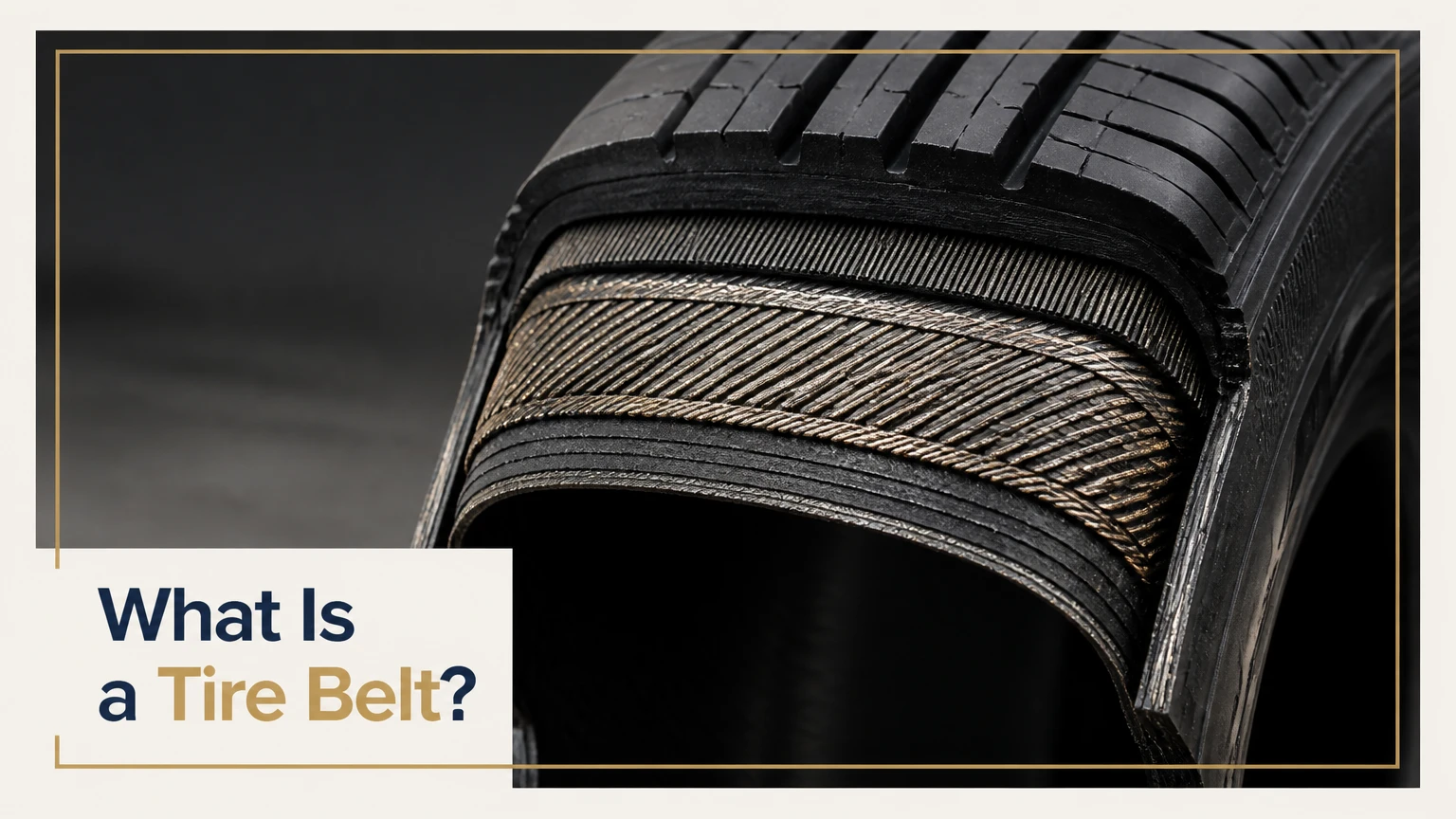
A tire belt is a rigid structural reinforcement layer positioned directly underneath the tread rubber of a radial tire that stabilizes the casing, improves tread wear, and prevents high-speed distortion. Composed primarily of high-tensile steel cords embedded in rubber, belts maintain the tire’s footprint and protect the inner casing plies from punctures.
At a Glance
- Primary Material: Fine, high-tensile brass-coated steel cords braided into cables ($0.2$ to $0.3\text{ mm}$ thick).
- Standard Quantity: Passenger vehicle tires utilize 2 crisscrossed steel belt layers; commercial vehicles use 3 to 4 plies.
- Placement Angle: Belts are laid diagonally at opposing angles between $15^\circ$ and $25^\circ$ relative to the tread centerline.
- High-Speed Protection: Speed-rated tires add 1 to 2 nylon or aramid “cap plies” wrapped spirally at $0^\circ$ over the steel belts.
- Repair Safety Zone: Punctures within $0.5\text{ inches}$ ($13\text{ mm}$) of the belt edge cannot be repaired due to extreme shoulder shear stress.
Where Are Tire Belts Located in Tire Anatomy?
Tire belts are situated directly between the flexible casing plies (body cords) and the outer tread rubber. They act as the structural spine of modern radial tires, encircling the circumference to form a stiff foundation beneath the wearable tread layer.
[ Outer Tread Rubber ]
----------------------------------
[ Cap Ply (0° Spiral Layer) ]       <-- In High-Speed Rated Tires
[ Belt Layer 2 (Opposite Angle) ]   <-- STEEL BELTS
[ Belt Layer 1 (Diagonal Angle) ]   <-- STEEL BELTS
----------------------------------
[ Casing / Body Plies ]
The inner casing plies run radially from bead to bead at a $90^\circ$ angle, providing carcass flexibility and maintaining air pressure. The rigid belt matrix sits on top of these carcass plies, binding them together to keep the tread flat against the road surface under cornering, braking, and acceleration forces.
What Materials Are Tire Belts Made Of?
Modern tire belts are primarily constructed from high-tensile steel cords coated in a micro-thin layer of brass, which chemically bonds with rubber during vulcanization. Specialty applications substitute or supplement steel with high-performance synthetic polymers such as polyamide (Nylon), aramid (Kevlar), or fiberglass.
| Material | Primary Application | Key Advantage | Limiting Factor |
| Brass-Coated Steel | Standard Passenger & Commercial Tires | Exceptional tensile strength, low cost, rigid footprint control | Vulnerable to rust if moisture penetrates tread |
| Aramid / Kevlar | Extreme High-Performance & Off-Road Tires | Superior strength-to-weight ratio, immune to corrosion | Higher manufacturing and material cost |
| Fiberglass | Vintage Belted Bias & Specialty Tires | High heat resistance, good structural stability | Brittle under extreme flex cycles |
| Polyamide (Nylon) | Cap Plies (Over Steel Belts) | Thermal contraction properties at high speeds | Prone to flat-spotting when parked cold |
How Many Belts Are Inside a Tire?
Passenger cars and light trucks universally utilize two steel belts laid in opposing diagonal directions. Commercial trucks, heavy-duty haulers, and industrial equipment often incorporate three to four steel belts to sustain high axle loads and harsh road conditions.
In passenger tires, these two main steel layers are topped by specialized nylon or aramid cap plies depending on the tire’s speed rating:
- Standard Passenger Tires (S/T Speed Rating, up to $118\text{ mph}$): 2 steel belts.
- Performance Tires (V/W/Y Speed Rating, up to $186\text{ mph}$): 2 steel belts + 1 or 2 full-width zero-degree cap plies.
- Heavy-Duty Commercial Tires (Load Range E/F/G): 3 to 4 steel belts + reinforced heavy-gauge casing plies.
At What Angles Are Steel Belts Placed and Why?
Steel belts are installed diagonally at opposing angles between $15^\circ$ and $25^\circ$ relative to the tread centerline. The opposing bias angles create a crisscross geometric matrix that prevents lateral distortion and optimizes tread stability.
[ Centerline ]
     \  \  \  \  <- Top Belt Layer (+20°)
     /  /  /  /  <- Bottom Belt Layer (-20°)
If the steel cords ran straight at $0^\circ$ along the circumference, the tread would flex excessively during high-g cornering. If they ran at $90^\circ$ across the tread, the tire would lack circumferential stiffness under acceleration and braking. The $15^\circ–25^\circ$ opposing matrix gives the tire squirm resistance, keeping the contact patch flat against the road surface without sacrificing flexibility.
What Is a Cap Ply and How Does It Protect Steel Belts?
A cap ply is a secondary reinforcement layer made of heat-resistant synthetic cords (such as nylon or aramid) wrapped spirally at $0^\circ$ directly over the steel belts. Its primary function is to prevent centrifugal expansion of the steel belts at speeds exceeding $130\text{ mph}$ ($210\text{ km/h}$).
At high vehicle speeds, centrifugal forces pull the heavy steel belts outward, causing the tread edges to lift and generating internal heat. Because heat causes nylon cords to shrink slightly, the $0^\circ$ cap ply acts like a tensioned corset, clamping the steel belts firmly down against the casing plies. This prevents heat buildup, edge lifting, and high-speed tread separation.
How Do Tire Belts Differ Across Different Tire Types?
Tire belt implementation varies significantly across tire engineering architectures. While radial tires use localized steel belts, older and specialty tires handle tread reinforcement differently:
- Radial Tires: Feature flexible $90^\circ$ body plies topped by rigid circumferential belts ($15^\circ–25^\circ$). This allows the sidewall and tread to act independently.
- Bias-Ply Tires: Lack independent tread belts. Body plies crisscross the entire tire at $30^\circ$ to $40^\circ$ angles from bead to bead, making the sidewall and tread rigid together.
- Belted Bias Tires: Feature a traditional bias-ply body topped with stabilizing fiberglass or aramid belts. Common in classic car restorations.
- Monostrand / Jointless Belts (JLB): Eliminate overlapping sheet seams by winding a continuous single strand of rubberized cord around the circumference. Found in high-end motorcycle and ultra-high-performance car tires to eliminate high-speed vibration.
What Is a Broken or Shifted Tire Belt?
A “broken” or “shifted” tire belt occurs when the internal rubber-to-brass chemical bond holding the steel cords fails, causing the belt plies to detach, slip, or buckle beneath the tread. The steel cords themselves rarely break; rather, the underlying structural matrix delaminates.
NORMAL TREAD PROFILE:      [========== Flat Tread Surface ==========]

SHIFTED BELT PROFILE:      [--- Tread --- / \ Bulge / \ --- Tread ---]
Primary Causes of Belt Separation
- Severe Impact Hazards: Striking deep potholes, curb edges, or road debris at high speeds causes instantaneous shear shock across the internal plies.
- Underinflation Heat: Driving severely underinflated generates extreme internal heat ($250^\circ\text{F}$ / $121^\circ\text{C}$+), degrading the vulcanized rubber-to-metal bonding agent.
- Age & Moisture Ingress: Inter-ply oxidation weakens the brass-to-rubber bond over time, exacerbated by water leaking through unpatched tread punctures.
What Are the Warning Signs of a Bad Tire Belt?
A shifted or damaged tire belt produces distinct physical and mechanical symptoms as the tire loses its round shape under dynamic load.
- Low-Speed Waddling: A rolling side-to-side wobble felt in the steering wheel or seat at low speeds ($5$ to $15\text{ mph}$).
- Persistent High-Speed Vibration: A continuous, rhythmic vibration through the floorboards or wheel between $55$ and $65\text{ mph}$ that persists even after professional dynamic balancing.
- Tread Bulges or Wavy Distortions: Visible humps, raised ridges, or unnatural contours running along the tread footprint (unlike sidewall bubbles).
- Localized Diagonal Tread Wear: Sudden, uneven bald patches wearing diagonally across a specific section of the tread face.
Can You Safely Drive on a Tire with a Damaged Belt?
No, you cannot safely drive on a tire with a damaged or shifted belt. Once internal belt separation occurs, the surrounding rubber layers must carry structural stresses they were never engineered to bear, putting the tire at immediate risk of a sudden highway blowout.
Continued operation causes high-speed centrifugal forces to pull the detached belt layer further away from the casing plies. This friction generates rapid thermal buildup, culminating in full tread delamination—where the entire tread strip violently tears free from the tire, damaging the vehicle wheel well, braking components, and body panels.
Why Does Water Exposure Destroy Steel Tire Belts?
Water destroys steel tire belts because moisture triggers oxidation (rust) on the internal steel cords, breaking the chemical bond between the brass coating and the surrounding vulcanized rubber matrix.
When a nail or screw penetrates through the tread into the steel belt layer, it creates a pathway for external water ingress. If the repair is made using a simple tire plug pushed from the outside—without an internal vulcanized patch-stem sealing the inner liner—water reaches the raw steel wires. Through capillary action, moisture travels down the cord length beneath the rubber, rusting the steel matrix and causing widespread internal belt separation over subsequent weeks.
Why Is Tread Depth Alone a Dangerous Indicator of Belt Safety?
Tread depth measures only wearable external rubber, completely ignoring internal rubber degradation, steel oxidation, and inter-ply bond weakening that occur over time.
[ External Tread: 6/32" Remaining ] --> APPEARS SAFE
------------------------------------
[ Inter-ply Rubber Breakdown      ] --> INTERNAL FAILURE RISK
[ Steel Belt Oxidation            ] --> TREAD SEPARATION HAZARD
As tires age beyond 6 years, the vulcanized rubber surrounding the internal steel belts undergoes progressive inter-ply oxidation. Atmospheric oxygen diffuses through the tire rubber, drying it out and breaking down the brass-to-rubber chemical bond. A tire with $6/32\text{“}$ of tread depth can experience catastrophic belt separation at high speeds if the internal matrix is over 6 to 10 years old. Always check the four-digit DOT manufacturing date code on the sidewall alongside tread depth.
Where on the Tread Can a Puncture Be Safely Repaired?
A puncture can only be safely repaired if it resides within the crown area of the tread, at least $0.5\text{ inches}$ ($13\text{ mm}$) inward from the outer edges of the steel belts.
[<- Unrepairable ->|======== SAFE REPAIR ZONE ========|<- Unrepairable ->]
[ Shoulder Flex Zone|           Steel Belt Area       | Shoulder Flex Zone]
The $0.5\text{-Inch}$ Belt Edge Rule
The edges of the steel belts experience severe shear stress as the tire flexes through its contact patch. Punctures located on the outer tread shoulder or within $0.5\text{ inches}$ of the belt termination zone cannot hold a repair. Flexing in this high-stress zone causes internal patch displacement, allowing high-pressure air and moisture to migrate directly between the belt layers, triggering total tread delamination.
Why Can’t Wheel Balancing Fix a Vibration Caused by a Shifted Belt?
Wheel balancing cannot fix a shifted belt vibration because dynamic spin balancers adjust static and dynamic mass distribution, whereas a shifted belt alters the tire’s structural roundness and spring rate under load.
A spin balancer spins the wheel in free air and may register a perfect “$0.00\text{ oz}$” mass balance. However, when the vehicle’s weight presses the tire onto the road surface, the shifted internal belt creates a stiff spot and a high spot. This dynamic distortion—known as Road Force Variation—pushes the axle upward on every revolution, causing violent cabin vibrations that can only be diagnosed using a specialized Road Force Measurement system.
The Bottom Line
A tire belt is the internal high-tensile steel cord layer beneath the tread that maintains tire shape, prevents punctures, and stabilizes vehicle handling. When internal belt bonds fail from road hazards, age-related oxidation, or water penetration, the tire experiences structural distortion that dynamic wheel balancing cannot correct. Always inspect tires past 6 years of age, avoid repairing punctures near the tread shoulders, and replace tires showing low-speed waddling or tread distortion immediately.