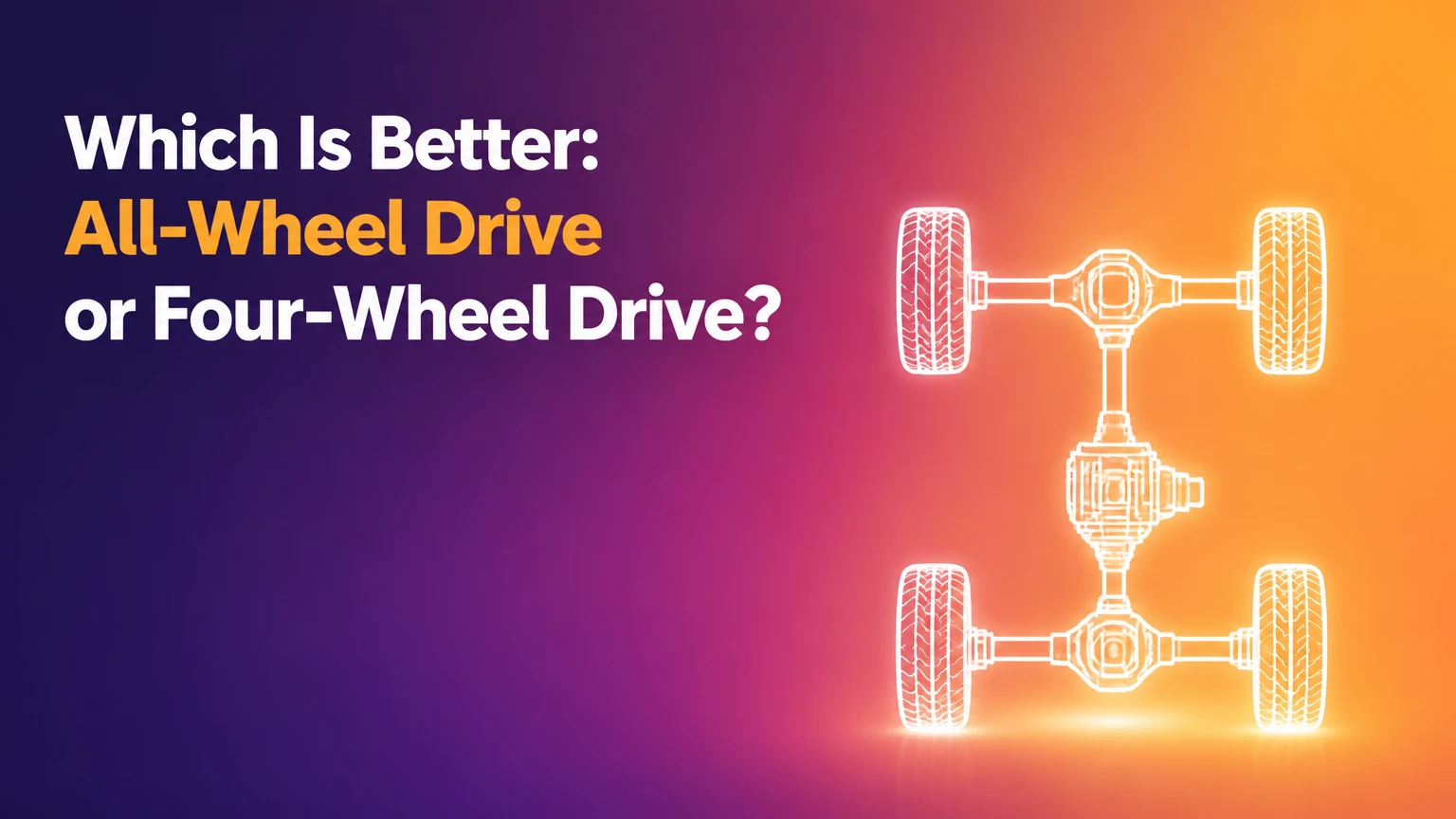
All-Wheel Drive (AWD) is better for daily road commuting, rain, and light snow because it operates automatically with variable torque distribution. Four-Wheel Drive (4WD) is better for extreme off-roading, deep mud, rock crawling, and heavy-duty towing because it mechanically locks axle speeds through a dedicated transfer case with low-range gearing.
At a Glance
- AWD operates continuously and automatically, varying torque between axles to prevent slip on paved or wet roads.
- 4WD locks front and rear axle speeds 50/50, delivering maximum traction for severe off-road terrain.
- AWD fuel economy penalty ranges from 1 to 3 MPG compared to 2WD models due to mechanical drag.
- 4WD driving on dry pavement causes drivetrain binding, which destroys gears and snaps drive axles.
- AWD systems require replacing all four tires if tread depth differences exceed 2/32 of an inch.
How Does All-Wheel Drive Work Mechanically?
All-Wheel Drive operates continuously without driver intervention by using a center differential or electronically controlled clutch pack to distribute engine torque dynamic to all four wheels. The system continuously monitors wheel rotation speeds through anti-lock braking (ABS) sensors.
                     ┌─── Front Axle ─── Front Wheels
                     │
[Engine] ── [Trans] ─┼── [Center Differential / Clutch Pack]
                     │   (Varies torque automatically 100:0 to 50:50)
                     │
                     └─── Rear Axle ──── Rear Wheels
In standard driving conditions, modern crossover AWD systems route 100% of engine torque to the front wheels to optimize fuel economy. When sensors detect front-wheel slippage, the center clutch pack engages within milliseconds, redirecting up to 50% of available torque to the rear axle. Performance-oriented AWD designs, such as Subaru’s Symmetrical AWD, maintain a continuous rear bias (e.g., 45:55 or 30:70) to optimize high-speed cornering stability. Because the center differential allows the front and rear driveshafts to rotate at different speeds, AWD remains safely engaged on dry pavement at any speed.
How Does Four-Wheel Drive Work Mechanically?
Four-Wheel Drive is a heavy-duty, selectable system that uses a mechanical transfer case to lock the front and rear driveshafts together, forcing both axles to rotate at identical speeds.
                     ┌─── Front Driveshaft ─── Front Differential
                     │
[Engine] ── [Trans] ─┴── [Transfer Case] (2H / 4H / 4L)
                         (Rigid 50/50 locked split or low-range gear reduction)
                     ┌─── Rear Driveshaft ──── Rear Differential
When a driver engages 4WD (4-High or 4-Low) via a mechanical shifter, dial, or button, the transfer case locks the split to a fixed 50/50 torque ratio between the front and rear differentials. Unlike an AWD center differential, a traditional 4WD transfer case contains no internal slippage mechanism. Both axles are forced to turn at the exact same rotational speed regardless of road traction. This rigid mechanical lock ensures that even if two wheels completely lose traction, power continues flowing to the remaining wheels.
What Is the Difference Between Part-Time AWD and Full-Time 4WD?
The primary distinction lies in whether the system uses a differential that allows axle speed differentiation or a locked transfer case that forces identical axle speeds.
- Part-Time AWD defaults to two-wheel drive (2WD) for fuel savings and automatically engages power to the secondary axle only when electronic sensors detect traction loss.
- Full-Time 4WD continuously routes power to all four wheels during normal driving like an AWD system, but includes a lockable center differential and a multi-speed transfer case with a 4-Low gear set for off-roading.
Modern vehicles feature hybrid configurations like “4WD Auto” (found in trucks like the Ford F-150), which uses an internal clutch in the transfer case to simulate AWD on pavement while retaining true 4-Low mechanical locking capability off-road.
How Does Electric Vehicle AWD (e-AWD) Compare to Mechanical 4WD?
Electric Vehicle All-Wheel Drive (e-AWD) replaces mechanical driveshafts, central differentials, and heavy transfer cases with independent electric motors mounted directly on the front and rear axles.
| Component | Traditional Mechanical 4WD | Electric Vehicle e-AWD |
| Power Routing | Driveshafts, transfer case, mechanical gears | Dual or quad electric motors via software control |
| Torque Split Speed | Mechanical engagement (100–500 milliseconds) | Microsecond computer adjustments |
| Center Differential | Required (or locked transfer case) | None (axles are mechanically disconnected) |
| Low-Range Gearing | Dedicated mechanical 2.5:1 to 4.0:1 reduction gear | High-torque motor control at zero RPM |
Because e-AWD systems control front and rear torque independently via software code, power distribution adjustments occur thousands of times per second. This eliminates mechanical friction losses and driveline lag, granting vehicles like the Rivian R1T extreme off-road traction without traditional 4WD hardware.
Why Is Low-Range Gearing (4-Low) Impossible to Replicate in AWD?
Low-range gearing (4-Low) relies on a secondary reduction gearset inside a mechanical transfer case that multiplies engine output torque by a factor of 2.5:1 to 4.0:1 while reducing vehicle speed proportionally.
AWD systems lack a two-speed transfer case. An AWD vehicle attempting to climb steep, rocky inclines or pull through deep, heavy mud must rely entirely on its transmission’s first gear ratio and high engine RPM. This generates extreme heat in the torque converter or clutch pack, triggering thermal shutdown or mechanical failure. 4-Low provides massive crawling torque at sub-5 mph speeds, allowing vehicles to traverse boulders and steep grades without slipping clutches or overheating.
What Is the Exact Fuel Economy Penalty for AWD vs 4WD?
All-Wheel Drive reduces fuel efficiency by 1 to 3 MPG compared to an equivalent 2WD vehicle. Four-Wheel Drive reduces efficiency by 2 to 4 MPG when actively engaged, but incurs only a 0.5 to 1.5 MPG penalty when operating in 2WD mode due to the added weight of the transfer case and front axle assemblies.
2WD Baseline Mode          :  25 MPG (Reference)
AWD System (Active)        :  22 – 24 MPG  (-1 to -3 MPG penalty)
4WD System (Disengaged 2H) :  23.5 – 24.5 MPG (-0.5 to -1.5 MPG penalty)
4WD System (Engaged 4H)   :  21 – 23 MPG  (-2 to -4 MPG penalty)
The AWD fuel penalty stems from continuous parasitic rotational drag generated by extra drive axles, differential gears, and fluid viscosity inside center couplings. 4WD vehicles run in rear-wheel drive (2H) under normal highway conditions, bypassing secondary axle drag until the driver manually selects 4H or 4L.
Do You Really Need to Replace All Four Tires If One Is Flat on an AWD Car?
Yes, replacing only one tire on an AWD vehicle damages the center differential unless the replacement tire’s tread depth matches the remaining three tires within 2/32 of an inch.
Because AWD systems continuously calculate wheel speeds using ABS sensors, a new tire with full tread depth has a larger rolling circumference than three worn tires. This minor circumference variation forces the new tire to rotate fewer times per mile than the older tires. The AWD control unit interprets this rotational speed discrepancy as continuous wheel slippage, locking the central clutch pack or viscous coupling continuously. Over hundreds of miles, this constant clutch slippage generates excessive thermal stress, deteriorating the viscous fluid and destroying the center differential.
Which System Requires More Maintenance and Higher Long-Term Repair Costs?
Four-Wheel Drive systems require more frequent routine maintenance, while All-Wheel Drive systems carry higher repair costs when electronic components fail.
ROUTINE MAINTENANCE COMPARISON

4WD Systems (Higher Frequency)
├── Transfer Case Fluid Service (Every 30,000 – 50,000 Miles)
├── Front & Rear Differential Fluid Changes (Every 30,000 Miles)
└── Monthly Manual System Engagement (Keeps internal seals lubricated)

AWD Systems (Lower Frequency)
├── Center Coupling / Differential Fluid Service (Every 50,000 – 60,000 Miles)
└── Rear Differential Fluid Changes (Every 60,000 Miles)
4WD owners must manually service three fluid sumps (front differential, rear differential, transfer case) and engage 4WD mode once a month for 10 miles on loose terrain to prevent internal actuator seals from seizing. However, AWD systems incorporate complex electronic sensor arrays, multi-plate clutch packs, and hydraulic modules. Replacing a burned-out electronic AWD clutch module typically costs between $1,800 and $3,500, whereas servicing or rebuilding a mechanical 4WD transfer case uses simpler, widely available mechanical components.
Is AWD or 4WD Better in Snow and Ice?
AWD is superior for driving on plowed, variable, or slushy paved winter roads, whereas 4WD is superior for driving through deep, unplowed snowdrifts exceeding 8 inches.
SURFACE CONDITION              RECOMMENDED DRIVETRAIN
────────────────────────────────────────────────────────
Patchy Ice & Highway Slush  ──►  All-Wheel Drive (AWD)
Plowed City Streets          ──►  All-Wheel Drive (AWD)
Deep Snow (> 8 inches)       ──►  Four-Wheel Drive (4WD)
Unplowed Rural Backroads     ──►  Four-Wheel Drive (4WD)
AWD instantly adjusts power to individual wheels as traction changes across icy patches, wet asphalt, and light slush without requiring driver input. However, neither AWD nor 4WD improves stopping distance or turning traction on ice. Braking distance and lateral grip depend exclusively on tire rubber compound and tread design; a front-wheel-drive car equipped with dedicated winter tires will consistently outperform an AWD or 4WD vehicle fitted with standard all-season tires on frozen surfaces.
What Happens If You Drive 4WD on Dry Pavement?
Driving a traditional part-time 4WD system in 4-High or 4-Low on dry pavement causes severe drivetrain binding, premature tire wear, and catastrophic transfer case damage.
When a vehicle turns a corner, the outside front tire travels along a wider arc and turns faster than the inside rear tire. Because a 4WD transfer case mechanically locks the front and rear driveshafts to the exact same rotational speed, the system cannot absorb this speed differential. On loose dirt or snow, the tires slip slightly on the surface to relieve the mechanical strain. On dry asphalt, high tire grip prevents surface slippage. The trapped rotational force twists the driveshafts, producing a shuddering sensation known as “drivetrain hop” or “binding,” which can snap axle shafts and shatter transfer case gears.
Can You Tow a Heavy Camper or Trailer with an AWD SUV?
Yes, AWD SUVs can tow light to medium loads (typically up to 3,500–5,000 lbs), but 4WD trucks and full-size SUVs are vastly better for pulling heavy campers, horse trailers, or boats over 5,000 lbs.
Heavy-duty towing requires high structural rigidity and low-speed torque management. 4WD vehicles utilize body-on-frame construction and a low-range gear reduction set. When pulling a 7,000 lb trailer up an unpaved, steep boat ramp or slippery camping incline, engaging 4-Low provides maximum crawl torque without slipping the transmission torque converter or overheating internal fluid. Most AWD crossovers use unibody construction and light-duty clutch couplings designed for highway stability rather than sustained high-load pulling.
How Do You Choose Between AWD and 4WD for Your Vehicle?
Select All-Wheel Drive if you drive primarily on paved roads, live in an urban or suburban climate with rain and moderate winter snowfall, and prefer set-it-and-forget-it traction. Select Four-Wheel Drive if you drive off-road over rocks, mud, and unplowed trails, regularly tow heavy loads, or require manual control over low-range crawling gearsets.
                  ┌─── Mainly Pavement / Highway Rain & Snow ──► Choose AWD
                  │
[Driving Profile] ┼─── Heavy Towing / Deep Mud & Rock Trails ──► Choose 4WD
                  │
                  └─── Daily Commute + Weekend Light Camping ───► Choose AWD / e-AWD
The Bottom Line
All-Wheel Drive is the better choice for daily commuters who face variable rain, light snow, and highway driving, providing automatic safety without driver input. Four-Wheel Drive is the superior choice for off-road enthusiasts, heavy towing, and extreme wilderness environments where locked 50/50 power distribution and 4-Low gearing are mandatory. Remember that neither system aids in stopping on icy roads—dedicated winter tires remain the single most critical factor for winter stopping performance.