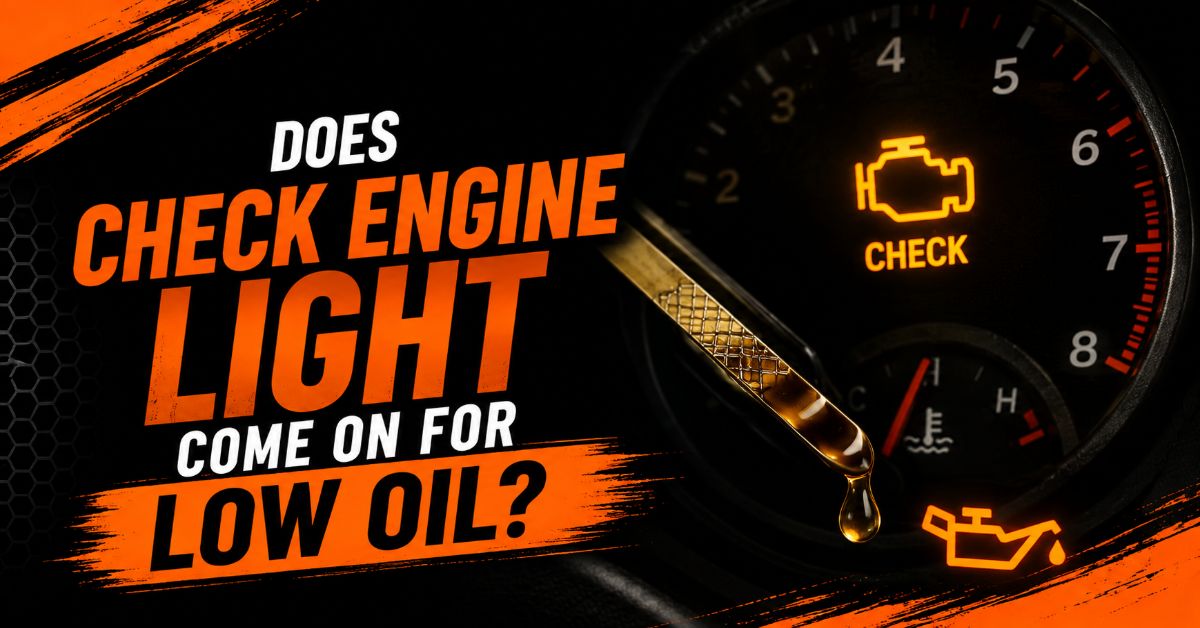
No, the check engine light does not directly monitor oil level, but low oil frequently triggers it indirectly by dropping hydraulic pressure. When engine oil drops 1.5 to 2 quarts low, the hydraulic pressure falls below the threshold required to operate Variable Valve Timing (VVT) solenoids and timing chain tensioners. This causes mechanical timing slippage, triggering check engine codes like P0011 or P0016 before the critical oil pressure warning light illuminates.
At a Glance
- Indirect Trigger: Check engine lights monitor emissions and timing, not liquid volume in the oil pan.
- VVT Failure Threshold: A drop of 1.5–2 quarts starves VVT systems, which require 20–25 PSI at hot idle.
- Common Fault Codes: Low oil pressure produces timing codes including P0011, P0012, P0014, P0016, and P0524.
- Dashboard Lights Differ: The yellow engine icon indicates timing/emissions issues; the red oil can indicates critical pressure loss.
- Post-Top-Off Lag: The light requires 3 to 10 drive cycles to reset naturally after adding oil.
How Does Low Oil Indirectly Trigger a Check Engine Light?
Low oil triggers a check engine light by starving hydraulic components that rely on pressurized oil to manage engine timing and combustion. The Powertrain Control Module (PCM) continuously monitors engine parameter sensors rather than fluid levels in the oil pan. When oil volume decreases, hydraulic oil pressure drops below operational thresholds, causing three distinct mechanical system failures that the PCM registers as emissions or performance faults:
Low Oil Volume → Pressure Drop → VVT / Tensioner Starvation → Timing Deviation → Check Engine Light
- Variable Valve Timing (VVT) System Starvation: VVT actuators require consistent oil pressure (typically 20–25 PSI at hot idle) to advance or retard camshaft positions. Insufficient pressure prevents the system from achieving target timing angles, prompting codes P0011 or P0014.
- Timing Chain Tensioner Slack: Hydraulic timing chain tensioners rely on pressurized oil. Aerated or low-pressure oil causes tensioner collapse, leading to chain slack and sensor misalignment between the crankshaft and camshaft (Code P0016).
- Misfires from Camshaft Misalignment: Severe timing lag impairs cylinder filling and exhaust scavenging, causing air-fuel mixture imbalances that trigger random misfire codes (P0300 through P0308).
How Low Does Engine Oil Have to Be to Trigger the Light?
Engine oil generally needs to drop 1.5 to 2.5 quarts below capacity (roughly 30% to 50% of total volume) to trigger a check engine light. At this level, the oil pump pickup screen periodically draws in air pockets, causing dynamic pressure drops during acceleration, cornering, or hot idling.
| Oil Volume Loss | Engine Pressure Impact | Primary Diagnostic Outcome |
| 0.5 – 1.0 Quart Low | Pressure remains stable (30–50 PSI). | No lights; normal operation. |
| 1.5 – 2.0 Quarts Low | Idle pressure drops below VVT minimum (20 PSI). | Check Engine Light turns on (P0011, P0016). |
| 2.5+ Quarts Low | Critical pressure drop below 4–7 PSI. | Red Oil Pressure Light turns on / Limp Mode activates. |
Modern engines with smaller oil capacities (such as 4.0-quart 4-cylinder engines) show symptoms faster than large-capacity V8 engines holding 6 to 8 quarts, because a 1.5-quart loss represents a larger percentage of total operational fluid.
What Diagnostic Trouble Codes (DTCs) Indicate Low Oil?
Diagnostic trouble codes P0011, P0012, P0014, P0016, and P0524 are the most common indicator codes triggered by low oil conditions. These OBD-II codes flag timing delays, sensor desynchronization, or low oil pressure circuit faults.
- P0011 / P0014 (Camshaft Position Timing – Over-Advanced): Indicates the VVT actuator on Bank 1 or Bank 2 failed to return to its baseline position due to insufficient hydraulic force.
- P0012 / P0017 (Camshaft Position Timing – Over-Retarded): Indicates oil pressure was too low to advance the camshaft timing when requested by the engine computer.
- P0016 (Crankshaft/Camshaft Position Correlation): Signals that a loose timing chain—caused by an unpressurized hydraulic tensioner—has allowed the camshaft and crankshaft to move out of synchronization.
- P0524 (Engine Oil Pressure Too Low): Stored when the oil pressure sensor registers an absolute pressure drop below the safety threshold established by the manufacturer.
What Is the Difference Between the Check Engine Light and the Oil Lights?
The Check Engine Light, Oil Pressure Warning Light, and Yellow Low Oil Level Light perform entirely different safety functions on a vehicle’s dashboard. Drivers frequently confuse these three warnings, leading to delayed maintenance or engine failure.
+--------------------------+------------------------------------+----------------------------+
| Warning Symbol           | Component Measured                 | Action Required            |
+--------------------------+------------------------------------+----------------------------+
| Check Engine (Yellow)    | Computer Sensors & Engine Timing   | Scan codes within 24 hours |
| Oil Pressure (Red)       | Absolute Oil Pressure (PSI)        | STOP ENGINE IMMEDIATELY    |
| Low Oil Level (Yellow)   | Fluid Height in Oil Pan            | Top off oil at next stop   |
+--------------------------+------------------------------------+----------------------------+
Check Engine Light (Yellow Engine Icon)
Monitors engine emissions, sensor inputs, and timing calibration. It turns on when mechanical timing shifts due to low hydraulic oil pressure, but it does not measure fluid level directly.
Oil Pressure Warning Light (Red Oil Can)
Monitors real-time oil pressure via a pressure switch. It illuminates only when oil pressure falls below 4 to 7 PSI—a critical threshold indicating near-total loss of lubrication.
Low Oil Level Indicator (Yellow Oil Can with Waves)
Found primarily on European vehicles (BMW, Audi, Mercedes-Benz) and select Japanese models (Honda). It directly measures liquid height using a thermal fluid level sensor in the oil pan and signals when fluid drops 1 quart low, independent of the check engine system.
Which Specific Engine Designs Are Most Vulnerable to Low-Oil Check Engine Lights?
Engines equipped with oil-actuated Variable Valve Timing, displacement-on-demand systems, or hydraulic timing tensioners are most sensitive to low-oil check engine lights.
       HIGH SENSITIVITY                       MODERATE SENSITIVITY
┌──────────────────────────────┐       ┌──────────────────────────────┐
│  GM 2.4L Ecotec (I4)         │       │  Ford 3.5L EcoBoost (V6)     │
│  Ford 5.4L Triton (V8)       │       │  Subaru 2.5L EJ/FB (H4)      │
│  Chrysler 2.4L Multiair (I4) │       │  Toyota 2.4L 2AZ-FE (I4)     │
└──────────────────────────────┘       └──────────────────────────────┘
- GM 2.4L Ecotec (I4): Uses fine-tolerance VVT solenoids that lock up with minor pressure drops or oil degradation, triggering P0010/P0011 codes rapidly.
- Ford 5.4L 3-Valve Triton (V8): Relies on long hydraulic passages to feed the VVT phasers. Low oil volume starves the top end first, causing phaser knock and camshaft position error codes.
- Chrysler 2.4L Tigershark MultiAir: Uses electro-hydraulic valve actuation instead of a standard intake camshaft. Low oil starves the intake valves directly, forcing the PCM to illuminate the check engine light and enter emergency shutdown mode.
Why Does the Oil Light or Check Engine Light Flicker During Hard Turning or Braking?
An oil light or check engine light flickers during hard cornering or braking because low fluid volume sloshes away from the oil pump pickup tube inside the oil pan.
When an engine is 2 or more quarts low, centrifugal force pushes the remaining pool of oil against the side walls of the pan during sharp turns or sudden deceleration. The oil pump pickup tube momentary draws air instead of fluid. This creates a temporary pressure drop that causes the red oil pressure light or yellow check engine light to flash for several seconds until the vehicle stabilizes and fluid covers the pickup screen again.
Why Is the Check Engine Light Still On After Adding Oil?
A check engine light remains illuminated after adding oil because the vehicle’s engine control module (ECM) holds diagnostic trouble codes in long-term memory until specific self-test conditions are fulfilled. The light does not shut off instantly when fluid is restored.
To turn off the check engine light automatically, the vehicle must complete 3 to 10 consecutive “drive cycles” without detecting the original fault. A complete drive cycle requires:
- Starting the engine cold (coolant temperature below 122°F / 50°C).
- Driving until normal operating temperature (180°F–210°F / 82°C–99°C) is reached.
- Sustaining a mix of city and highway driving for 15–20 minutes.
- Turning off the engine and letting it cool completely.
To clear the light immediately, connect an OBD-II scanner to the vehicle’s port beneath the dashboard and select “Clear/Reset Diagnostic Trouble Codes.” Alternatively, disconnecting the negative battery terminal for 15 minutes clears stored memory on older vehicles (pre-2008), though this resets radio presets and clock settings.
Why Is Oil Low When the Dashboard “Oil Life” Display Says 30% Remains?
The dashboard “Oil Life” percentage display monitors oil degradation, not physical oil volume.
The Engine Oil Life System (OLS) calculates remaining fluid usability using an algorithm based on engine revolutions, operating temperatures, idle time, and accumulated mileage. It assumes the oil pan contains a full factory fill of fluid. If an engine burns or leaks oil, the volume drops while the remaining fluid continues to age at its predicted rate. An engine can hold zero quarts of oil while the display reads 100% Oil Life Remaining. Manual dipstick inspection remains the only reliable method for verifying oil level.
Can Low Oil Cause Permanent Damage Before Any Light Comes On?
Yes, low oil can cause permanent internal engine wear before any dashboard warning light turns on. Hydraulic starvation occurs at micro-interfaces—such as camshaft journal bearings, piston skirts, and wrist pins—long before systemic oil pressure falls low enough to trip the 4–7 PSI threshold of a red pressure light.
When engine oil runs 1 to 1.5 quarts low, fluid circulation temperatures spike because less oil is available to dissipate heat. This heat accelerates oil oxidation and causes thermal breakdown. The reduced oil film thickness leads to metal-to-metal contact on boundary-lubricated components. By the time a red pressure light turns on or a check engine light sets a timing code, microscopic scoring on bearings and crankshaft journals has already occurred.
How Long Can an Engine Run with the Red Oil Pressure Light On?
An engine operating with an active red oil pressure light will suffer catastrophic mechanical failure within 5 to 30 seconds.
Without pressurized fluid to cushion moving parts, metal-to-metal friction generates heat fast enough to weld rod bearings to the crankshaft, gall camshaft journals, and seize pistons inside cylinder walls.
Emergency Protocol for Red Oil Light
- Pull Over Immediately: Safely steer to the shoulder or road margin.
- Turn Off Ignition: Shut down the engine within 5 seconds of stopping. Do not coast with the engine idling.
- Do Not Restart: Check the dipstick. If oil is absent, adding oil may allow safe restarting only if no knocking noises are present. If the light remains on after filling, tow the vehicle immediately.
Can You Drive Home with a Check Engine Light On and Low Oil?
You can drive home with a check engine light on only after adding oil to bring the fluid level into the crosshatched “FULL” mark on the dipstick.
If the dipstick reads completely dry below the bottom indicator hole, do not start the engine. Operating an unlubricated engine risks immediate mechanical breakdown. Walk to an auto parts store or arrange to have motor oil delivered to your location. Once topped off with the correct viscosity grade, the engine is safe to operate while the ECM processes the drive cycles required to turn off the check engine light.
The Bottom Line
While a check engine light does not monitor oil levels directly, low oil frequently triggers it by lowering hydraulic pressure until Variable Valve Timing systems and timing chain tensioners fail.
Never rely on the “Oil Life” percentage monitor to determine fluid volume, as it calculates oil age rather than physical fluid level. Always pull over immediately if the red oil pressure light illuminates, but if a yellow check engine light appears alongside low oil, top off the engine with fluid before continuing your journey.