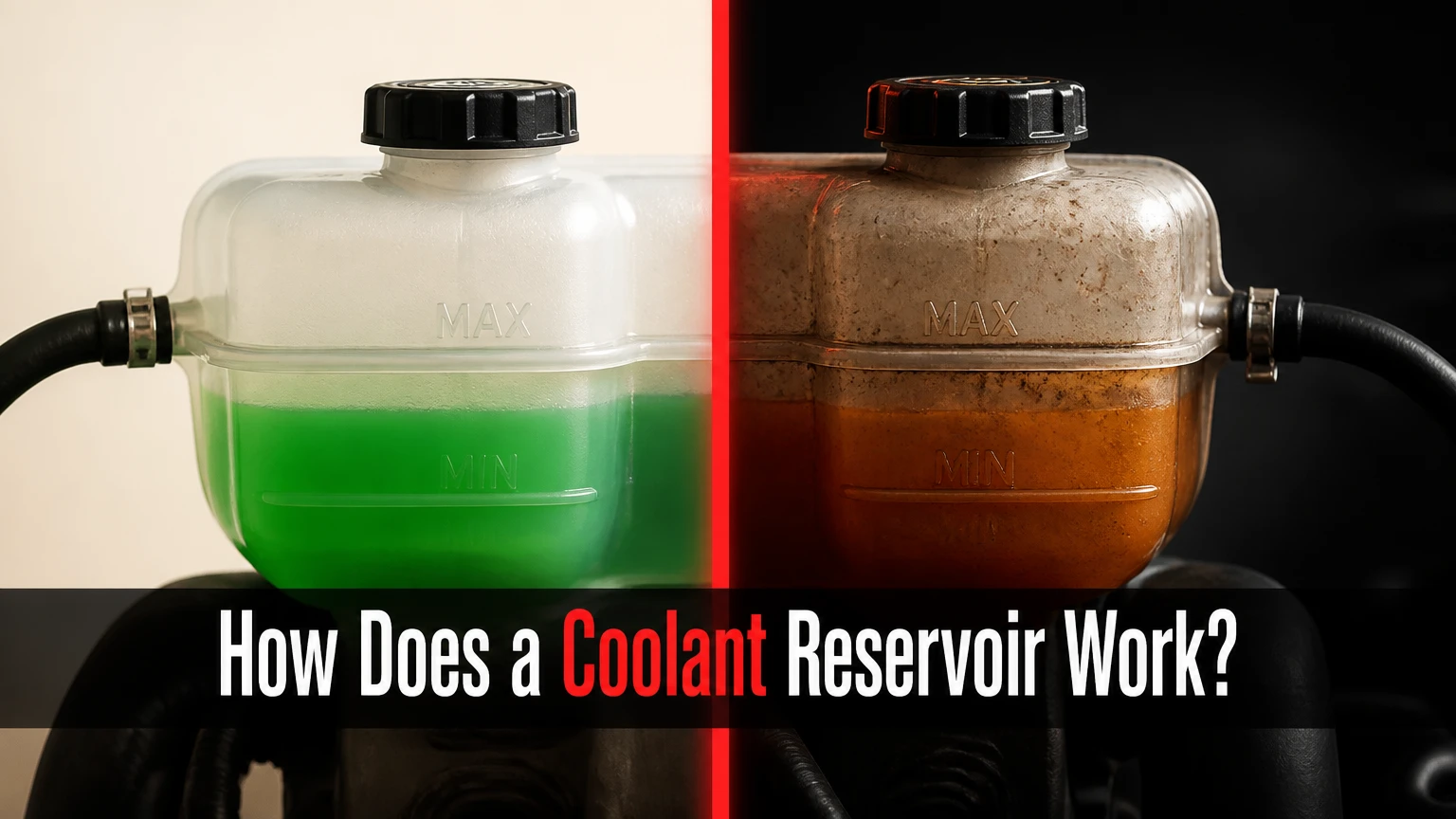
A coolant reservoir manages the thermal expansion and contraction of engine coolant by storing displaced fluid as temperatures rise and returning it to the main cooling loop as the engine cools. This dynamic process maintains constant fluid volume, prevents air pockets, and keeps the cooling system pressurized to elevate the fluid’s boiling point.
At a Glance
- Thermal Expansion Handling: Coolant expands by 4% to 6% at operating temperature ($195^\circ\text{F}\text{–}220^\circ\text{F}$), requiring the reservoir to store excess volume safely.
- Two Distinct Designs: Pressurized expansion tanks actively hold system pressure ($15\text{–}22\text{ PSI}$), whereas non-pressurized overflow bottles operate at atmospheric pressure ($0\text{ PSI}$).
- Boiling Point Elevation: Pressurization via the system cap raises the boiling point of a 50/50 glycol mix from $225^\circ\text{F}$ up to $265^\circ\text{F}$.
- Vacuum Return Loop: As the engine cools, dropping fluid volume creates a $-1\text{ PSI}$ vacuum that draws air-free coolant back into the radiator.
- Diagnostics Sentinel: Visual cues in the reservoir—such as bubbling, milky sludge, or stagnant levels—signal head gasket breaches, cap failures, or micro-leaks.
What Is the Difference Between an Expansion Tank and an Overflow Bottle?
An expansion tank is a pressurized component integrated directly into the primary cooling loop, whereas an overflow bottle is a non-pressurized catch basin operating at atmospheric pressure. The choice of design determines where pressure is managed, how fluid circulates, and how the system is serviced.
| System Feature | Pressurized Expansion Tank | Non-Pressurized Overflow Bottle |
| Operating Pressure | Fully pressurized ($15\text{ to }22\text{ PSI}$) | Atmospheric pressure ($0\text{ PSI}$) |
| Pressure Cap Location | Directly on the plastic reservoir | On top of the metal radiator neck |
| Coolant Circulation | Active, continuous flow through the tank | Passive, moves only during thermal cycles |
| Structural Material | Heavy-duty, reinforced thick plastic | Translucent, unreinforced molded plastic |
| Air Management | Features a built-in air cushion space | Relies on the radiator neck to vent air |
In a pressurized expansion tank, the reservoir itself contains the air cushion necessary to absorb fluid expansion. Because it withstands high pressure, any physical damage or cap failure results in immediate pressure loss and fluid boil-over.
In a non-pressurized overflow system, the radiator holds all the system pressure. The overflow bottle simply stores displaced fluid that pushes past the spring-loaded radiator cap when hot, holding it until a vacuum pulls it back upon cooling.
What Is the Step-by-Step Physics of Coolant Expansion and Contraction?
The coolant reservoir functions through a five-stage thermodynamic cycle driven by engine heat, fluid density changes, and atmospheric pressure differentials.
[ Engine Heats Up ] ──> [ Fluid Expands 4–6% ] ──> [ Pressure Hits ~15 PSI ] ──> [ Cap Valve Opens ]
                                                                                         │
[ System Fully Sealed ] <── [ Vacuum Pulls Fluid ] <── [ System Cools & Contracts ] <────┘
- Thermal Expansion: As combustion heats the engine to operating temperatures ($195^\circ\text{F}\text{ to }220^\circ\text{F}$), the $50/50$ water-glycol mixture expands in volume by approximately $4\%\text{ to }6\%$.
- Pressure Threshold: Because liquid cannot be compressed, expansion increases hydraulic pressure inside the sealed cooling system until it hits the cap’s rated limit (typically $15\text{ to }16\text{ PSI}$).
- Fluid Displacement: The primary spring-loaded valve in the cap compresses under this pressure. In overflow setups, fluid vents through a overflow hose into the bottle. In expansion setups, fluid flows into the tank, compressing its internal air cushion.
- Thermal Contraction: When the engine shuts down and cools, the liquid contracts. This reduction in volume creates a localized negative pressure (vacuum) inside the main radiator and block.
- Vacuum Return: Once internal pressure drops to roughly $-1\text{ PSI}$, a secondary, smaller vacuum valve in the center of the cap opens. The pressure differential draws air-free liquid from the reservoir back into the main loop, keeping the engine $100\%$ primed.
At What Temperature and Pressure Does a Coolant Reservoir Operate?
A coolant reservoir operates within fluid temperatures of $175^\circ\text{F}\text{ to }220^\circ\text{F}$ ($79^\circ\text{C}\text{ to }105^\circ\text{C}$) and pressures ranging from $0\text{ PSI}$ on overflow bottles up to $22\text{ PSI}$ on modern pressurized expansion tanks.
Pure Water (Sea Level, 0 PSI)         : 225°F Boiling Point
50/50 Glycol Mix (Pressurized 15 PSI) : 265°F Boiling Point
                                        ▲
                                        └── +3°F Elevation per 1 PSI Pressure
System pressure directly dictates thermal tolerance:
- Base Boiling Point: Pure water boils at $225^\circ\text{F}$ ($107^\circ\text{C}$) at sea level when mixed $50/50$ with standard ethylene glycol.
- Pressure Elevation: Every $1\text{ PSI}$ of pressure added to the system elevates the boiling point of the coolant mixture by roughly $3^\circ\text{F}$ ($1.6^\circ\text{C}$).
- Operating Ceiling: Under a standard $15\text{ PSI}$ cap, the boiling point of a $50/50$ glycol mixture rises to approximately $265^\circ\text{F}$ ($129^\circ\text{C}$). This $45^\circ\text{F}$ margin prevents localized boiling around engine cylinder walls under heavy load.
How Does a Radiator Cap Control Fluid Flow to and From the Reservoir?
A radiator cap acts as a dual-action mechanical valve that regulates maximum system pressure and manages dynamic fluid recovery. It contains two distinct spring-loaded mechanisms calibrated to opposite pressure conditions.
  OVER-PRESSURE CONDITION (>15 PSI)       VACUUM CONDITION (-1 PSI)

       [ Compressed Spring ]                 [ Relaxed Spring ]
                 │                                   │
         ▲ ▲ ▲ Fluid Out ▲ ▲ ▲               ▼ ▼ ▼ Fluid In ▼ ▼ ▼
     ═════════════════════════           ═════════════════════════
         Main Pressure Valve                 Central Vacuum Valve
             (Pushed Up)                         (Pulled Down)
The larger main valve faces inward toward the engine coolant. When system pressure exceeds the calibrated spring force (e.g., $16\text{ PSI}$), the spring compresses, lifting the main rubber seal off its seat to bypass excess pressure and fluid toward the reservoir overflow port.
The smaller vacuum valve sits suspended in the center of the main valve disk. When the engine shuts down and cooling fluid contracts, internal pressure drops below atmospheric level. The resulting $-1\text{ PSI}$ differential unseats this central pin valve, opening a path for fluid to flow backwards from the reservoir into the radiator neck.
Where Should the Coolant Level Be When the Engine Is Cold vs. Hot?
When the engine is stone cold, the fluid level should rest precisely at the Cold Full (or “MIN”) mark; when fully warmed up, it should rise to the Hot Full (or “MAX”) line. The $2\text{ to }3\text{ inch}$ vertical gap between these lines provides the necessary buffer for thermal swelling.
       ┌─────────────────────────┐
       │   [ PRESSURIZED TANK ]  │
       │                         │
       │ ── ── ── ── ── ── ── ── │  <-- HOT FULL / MAX (Engine Hot)
       │    ~ 2 to 3 Inches      │
       │ ── ── ── ── ── ── ── ── │  <-- COLD FULL / MIN (Engine Cold)
       │                         │
       └─────────────────────────┘
Filling a cold reservoir up to the “Hot Full” mark leaves inadequate volume for thermal expansion. Once the engine hits $200^\circ\text{F}$, expanding fluid fills the remaining volume and vents onto the ground.
Conversely, allowing the cold fluid level to fall below the “Cold Fill” line introduces air into the siphon tube during the cool-down phase, drawing air pockets directly into the engine block.
Why Is the Coolant Reservoir Full But the Radiator Is Empty?
A full reservoir alongside an empty radiator indicates a complete failure of the vacuum recovery siphon, usually caused by a micro-leak, a defective cap, or a damaged connecting hose.
                  [ FULL OVERFLOW BOTTLE ]
                             │
                             │ (Siphon Hose Cracked/Loose)
                             ▼
                     [ AIR LEAKS IN ]
                             │
                             ▼
[ VACUUM DESTROYED ] ──> [ ENGINE DRAINS DRY ]
When the engine cools down, the system must maintain an airtight vacuum to draw fluid back from the bottle. If the transfer hose between the radiator neck and reservoir is split, clogged, or loose at the fittings, the vacuum draws outside air rather than liquid coolant.
Similarly, an incorrect radiator cap depth prevents proper seating against the inner seal. An “SAE Shallow” cap ($0.375\text{ inch}$ reach) installed on an “SAE Deep” neck ($0.75\text{ inch}$ reach) leaves a permanent gap, completely disabling the vacuum siphon while leaving the external bottle full.
Why Is My Coolant Reservoir Bubbling or Boiling When the Engine Is Off?
Bubbling or boiling in the coolant reservoir after engine shutdown indicates either severe thermal heat-soak, a failed pressure cap, or combustion gases leaking past the head gasket into the cooling jackets.
If the pressure cap fails to hold its rated specification (e.g., venting at $3\text{ PSI}$ instead of $15\text{ PSI}$), system pressure drops prematurely. This sudden drop lowers the fluid’s boiling point from $265^\circ\text{F}$ down toward $225^\circ\text{F}$, causing operational fluid to vaporize into steam bubbles that purge into the reservoir.
If boiling is accompanied by a sweet exhaust smell or rapid, violent bubbling immediately upon starting a cold engine, combustion chamber pressure (often exceeding $1,000\text{ PSI}$) is pushing exhaust gases across a damaged head gasket directly into the liquid coolant stream.
Can I Drive With a Cracked Coolant Reservoir?
You cannot drive with a cracked pressurized expansion tank, but you can temporarily drive short distances with a damaged non-pressurized overflow bottle if radiator fluid levels are manually maintained.
CRACKED EXPANSION TANK    ==>  Pressure Drop  ==> Boiling Point Drops  ==> Catastrophic Overheat
CRACKED OVERFLOW BOTTLE  ==>  Fluid Loss     ==> No Vacuum Return     ==> Drive Short-Term (Monitor Radiator)
A crack in a pressurized expansion tank vents system pressure directly into the atmosphere ($0\text{ PSI}$). This lowers the boiling point of the coolant instantly, causing localized flash-boiling, thermal air pockets, severe cylinder head warping, and rapid engine destruction within minutes of reaching operating temperature.
A crack in a non-pressurized overflow bottle simply leaks displaced excess fluid. The main engine loop remains pressurized via the radiator cap, allowing short-distance driving provided you check and top off the radiator directly at the cap when cold.
Why Is There Milky Brown Sludge Inside My Coolant Reservoir?
Milky brown sludge in the reservoir is an emulsion caused by motor oil or automatic transmission fluid mixing directly with the water-glycol coolant.
[ Engine Oil / Transmission Fluid ] ──┐
                                     ├──> Intermix via Failed Barrier ──> [ Milky Brown Emulsion ]
[ Water-Glycol Coolant ] ────────────┘
The three most common causes of fluid contamination are:
- Failed Head Gasket: High-pressure oil galleries leak across the gasket fire-ring directly into adjacent cooling passages.
- Breached Oil Cooler: Internal seals inside an oil-to-water engine oil cooler degrade, allowing higher-pressure oil to enter the lower-pressure cooling circuit.
- Ruptured Transmission Cooler: The internal heat exchanger inside the radiator tank splits, allowing automatic transmission fluid (ATF) to mix with coolant, creating a thick, light-brown emulsion often described as “chocolate milk.”
How Does High Altitude Affect Coolant Reservoir Performance?
High altitude reduces atmospheric pressure, which decreases the baseline boiling point of unpressurized fluid in overflow systems and causes pressure caps to vent earlier relative to ambient air.
At elevations above $10,000\text{ feet}$ ($3,000\text{ meters}$), ambient atmospheric pressure drops from $14.7\text{ PSI}$ (sea level) to roughly $10.1\text{ PSI}$.
- Overflow Bottle Impact: The unpressurized fluid in an overflow bottle boils at roughly $214^\circ\text{F}$ instead of $225^\circ\text{F}$, accelerating evaporation loss through the atmospheric vent.
- Expansion Tank Impact: The internal-to-external pressure differential increases. A cap calibrated to vent at $15\text{ PSI}$ relative differential will vent fluid into the expansion volume earlier, narrowing the engine’s thermal safety margin under steep mountain climbs.
What Happens If You Overfill or Underfill a Coolant Reservoir?
Overfilling or underfilling a coolant reservoir disrupts the thermal expansion cycle, causing fluid waste or introducing air into the cooling circuit.
Overfilling a reservoir eliminates the air cushion designed to absorb thermal expansion. When the engine reaches operating temperature, the expanding fluid has nowhere to expand, causing it to vent out of the overflow tube onto the ground. This wastes fluid and poses an environmental hazard.
Underfilling the reservoir starves the siphon tube during engine cool-down. When the vacuum phase occurs, the tube draws air instead of liquid into the radiator, creating air pockets in the engine block that lead to localized hot spots and erratic thermostat behavior.
How Do You Safely Bleed Air Out of a Coolant Reservoir System?
Bleeding air out of a cooling system requires elevating the fill point, opening air purge valves, and running the engine through thermal cycles until all trapped air bubbles escape.
- Park on an Incline: Park the vehicle on a steep driveway or elevate the front wheels using jack stands to ensure the radiator cap or expansion tank is the highest point in the system.
- Attach a No-Spill Funnel: Lock a spill-free coolant funnel into the radiator neck or expansion tank, filling it one-third full with a $50/50$ coolant mixture.
- Set Heater Controls to High: Turn the vehicle’s interior heat to maximum temperature and fan speed to open the heater core valve, ensuring full circulation.
- Run to Operating Temperature: Start the engine and let it idle until the thermostat opens (indicated by the upper radiator hose growing hot). Watch for rising air bubbles in the funnel.
- Squeeze Radiator Hoses: Squeeze the upper and lower radiator hoses periodically to force trapped air pockets upward into the funnel. Continue until no further air bubbles rise, then top off the reservoir to the “Cold Full” mark.
How Often Should You Replace or Clean a Coolant Expansion Tank?
A plastic coolant expansion tank should be inspected annually and replaced every 60,000 to 100,000 miles (or 5 to 8 years), as heat cycling degrades polypropylene plastic and causes stress fractures.
Over time, continuous exposure to hot glycol ($200^\circ\text{F}+$) and high pressure ($15\text{–}22\text{ PSI}$) turns flexible plastic brittle. Inspect the tank for micro-crazing (a network of fine hairline cracks), yellowing, or plastic flaking around the hose barbs.
If cleaning an dirty overflow bottle during a fluid flush, remove the bottle from the engine bay and rinse it with a mixture of warm water, dish soap, and pea-sized gravel, shaking vigorously to strip internal scale without damaging the plastic walls.
The Bottom Line
A coolant reservoir manages thermal expansion, maintains system pressurization, and purges air bubbles to protect the engine from severe heat damage. Pressurized expansion tanks continuously hold active system pressure, while non-pressurized overflow bottles passively catch and return displaced fluid via a radiator vacuum loop.
To maintain system health, keep cold fluid strictly at the “Cold Full” mark, replace worn pressure caps with the correct reach depth, and never ignore bubbling or oil contamination inside the tank.