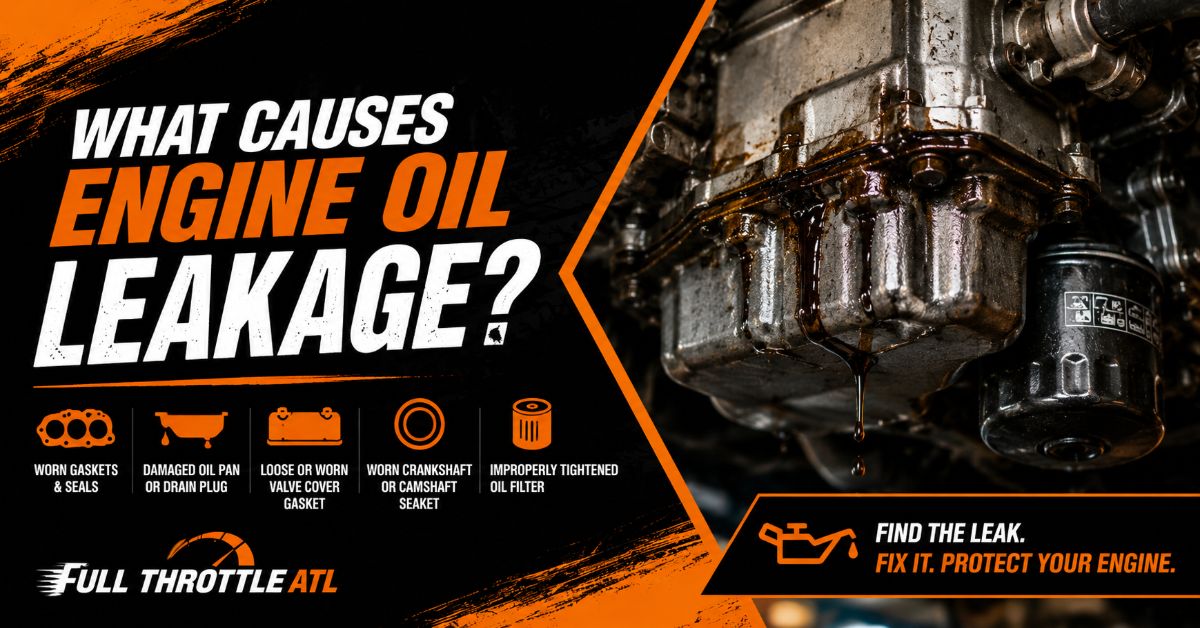
Engine oil leakage is primarily caused by degraded rubber seals and gaskets, excessive crankcase pressure from a failed PCV system, or improper installation of maintenance items like oil filters and drain plugs. As internal pressure pushing against aging materials exceeds containment thresholds—typically 20 to 60 PSI at operating temperature—oil forces its way past the mating surfaces.
At a Glance
- Gaskets & Seals: Valve cover and oil pan gaskets degrade through thermal cycling, typically failing between 60,000 and 100,000 miles.
- Crankcase Pressure: A clogged PCV valve spikes crankcase pressure above 3 to 5 PSI, blowing out otherwise healthy seals.
- Maintenance Errors: Overtightening an oil filter beyond 10–15 lb-ft crushes the O-ring seal, triggering immediate fluid loss.
- Thermal Contraction: Nighttime drops in temperature cause dissimilar engine metals to contract at different rates, opening microscopic leak paths.
- Wicking Risks: Internal sensor leaks can send oil through wiring harnesses directly into the Engine Control Unit (ECU) via capillary action.
How Do You Tell if Leaking Fluid Is Actually Engine Oil?
You can identify engine oil by its amber-to-black color, slick petroleum texture, and distinct burnt-fuel odor. Engine oil drops gather directly underneath the front half of the vehicle, centered under the engine block.
| Fluid Type | Color / Appearance | Consistency / Feel | Smell | Common Leak Location |
| Engine Oil | Light amber (new) to dark brown/black (used) | Slick, thick, viscous | Burnt oil, petroleum | Center front under the engine pan |
| Transmission Fluid | Red, pink, or dark brown | Slick, medium viscosity | Sweet, burnt, or acrid | Middle to front-center of vehicle |
| Coolant (Antifreeze) | Bright green, orange, pink, or blue | Watery, slippery | Sweet, sugary | Near the radiator or water pump |
| Brake Fluid | Clear to light yellow | Oily, slippery | Sharp, chemically harsh | Near wheels or engine firewall |
What Are the Most Common Components That Leak Engine Oil?
The most common components that leak engine oil are the valve cover gasket, oil pan gasket, main crankshaft seals, and oil filter assembly. These components contain pressurized oil while undergoing continuous thermal cycling between ambient temperatures and 200°F+ operating conditions.
+-------------------------------------------------------------------+
|                        TOP OF ENGINE                              |
|  [ Valve Cover Gaskets ] -> Thermal hardening from head heat       |
+-------------------------------------------------------------------+
|                       CENTER OF ENGINE                            |
|  [ Timing Covers / Cam Sensors ] -> Capillary wicking & seal dry  |
|  [ Oil Filter / Cooler Adapters ] -> Over-torque & O-ring crushing|
+-------------------------------------------------------------------+
|                       BOTTOM OF ENGINE                            |
|  [ Front / Rear Main Seals ] -> High crankcase pressure blowout   |
|  [ Oil Pan Gasket & Drain Plug ] -> Gravity accumulation & strike |
+-------------------------------------------------------------------+
Valve Cover Gaskets
Located at the highest point of the engine, valve cover gaskets seal the joint between the cylinder head and the valve cover. Constant exposure to extreme heat hardens the rubber, making it brittle and prone to cracking after 60,000 to 100,000 miles.
Oil Pan Gaskets and Drain Plugs
The oil pan stores the engine’s oil reserve at the bottom of the block. The gasket fails over time due to engine vibration and thermal movement. Drain plug leaks typically occur when the crush washer is reused or the plug threads are over-torqued past 35 lb-ft, stripping aluminum threads.
Crankshaft Main Seals (Front and Rear)
These circular lip seals wrap around the rotating crankshaft ends. The rear main seal is particularly prone to leaking over time because it sits directly behind the flywheel; failure allows oil to enter the transmission bellhousing, risking clutch contamination in manual vehicles.
Why Does Excessive Crankcase Pressure Cause Oil Leaks?
Excessive crankcase pressure causes oil leaks by physically forcing rubber seals outward away from their metal mating surfaces. Combustion gases naturally bypass piston rings into the crankcase (“blow-by”). If these gases cannot escape, pressure builds until the weakest seal gives way.
Normal engine crankcase pressure ranges between -0.5 PSI and +0.5 PSI. The Positive Crankcase Ventilation (PCV) system uses engine vacuum to draw these blow-by gases back into the intake manifold. When a PCV valve clogs, crankcase pressure can spike above 3 to 5 PSI. Under this positive pressure, even brand-new main seals and valve cover gaskets will weep or blow out completely.
Can an Improper Oil Change Cause an Engine Oil Leak?
Yes, an improper oil change is one of the most frequent causes of sudden, heavy engine oil leakage. Mistakes made during routine maintenance can breach the oil system’s integrity within seconds of starting the engine.
The “Double Gasket” Phenomenon
When removing an old oil filter, its rubber O-ring seal sometimes sticks to the engine block surface rather than staying attached to the filter casing. Installing a new filter over the old rubber ring creates a “double gasket.” Once the engine starts and oil pressure rises to 40–60 PSI, oil blows past the unsealed gap, dumping multiple quarts of oil onto the ground in seconds.
Improper Torque Specifications
- Oil Filters: Should be hand-tightened plus 3/4 to 1 full turn (approx. 10 to 15 lb-ft). Overtightening crushes and splits the internal rubber gasket.
- Drain Plugs: Require 15 to 30 lb-ft of torque depending on whether the pan is steel or aluminum. Exceeding 35 lb-ft strips the threads or cracks aluminum oil pans, leading to continuous weeping.
Why Does Engine Oil Leak Only After the Car Sits Overnight?
Engine oil leaks overnight primarily due to thermal contraction of internal metals and static fluid settling. As an engine cools down, components made of dissimilar metals—such as an aluminum cylinder head mated to a cast-iron engine block—contract at different rates.
This differential thermal contraction alters the clearance gap between metal mating surfaces. A hardened, aging rubber gasket that remains pliable enough to seal while hot (due to thermal expansion) shrinks and stiffens as ambient temperatures drop overnight. This creates microscopic gaps that allow resting oil to seep through until the engine warms up and expands again.
What Hidden Engine Oil Leaks Occur Without Dripping on the Ground?
Engine oil can leak internally into electrical, cooling, or combustion systems without ever dripping onto the driveway. These hidden leaks are often more damaging than external drips because they go undetected until secondary components fail.
Capillary Action in Wiring Harnesses
Oil can leak internally through sealed engine sensors, such as the oil pressure switch or camshaft position sensor. Pressure pushes oil through the inside of the copper wiring strands via capillary action. Oil can travel several feet along the engine wiring harness directly into the Engine Control Unit (ECU), ruining delicate circuit boards without leaving a single drop on the floor.
Casting Porosity and Internal Coolant Leaks
- Cast Matrix Porosity: Rare manufacturing defects in cast aluminum engine blocks leave microscopic voids within the solid metal walls, allowing pressurized oil to seep straight through the block shell.
- Oil Cooler / Head Gasket Breaches: An internal breach in the oil cooler matrix or cylinder head gasket allows high-pressure oil (up to 60+ PSI) to cross over into the lower-pressure cooling system (15 PSI). This coats the cooling system in a thick milk-chocolate-colored emulsion, reducing cooling efficiency without leaking externally.
Why Does Replacing a Wet Gasket Fail to Fix an Oil Leak?
Replacing a wet gasket fails to fix an oil leak when the technician replaces the destination of the oil rather than its origin. Because gravity and air resistance push fluid downward and backward, oil travels far from its original entry point before pooling.
       [ Valve Cover Gasket Leak ]  <--- TRUE ORIGIN (High up)
                   |
                   v  (Gravity pulls fluid down engine block)
         [ Engine Block Wall ]
                   |
                   v  (Airflow pushes fluid backward while driving)
         [ Oil Pan Gasket Area ]   <--- FALSE DIAGNOSIS (Replaced unnecessarily)
This phenomenon—known as the Upstream Mirage—frequently leads to incorrectly replacing lower oil pan gaskets when the leak actually originates high up at a valve cover gasket or camshaft seal.
Additionally, addressing the gasket alone fails if the root cause is structural. For instance, modern engines utilizing a horizontal bedplate design split the engine block at the crankshaft centerline. Diagnosing a bedplate leak as a standard oil pan leak will fail, as resolving it requires pulling the engine out to reseal the structural block halves.
Can I Drive a Car with an Engine Oil Leak?
Yes, you can safely drive with an engine oil leak if the leak is a minor seep, the engine oil level remains within the safe operating range on the dipstick, and oil is not dripping onto hot exhaust components.
                                  Is the oil leaking?
                                           |
                   +-----------------------+-----------------------+
                   |                                               |
         [ Drips < 1 quart/1,000 miles ]                 [ Heavy Drip or Puddle ]
                   |                                               |
    Does it touch hot exhaust parts?                     Losing > 1 quart per 100 miles?
         /                   \                                     |
     ( Yes )                ( No )                             ( YES )
        |                      |                                   |
        v                      v                                   v
  STOP DRIVING           DRIVE SAFELY                        DO NOT DRIVE
  Fire Risk              Monitor Dipstick                    Engine Damage Risk
When It Is Unsafe to Drive
- Fire Hazard: Oil dripping directly onto an exhaust manifold or catalytic converter presents an immediate fire risk. Engine exhaust surfaces reach temperatures well above 400°F (204°C), which exceeds the flashpoint of dirty engine oil.
- Rapid Pressure Loss: If the vehicle loses more than 1 quart of oil every 100 miles, running low on oil risks oil pump starvation, rod bearing destruction, and engine seizure.
Does Switching to a Higher Viscosity Oil Stop Oil Leaks?
No, switching to a higher viscosity oil (such as moving from 5W-20 to 10W-40) does not stop mechanical oil leaks and can cause severe valvetrain damage in modern engines. While thicker fluid flows more slowly through worn gaps, it fails to repair degraded rubber or lower crankcase pressure.
Modern engines rely on precise oil viscosity to operate Variable Valve Timing (VVT) actuators, hydraulic lifters, and active fuel management systems. Using high-viscosity oil delays hydraulic response times within VVT solenoids, triggering check engine lights (e.g., code P0011), causing rough idling, and accelerating cold-start engine wear.
Do Oil Leak Stop-Leak Additives Actually Work?
Oil leak stop-leak additives work temporarily for minor seeps along dried, hardened rubber seals, but they cannot fix torn gaskets, cracked metal, or high-pressure seal blowouts.
+-----------------------------------+-----------------------------------+
|     WHAT STOP-LEAK CAN FIX        |     WHAT STOP-LEAK CANNOT FIX     |
+-----------------------------------+-----------------------------------+
| * Minor seeps on rubber seals     | * Torn or split paper gaskets     |
| * Dried-out, hardened neoprene    | * Cracked aluminum pans or blocks |
| * Small valve cover seeps         | * High-pressure main seal leaks   |
|                                   | * Leaks caused by high PCV pressure|
+-----------------------------------+-----------------------------------+
Stop-leak chemicals function by utilizing petroleum distillates and plasticizers to swell and soften aging rubber seals. However, overusing these chemical treatments breaks down the structural integrity of the rubber over time, turning seals soft and gummy. Excess additive can also react with engine oil to form thick sludge deposits that clog oil passages and oil pump pickup screens.
How Do Mechanics Locate the Exact Source of an Oil Leak?
Mechanics locate the exact source of an oil leak using a systematic process combining high-pressure cleaning, UV fluorescent dye tracing, and smoke testing.
<Sequence>
  <Step title="Clean the Engine Bay">
    Spray the engine block with a heavy-duty degreaser and wash down the surface to clear away historical oil sludge and road debris.
  </Step>
  <Step title="Add UV Fluorescent Dye">
    Pour an automotive-grade UV leak detection dye directly into the oil filler cap.
  </Step>
  <Step title="Run the Engine">
    Idle or test-drive the vehicle for 10 to 15 minutes under normal operating pressures to allow the dye to circulate.
  </Step>
  <Step title="Inspect with a UV Light">
    Scan the engine block with a ultraviolet (UV) blacklight and yellow safety glasses. The exact origin point of the leak will glow bright yellow-green.
  </Step>
</Sequence>
How Much Does It Cost to Fix an Engine Oil Leak?
Fixing an engine oil leak costs between $150 and $2,000+, depending entirely on the labor required to access the damaged component rather than the cost of the seal itself.
| Leaking Component | Typical Parts Cost | Typical Labor Cost | Total Repair Cost |
| Valve Cover Gasket | $25 – $60 | $120 – $350 | $145 – $410 |
| Oil Pan Gasket | $30 – $80 | $250 – $600 | $280 – $680 |
| Oil Filter Housing / Adapter | $40 – $150 | $200 – $500 | $240 – $650 |
| Front Crankshaft Seal | $15 – $40 | $200 – $450 | $215 – $490 |
| Rear Main Seal | $20 – $50 | $800 – $1,500+ | $820 – $1,550+ |
Note: The rear main seal requires removing the entire transmission or engine assembly to access a $30 rubber part, resulting in high labor costs.
The Bottom Line
Engine oil leakage is driven by degraded sealing materials, high crankcase pressure from PCV failures, or incorrect installation torque. While minor seeps can be monitored by checking the dipstick regularly, leaks that drip onto hot exhaust manifolds or drop fluid rapidly present immediate fire and engine damage risks. Accurately diagnosing a leak requires tracing the oil upstream to its highest origin point rather than replacing whichever lower component happens to be wet.