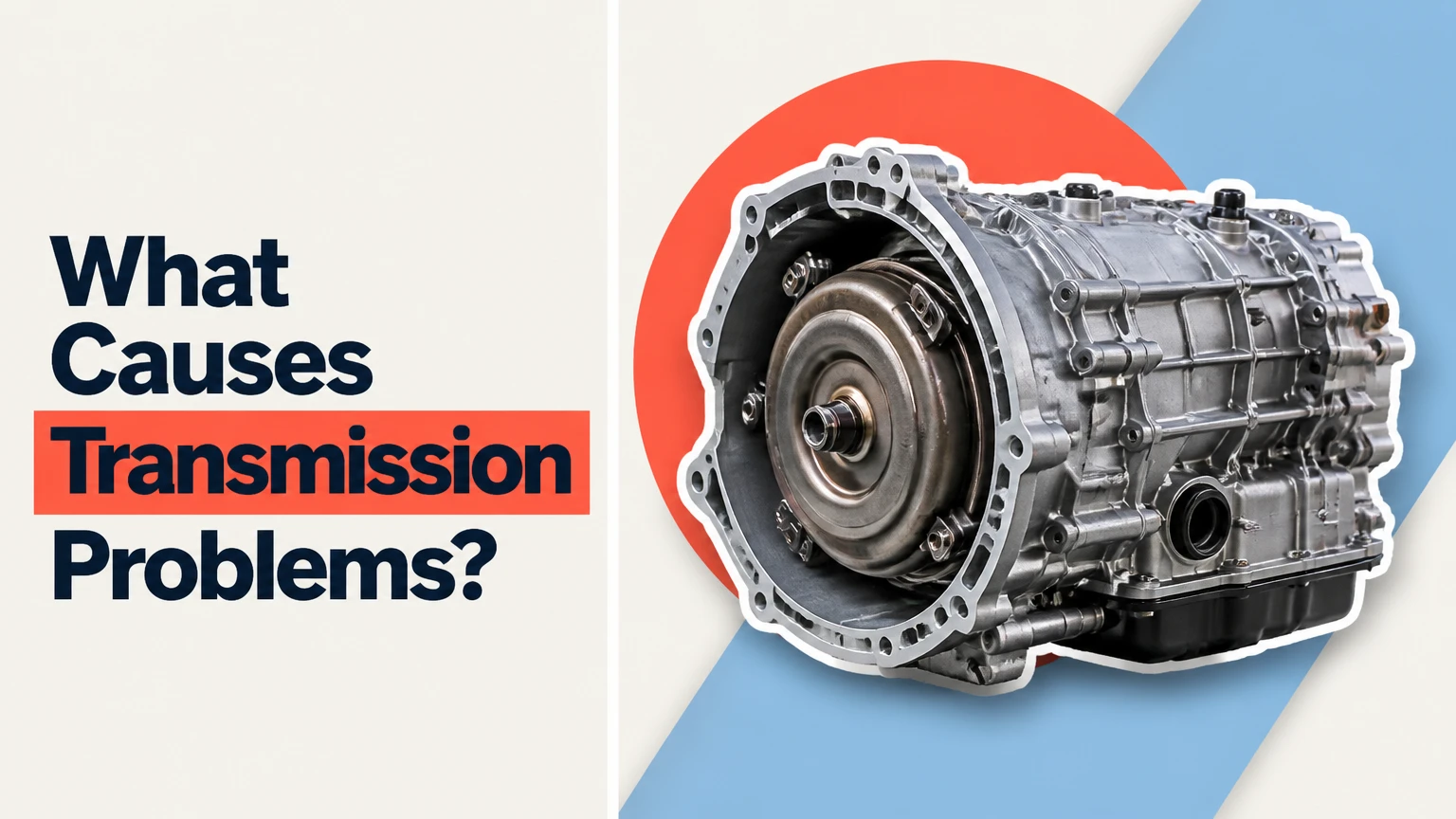
Transmission problems are primarily caused by thermal fluid degradation, internal mechanical friction wear, and electronic control failures. When transmission fluid exceeds its 175°F optimal operating temperature, the fluid loses hydraulic pressure, causing internal seals to shrink, clutch plates to slip, and critical components to permanently fail.
At a Glance: Key Transmission Failure Thresholds
- Transmission fluid life drops by 50% for every 20°F increase above the normal 175°F operating temperature.
- Hydraulic pressure dropping below 130 PSI prevents clutch engagement and causes immediate friction wear.
- Low battery voltage dipping below 10.5V during engine cranking can trigger false transmission failure codes.
- Flushing a high-mileage transmission that has never been serviced often triggers immediate mechanical slipping.
- Factory “lifetime” transmission fluids generally expire and lose sheer stability after 60,000 to 100,000 miles.
What are the early warning signs of transmission failure?
The earliest warning signs of transmission failure are delayed gear engagement, harsh shifting, and abnormal whining noises. A driver will typically notice a two-to-three-second pause between shifting the vehicle into “Drive” and feeling the transmission physically engage the wheels.
Other critical early warning signs include:
- RPM flaring: The engine RPM spikes upward between gear shifts before the next gear forcefully clunks into place.
- Puddle formation: Red, sweet-smelling fluid pooling under the center of the vehicle indicates a pan gasket or output shaft seal leak.
- Vibration under load: A shuddering sensation at speeds between 30 and 50 MPH often indicates early torque converter lock-up clutch failure.
Can low transmission fluid cause shifting problems?
Yes, low transmission fluid causes immediate and severe shifting problems by starving the transmission pump of hydraulic volume. Automatic transmissions rely entirely on hydraulic fluid to generate the 130 to 150 PSI of pressure required to compress clutch packs and hold gears in place.
When fluid levels drop, the transmission pump draws in air. This aerates the fluid into a foam, which compresses easily unlike pure liquid. Because aerated fluid cannot maintain the necessary 130 PSI threshold, the internal solenoids cannot actuate the valve body, leading to slipping gears, overheating, and eventual failure of the friction plates.
How does heat and fluid degradation destroy a transmission?
Excessive heat destroys a transmission by oxidizing the automatic transmission fluid (ATF), stripping the fluid of its lubricating properties and shear stability. At 300°F (149°C), complete mechanical destruction occurs within a few hundred miles.
As ATF overheats, it transforms from a high-friction hydraulic oil into a thin, burnt varnish. This degradation triggers a chain reaction:
- Seal Shrinkage: High heat causes internal neoprene and rubber seals to harden and shrink, creating internal pressure leaks.
- Debris Buildup: As the fluid thins, clutch plates slip and shed microscopic friction material.
- Valve Body Jamming: The shed clutch material travels through the fluid and permanently clogs the tiny orifices inside the valve body, preventing the transmission from changing gears.
What internal mechanical parts fail inside a transmission?
The most common mechanical failures inside a transmission occur within the clutch packs, planetary gear sets, and the torque converter. These rotating components bear the entire physical load of the vehicle’s acceleration.
- Clutch Packs: Friction material physically delaminates from the internal clutch discs due to heat, leaving bare steel plates that cannot grip one another.
- Planetary Gear Sets: The tiny needle bearings supporting the planetary gears fracture under heavy load, causing the gear set to shred itself and send metal shrapnel throughout the unit.
- Torque Converter: The internal lock-up clutch linings wear out over thousands of lock-and-unlock cycles, eventually sending metal debris directly into the primary transmission pump.
Can electronic sensor failures cause transmission problems?
Yes, electronic sensor failures frequently cause transmission problems by feeding incorrect data to the Transmission Control Module (TCM), forcing the vehicle into a protective “limp mode.” A transmission locked in limp mode will typically stay in second or third gear to prevent further mechanical damage.
Modern transmissions rely on shift solenoids and speed sensors. Continuous heat cycles break down the internal copper windings of shift solenoids, causing them to fail when hot. Furthermore, faulty Input/Output Speed Sensors can miscalculate wheel speed versus engine speed, triggering an immediate gear-ratio error code despite the transmission having zero physical mechanical damage.
Can a bad car battery cause rough transmission shifting?
Yes, a degrading car battery can cause erratic transmission shifting by dropping system voltage below critical thresholds. Modern Transmission Control Modules are highly sensitive to voltage stability. If a weak battery drops below 10.5 volts during engine cranking, it can corrupt the TCM’s short-term memory, wiping out custom shift adaptations or triggering false mechanical error codes.
What is the “strawberry milkshake” transmission problem?
The “strawberry milkshake” transmission problem occurs when a structural failure inside the vehicle’s radiator allows engine coolant to mix with automatic transmission fluid. This cross-contamination creates a milky, pink liquid that rapidly destroys the transmission.
The mixture is catastrophic because automatic transmission clutch plates are bonded together using water-soluble glue. When the water-based engine coolant enters the transmission case, it dissolves this glue within hours. The friction material separates from the steel plates entirely, resulting in complete transmission failure without any prior warning signs of overheating or slipping.
Are CVT transmission problems different from traditional automatics?
Yes, Continuously Variable Transmission (CVT) problems differ entirely from traditional automatic transmission issues because CVTs use a steel push-belt and pulley system instead of traditional planetary gears and clutch packs.
While traditional automatics fail via clutch plate wear, CVTs fail through belt stretching and pulley scoring. When a CVT overheats or lacks proper fluid maintenance, the steel belt physically slips against the aluminum pulleys. This metal-on-metal slippage gouges deep grooves into the pulleys, causing a violent rubber-band-like shuddering during acceleration. Once a CVT pulley is scored, the entire transmission must generally be replaced, as they are notoriously difficult to rebuild.
Why do transmissions slip after a high-mileage fluid flush?
Transmissions over 150,000 miles often slip immediately after a pressurized fluid flush because the old, gritty fluid was the only thing providing friction. Over years of driving without maintenance, the internal clutch packs shed their abrasive friction material into the fluid.
In a heavily worn transmission, this suspended microscopic debris acts as a liquid sandpaper, allowing the bare clutch plates to grab one another. When a flush machine forces new, highly-detergent fluid through the system, it completely washes away this abrasive grit. Without the grit, the worn clutches immediately slip against each other, rendering the vehicle undrivable.
Do transmission stop-leak additives actually work?
No, transmission stop-leak additives do not permanently fix leaks, and they often cause catastrophic transmission failure within a few months of use. These over-the-counter chemicals operate by chemically forcing hardened rubber seals to rapidly swell and soften, temporarily stopping external fluid drips.
However, the additive cannot distinguish between a leaking seal and a healthy internal seal. The chemical continues to swell all internal piston seals uncontrollably. Eventually, the seals turn soft, mushy, and disintegrate entirely. This results in massive internal hydraulic pressure loss, requiring a complete transmission rebuild.
Does “lifetime” transmission fluid really last forever?
No, “lifetime” transmission fluid does not last forever; the term simply refers to the manufacturer’s expected factory warranty period, which is typically 60,000 to 100,000 miles. Automotive engineers acknowledge that no hydraulic fluid can indefinitely withstand the shear forces and thermal breakdown of a combustion engine environment.
If a vehicle is subjected to severe duty conditions—such as towing trailers, idling in heavy traffic, or navigating steep mountainous terrain—the “lifetime” fluid degrades even faster. Driving past 100,000 miles on the original factory fluid guarantees excessive internal wear and significantly shortens the lifespan of the transmission.
Can I drive a car with a slipping transmission?
No, you should never drive a vehicle with a slipping transmission. Driving a slipping transmission generates extreme localized heat almost instantly, turning minor, inexpensive electrical repairs into catastrophic mechanical failures.
When a transmission slips, the internal clutch plates rub against each other without fully locking. This friction spikes the fluid temperature well beyond 300°F. A slip that could have originally been fixed by replacing a simple $150 electronic shift solenoid will permanently burn out a $4,000 clutch pack within just a few miles of continued driving.
Why does a transmission slip only when the engine is hot?
A transmission slips when hot because transmission fluid loses viscosity and thins out as its temperature rises. If a transmission has hardened internal rubber seals or a worn-out hydraulic pump, the transmission can still function when cold because thick fluid cannot easily squeeze past the damaged seals.
Once the vehicle reaches operating temperature, the thin, hot fluid easily leaks past these worn internal boundaries. This internal bleeding drops the hydraulic pressure below the strict 130 PSI threshold required to hold the gear sets in place, resulting in a sudden, violent slip only after the vehicle has been driven for several miles.
Is a transmission fluid change or a fluid flush better?
A transmission fluid change is significantly safer and better for the longevity of the vehicle than a pressurized fluid flush.
| Procedure | Method | Safety Risk | Best For |
|---|---|---|---|
| Fluid Change | Gravity drain of pan, replaces filter, swaps 30–50% of fluid. | Low | Vehicles of all mileages; safe routine maintenance. |
| Fluid Flush | Machine forces fluid through the entire system under pressure. | High | Only for vehicles with a strict, unbroken record of flushes every 30k miles. |
A flush uses external pressure that can easily dislodge heavy metal sludge from the bottom of the transmission pan and jam it directly into the delicate valves of the valve body. A fluid change relies on gravity, safely replenishing the chemical additives in the fluid without violently disturbing internal debris.
How often should transmission fluid actually be changed?
Transmission fluid should be changed every 30,000 to 60,000 miles, depending on the type of transmission and the driver’s habits. Preventative maintenance is the single most effective way to stop hydraulic and mechanical transmission problems before they start.
- Severe Duty (30,000 miles): Vehicles used for towing, fleet delivery, off-roading, or heavy stop-and-go city traffic.
- Standard Duty (60,000 miles): Vehicles driven primarily on highways under normal, predictable conditions.
- CVT Transmissions (30,000 miles): Continuously Variable Transmissions degrade fluid much faster due to the extreme friction of the steel push-belt and require strict 30,000-mile intervals.
How much does it cost to fix a transmission problem?
Fixing a transmission problem costs anywhere from $150 to $5,000, depending heavily on whether the failure is electronic, hydraulic, or catastrophic mechanical damage. Diagnosing the exact fault code is required before estimating a repair.
- Fluid and Filter Service: $150 – $300.
- Electronic Solenoid/Sensor Replacement: $200 – $500. Solenoids can often be accessed by simply dropping the transmission pan without removing the entire unit from the car.
- Transmission Rebuild: $2,500 – $4,500. The transmission is removed, fully disassembled, and all soft parts (seals, clutches, bands) are replaced.
- Complete Replacement: $3,000 – $5,000+. Required when hard metal parts (cases, planetary gears) are shredded beyond repair.
The Bottom Line
Transmission problems stem from three distinct failures: thermal fluid breakdown, electronic control glitches, and physical friction wear. Protecting the transmission requires keeping hydraulic pressure high and fluid temperatures strictly below 200°F. Never assume a transmission is mechanically dead without first checking the vehicle’s battery voltage and electronic solenoids. Finally, avoid pressurized flushes or “stop-leak” chemical additives on high-mileage vehicles, as these shortcuts reliably trigger complete transmission failure.