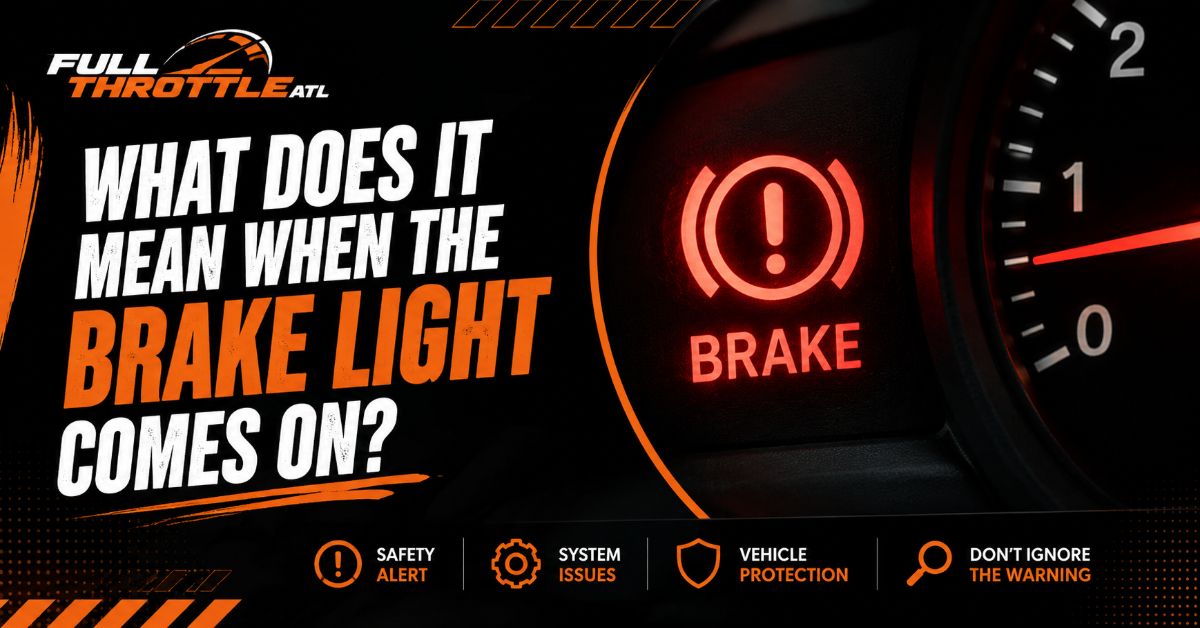
When a vehicle’s dashboard brake light illuminates, the braking system has experienced a critical drop in hydraulic fluid volume, a loss of hydraulic pressure, or an active engagement of the parking brake mechanism. Represented as a red exclamation mark inside a circle (!) or the word BRAKE, this primary safety warning indicates that stopping performance is compromised and requires immediate inspection before driving further.
At a Glance
- Fluid Drop Threshold: Sensors trigger the dashboard light when reservoir fluid drops below 70% to 75% capacity (reaching the “MIN” line).
- Pad Wear Factor: Brake pads worn from 12mm down to 2mm pull fluid into extended caliper pistons, dropping reservoir levels automatically.
- Color Severity: Red warning lights signal severe hydraulic or mechanical failures; yellow or amber lights signal secondary electronic faults like ABS or wear sensor alerts.
- Dual Light Warning: Simultaneous ABS and Brake light illumination indicates Electronic Brakeforce Distribution (EBD) failure, which presents a high risk of rear-wheel lockup and vehicle spinouts.
- Top-Off Risk: Adding brake fluid to a low reservoir without replacing thin brake pads causes fluid to overflow and corrode the engine bay during subsequent pad replacement.
What triggers the dashboard brake warning light?
The dashboard brake warning light is triggered when an electrical circuit closes inside the master cylinder reservoir float switch, the parking brake lever assembly, or the brake pressure differential valve. When any of these three electrical ground switches close, current flows directly to the instrument cluster to illuminate the warning icon.
| Trigger Component | Direct Cause | System Threshold / Condition | Immediate Risk Level |
| Master Cylinder Float Switch | Low fluid level | Fluid drops below 70%–75% of MAX line | High (Hydraulic failure risk) |
| Parking Brake Switch | Lever or pedal engaged | Switch depressed by 1mm–2mm or EPB unretracted | Moderate (Brake drag & heat) |
| Pressure Differential Valve | Hydraulic line breach | Pressure delta exceeding 50 to 150 PSI between loops | Extreme (Loss of 50% stopping power) |
| Brake Pad Wear Sensor | Thin friction material | Pad lining wears down to ≤2mm threshold | Moderate to High (Rotor damage) |
Why does brake fluid drop when brake pads wear down?
Brake fluid drops naturally as brake pads wear down because the hydraulic caliper pistons must extend further outward to push thin friction material against the brake rotor. As the piston displacement increases, a larger volume of fluid remains permanently inside the brake caliper lines, drawing fluid directly out of the top reservoir.
New brake pad friction material measures between 10mm and 12mm in thickness. When the friction material degrades to 2mm or 3mm, the volume of hydraulic fluid required to fill the expanded caliper cavity drops the reservoir level to the “MIN” line. This intentionally triggers the float switch to alert the driver to worn friction pads, even when no external fluid leak exists in the hydraulic lines.
Is it safe to drive with the brake light on?
No, driving with a solid red brake warning light illuminated is not safe because hydraulic stopping power can fail unexpectedly. If the brake pedal feels firm and responsive, the vehicle may be driven at low speeds over a short distance directly to a repair facility. If the brake pedal feels soft, spongy, or sinks to the floorboard, the vehicle must be parked immediately and towed.
                  [ Dash Brake Light Illuminates ]
                                 |
                     Test Brake Pedal Pressure
                                 |
        +------------------------+------------------------+
        |                                                 |
  [ Soft / Spongy / Sinks ]                       [ Firm & Normal ]
        |                                                 |
  Stop Driving Immediately                         Check Fluid Level
  Do NOT Drive — Call Tow Truck                           |
                                         +----------------+----------------+
                                         |                                 |
                                  [ Below MIN Line ]               [ Fluid Full ]
                                         |                                 |
                               Drive Slowly to Shop            Inspect EPB / Float Switch
                               Do NOT Highway Drive            Safe for Short Trips
What is the difference between a red brake light and a yellow brake light?
A red brake light signifies a primary hydraulic failure, low fluid condition, or engaged parking brake that directly threatens mechanical stopping ability. A yellow or amber brake light indicates a secondary electronic assist fault—such as an Anti-lock Braking System (ABS) malfunction, Traction Control disablement, or brake pad wear sensor notification—that leaves basic mechanical braking intact.
Red warning indicators mandate immediate inspection before continuing travel. Yellow or amber indicators inform the driver that automated safety aids (like wheel anti-lock control during panic stops) are disabled, though standard hydraulic braking remains fully functional.
Why does the brake light turn on when accelerating or taking sharp turns?
A brake light that flashes during acceleration, hard braking, or sharp turns is caused by borderline low brake fluid sloshing inside the master cylinder reservoir. As vehicle inertia shifts the liquid away from the internal float switch, the sensor momentarily drops dry, closing the ground circuit and flashing the dashboard light until the fluid levels out again.
This dynamic flickering indicates that reservoir fluid sits precisely at the triggering threshold (the “MIN” line). Accelerating downhill or taking high-g cornering moves the liquid mass away from the sensor well, confirming that the fluid level must be inspected and brake pad thickness verified immediately.
Why is my brake light on if the fluid reservoir is full?
A brake light that remains on despite a full fluid reservoir indicates a stuck internal reservoir float, a failed electrical level sensor, a misaligned parking brake switch, or circuit wiring shorted to the vehicle ground.
- Stuck Float Switch: The plastic float inside the reservoir can become saturated, waterlogged, or mechanically bound to the bottom of its shaft. Tapping the side of the plastic reservoir with a screwdriver handle can free a bound float.
- Misaligned Parking Brake Switch: A bent mechanical bracket on the handbrake lever or foot pedal can fail to depress the circuit breaker pin, leaving the dashboard light powered.
- Electrical Short: Rodent damage or chafed wiring along the sensor harness can ground the signal wire directly to the chassis, keeping the instrument light lit regardless of switch positions.
What does it mean if both the ABS light and brake light come on together?
Simultaneous illumination of the red brake light and the yellow ABS light indicates a complete failure of the vehicle’s Electronic Brakeforce Distribution (EBD) system. EBD regulates hydraulic pressure between the front and rear axles to prevent dangerous rear-wheel lockups during hard braking.
Driving with a disabled EBD system presents an extreme crash hazard. Without electronic proportioning, hard pedal pressure causes the light rear axle to lock its wheels before the heavy front axle, causing the vehicle to spin out violently. Vehicles displaying both lights simultaneously must be towed.
Why does cold weather trigger a dashboard brake light?
Cold weather triggers a dashboard brake light because automotive brake fluid thermally contracts when ambient temperatures drop rapidly, decreasing the fluid volume inside the reservoir.
Standard glycol-based brake fluids (DOT 3 and DOT 4) contract in sub-freezing temperatures. If a vehicle’s fluid level is already running near the lower threshold due to routine pad wear, overnight freezing can reduce fluid volume by 1% to 2%. This drop lowers the float switch below its activation mark on morning engine start. As engine bay heat warms the reservoir during operation, the fluid expands back to its baseline volume, turning the light off.
Why you should never top off brake fluid when your light turns on
Topping off brake fluid when the dashboard light illuminates hides critical friction pad wear and creates a high risk of chemical overflow during future service.
When brake pads wear down, fluid shifts from the reservoir into the calipers to compensate for thin pads. If a driver fills the reservoir back to the “MAX” line without replacing thin pads, the hydraulic system becomes overfilled. Later, when a technician compresses the caliper pistons back into their housings to install new brake pads, the excess fluid is forced backward up the lines. This causes corrosive brake fluid to spill out of the reservoir top, damaging paint, degrading rubber wiring insulation, and risking electrical shorts inside the engine bay.
How do I tell if my brake system has an external fluid leak or an internal seal failure?
To distinguish between an external fluid leak and an internal master cylinder seal failure, perform a static pedal pressure test and a visual fluid loss check.
- Check Reservoir Level: An external leak drops hydraulic fluid levels continuously over time, leaving visible wet spots on the inner tire walls, brake calipers, or garage floor.
- Perform the Static Pedal Test: Park the vehicle, start the engine, and press down firmly on the brake pedal with constant pressure for 30 seconds.
- Evaluate Pedal Resistance: If the pedal slowly sinks all the way to the floorboard while fluid levels in the reservoir remain completely stable, the internal rubber cup seals of the master cylinder have failed. Fluid is bypassing the internal pressure plungers inside the bore, preventing hydraulic pressure buildup without dropping external fluid volume.
How does an electronic parking brake (EPB) failure cause a brake light?
An electronic parking brake (EPB) failure triggers the red brake light when the rear caliper servo motors fail to fully retract their mechanical lock pins away from the brake discs.
Unlike mechanical handbrakes that rely on physical steel cables, EPB systems utilize electric motor actuators mounted directly on the rear calipers. If low battery voltage, a failed actuator motor, or a corrupted control module prevents the electric pin from retracting fully, the EPB module sends a fault signal across the Controller Area Network (CAN bus). This lights up the primary brake warning icon to prevent the driver from driving with bound rear brakes.
Is the dashboard brake warning light related to my rear tail lights staying lit?
No, the red dashboard brake warning light is entirely separate from the exterior rear brake lights mounted on the back of the vehicle.
The dashboard warning light signals an internal hydraulic, fluid level, or parking brake fault detected by engine compartment sensors. Conversely, exterior rear brake lights that remain stuck on when the brake pedal is released are caused by a failed mechanical brake light switch beneath the dashboard, or a broken plastic switch stopper cushion on the brake pedal arm.
How do I diagnose and reset an illuminated dashboard brake light?
To accurately diagnose and clear an illuminated dashboard brake light, follow this systematic multi-step troubleshooting procedure.
1.Inspect the Parking Brake Lever:Check for physical switch contact.
Ensure the handbrake lever or foot pedal is returned entirely to its resting stop. Pull up slightly and push down firmly to verify that the physical switch plunger under the lever boot is fully depressed.
2.Check Fluid Level and Pad Thickness:Avoid automatically adding fluid.
Open the hood and view the master cylinder reservoir level against the molded “MIN” and “MAX” lines. Inspect brake pad lining thickness through the wheel spokes. If pads are under 3mm thick, replace the pads rather than overfilling the reservoir.
3.Test the Reservoir Float Switch:Verify electrical sensor function.
Unplug the two-wire harness connector at the reservoir cap or body. If the dashboard light turns off immediately upon unplugging, the internal float switch is either stuck or defective. Tap the reservoir body gently to free bound floats.
4.Scan for Diagnostic Trouble Codes (DTCs):Clear electronic fault memories.
Connect an OBD-II scan tool capable of reading chassis (C-code) parameters. Scan the Anti-lock Brake System (ABS) and Body Control Module (BCM) for fault codes. Resolve the underlying mechanical or sensor condition and clear the fault codes using the scanner to reset the cluster light.
The Bottom Line
A dashboard brake light indicates a critical drop in hydraulic fluid, thin brake pads, or an active parking brake switch. Never ignore a solid warning light or top off fluid without inspecting pad thickness, as low fluid typically signals that brake pads have worn down to replacement thresholds. If the pedal feels soft or both the ABS and brake lights illuminate together, park the vehicle immediately and arrange for a tow.