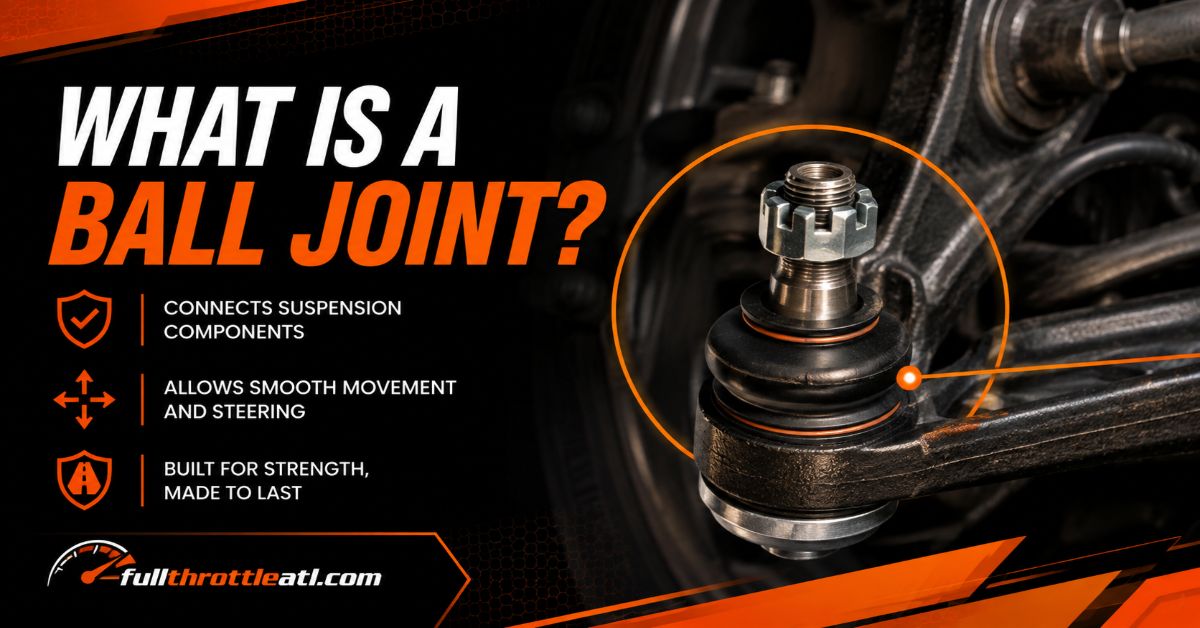
A ball joint is a critical suspension component functioning as a spherical pivot point between a vehicle’s wheels and its control arms. It allows smooth 360-degree rotation for steering and angular travel for suspension movement while supporting structural vehicle loads over rough terrain.
At a Glance: Key Ball Joint Facts
- A ball joint consists of a steel bearing stud and socket housed together, mimicking the human hip joint.
- Standard factory ball joints typically last between 70,000 and 150,000 miles under normal driving conditions.
- Maximum allowable play before replacement is usually between 0.020 inches and 0.050 inches.
- Ball joints are classified into load-carrying types (tension) and follower types (compression).
- Failed ball joints can cause catastrophic wheel detachment and complete loss of steering control.
How does a ball joint work?
A ball joint works by using a spherical steel stud enclosed inside a greased socket to link the vehicle control arm to the steering knuckle. The design permits multi-directional movement so the wheel can turn left or right while simultaneously traveling up and down over road bumps.
Inside the housing, the bearing stud rotates freely while synthetic grease reduces friction between the metal surfaces. Sealed units retain this lubrication for life, whereas greaseable units require fresh grease injected via a zerk fitting every 3,000 to 5,000 miles. Without this specialized pivot mechanism, steering linkage would bind instantly during vertical suspension compression.
What are the standard ball joint wear limits and tolerances?
New ball joints operate with zero axial or radial play to ensure tight, responsive steering geometry. Manufacturers establish a strict wear limit specifying that any vertical or horizontal movement exceeding 0.020 inches to 0.050 inches requires immediate component replacement.
When installing a new ball joint, professional technicians check the turning resistance, also known as preload torque, which should measure between 1 Newton-meter and 4 Newton-meters of force to rotate the stud smoothly within its socket. Operating past the maximum wear limit accelerates tire cupping, introduces steering slop, and dramatically increases the risk of structural fracture.
What is the difference between load-carrying and follower ball joints?
Load-carrying ball joints support the weight of the vehicle and experience heavy tension forces, while follower ball joints simply guide steering alignment and experience lower structural stress. Load-carrying joints are typically found on the lower control arms of traditional Short-Long Arm suspension setups and MacPherson strut configurations where the coil spring presses directly against the lower arm.
Follower ball joints are typically positioned on upper control arms or lower arms where springs do not exert direct downward pressure. Because load-carrying joints bear constant vehicle weight, their failure mode tends to be catastrophic separation, whereas follower joints usually develop loose play and noisy clunking long before complete separation occurs.
Why do integrated control arms complicate ball joint replacement?
Integrated control arms complicate ball joint replacement because the joint is permanently pressed or forged directly into the control arm assembly during manufacturing. This design is standard on many modern European vehicles and aluminum-intensive chassis structures.
The financial impact of this design is significant. While a standalone press-in ball joint might cost $30, an integrated control arm failure forces the replacement of the entire assembly, which frequently costs between $200 and $500 in parts alone. Technicians cannot press out the worn joint individually because the surrounding arm material lacks the structural integrity to retain a replacement part safely.
How do suspension lift kits affect ball joint lifespan?
Suspension lift kits shorten ball joint lifespan by altering the static operating angle of the control arm and steering knuckle. When a truck or SUV is lifted without correcting the control arm geometry, the factory ball joint is forced to operate near the extreme edge of its angular travel limits even while parked on level ground.
When hitting a pothole or driving over speed bumps, the joint quickly reaches its physical boundary and binds violently. This mechanical binding creates severe localized stress that can destroy factory ball joints in less than 10,000 miles. Vehicle owners lifting trucks more than two inches should install aftermarket upper control arms with corrected angles or specialized uniball joints.
Why do cheap lifetime warranty ball joints fail quickly?
Cheap lifetime warranty ball joints fail quickly because budget manufacturers often substitute durable bronze or steel internal bearing races with soft polymer plastic seats. While these budget parts pass simple hand-testing out of the box, they deform rapidly under real-world vehicle weight.
This deformation allows microscopic movement inside the socket, leading to rapid alignment drift, wandering steering, and premature rubber boot tearing. Although the replacement part is technically free under warranty, vehicle owners repeatedly pay for expensive wheel alignments and labor hours every time the cheap component fails.
Why does the standard wheel wiggle test fail on certain vehicles?
The standard wheel wiggle test fails on vehicles equipped with load-carrying lower ball joints because spring tension binds the internal bearing stud tightly inside the socket. When a mechanic jacks up the vehicle by the frame, the coil spring pushes down on the lower control arm, masking loose internal play.
To accurately test these specific suspension types, technicians must place the floor jack directly underneath the lower control arm to compress the spring and unload the joint before applying upward pressure with a pry bar. If this specific procedure is ignored, a severely worn load-carrying ball joint will feel completely solid during a standard wheel shake test.
How do you test a ball joint using a dial indicator?
Testing a ball joint using a dial indicator requires mounting the magnetic base of the tool firmly to the control arm while positioning the plunger tip directly against the steering knuckle or the ball joint housing. A mechanic then uses a pry bar to apply vertical leverage to the wheel or control arm.
The dial indicator measures axial play down to thousandths of an inch as the joint shifts under load. If the gauge needle deflects past the manufacturer specification limit of 0.030 inches, the ball joint is definitively worn out and must be replaced immediately to restore safe steering geometry.
Should ball joints always be replaced in pairs?
Ball joints should always be replaced in pairs across the same axle because suspension components experience identical wear cycles and environmental exposure. If the driver-side ball joint fails at 100,000 miles due to fatigue and wear, the passenger-side unit has endured the exact same mileage and stress.
Replacing ball joints in pairs ensures balanced handling characteristics, prevents uneven tire wear caused by mismatched steering resistance, and saves vehicle owners money by combining multiple labor operations and secondary alignment visits into a single appointment.
Can a bad ball joint cause a steering wheel vibration?
A bad ball joint rarely causes a high-speed steering wheel vibration. Worn ball joints typically manifest as clunking noises over bumps, loose steering feel, or a wandering vehicle response where the car drifts unpredictably across lanes.
High-speed steering wheel vibrations are almost always caused by out-of-balance tires, bent wheel rims, warped brake rotors, or worn wheel bearings rather than a failing ball joint. If a vehicle exhibits both vibration and loose steering, technicians must inspect both the tire assembly and the suspension linkages independently.
What happens if a ball joint fails completely while driving?
When a ball joint fails completely while driving, the bearing stud pulls entirely out of its socket, causing the steering knuckle and wheel hub assembly to detach from the control arm. The affected wheel instantly folds outward or tucks underneath the front fender.
This catastrophic failure results in an immediate, total loss of steering control, severe body damage to the quarter panels, and frequently a severed brake line due to sudden tension on the flexible hydraulic hoses. Drivers experiencing severe grinding or loud popping noises should pull over immediately to prevent this hazardous event.
Can you drive with a bad ball joint?
Driving with a bad ball joint is extremely dangerous and strongly discouraged by automotive professionals. Once a ball joint develops play beyond factory limits, the structural integrity of the front suspension is compromised.
Normal driving forces, sudden braking, or sharp cornering maneuvers can trigger a complete separation of the joint at any moment. Addressing ball joint wear promptly protects against dangerous loss of vehicle control and prevents secondary damage to tires, axles, and steering racks.
How much does ball joint replacement cost?
Ball joint replacement typically costs between $200 and $600 per side for parts and professional labor combined on standard vehicles. Labor accounts for the majority of the invoice, as pressing old joints out of control arms requires specialized hydraulic press tools and considerable shop time.
For vehicles requiring integrated control arm replacement, total costs can escalate rapidly to between $400 and $900 per side. Following any ball joint installation, a professional four-wheel alignment costing $100 to $200 is mandatory to prevent rapid tire wear.
How often should greasable ball joints be serviced?
Greasable ball joints require fresh chassis grease every 3,000 to 5,000 miles, usually performed concurrently with standard engine oil changes. Injecting high-temperature multi-purpose chassis grease flushes out moisture, road grit, and microscopic metal debris.
Skipping routine lubrication causes the internal synthetic grease to dry out, leading to rapid metal-on-metal friction and accelerated wear. Maintaining a consistent service interval can easily double the operational lifespan of heavy-duty aftermarket ball joints.
What tools are needed to replace a ball joint?
Replacing a press-in ball joint requires a heavy-duty ball joint press kit with specialized C-clamps and receiving adapters, a robust socket set, torque wrenches, a pickle fork or ball joint separator, and a hydraulic floor jack.
Professional mechanics also rely on pneumatic impact wrenches to speed up disassembly of rusted suspension fasteners and rely on torque multipliers to reinstall pinch bolts and castle nuts to exact manufacturer specifications. DIY repairs without these specialized press tools often result in damaged control arms or improperly seated components.
The Bottom Line
A ball joint acts as the crucial pivot point uniting vehicle control arms with steering knuckles, directly impacting handling safety and wheel alignment. Recognizing early symptoms like popping noises or loose steering prevents catastrophic separation on the highway. Always verify wear tolerances using proper loading procedures and replace components in matched axle pairs to maintain predictable vehicle dynamics.