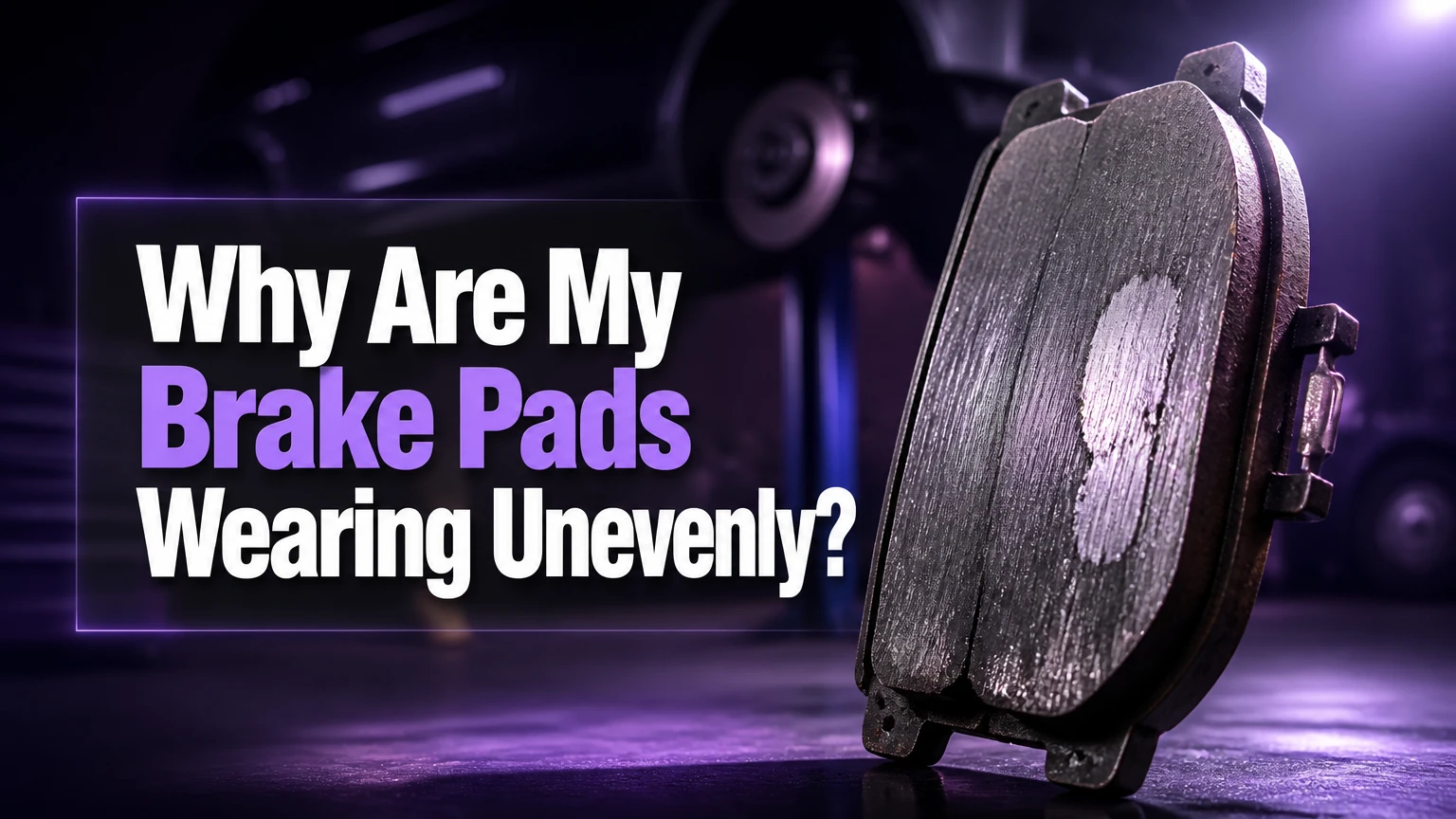
Uneven brake pad wear is caused by mechanical binding, fluid pressure restrictions, or structural misalignment within the braking system. When functioning properly, a brake caliper applies equal clamping force across both friction surfaces. Component failures—such as seized slider pins, stuck pistons, corroded bracket tracks, or collapsed brake hoses—disrupt this balance, forcing one pad to drag continuously against the brake rotor.
At a Glance: Key Wear Tolerances & Rules
- Maximum Inner-vs-Outer Variance: A difference greater than 2.0 mm (5/64 inch) between inner and outer pads on a single caliper indicates a mechanical failure.
- Maximum Axle Variance: A difference of up to 1.5 mm (1/16 inch) between the driver and passenger sides on the same axle is acceptable operating tolerance.
- Maximum Pad Taper: Tapered wear across a single pad must not exceed 1.0 mm from end to end.
- Absolute Safety Threshold: Any brake pad with 2.0 mm to 3.0 mm of remaining friction material requires immediate replacement regardless of wear pattern.
- Mandatory Pair Replacement: Brake pads must always be replaced in complete axle sets (both left and right sides) to prevent dangerous braking asymmetry.
What Causes Uneven Brake Pad Wear?
Uneven brake pad wear stems from an imbalance in how hydraulic pressure is applied or released across the brake assembly. When you press the brake pedal, hydraulic fluid pushes the caliper piston against the inner pad, which simultaneously pulls the floating caliper body to press the outer pad against the rotor.
If any component prevents the free sliding, pressing, or retracting of these parts, one pad remains trapped against the spinning rotor. The three primary culprits are mechanical friction (corroded guide pins or binding pad ears), hydraulic trapping (degraded square-cut piston seals or internal hose delamination), and structural misalignment (bent brackets or warped rotors).
How Much Wear Variance Is Acceptable Before Repairs Are Needed?
An inner-to-outer pad wear variance under 2.0 mm (5/64 inch) is considered acceptable normal operating wear. Because the caliper piston contacts the inner pad directly, the inner friction lining naturally wears slightly faster than the outer lining.
+-----------------------------------------------------------------------------------+
|                        BRAKE PAD WEAR TOLERANCE THRESHOLDS                        |
+------------------------------------+----------------------------------------------+
| Measurement Type                   | Acceptable Operating Limit                   |
+------------------------------------+----------------------------------------------+
| Inner vs. Outer Pad Variance       | ≤ 2.0 mm (5/64 inch) on a single caliper     |
| Driver vs. Passenger Axle Variance | ≤ 1.5 mm (1/16 inch) across the same axle    |
| Single Pad Taper Variance          | ≤ 1.0 mm difference from top-to-bottom/side  |
| Minimum Safety Replacement Limit   | 2.0 mm – 3.0 mm remaining friction material  |
+------------------------------------+----------------------------------------------+
When measuring friction material with a digital micrometer or brake gauge, any measurement exceeding these thresholds indicates an active mechanical fault that requires diagnostic inspection.
Why Is My Inner Brake Pad Wearing Faster Than the Outer Pad?
Excessive inner brake pad wear is caused by a caliper piston that fails to retract or a restricted brake hose trapping hydraulic pressure. Because the piston contacts the inner pad directly, hydraulic or mechanical failures at the piston level concentrate continuous friction on the inside face of the rotor.
1. Seized or Damaged Caliper Piston
Inside the caliper bore, a square-cut rubber seal flexes when pressure is applied and acts as a micro-spring to pull the piston back 0.1 mm when pressure is released. If this seal hardens, tears, or if rust builds up on the piston wall, the piston remains extended, causing constant inner pad drag.
2. Internal Brake Hose Delamination
Aging rubber brake hoses delaminate internally, creating a structural flap that acts as a one-way check valve. Fluid is forced under high pedal pressure past the flap to extend the piston, but cannot flow backward when you release the pedal. This traps fluid inside the caliper, locking the inner pad against the rotor.
3. Electronic Parking Brake (EPB) Failure
On modern vehicles with electronic parking brakes, a motor mounted directly to the rear caliper winds the piston forward. If the EPB actuator fails to fully retract, or if new pads were installed without electronically placing the system into “Service Mode,” the rear inner pad drags continuously.
Why Is My Outer Brake Pad Wearing Faster Than the Inner Pad?
Rapid outer brake pad wear is caused by frozen caliper slider pins or dry guide hardware that prevents the floating caliper body from centering itself.
When slider pins seize due to corrosion, lack of grease, or swollen rubber boots, the caliper cannot slide back outward after a brake application. The piston retracts inward slightly, creating a gap on the inner side, while the outer caliper frame holds the outer pad firmly pressed against the spinning rotor.
What Causes Tapered Wear Across a Single Brake Pad?
Tapered brake pad wear—where a single pad is noticeably thinner on one edge or side—is caused by uneven pressure distribution from a twisted caliper, a bent mounting bracket, or unevenly lubricated guide pins.
TAPERED WEAR PATTERNS & CAUSES
===================================================================

Horizontal Taper (One end thinner than the other):
[=====================] <-- Top end moving freely
[==========\          ] <-- Bottom end binding on guide pin / rust track
Cause: One slider pin frozen while the other moves freely.

Vertical Taper (Top thinner than bottom, or vice versa):
[=====================] <-- Top edge pinching
[/////////////////    ] <-- Bottom edge flared outward
Cause: Twisted caliper bracket, loose mounting bolts, or debris behind hardware.
===================================================================
If one slider pin glides smoothly while the second pin is frozen, the caliper twists during braking, applying force at an angle. Similarly, if rust builds up unevenly under the stainless steel abutment clips, the pad ear binds on one side, forcing the pad to pivot and wear unevenly.
Why Are Both Pads on One Wheel Wearing Faster Than the Opposite Side?
Accelerated pad wear on one complete wheel assembly relative to the opposite side on the same axle points to a stuck ABS valve, a collapsed brake line junction, or an aggressive safety intervention system.
- Stuck ABS/ESC Valve: A contaminated Anti-lock Braking System (ABS) valve block can hold residual pressure in a single hydraulic line, keeping one wheel’s brake partially applied at all times.
- Adaptive Cruise Control (ACC) & Vectoring: Modern vehicles equipped with Adaptive Cruise Control and Electronic Stability Control apply localized braking—typically to individual rear wheels—to control pitch and vehicle yaw during highway navigation. Drivers utilizing ACC frequently experience accelerated rear pad wear on one or both rear wheels compared to the front.
- Corroded Hard Lines: Physical damage or internal corrosion in the steel brake line feeding a single wheel restricts return fluid flow, causing localized drag.
How Do I Diagnose a Seized Slider Pin vs. a Stuck Caliper Piston?
To determine whether uneven pad wear is caused by a mechanical slider pin fault or a hydraulic/piston issue, perform a manual retraction test using a caliper compression tool and a bleeder valve test.
1.Inspect Slider Pin Movement:Isolate mechanical floating hardware.
Unbolt the caliper body from the mounting bracket and slide the guide pins back and forth manually. Pins should glide smoothly with slight hydraulic cushion resistance. If a pin is immovable, pitted, or dry, the slider pins are seized.
2.Test Piston Compression:Apply mechanical force to the piston.
If slider pins move freely, place a caliper compression tool over the piston and apply steady pressure. If the piston compresses smoothly into the bore, the hydraulic system and piston seal are functioning properly.
3.Open the Bleeder Valve:Differentiate between piston binding and hydraulic lockup.
If the piston refuses to press back, crack open the caliper bleeder valve slightly into a catch bottle and reapply pressure to the tool.
- If the piston now compresses effortlessly: Fluid is trapped upstream by a delaminated brake hose or master cylinder restriction.
- If the piston remains frozen: The piston itself is mechanically seized inside the bore due to corrosion or a damaged seal.
Why Does Outer Pad Wear Persist Even When Slider Pins Move Freely?
Outer pad wear can continue despite smooth slider pin movement if petroleum-based chassis grease was used instead of specialized brake lubricant, or if “rust jacking” has seized the pad ears inside the bracket.
1. Swollen Rubber Boots & High-Heat Thermal Binding
Using petroleum-based grease causes the rubber dust boots on slider pins to swell, trap air, and create a pneumatic lock when hot. While the pin moves freely on a cold bench, heat generated during driving expands the trapped air and rubber, locking the slider mechanism mid-drive.
2. Rust Jacking Beneath Abutment Clips
Rust forming underneath the stainless steel abutment clips expands (rust jacking), compressing the channels where the pad ears sit. The hydraulic piston can push the pad forward during braking, but the tiny movement of the rotor cannot push the tightly pinched pad back, causing continuous drag.
Can I Replace Only the Single Worn Brake Pad?
No, you should never replace a single worn brake pad or a single wheel’s pad set. Brake pads must always be replaced in complete axle pairs (both front wheels or both rear wheels simultaneously).
Replacing friction material on only one side creates a coefficient of friction mismatch between the left and right wheels. During hard or emergency braking, the side with new friction material will grab with greater force than the aged side, causing the vehicle to pull violently toward the new pad side and compromising ABS and stability control calibration.
Will Uneven Brake Pad Wear Cause the Steering Wheel to Shake?
Uneven brake pad wear does not directly cause steering wheel vibration, but the underlying condition causing the pad wear will cause wheel shake over time.
A dragging brake pad generates intense, continuous heat. This thermal buildup causes uneven material deposition onto the rotor surface or distorts the brake rotor’s physical structure, creating Disc Thickness Variation (DTV). As the brake pads clamp onto areas of varying rotor thickness during a stop, the pulsing force pushes back through the steering linkage, causing the steering wheel to shake.
What Happens If I Ignore Uneven Brake Pad Wear?
Ignoring uneven brake pad wear leads to severe component destruction, elevated fuel consumption, and sudden braking failure.
CONSEQUENCES OF UNCHECKED BRAKE PAD WEAR
===================================================================
Stage 1: Accelerated Drag
         ──> Reduced fuel efficiency & local thermal buildup.
Stage 2: Metal-to-Metal Contact
         ──> Friction material wears out completely on one side;
             steel backing plate cuts deep grooves into the rotor.
Stage 3: Caliper & Hydraulic Failure
         ──> Overextended piston pops out or seals melt from extreme
             heat, causing total hydraulic fluid loss.
===================================================================
When a dragged pad wears completely down to its steel backing plate, it grindingly destroys the brake rotor surface within miles. Continuous overheating can boil the brake fluid—leading to a soft, spongy pedal—or melt internal rubber piston seals, resulting in catastrophic loss of stopping power.
How Much Does It Cost to Fix Uneven Brake Pad Wear?
The cost to fix uneven brake pad wear ranges from $30 to $150 for DIY maintenance up to $300 to $800+ for professional repair, depending on which components require replacement.
| Repair Scope | Average Cost (Parts Only) | Average Cost (Professional Repair) | Key Components Included |
| Basic Servicing & Hardware | $20 – $50 | $120 – $220 | Slider pins, silicone lube, stainless abutment clips, wire brushing. |
| Standard Axle Pad & Rotor Replacement | $100 – $250 | $350 – $550 | New axle pad set, premium rotors, hardware kit. |
| Caliper & Hose Replacement | $150 – $350 | $500 – $850+ | Remanufactured/new caliper assembly, flexible brake line, system fluid bleed. |
The Bottom Line
Uneven brake pad wear is a clear indicator of a mechanical or hydraulic imbalance within your braking system, most commonly stemming from seized slider pins, stuck caliper pistons, or corroded hardware tracks. Maintaining pad wear within the acceptable 2.0 mm inner-to-outer tolerance limit is critical to safety.
Whenever uneven wear is identified, clean and lubricate slider channels, verify hydraulic release, and always replace brake pads in complete axle sets to maintain balanced stopping power.