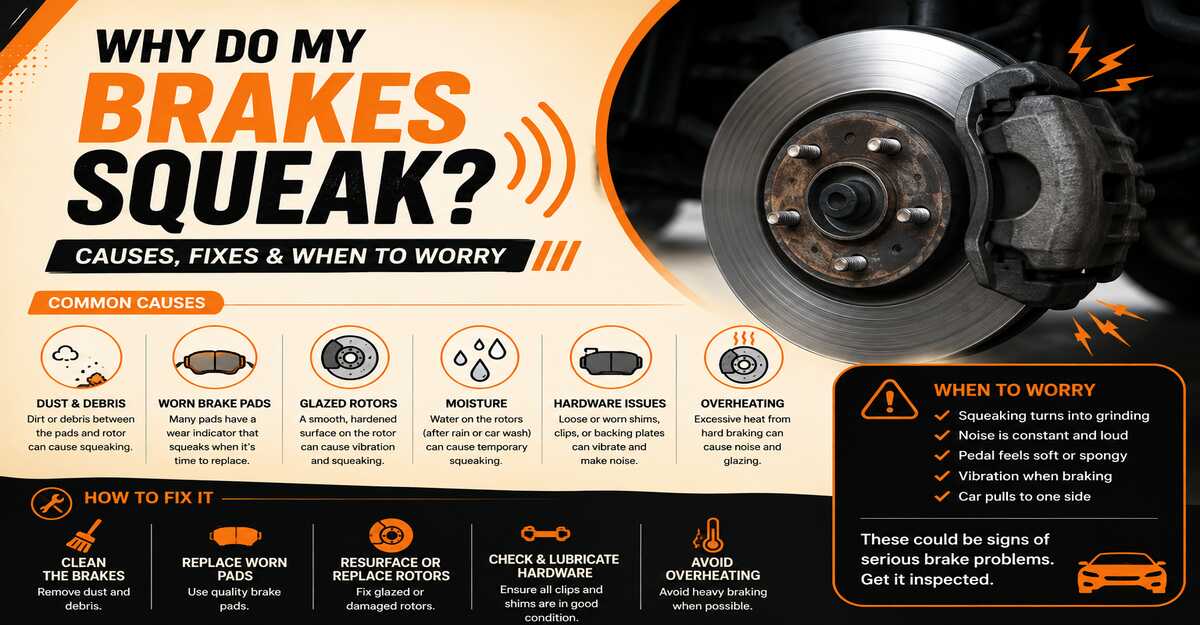
Brake squeak is primarily caused by high-frequency harmonic vibrations generated between the brake pad friction material and the rotating brake rotor. When the caliper presses the pads against the rotor unevenly or without adequate dampening, these metal components vibrate at audible frequencies between 2,000 Hz and 12,000 Hz.
At a Glance: Key Brake Noise Facts
- Mechanical wear indicators trigger an intentional squeal when brake pads reach 4 to 6 millimeters of remaining thickness.
- The absolute minimum legal friction material thickness is 2 millimeters before immediate replacement is required.
- Standard organic brake pads suffer thermal breakdown and glaze over when temperatures exceed 700°C (1,300°F).
- Lateral rotor runout (warping) exceeding 0.05 millimeters will cause periodic pad contact and persistent squeaking.
- High-performance ceramic and carbon brake compounds inherently squeal when operating below track temperatures.
What is the difference between brake squeak and brake grinding?
The primary difference between a brake squeak and a brake grinding noise lies in the remaining friction material on the brake pad. A squeak indicates high-frequency vibration or a low-pad warning, whereas a grind indicates total friction material failure, resulting in destructive metal-on-metal contact.
| Feature | Brake Squeak | Brake Grinding |
|---|---|---|
| Acoustic Profile | High-pitched, shrill, 2,000-12,000 Hz | Low-pitched, scraping, guttural crunch |
| Primary Cause | Vibration, surface glaze, or wear indicator | Pad backing plate gouging the iron rotor |
| Safety Level | Often safe, requires inspection | Extremely dangerous, immediate failure risk |
| Required Fix | Lubrication, cleaning, or pad replacement | Full replacement of pads and ruined rotors |
Brake grinding requires pulling the vehicle over immediately. Continuing to drive with grinding brakes will physically destroy the brake caliper and the rotor, turning a standard maintenance procedure into a massive repair bill.
At what brake pad thickness does squeaking begin?
Brake squeaking typically begins when the brake pad thickness reaches 4 to 6 millimeters. Modern brake pads are manufactured with built-in mechanical wear indicators-small metal tabs commonly called “scratchers.”
Once the friction material wears down to this 4-6 millimeter threshold, the metal tab makes deliberate, continuous contact with the spinning brake rotor. This contact generates a highly audible, high-pitched squeal designed to alert the driver that a brake service is due. The noise often disappears when the brake pedal is depressed because the clamping force alters the acoustic resonance of the tab. If the driver ignores this warning squeak, the pad will eventually reach the 2-millimeter absolute minimum safe thickness, at which point braking performance degrades significantly.
Can overheated brakes cause glazing and noise?
Yes, overheated brakes cause a condition called glazing, which results in a persistent, glassy squeal even on full-thickness pads. Standard organic or semi-metallic brake pads have a thermal breakdown point of approximately 700°C (1,300°F).
When a driver rides the brakes down a steep mountain pass or engages in aggressive stop-and-go driving, pad temperatures exceed this threshold. The extreme heat melts the resins inside the friction material, turning the normally porous pad surface into a hard, crystalline, and highly reflective glaze. Glazed brake pads lose their friction coefficient and slide across the rotor rather than gripping it. This frictionless sliding acts exactly like a wet finger rubbing the rim of a wine glass, producing a loud harmonic screech every time the brake pedal is applied.
How does a warped rotor contribute to brake squeal?
A warped rotor causes brake squeal by creating uneven, periodic contact with the brake pad as the wheel rotates. Automotive engineers define this warping as “lateral runout.”
If a brake rotor develops a lateral runout exceeding 0.05 millimeters (0.002 inches), the disc no longer spins perfectly flat. Instead, the high spots of the wavy rotor repeatedly slap against the brake pad inside the stationary caliper. This periodic contact generates cold squeaking-a chirping sound that matches the rotational speed of the tires. Shops that machine or “turn” rotors below their minimum discard thickness remove critical thermal mass from the iron. Thinned rotors heat up instantly under load, warp permanently, and ring like a bell because they lack the physical density required to dampen acoustic harmonics.
Why do my brakes squeak first thing in the morning?
Brakes squeak in the morning because overnight humidity causes a microscopic layer of iron oxide (rust) to form on the bare metal rotors. Iron rotors oxidize extremely rapidly when exposed to dew, rain, or high ambient moisture levels.
When the vehicle is driven for the first time in the morning, the brake pads must physically scrape off this fresh rust layer. The resulting noise presents as a harsh squeal or a light scraping sound. This specific morning brake squeal is entirely harmless and is an unavoidable chemical reality of cast-iron brake components. The noise will naturally disappear after the first three to five brake applications once the pads sweep the rotor face clean and restore a smooth, polished metal surface.
Why do high-performance brakes squeak when driving normally?
High-performance carbon or ceramic brakes squeak during normal driving because they are operating below their optimal thermal range. Track-focused or heavy-duty towing brake compounds require massive heat accumulation to function quietly and efficiently.
When driven at low speeds in city traffic, high-density metal or carbon brake pads remain cold. Cold performance pads possess an incredibly high friction coefficient that aggressively bites into the rotor, triggering immense high-frequency vibration. Automotive manufacturers classify this low-temperature screech as an inherent design characteristic, not a defect. Drivers who upgrade to high-performance brake packages for aesthetic reasons often regret the decision due to the inescapable, locomotive-like squealing that occurs during casual grocery runs.
Why do brakes squeal only when in reverse?
Brakes squeal in reverse because the brake pads wear down dynamically along the forward rotational path of the rotor, creating a micro-tapered edge. Thousands of miles of forward driving force the friction material to establish a specific directional “grain.”
When the driver shifts into reverse and applies the brakes, the brake rotor spins backward against this established wear pattern. The backward rotation catches the trailing edge of the brake pad, lifting it slightly inside the caliper bracket. This lifting action forces the pad to skip and chatter against the rotor surface, producing a distinct, low-speed squeal. Reverse brake squeal is generally harmless and simply reflects the natural geometrical shifting of the brake hardware under reverse torque loads.
Does cold or wet weather make brake squeal worse?
Yes, cold and wet weather amplifies brake squeal by altering the friction coefficient of the pad and promoting rapid surface oxidation. Cold temperatures harden the rubber dampening materials located on the back of the brake pads, reducing their ability to absorb harmonic vibrations.
Simultaneously, winter weather introduces road salt, slush, and freezing rain to the braking assembly. Water acts as a temporary barrier between the pad and the rotor, changing the resonance frequency of the metal contact. Furthermore, freezing temperatures cause the metal caliper brackets to contract slightly, which can restrict the smooth movement of the brake pads. This combination of hardened dampeners, compromised friction surfaces, and restricted hardware tolerances makes winter brake squeal a highly common seasonal complaint.
Why do brand new brakes squeak?
Brand new brakes squeak because the freshly installed brake pads have not yet completed the critical “bedding” process. The bedding process involves progressively heating the brakes through a series of hard stops to transfer an even, microscopic layer of pad material onto the bare rotor face.
During the initial 100 to 200 miles-known as the “green” phase-the bare pad material scrapes directly against the bare iron rotor. This raw friction lacks the necessary transfer layer that normally smooths out engagement and dampens noise. If a mechanic or driver fails to properly bed the brakes immediately after installation, the pad material transfers unevenly, resulting in a permanent structural squeak that lasts for the lifespan of the newly installed parts.
Why did brake noise get worse after a pad replacement?
Brake noise worsens after a pad replacement if the installer failed to clean factory shipping oil off the new rotors or neglected to lubricate the critical metal-to-metal contact points. Auto manufacturers coat new replacement rotors in anti-corrosion oil to prevent rust during warehouse storage.
If a technician skips using an aerosol brake cleaner to strip this oil before mounting the wheels, the oil instantly burns into the new brake pads, permanently glazing them on the first test drive. Furthermore, mechanics who install pads “dry” without applying specialized ceramic or silicone brake grease to the pad ears, shims, and caliper piston faces guarantee a noisy brake job. Without grease to absorb the vibration, the raw metal components will immediately vibrate and screech worse than the worn parts they replaced.
Which faulty hardware components cause permanent brake squeal?
Permanent brake squeal is frequently caused by seized caliper slide pins, weakened anti-rattle clips, or missing backing shims. Standard troubleshooting fails entirely when the structural integrity of the caliper is compromised.
- Caliper Slide Pins: If the protective rubber boots tear, moisture seizes the steel pins. The caliper cannot center itself, forcing the inner pad to drag continuously against the rotor at an angle.
- Anti-Rattle Clips: Reusing old, heat-fatigued spring clips allows the brake pad to rattle loosely inside the bracket cage. No amount of grease can fix this structural vibration.
- Missing Shims: The thin metal plates glued to the back of the brake pad absorb the piston’s acoustic energy. If they rust off or are discarded during a cheap brake job, a permanent 2,000 to 5,000 Hz squeal is guaranteed.
How can I stop brake squeak without replacing the pads?
You can stop brake squeak without replacing the pads by applying specialized dampening grease, cleaning the hardware, and chamfering the pad edges, provided the pads have sufficient thickness remaining.
- Remove the Caliper: Safely lift the vehicle, remove the wheel, and unbolt the brake caliper to expose the brake pads.
- Clean the Hardware: Use a wire brush and aerosol brake cleaner to scrub all brake dust and rust off the stainless steel abutment clips and the caliper bracket.
- Apply Ceramic Grease: Smear a high-temperature ceramic or silicone brake grease specifically on the metal “ears” of the pads where they slide into the clips, and on the back of the pad where the piston pushes. Never apply grease to the friction surface.
- Chamfer the Edges: Use a file to gently sand a 45-degree angle into the sharp leading and trailing edges of the friction material. This prevents the pad from grabbing the rotor abruptly and eliminates chatter.
Is it safe to spray WD-40 or oil on squeaking brakes?
No, it is extremely dangerous to spray WD-40, silicone spray, or any petroleum-based oil onto squeaking brake components. Applying aerosol lubricants to brake rotors or brake pads will cause immediate and total braking failure.
Braking systems rely entirely on mechanical friction to convert the kinetic energy of a moving vehicle into thermal energy, safely bringing the car to a halt. WD-40 eliminates this friction. A lubricated brake rotor will allow the brake pad to slide flawlessly over the metal without grabbing, meaning the vehicle will not stop when the driver presses the pedal. Any brake pad contaminated by oil or WD-40 cannot be cleaned; the porous friction material absorbs the liquid and the pads must be thrown in the trash and replaced entirely.
Is it dangerous to drive with squeaking brakes?
It depends; driving with squeaking brakes is safe if the noise stems from morning surface rust or high-performance compounds, but dangerous if caused by severely worn pads, loose caliper hardware, or active glazing.
A squeak triggered by the mechanical wear indicator tab (the 4-6 millimeter mark) means the vehicle is currently safe to drive, but maintenance must be scheduled within a few weeks. Conversely, if a squeak is accompanied by a vibrating steering wheel, a spongy brake pedal, or a distinct burning smell, the vehicle is suffering from rotor runout, hydraulic boiling, or pad glazing. Continuing to drive under these compromised conditions can lead to catastrophic rotor failure or heavily extended stopping distances during an emergency braking event.
How much does it cost to fix a brake squeak?
Fixing a brake squeak costs between $50 and $600, depending on the underlying cause and the required parts. Minor acoustic issues are inexpensive to solve, while structural failures require full axle replacements.
- $50 to $100: The cost of a simple brake service where a mechanic disassembles the brakes, cleans the brackets, applies high-temperature silicone grease, and reassembles the existing healthy parts.
- $150 to $300: The average cost per axle to replace worn brake pads and install fresh anti-rattle clips.
- $300 to $600+: The cost per axle to replace both the brake pads and warped or heavily scored brake rotors. Machining rotors is becoming less common, pushing repair costs into the full-replacement tier.
The Bottom Line
Brake squeak is the audible result of high-frequency vibration between the brake pad and the rotor, most commonly acting as an intentional warning that the pads have reached 4 to 6 millimeters of remaining thickness. While morning rust and cold high-performance compounds cause harmless squealing, persistent screeching indicates neglected hardware, glazed pads, or warped rotors. To ensure absolute safety, drivers should never ignore a changing acoustic profile in their braking system and must completely avoid DIY aerosol lubricant fixes.