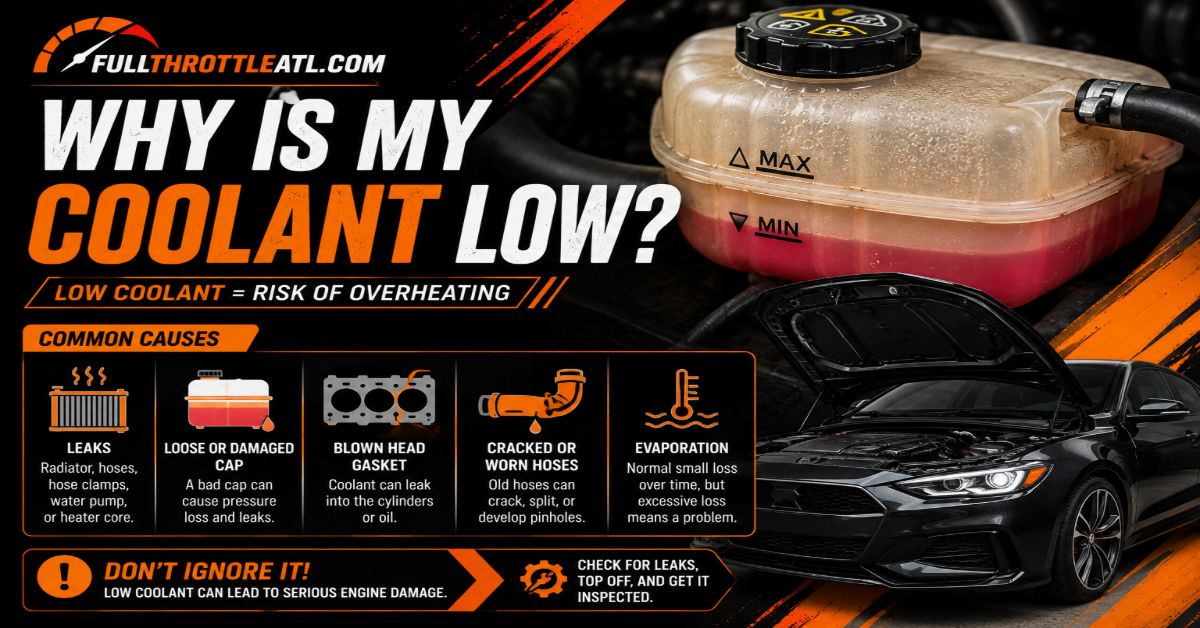
Your coolant is low primarily due to an external fluid leak, an internal engine leak, or normal system volume changes over time. Under normal operating conditions, a sealed automotive cooling system naturally loses 0.25 to 0.5 quarts (approx. 250 to 500 mL) of fluid annually through microscopic evaporation across rubber hoses and pressure cap venting.
At a Glance: Core Facts
- Standard cooling systems maintain an operating pressure between 14 to 18 PSI.
- Normal engine coolant operating temperatures range from 195°F to 220°F (90°C to 104°C).
- A drop of 1 to 2 quarts immediately after service is normally trapped air escaping, not a leak.
- Modern plastic expansion tanks frequently develop micro-fissures along seams only when pressurized.
- Driving with an empty reservoir can warp aluminum cylinder heads in less than 60 seconds of severe overheating.
How much coolant should a normal car lose per year?
A healthy, sealed vehicle cooling system loses less than 0.25 to 0.5 quarts (250 to 500 mL) per year. This minor fluid reduction happens via microscopic vapor permeation through rubber hoses and controlled venting through the radiator pressure cap. If your vehicle loses fluid at a faster rate-such as needing a top-up every few weeks-you are dealing with an active physical leak or an internal consumption issue rather than normal evaporation.
What are normal system pressure and operating temperature ranges?
Normal automotive cooling systems operate under 14 to 18 PSI of pressure raised to elevate the boiling point of the fluid. Engine coolant operating temperature typically sits between 195°F and 220°F (90°C to 104°C). Consistent dashboard or diagnostic scanner readings exceeding 230°F (110°C) indicate that the coolant volume has dropped below safe operational thresholds, causing localized boiling or vapor lock.
How do I perform a manual pressure test to check for a leak?
To perform a manual cooling system pressure test, attach a hand-operated pressure pump kit directly to the radiator or expansion tank neck, then pump the system up to the vehicle’s rated cap pressure (usually 15 PSI). Monitor the gauge for 15 minutes. A pressure drop exceeding 2 PSI confirms an active internal or external fluid leak, allowing you to visually trace external drips before tearing down engine components.
What is an “invisible” water pump leak and how do I spot it?
An invisible water pump leak occurs when internal shaft seals fail and coolant escapes through the water pump weep hole only while the engine is running at high RPMs and system pressure. The high-velocity spray hits the hot engine block and evaporates instantly, leaving behind no puddles on the ground-only a faint, chalky white or colored crust around the pulley housing. Spotting this requires inspecting the pump underside with a mirror and UV dye light after a highway drive.
Can a turbocharger or EGR cooler cause coolant loss without leaks?
In turbocharged engines or vehicles equipped with Exhaust Gas Recirculation (EGR) coolers, internal thermal cracks can allow coolant to leak directly into the exhaust or intake stream. The fluid burns off immediately inside the combustion chambers or hot turbine housing, leaving zero puddles on your driveway and minimal visible tailpipe smoke if the micro-crack is small. Mechanics diagnose this by pressure-testing the EGR circuit or inspecting spark plugs for steam-cleaning clean spots.
What is a transmission heat exchanger coolant failure?
A transmission heat exchanger failure happens when the internal oil-to-coolant radiator core ruptures, allowing transmission fluid and engine antifreeze to cross-contaminate. This specific failure fills your coolant expansion reservoir with a thick, brown “strawberry milkshake” fluid mixture while simultaneously destroying the transmission clutch packs. Immediate radiator replacement and complete system flushing are mandatory to save both mechanical components.
Why does my coolant drop suddenly after a flush? (The Ghost Drop)
A sudden drop of 1 to 2 quarts of coolant immediately after a coolant flush or thermostat replacement is not a leak, but rather the result of trapped air pockets purging from the engine block. As the engine cycles through multiple hot and cold cycles, the thermostat opens completely and “burps” large air bubbles out of the heater core and cylinder head jackets, causing the fluid level in the overflow tank to drop rapidly. Simply topping off the reservoir after two complete drive cycles resolves this ghost drop.
How does thermal shrinkage affect coolant reservoir levels in winter?
Coolant volumes expand and contract drastically based on ambient temperature due to the physical properties of ethylene glycol and water. Checking your overflow reservoir at -10°F (-23°C) in the dead of winter will reveal a significantly lower fluid level than checking it at 100°F (38°C) in mid-summer. This variation represents standard thermal contraction rather than a mechanical fluid loss, provided the level returns to the “Full Cold” mark once the engine warms up.
Why do plastic expansion tanks develop micro-fissures under pressure?
Modern vehicles utilize high-density plastic coolant expansion reservoirs that develop microscopic hairline cracks along their injection-molded bottom seams over years of thermal cycling. These structural fissures remain tightly closed when the car is cold or idling, but they expand and leak actively only when the plastic reaches full operating temperature and stretches under 15 PSI of pressure. Visual dry inspections often miss these; technicians must pressurize the system to find them weeping.
Can I top up low coolant with water in an emergency?
You should only top up low coolant with water in an absolute roadside emergency, and you must use distilled water rather than tap water. Tap water contains hard minerals that bake onto internal engine passages, creating insulating scale deposits that reduce cooling efficiency by up to 40%. You must restore a proper 50/50 mix of antifreeze and distilled water as soon as possible to prevent winter freezing and summer boiling.
Is it safe to drive with low coolant if it isn’t overheating yet?
If the expansion reservoir is completely empty but the dashboard temperature gauge remains firmly in the normal operating zone, you can safely drive 3 to 5 miles directly to a service garage. However, if the temperature gauge begins to climb or a warning chime sounds, pull over immediately; modern aluminum cylinder heads can warp, drop valve seats, and blow head gaskets in less than 60 seconds of severe overheating.
Why is my expansion tank dry while the radiator remains full?
When your coolant expansion tank runs completely dry while the radiator and engine block remain full, your cooling system has caught an early external leak before air could be drawn into the core. The overflow hose or tank pickup tube may have developed a minor air leak, preventing the radiator from sucking fluid back in during the cool-down phase. Top off the reservoir immediately and inspect the overflow hose connection clamps.
How do I test for a blown head gasket using a block test?
To test for combustion gas leaking into your cooling system, use a chemical combustion leak detector tool loaded with blue block test fluid. With the engine running at operating temperature, draw air from above the open radiator or coolant tank neck through the fluid chamber. If the chemical fluid turns from blue to yellow or green, it confirms that carbon dioxide ($CO_2$) gas is blowing past the head gasket into the cooling system.
The Bottom Line
Diagnosing low coolant requires moving past basic visual checks for driveway puddles to examine hidden failure points like water pump weep holes, EGR coolers, and heat exchangers. Always verify your system pressure and fluid volume state when the engine is completely cold to account for thermal expansion. Catching these hidden leaks early prevents catastrophic aluminum engine warping and costly mechanical repairs.