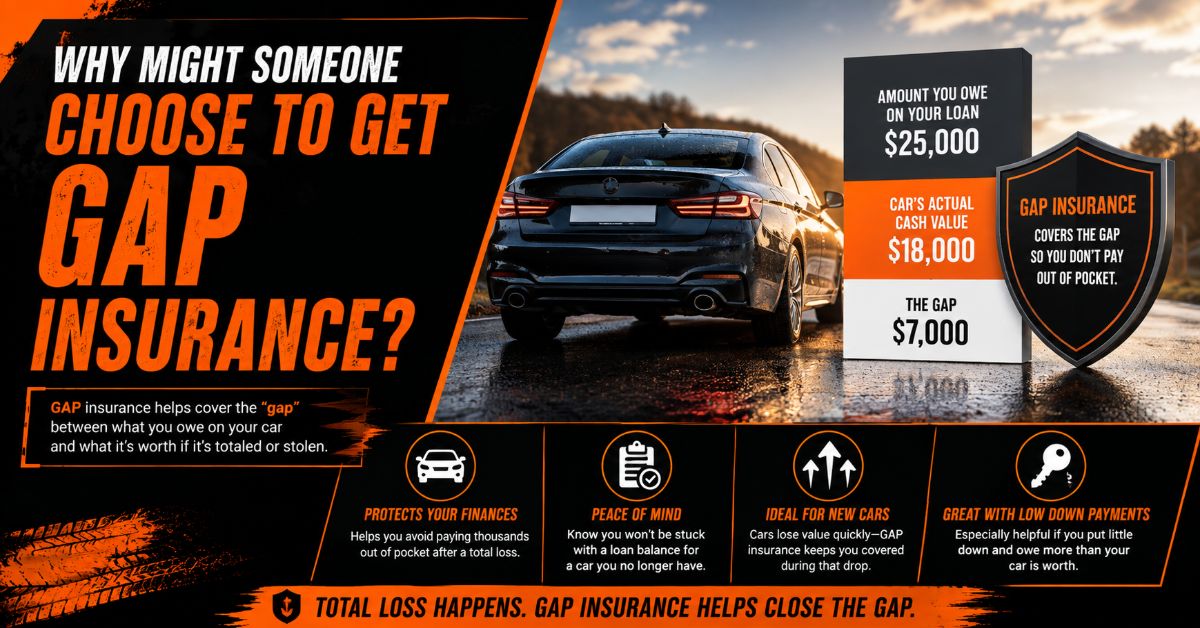
Drivers choose gap insurance to cover the financial shortfall between a vehicle’s actual cash value (ACV) and the remaining auto loan or lease balance if the car is totaled or stolen. Because primary auto insurance only pays current market value, gap insurance prevents drivers from paying thousands of dollars out of pocket for a vehicle they no longer own.
At a Glance
- Primary Function: Pays the difference between a car’s actual cash value and the remaining loan principal following a total loss.
- Depreciation Risk: New vehicles lose approximately 20% of their market value within the first year, creating immediate negative equity for low-down-payment buyers.
- Cost Advantage: Adding gap coverage through a auto insurer costs $20 to $60 annually, compared to $500 to $1,000 as a flat dealership fee.
- Trigger Condition: Coverage only applies to unrecovered thefts or total loss declarations—it never covers routine repairs or maintenance.
- Cancellation Benchmark: Policyholders should drop gap insurance once the loan balance falls below the vehicle’s market value, usually within 2 to 3 years.
How Does Gap Insurance Calculate a Payout During a Total Loss?
Gap insurance calculates its payout by subtracting your primary insurer’s total loss settlement from your total remaining loan principal. Primary auto insurance policies pay out based on Actual Cash Value (ACV)—the vehicle’s market value right before the accident—rather than what you originally paid or currently owe.
Total Vehicle Loan Balance:     $35,000
Primary Insurer ACV Payout:   - $28,000
---------------------------------------
Raw Gap Coverage Payout:        $7,000  (Minus deductible/uncovered fees)
If your primary insurer determines your vehicle is worth $28,000 at the time of a loss, but your lender account shows a balance of $35,000, gap insurance pays the remaining $7,000 deficit directly to the lender. Without gap protection, your primary insurer sends $28,000 to the lienholder, and you remain personally liable to pay the $7,000 balance out of pocket.
When Is Gap Insurance Strictly Necessary for a Car Loan?
Gap insurance is strictly necessary whenever a borrower is “underwater” (owing more on the loan balance than the car is worth on the open market). This financial deficit occurs under predictable financing structures and loan agreements.
Gap insurance is essential if your purchase matches any of these four criteria:
- Down Payment Under 20%: Put down less than 20% cash, leaving your initial loan balance higher than the car’s immediate market value.
- Loan Term of 60+ Months: Structured your auto loan with repayment terms of 60 to 84 months, which slows principal reduction.
- Leased Vehicle: Leased the car (most lease contracts mandate gap protection to safeguard the leasing company’s asset).
- Rolled-Over Debt: Rolled unpaid debt from a previous car loan directly into your new financing package.
Why Do Low Down Payments Leave Vehicle Owners Underwater?
Low down payments leave vehicle owners underwater because standard automotive depreciation occurs faster than early loan principal reduction. New cars lose roughly 20% of their market value within the first 12 months of ownership, with up to 10% lost the moment the car is driven off the dealership lot.
[Day 1 Purchase: $40,000 Loan Value] ──► [Immediate 10% Drop: $36,000 Market Value]
                                                   │
                                            $4,000 Instant Gap
When a buyer puts down 0% to 10% cash, the initial loan balance equals or exceeds the vehicle’s retail price. Meanwhile, monthly financing payments made during the first year primarily cover interest charges and lender fees rather than loan principal. If a total loss collision occurs during month ten, the market value drop heavily outpaces the small amount paid toward the loan balance, creating a thousands-of-dollars gap.
Which Vehicle Types Depreciate Fast Enough to Require Gap Coverage?
Luxury sedans, electric vehicles (EVs), and premium full-size SUVs depreciate faster than economy cars or popular midsize trucks, making them high-risk assets for loan deficits. Rapid market value drops leave owners of these vehicles deeply underwater even if they made a standard 15% to 20% down payment.
| Vehicle Category | Average 1-Year Depreciation | Gap Insurance Necessity |
| Electric Vehicles (EVs) | 30% – 45% | Critical: Rapid tech upgrades and tax credit shifts drop used values fast. |
| Luxury Sedans | 25% – 35% | High: Out-of-warranty maintenance costs drive resale values down quickly. |
| Full-Size Premium SUVs | 20% – 30% | High: High original MSRPs lead to steep initial market value drops. |
| Economy Sedans & Trucks | 10% – 18% | Moderate/Low: Strong used-market demand holds resale values steady. |
Owners financing high-depreciation models should maintain gap insurance longer into their loan terms than owners of mainstream trucks or compact cars.
How Does High-Interest Financing Increase Gap Loss Exposure?
High-interest auto financing increases gap loss exposure by slowing how fast you pay down loan principal during the first two to three years of the term. When interest rates exceed 8% to 10%, a substantial portion of each monthly payment goes toward financing charges rather than reducing debt.
For example, on a 72-month loan at 11% APR, over 40% of your first year’s payments fund interest costs. Even if you make every monthly payment on time, your remaining loan principal declines very slowly. Because the car’s actual cash value drops at a normal or accelerated rate while the loan balance barely moves, the gap between market value and debt widens, exposing you to severe financial loss if the vehicle is totaled.
What Happens When You Roll Negative Equity Into a New Car Loan?
Rolling negative equity into a new car loan combines your previous unpaid vehicle debt with your new loan balance, making you underwater from day one. This process inflates your new loan balance far beyond the actual retail value of the new car.
If you owe $4,000 on a trade-in car that is only worth $2,500, you have $1,500 in negative equity. Rolling that $1,500 balance into a new $30,000 loan creates a total initial loan debt of $31,500 for an asset worth $30,000. Combined with first-year depreciation, your gap exposure can quickly reach $6,000 to $8,000, making gap protection mandatory to avoid personal liability after a total loss.
Where Should You Buy Gap Insurance for the Lowest Cost?
You should buy gap insurance directly through your primary auto insurance company or an independent insurance broker rather than a car dealership. Standalone auto insurers offer identical or superior coverage at a fraction of the price charged by automotive finance departments.
Dealership Financing Add-on ──► $500 – $1,000 Flat Fee (Financed with interest)
Primary Insurance Add-on   ──► $20 – $60 / year (Pay-as-you-go, cancel anytime)
Buying gap insurance through primary auto insurers like Progressive, Allstate, or State Farm allows you to pay per month and cancel the moment your loan equity turns positive. Buying through a car dealership locks you into paying upfront fees or financing the cost over your entire loan term.
How Much Does Gap Insurance Cost from Insurers vs. Dealerships?
Gap insurance costs between $20 and $60 per year when added as an endorsement to a primary auto insurance policy, compared to $500 to $1,000 as a flat fee when purchased at a dealership.
| Provider Source | Typical Cost Structure | Total 3-Year Expense | Financing Impact |
| Auto Insurance Carrier | $2 to $5 per month added to premium | $60 – $180 | None (Paid monthly, cancel anytime) |
| Credit Union / Bank | $200 to $400 flat fee | $200 – $400 | Usually paid upfront or added to loan |
| Car Dealership (F&I) | $500 to $1,000 flat upfront price | $500 – $1,000+ | High: Rolled into loan, accrues interest |
Purchasing gap coverage from your auto insurance carrier saves hundreds of dollars and lets you stop paying the premium the moment your loan balance drops below the car’s market value.
How Long Should You Keep Gap Insurance Before Cancelling?
You should keep gap insurance for 2 to 3 years, or until your outstanding loan principal is less than the vehicle’s actual cash value. Once you hold positive equity in the vehicle, gap insurance provides zero financial benefit and should be cancelled immediately.
1.Check Your Current Loan Payoff Amount:
Log into your lender account or request an official payoff quote to find your exact remaining principal balance.
2.Determine Vehicle Actual Cash Value (ACV):
Research your car’s private party and trade-in market value using valuation tools like Kelley Blue Book (KBB), Edmunds, or NADA Guides.
3.Compare Loan Principal to Market Value:
Subtract your vehicle’s market value from your loan balance. If the resulting number is negative (Market Value > Loan Balance), you hold positive equity.
4.Contact Your Insurer to Cancel Coverage:
Call your insurance provider to drop the gap coverage endorsement. If you purchased a dealership policy upfront, request a prorated refund for the unused portion.
What Specific Financial Losses Does Gap Insurance Exclude?
Gap insurance excludes costs unrelated to the physical vehicle’s actual cash value, including loan late fees, overdue payments, extended warranties, and primary insurance deductibles.
Gap policies specifically do not cover:
- Overdue Loan Payments: Missed or late monthly financing payments prior to the total loss incident.
- Add-On Financial Products: Rolled-in costs for extended service contracts, tire protection warranties, or credit life insurance.
- Excessive Mileage / Damage Penalties: Lease penalties charged for exceeding mileage allowances or unaddressed wear and tear.
- Primary Insurance Deductibles: Most standard gap policies do not pay your primary collision or comprehensive deductible (typically $500 or $1,000), though specialty gap plans may include deductible coverage up to set limits.
How Does the 120% LTV Cap Affect Your Gap Coverage Payout?
A Loan-to-Value (LTV) cap restricts the maximum payout a gap insurance policy will cover, usually setting a ceiling between 120% and 150% of the vehicle’s actual cash value. If your total loan balance exceeds this percentage limit due to high negative equity or excessive add-ons, you must pay the remaining balance out of pocket.
Actual Cash Value (ACV):         $20,000
120% LTV Maximum Coverage Cap:   $24,000  (120% x $20,000)
----------------------------------------------------------
Total Loan Balance Owed:        $27,000
Gap Policy Pays:                 $4,000  ($24,000 cap - $20,000 ACV)
Uncovered Balance You Owe:       $3,000  ($27,000 loan - $24,000 cap)
If your car is worth $20,000 but you owe $27,000 because of rolled-over debt, a policy with a 120% LTV cap limits maximum loan protection to $24,000. Gap insurance pays $4,000 (the difference between the $20,000 ACV and $24,000 cap), leaving you personally responsible for the remaining $3,000 balance.
Does Gap Insurance Cover Routine Repairs or Mechanical Breakdowns?
No, gap insurance does not cover standard car repairs, routine maintenance, or mechanical breakdowns. Gap coverage activates solely when your primary auto insurer declares a vehicle a total loss due to severe collision damage, natural disasters, fire, or unrecovered theft.
If your transmission fails or your vehicle suffers $4,000 in fender damage from a minor accident, gap insurance pays zero. Standard repairs are covered by primary collision/comprehensive insurance, manufacturer warranties, or mechanical breakdown insurance (MBI).
Do You Need Gap Insurance When Buying or Financing a Used Car?
You need gap insurance on a used car if you make a minimal down payment, sign an extended repayment term (60+ months), or roll negative equity from a prior loan into the used auto loan. While used vehicles experience slower depreciation than new vehicles, high loan balances still create underwater risk.
Gap insurance is rarely necessary for used cars when:
- You make a cash down payment of 20% or more.
- You choose a short loan term (36 to 48 months).
- The vehicle is an older model that has already completed its primary depreciation curve.
The Bottom Line
Drivers choose gap insurance to protect themselves from paying thousands of dollars out of pocket if a financed or leased vehicle is totaled or stolen. It bridges the deficit between your primary insurer’s market-value settlement and your remaining loan principal, making it critical for low down payments, rapid vehicle depreciation, or rolled-over debt. For maximum savings, buy gap coverage as an add-on through your auto insurance provider for $20 to $60 per year, and cancel it as soon as your loan principal drops below the car’s market value.