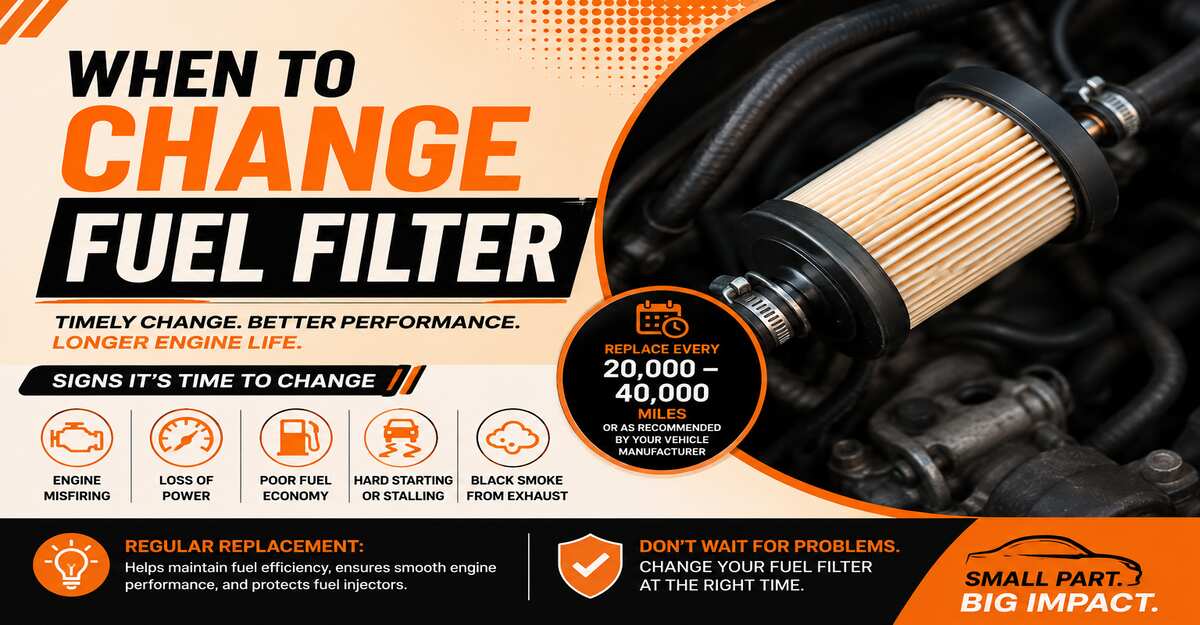
The recommended interval to change a fuel filter is every 20,000 to 40,000 miles for vehicles with inline filters, typically built before 2010. Modern vehicles manufactured after 2010 usually feature in-tank fuel filters designed to last over 100,000 miles, requiring replacement only if the fuel pump fails or clogs.
At a Glance:
- Inline fuel filters require replacement every 20,000 to 40,000 miles or every two years.
- Diesel engines need fuel filter replacements every 10,000 to 20,000 miles to prevent expensive water contamination damage.
- Modern vehicles post-2010 integrate the fuel filter into the in-tank pump assembly as a “lifetime” part lasting roughly 100,000 miles.
- A single tank of contaminated gasoline can instantly clog a brand-new fuel filter.
- Common symptoms of a restricted fuel filter include hard starting, engine hesitation under load, and a whining fuel pump.
- You cannot effectively clean a modern paper or mesh fuel filter; replacement is mandatory.
Where is the fuel filter located?
The fuel filter is located either underneath the vehicle along the main fuel line or integrated directly into the fuel pump assembly inside the gas tank. The exact location depends entirely on the vehicle’s manufacturing year and fuel system design.
For vehicles manufactured before 2005, engineers placed the fuel filter along the frame rail under the driver or passenger seat, or occasionally inside the engine bay near the firewall. These external locations made the filter easily accessible for routine maintenance. On vehicles built after 2010, the fuel filter sits submerged inside the gas tank as part of the fuel pump module. Automakers moved the filter inside the tank to capture debris before it ever enters the pressurized fuel lines, though this design makes physical access significantly more difficult.
Inline vs. In-Tank: Which filter do I have?
You can determine if your car has an inline or in-tank fuel filter by checking the vehicle’s manufacturing year and consulting the routine maintenance schedule in the owner’s manual. A general rule of thumb is that pre-2005 vehicles utilize inline filters, while post-2010 vehicles utilize in-tank filters.
If your owner’s manual lists a specific mileage interval for replacing the fuel filter (such as every 30,000 miles), the vehicle features an accessible inline filter. If the manual omits the fuel filter entirely from the maintenance schedule, the vehicle uses a “lifetime” in-tank filter. Mechanics can also visually verify the type by putting the vehicle on a lift and tracing the fuel lines from the gas tank to the engine bay. If a cylindrical metal or plastic canister interrupts the fuel line, the vehicle has an inline filter.
How often should you replace an inline filter?
You should replace an inline fuel filter every 20,000 to 40,000 miles, or approximately every two years for older vehicles. This interval ensures the fuel system maintains optimal pressure and flow to the engine.
Inline filters are relatively small and rely on tightly woven paper elements to trap rust, dirt, and sediment. Because of their limited surface area, inline filters clog much faster than large in-tank strainers. Waiting beyond 40,000 miles forces the fuel pump to push fuel through a severely restricted barrier, which degrades fuel pressure. Regular inline filter replacements are cheap insurance against lean engine conditions and premature fuel pump failure on older vehicles.
Do modern cars have lifetime fuel filters?
Yes, modern vehicles feature “lifetime” fuel filters, but in automotive engineering, “lifetime” typically refers to the warranty period of the vehicle—roughly 100,000 to 150,000 miles. The filter itself is not invincible.
Automakers build these modern filters directly into the fuel pump module inside the gas tank. They are engineered with a much larger surface area than old inline filters, allowing them to trap debris for years without causing a total restriction. However, by the time a vehicle reaches 120,000 miles, this internal screen often becomes saturated with sediment. When a “lifetime” filter eventually fails or clogs, owners cannot simply swap the filter element. Mechanics must drop the entire gas tank and replace the complete fuel pump assembly.
What is the replacement interval for diesels?
Diesel fuel filters require replacement every 10,000 to 20,000 miles without exception. Strict adherence to this interval is critical because diesel fuel is highly susceptible to water contamination and bacterial growth.
Unlike gasoline, diesel fuel inherently absorbs moisture from the atmosphere. To combat this, many diesel engines utilize a dual-filter system: a primary water-separator filter and a secondary particulate filter. If a diesel filter becomes saturated and allows water to pass into the fuel system, the water will instantly destroy the high-pressure fuel injectors by stripping away their lubrication. Replacing a diesel fuel filter every 15,000 miles costs under $100, whereas replacing damaged diesel injectors can easily exceed $3,000.
When to change a turbocharged car’s fuel filter?
Turbocharged and high-performance vehicles require a fuel filter replacement every 10,000 to 15,000 miles. Forced-induction engines demand massive, uninterrupted volumes of fuel under heavy acceleration, making them highly sensitive to even minor flow restrictions.
A turbocharged engine operating under high boost requires precise air-to-fuel ratios. If a partially clogged fuel filter drops the fuel pressure, the engine will run “lean” (too much air, not enough fuel). Lean conditions in a turbocharged engine generate extreme combustion temperatures, which rapidly cause engine knock, detonation, and catastrophic damage such as melted pistons. For performance vehicles, frequent filter changes are mandatory to maintain safe fueling margins.
Does getting bad gas ruin a fuel filter?
Yes, a single tank of bad gas can instantly ruin a brand-new fuel filter. You must replace the fuel filter immediately if you fill up with contaminated fuel and experience immediate sputtering or stalling.
Gas stations with poorly maintained underground storage tanks can pump water, heavy sediment, and sludge directly into your vehicle. When this contaminated fuel reaches the fuel filter, the high concentration of debris saturates the filtering element within miles. No amount of driving will clear the blockage. The only solution is to drain the contaminated fuel from the tank and install a fresh fuel filter to restore normal fuel pressure.
How does E85 ethanol affect the fuel filter?
Converting a standard gasoline vehicle to run on E85 ethanol requires replacing the fuel filter immediately after the first tank of E85 is consumed. E85 acts as a powerful industrial solvent inside the fuel system.
When you introduce E85 into a gas tank that has held standard gasoline for years, the high ethanol content strips away accumulated varnish, carbon, and old deposits from the tank walls and fuel lines. This massive wave of loosened debris travels straight to the fuel filter, clogging it almost instantly. Performance tuners recommend running one full tank of E85 to clean the system, replacing the fuel filter to remove the flushed debris, and then resuming normal driving.
How does a rusty gas tank impact filter life?
A rusty gas tank will destroy a new fuel filter in as little as 1,000 miles. Vehicles that have sat dormant for years develop severe internal tank rust that continuously flakes off into the fuel supply.
When restoring a classic car or waking up a vehicle from long-term storage, the fuel filter acts as the only defense against rust particles entering the carburetor or injectors. Because the rust shedding is continuous, owners must treat fuel filters as disposable items during the initial driving period. The filter will repeatedly clog and restrict fuel flow until the owner either has the gas tank professionally chemically cleaned and sealed, or replaces the tank entirely.
What are the symptoms of a clogged fuel filter?
The most common symptoms of a clogged fuel filter are hard starting, engine hesitation under load, and a noticeable whining noise from the gas tank. These symptoms occur because the engine is being starved of proper fuel pressure.
| Symptom | Underlying Cause |
| Hard Starting | The fuel pump struggles to push enough initial pressure past the clog to ignite the engine. |
| Hesitation Under Load | Accelerating requires high fuel volume; a restricted filter chokes the supply, causing a jerking sensation. |
| Whining Fuel Pump | The pump motor works at maximum capacity against a physical blockage, generating an audible whine. |
| Check Engine Light | The ECU detects a lean condition (often throwing a P0171 or P0174 diagnostic code). |
| Engine Stalling | Fuel flow drops so low at idle that combustion cannot be sustained. |
Can a clogged fuel filter damage the fuel pump?
Yes, a severely clogged fuel filter will damage and eventually destroy a fuel pump. The filter restriction forces the electric pump motor to work exponentially harder to maintain target fuel pressure.
Fuel pumps rely on the continuous flow of cool liquid gasoline passing through them to lubricate and cool the internal electric motor. When a clogged filter restricts this flow, the pump simultaneously works harder against the blockage and receives less cooling fuel. This combination of high mechanical resistance and excessive heat literally burns the fuel pump motor out. Replacing a $30 filter on time prevents a $600 fuel pump replacement.
Is it dangerous to drive with a clogged fuel filter?
Yes, driving with a clogged fuel filter is dangerous because it can cause the vehicle to stall unpredictably in active traffic. Losing engine power at highway speeds immediately disables power steering and power brakes.
Beyond the immediate physical danger of losing vehicle control, driving with a restricted filter poses a severe mechanical danger to the engine. The resulting lack of fuel creates a lean fuel-trim condition. Lean combustion burns significantly hotter than a balanced air-fuel mixture. Prolonged driving under these conditions will melt the vehicle’s catalytic converters, overheat the exhaust valves, and potentially crack engine pistons.
Will changing the fuel filter improve gas mileage?
Changing a clogged fuel filter will indirectly improve gas mileage by restoring the engine to its baseline factory efficiency. It will not magically boost fuel economy beyond the vehicle’s original specifications.
When a fuel filter restricts fuel flow, the engine computer detects poor combustion and attempts to compensate by forcing the fuel injectors to stay open longer. This creates inefficient, sloppy fuel delivery that wastes gas. Furthermore, a struggling engine requires the driver to press the accelerator pedal harder to achieve normal speeds. Installing a clean filter restores crisp fuel atomization and allows the engine to generate power effortlessly, returning MPG figures to normal.
Can you clean a fuel filter instead of replacing it?
No, you cannot effectively clean an automotive fuel filter instead of replacing it. Modern fuel filters are sealed units containing tightly folded paper, fiberglass, or fine mesh elements that permanently trap microscopic debris.
Attempting to back-flush a sealed metal or plastic fuel canister with compressed air or solvents will not dislodge embedded particles. Worse, blowing compressed air into a filter easily tears the delicate internal paper element. Once the paper is torn, the filter becomes structurally compromised and will allow raw dirt to flow directly into the engine’s sensitive fuel injectors. Because inline filters cost less than $40, attempting to clean them is an unacceptable risk.
How much does a fuel filter replacement cost?
A fuel filter replacement costs between $15 and $150 for an inline filter, while an in-tank fuel filter assembly replacement costs between $400 and $1,000. The massive price difference dictates whether the job is a simple maintenance task or a major repair.
For inline filters located under the car, the part itself costs $15 to $40. A DIY mechanic can replace it in 20 minutes, while a professional shop will charge roughly $80 to $150 including labor. For in-tank filters, the filter is integrated into the fuel pump. Replacing it requires a mechanic to physically lower the gas tank out of the vehicle, resulting in heavy labor charges and a part cost that spans hundreds of dollars.
The Bottom Line
Replacing your fuel filter hinges entirely on your vehicle’s age and fuel system architecture. Pre-2010 vehicles with accessible inline filters require a strict 20,000 to 40,000-mile replacement schedule to protect the fuel pump and maintain drivability. Modern vehicles treat the in-tank filter as a 100,000-mile lifetime component that requires no attention unless you experience symptoms like hard starting or engine hesitation. Regardless of the vehicle type, if you encounter severely contaminated gasoline or convert to E85 ethanol, immediate filter replacement is mandatory to prevent catastrophic engine damage.