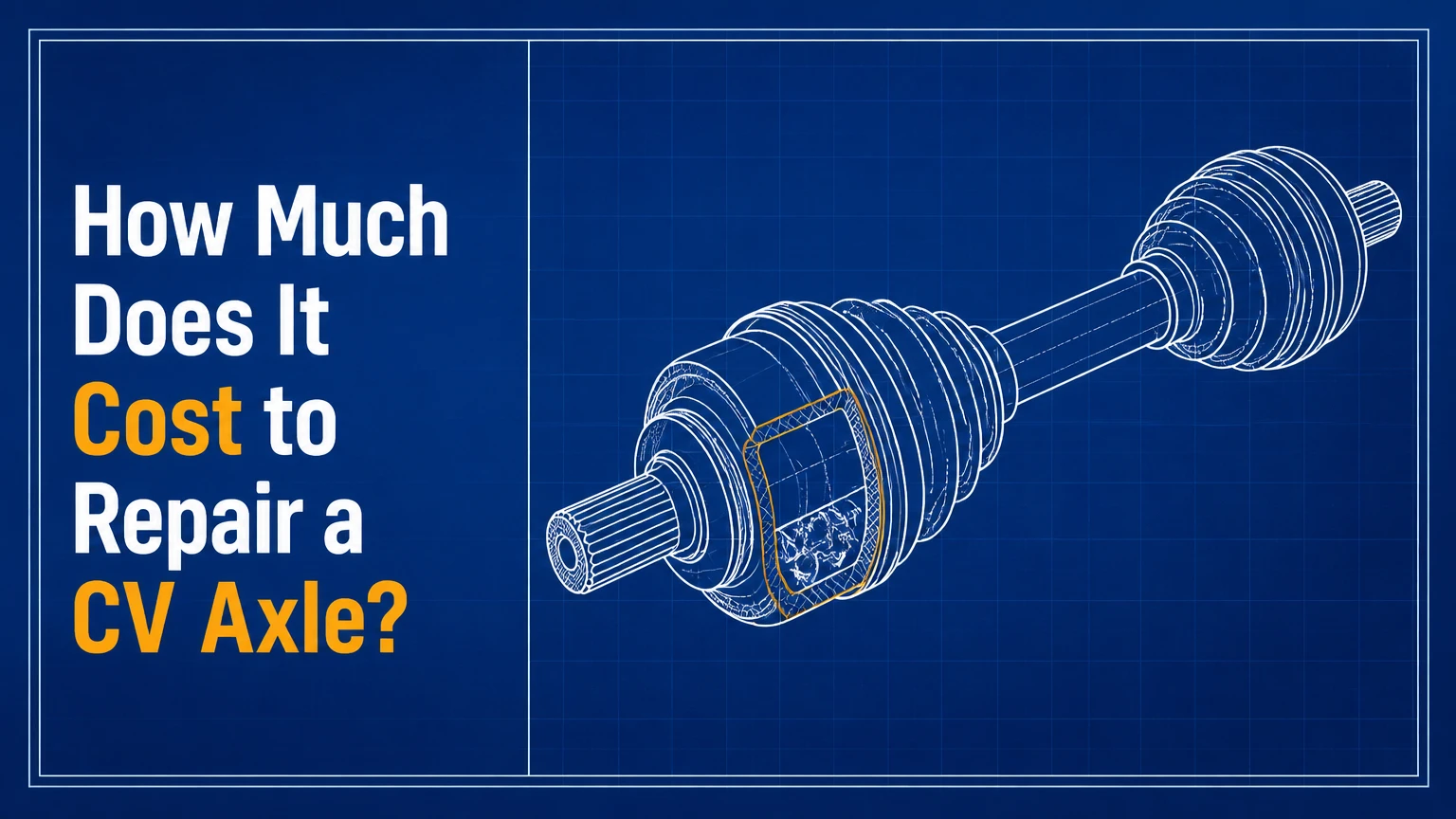
Replacing a single CV axle assembly costs $250 to $600 for a standard front-wheel-drive vehicle, while luxury, all-wheel-drive (AWD), or heavy-duty vehicles cost $600 to $1,200+ per side. Most auto repair shops replace the full CV axle assembly rather than repairing inner joints because complete unit replacement minimizes labor charges.
At a Glance
- Standard Single-Axle Cost: $250 to $600 installed (parts and labor included).
- Luxury / AWD / Heavy-Duty Cost: $600 to $1,200+ per side.
- Average Parts Price: $50 to $150 for standard aftermarket; $200 to $500+ for OEM or specialized parts.
- Average Labor Time: 1.5 to 3.0 hours at $100 to $200+ per hour.
- Repair Strategy: Shops universally replace the entire axle assembly rather than rebuilding individual joints.
What Is the Total Cost Breakdown for Replacing a CV Axle?
A standard single CV axle replacement costs $250 to $600 per side at an independent repair shop. If you replace both front CV axles simultaneously, expect a total bill between $500 and $900, as shops save minimal labor time by servicing both sides at once.
| Vehicle Category | Parts Range (Aftermarket / OEM) | Labor Hours | Total Estimated Cost Per Side |
| Economy / Compact | $50 – $200 | 1.0 – 1.8 hrs | $250 – $450 |
| Midsize Sedan / SUV | $80 – $350 | 1.3 – 2.1 hrs | $350 – $650 |
| AWD Crossover / Light Truck | $120 – $500 | 1.5 – 2.5 hrs | $450 – $850 |
| European Luxury / Heavy-Duty | $250 – $700+ | 1.5 – 3.0 hrs | $600 – $1,200+ |
The final price depends heavily on local labor rates. Independent mechanics typically charge $90 to $175 per hour, whereas dealership service departments charge $150 to $250+ per hour for identical operations.
How Much of the Total CV Axle Cost Goes to Parts Versus Labor?
Parts account for approximately 40% to 50% of a standard CV axle repair bill, while labor accounts for the remaining 50% to 60%. On economy vehicles, a quality aftermarket constant-velocity axle shaft costs $50 to $150, accompanied by $150 to $300 in labor charges.
Standard Single CV Axle Estimate
├── Parts (Aftermarket Assembly):  $100  (40%)
└── Labor (2.0 Hours @ $125/hr):   $250  (60%)
    Total Estimate:                $350
On luxury European vehicles (such as BMW, Audi, or Mercedes-Benz), the parts-to-labor ratio shifts. Original Equipment Manufacturer (OEM) drive shafts for these platforms regularly exceed $400 to $800 for the physical component alone, making parts the dominant cost factor on high-end cars.
Why Do Luxury, AWD, and Lifted Vehicles Cost More for CV Axle Repair?
Complex drivetrains and modified suspensions increase CV axle repair bills to $600–$1,200+ due to additional labor steps and specialized components.
- All-Wheel Drive (AWD) & 4WD Systems: Rear axles or front axles on 4WD platforms require removing skid plates, exhaust shields, or differential support brackets. This added teardown adds $100 to $250 in labor fees.
- Lifted Trucks & Modified Suspensions: Altered ride heights change the operating angle of the constant-velocity joints. Standard factory replacement axles will bind or pull apart; these vehicles require extended-travel or heavy-duty aftermarket axles that cost $400 to $800 for the part alone.
- European & Luxury Engineering: Tightly packaged engine bays require technicians to drop subframes or disconnect lower control arms to gain clearance, pushing labor times to 3.0+ hours.
What Hidden Charges Can Increase a CV Axle Replacement Estimate?
Rust, secondary mechanical damage, and auxiliary seals can add $50 to $1,500+ to an initial repair estimate. Standard written quotes cover uncomplicated part swaps, but real-world wear often introduces extra requirements during service.
- Seized Axle Splines ($50 – $150 extra): Road salt welds the steel axle spline inside the wheel hub bearing. Technicians must spend extra labor time using hydraulic pullers, air hammers, or induction heaters to free the rusted joint.
- Transmission / Axle Seal Replacement ($40 – $150 extra): Removing the inner CV stub shaft can damage old, hardened rubber transmission fluid seals. Replacing the seal while the axle is removed prevents immediate transmission fluid leaks.
- Differential Housing Damage ($1,500 – $4,000+ extra): If a completely snapped axle shaft flails inside the wheel well at high speed, it can crack the transmission case or differential housing, causing catastrophic fluid loss and mechanical failure.
How Can You Tell If a Noise Is a Failing CV Axle or Another Component?
A failing outer CV joint produces a distinct rhythmic clicking or popping sound that accelerates when making sharp turns (such as parking lot maneuvers or 90-degree street corners).
To isolate the source of noise before approving repairs, apply this diagnostic rule:
                                    NOISE / SYMPTOM
                                           │
             ┌─────────────────────────────┴─────────────────────────────┐
             ▼                                                           ▼
     Occurs During TURNS                                       Occurs Over BUMPS /
  (Accelerating around corners)                               (Driving Straight Line)
             │                                                           │
             ▼                                                           ▼
     CV AXLE JOINT                                              SUSPENSION / BEARING
  • Rhythmic clicking/popping                             • Clunking = Ball joint / Bushing
  • Grease slung on inner wheel rim                          • Deep Humming/Roar = Wheel Bearing
  • Heavy cabin vibration on acceleration                     • Squeaking = Struts / Sway Bar Links
If your vehicle produces a deep humming or roaring noise that changes pitch with vehicle speed—regardless of whether you turn—the failure is a bad wheel bearing, not a CV axle.
Can You Replace Just the CV Axle Boot Instead of the Whole Assembly?
You can replace just the rubber CV boot for $150 to $300 only if the tear is fresh and the joint has not been contaminated by dirt or run out of grease.
Replacing only the boot requires pulling the axle, completely disassembling the joint, cleaning out debris, repacking grease, and installing a new boot kit. Because this procedure requires equal or greater labor than installing a brand-new, pre-assembled shaft, most repair shops charge nearly the same price for a re-boot as a complete axle swap.
Expert Rule: If a torn boot has been driven on for more than 3–5 days, road grit has already ground down the precision steel bearings inside. Once clicking or popping begins, boot replacement fails 100% of the time—you must replace the complete axle assembly.
Should You Use OEM or Aftermarket CV Axles?
You should use aftermarket CV axles for standard economy sedans, but you must use Original Equipment Manufacturer (OEM) axles for lifted vehicles, heavy-duty trucks, and specific Honda or Subaru models.
| Feature / Metric | Aftermarket CV Axles | OEM CV Axles |
| Typical Cost (Part Only) | $50 – $200 | $200 – $600+ |
| Best Used For | Standard commuters (Toyota, Nissan, Hyundai) | Luxury, performance, and specific AWD setups |
| Vibration Risk | Moderate on sensitive suspensions | Zero (Factory dynamic balance match) |
| Warranty Coverage | Often Limited Lifetime | 12 Months / 12,000 Miles standard |
Budget aftermarket axles sold at retail auto stores sometimes lack precise rotational balancing. On vehicles with sensitive powertrain dampening (such as Subaru Symmetrical AWD or Honda Civic/Accord models), cheap aftermarket axles frequently produce an immediate, violent shudder through the floorboards during hard acceleration.
Should You Replace Both CV Axles at the Same Time?
No, you do not need to replace both CV axles at the same time. Unlike brake pads or shock absorbers, constant-velocity drive shafts do not experience symmetrical wear.
CV axles wear out independently based on boot degradation, road debris impacts, and tight turning stress (for instance, right-side axles often fail first due to hitting curb debris and puddles). Unless both axle boots show visible tears or both joints click during turns, replace only the damaged axle to avoid unnecessary repair costs.
How Long Can You Safely Drive With a Bad CV Axle?
You can safely drive on a failing CV axle for less than 50 miles after symptoms begin. Continuing to operate a vehicle with a clicking CV joint presents an immediate hazard.
If a joint collapses while driving:
- The steel ball bearings bind up, seizing the front hub or snapping the shaft completely.
- The engine immediately loses all propulsion power to the drive wheels (leaving you stranded in traffic).
- The loose, heavy metal stub shaft whips around under the vehicle, tearing through brake lines, snapping lower control arms, and destroying the aluminum transmission housing.
Do You Need a Wheel Alignment After Replacing a CV Axle?
Usually, no. On most vehicles, a technician can free the outer axle shaft by disconnecting only the sway bar link or pressing the lower ball joint out of the steering knuckle—procedures that do not alter wheel toe or camber settings.
However, a $100 to $150 wheel alignment is required if the repair process required:
- Unbolting the strut tower base from the steering knuckle (altering camber).
- Disconnecting tie rod ends from the steering rack (altering toe angle).
- Servicing an AWD vehicle where subframe bolts were loosened to drop the assembly.
Always ask the shop’s service advisor if the specific teardown procedure for your vehicle model required unbolting alignment-affecting geometry.
How Much Can You Save by Replacing a CV Axle Yourself?
Performing a DIY CV axle replacement saves $150 to $300 in labor charges, reducing the total expense down to the raw cost of the part ($50 to $200).
DIY Expense Model
├── Aftermarket CV Axle Assembly:  $110
├── Rental Axle Nut Socket Set:      $0 (Refundable deposit)
└── Transmission Fluid Top-off:     $15
    Total DIY Outlay:              $125  (Savings: ~$225 vs. Shop)
To complete this repair safely at home, you require specialized tools beyond a standard socket set:
- A 1/2-inch drive impact wrench or 30-inch breaker bar to remove the factory axle nut (torqued to 180–250 ft-lbs).
- A vehicle-specific axle nut socket (typically 30mm to 36mm deep-well).
- A pry bar or slide hammer with an axle fork to pop the inner shaft retaining clip out of the transaxle.
- Jack stands and a heavy-duty hydraulic floor jack.
If rust has fused the axle splines into your wheel hub, DIY removal without pneumatic air hammers or heavy pullers can become extremely difficult.
The Bottom Line
A standard single CV axle replacement costs between $250 and $600 for parts and labor, while luxury cars and AWD systems run $600 to $1,200+. Replace the full assembly rather than attempting boot repairs once clicking noises begin, as labor fees make joint rebuilding economically unviable. Address failing axles immediately to prevent snapped shafts from causing thousands of dollars in secondary suspension and transmission damage.