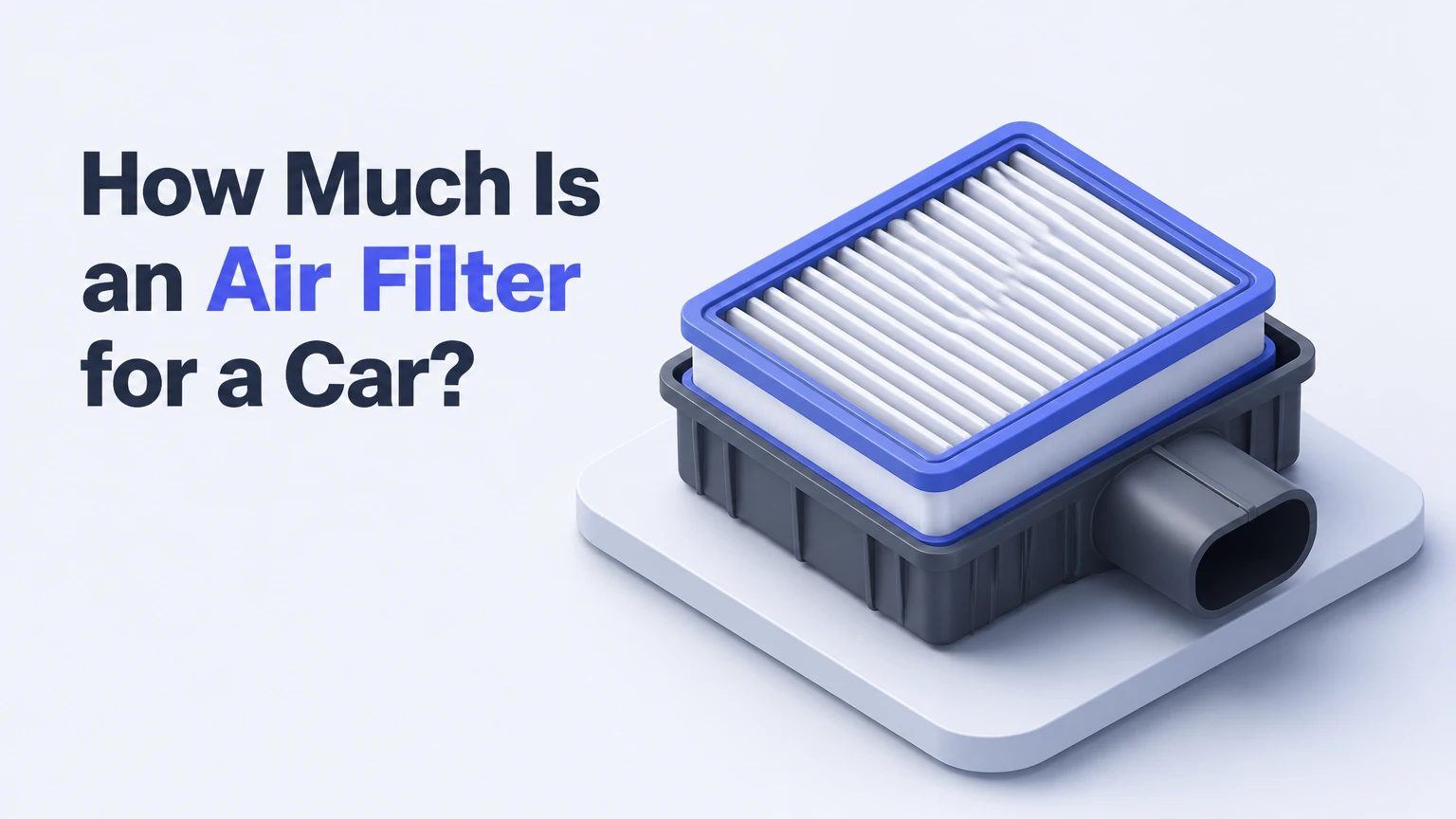
A standard car engine air filter costs between $15 and $50 for the part, while a cabin air filter ranges from $15 to $40. Professional installation adds $20 to $80 in labor, bringing the total installed replacement cost to $35 to $130 for most standard passenger vehicles.
At a Glance
- Standard Part Cost: $15 to $50 for standard engine filters; $15 to $40 for standard cabin filters.
- Professional Labor Cost: $20 to $80 at independent mechanics, lube shops, or dealerships.
- Total Replacement Cost: $35 to $130 per filter when professionally installed.
- High-End & Specialty Part Cost: $50 to $95 for washable performance filters; $200 to $500+ for supercar setups.
- Replacement Interval: Every 12,000 to 15,000 miles for engine filters; every 15,000 to 30,000 miles for cabin filters.
What is the difference between an engine air filter and a cabin air filter?
An engine air filter cleans the air entering the engine cylinders to prevent internal combustion damage, whereas a cabin air filter purifies the air entering the vehicle’s interior climate control system to protect passengers from dust, pollen, and pollutants.
+------------------------+-----------------------------------+-----------------------------------+
| Feature                | Engine Air Filter                 | Cabin Air Filter                  |
+------------------------+-----------------------------------+-----------------------------------+
| Primary Function       | Protects engine cylinders & combustion| Purifies HVAC air for passengers  |
| Location               | Under the hood inside air intake box| Behind glovebox or under dashboard|
| Part Cost Range        | $15 - $50 (Standard)              | $15 - $40 (Standard)              |
| Failure Symptoms       | Hesitation, dark exhaust, check engine light | Musty odors, weak HVAC airflow    |
+------------------------+-----------------------------------+-----------------------------------+
Engine air filters prevent abrasive dirt particles from scouring engine cylinder walls, pistons, and valves. In contrast, cabin air filters clear particulate matter and odors from air blown through the dashboard heating, ventilation, and air conditioning (HVAC) vents.
How much does a car engine air filter cost by brand and type?
A standard disposable paper engine air filter costs $15 to $30, while a premium reusable performance engine air filter costs $50 to $95.
- Standard OEM-Style Paper Filters ($15 – $30): Manufactured by brands like Fram, Wix, STP, and Purolator, these single-use filters utilize pleated cellulose media. They capture 98% to 99% of dust particles and require full replacement every 12,000 to 15,000 miles.
- Reusable Cotton-Gauze Performance Filters ($50 – $95): Produced by brands like K&N, AEM, and Spectre, these high-flow filters feature oiled or dry cotton mesh encased in wire framing. They last the lifetime of the vehicle but require a $15 cleaning and re-oiling kit every 50,000 miles.
How much does a cabin air filter cost by filtration grade?
A standard particulate cabin air filter costs $15 to $25, while an activated carbon or HEPA cabin air filter costs $25 to $45.
- Standard Particulate Cabin Filters ($15 – $25): Constructed from synthetic non-woven paper or electrostatically charged fibers, these basic filters capture macro-allergens such as pollen, dust mite debris, and road dust.
- Activated Carbon & HEPA Cabin Filters ($25 – $45): Infused with pulverized charcoal, baking soda, or multi-layer HEPA media, these premium filters actively adsorb toxic gases, diesel exhaust fumes, and microscopic bacteria down to 0.3 microns.
How much do mechanics charge to replace an air filter?
Mechanics, quick-lube centers, and dealerships charge $20 to $80 in labor to replace an air filter, making the average total installed bill $35 to $130 per filter.
- Quick-Lube Chains (Jiffy Lube, Valvoline): $20 to $35 labor charge. Parts are marked up 20% to 40% above retail store pricing.
- Independent Repair Shops: $25 to $50 labor charge. Independent mechanics typically bill based on a minimum quarter-hour labor increment ($25 to $35 minimum).
- Franchised Dealerships: $40 to $80 labor charge. Dealership labor rates range from $120 to $220 per hour, carrying a minimum half-hour labor fee for basic intake or HVAC servicing.
Why do some vehicles cost over $100 in labor for an air filter replacement?
Vehicle labor costs exceed $100 when complex engineering layouts require dashboard disassembly, structural brace removal, or dual-intake service to access the filter housing.
- Glovebox Demolition (Cabin Filters): Models like the Nissan Sentra, Mazda CX-5, and select Ford vehicles require removing the entire glovebox assembly, lower dash trim panels, and electrical connectors to reach the cabin filter door. Labor time increases from 5 minutes to 45 minutes.
- Under-Shroud Engineering (Engine Filters): German luxury vehicles (Mercedes-Benz, BMW, and Audi V6/V8 models) place engine filters beneath structural strut tower bracing and plastic beauty shrouds held by Torx fasteners, requiring mechanical teardown rather than simple toolless spring clips.
- Dual-Intake Systems: Performance vehicles like the Nissan 370Z or Infiniti Q50 host two separate air intake boxes, doubling both part and labor requirements.
How much do air filters cost for exotic, diesel, or modified cars?
Replacement air filter hardware for exotic supercars, heavy-duty diesel trucks, and modified cold air intakes ranges from $45 to over $500 for parts alone.
- Exotic Supercars ($200 – $500+): Vehicles from Ferrari, Lamborghini, or Aston Martin use specialized dual carbon-fiber intake tracks with high-temp silicon linings, pushing individual filter element replacement costs past $200 per side.
- Heavy-Duty Diesel Trucks ($60 – $120): Commercial-grade turbodiesels (Ford Powerstroke 6.7L, Ram Cummins 6.7L, GM Duramax 6.6L) require deep pleated, multi-stage paper elements capable of handling high intake airflow pressures without collapsing.
- Aftermarket Cold Air Intakes ($45 – $90): Custom intake kits (Injen, Mishimoto, Cobb) use proprietary conical clamp-on filters that cannot be replaced with standard rectangular OEM drop-in filters.
How often should you replace a car air filter?
You should replace your car engine air filter every 12,000 to 15,000 miles, and your cabin air filter every 15,000 to 30,000 miles under normal driving conditions.
If you drive regularly on unpaved gravel roads, in desert regions, or through heavy urban construction zones, inspect both filters every 6,000 miles and shorten replacement intervals by half.
How do you perform the flashlight test to check if an air filter is dirty?
To perform the flashlight test, remove the air filter from its box and hold a bright LED flashlight directly against the back side of the pleated paper.
- Pass (Functional Filter): If bright light penetrates cleanly through the paper pleats, the filter pores remain unblocked and fit for service.
- Fail (Clogged Filter): If the paper completely blocks the light output or appears opaque and dark across more than 50% of the pleats, the filter media is saturated with dirt and requires immediate replacement.
What are the symptoms of a dirty engine filter versus a dirty cabin filter?
A dirty engine air filter causes engine misfires, reduced throttle response, dark exhaust smoke, and a lit Check Engine light, whereas a dirty cabin air filter produces persistent musty odors, sluggish defroster performance, and weak HVAC fan airflow.
- Engine Filter Symptoms: The engine stumbles during hard acceleration, engine idle feels rough, and unburned fuel triggers error codes like
P0171(System Too Lean) orP0300(Random Misfire) due to air starvation. - Cabin Filter Symptoms: A whistling sound occurs when the blower fan is set to high, the windshield fogs up rapidly and clears slowly, or a foul, moldy smell blows from the dashboard air vents when turning on the AC.
Can you clean a dirty air filter with compressed air to save money?
No, you cannot clean a paper air filter with compressed air because high-pressure air tears the microscopic cellulose fibers and expands the filter pores.
While blowing high-pressure air removes large surface dirt, it destroys the filter’s micron-level filtering capacity. The enlarged pores allow abrasive quartz dust particles to pass directly into the engine, accelerating wear on cylinder walls and piston rings. Paper air filters are strict single-use components.
Does a dirty air filter lower your car’s gas mileage?
A dirty engine air filter does not significantly reduce fuel economy on modern fuel-injected cars, but it decreases engine acceleration performance by 6% to 11%.
Modern engine control units (ECUs) use Mass Air Flow (MAF) sensors to measure reduced air volume through a dirty filter and automatically trim fuel injector pulse widths to maintain a clean 14.7:1 air-to-fuel ratio. While this preserves gas mileage, it starves the engine of oxygen under load, reducing overall horsepower and throttle responsiveness.
Do expensive performance air filters add real horsepower?
High-flow performance air filters add only 1 to 3 horsepower on standard commuter engines, though they improve throttle response and intake sound.
Stock commuter intake systems are limited by throttle body diameters and factory exhaust restrictions rather than filter element resistance. High-flow cotton filters allow air to pass with less restriction, but the ECU adjusts fuel mapping to maintain emission compliance, preventing major horsepower gains without professional ECU tuning.
How do you replace a car air filter yourself in under 10 minutes?
Replacing a standard engine air filter yourself requires no specialized tools and takes under 10 minutes using five straightforward steps:
1.Locate the Air Filter Box:Pop the hood with the engine switched off.
Identify the black plastic intake box located near the engine block, connected to a thick corrugated rubber intake hose.
2.Unclip the Housing Retainers:No tools required for most domestic and Asian models.
Unsnap the two to four metal spring clips or loosen the 8mm hex screws securing the top lid of the air box.
3.Remove the Old Air Filter:Note the seating orientation before removal.
Lift the top lid, pull out the dirty filter, and note whether the rubber sealing lip faces up or down.
4.Clean the Air Box Interior:Prevent leftover grit from entering the intake.
Wipe out loose dirt, leaves, and bugs from the bottom of the plastic air box using a damp microfiber cloth.
5.Seat the New Filter and Reclamp:Ensure a tight perimeter seal.
Drop the new filter into the housing, ensure the rubber gasket seats flush along all edges, lower the lid, and re-engage the spring clips.
What happens to your engine if you never change the air filter?
If an engine air filter is never replaced, it will eventually collapse or tear under vacuum pressure, drawing raw, unfiltered dirt and debris directly into the combustion chamber.
A severely clogged air filter causes severe carbon fouling on spark plugs, premature catalytic converter failure from unburned fuel contamination, and abrasive wear on internal piston rings that leads to permanent compression loss and costly oil burning.
The Bottom Line
A replacement car air filter costs $15 to $50 for parts alone, or $35 to $130 when installed by a professional mechanic. While engine and cabin filters carry similar purchase prices, complex vehicle dashboard designs can push labor costs over $100 for cabin filter service. Replacing standard paper air filters yourself every 12,000 to 15,000 miles is one of the easiest, most cost-effective ways to protect engine health and preserve crisp throttle performance.