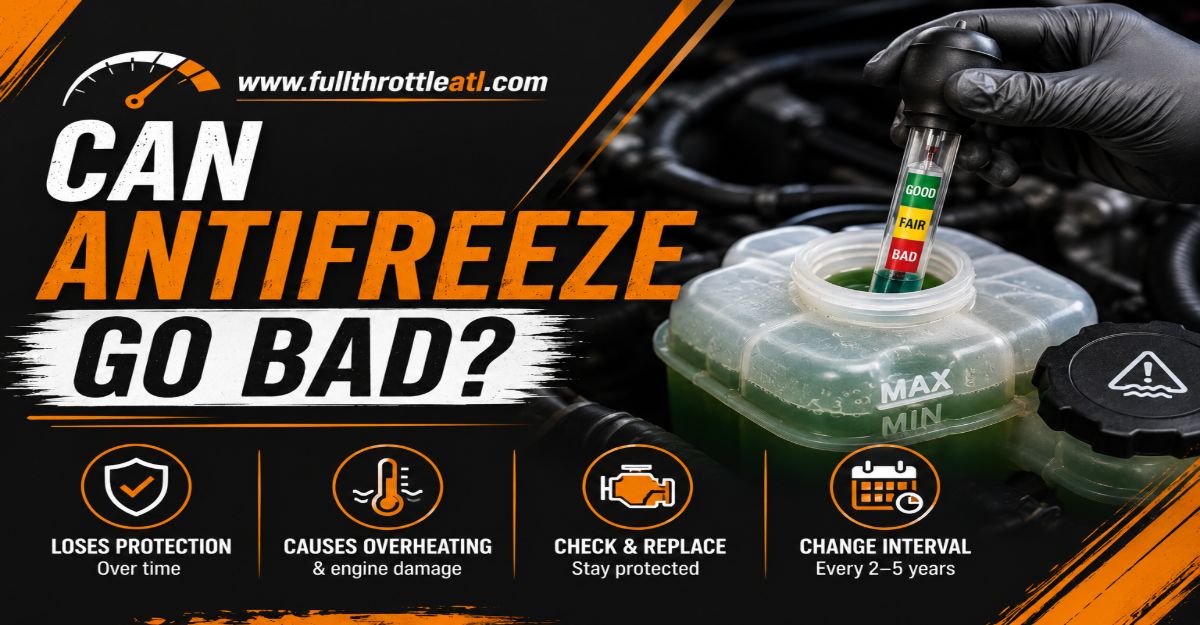
Yes, antifreeze absolutely goes bad. While the base glycol chemical is fundamentally stable, its vital protective additive package degrades over time through thermal cycling and oxidation, leaving engine metal components vulnerable to rust, acid corrosion, and catastrophic structural failure.
Key Facts at a Glance
- Unopened Shelf Life: 5 to 10 years when stored in a sealed container under controlled ambient temperatures.
- Active Service Life: 2 years for traditional Inorganic Acid Technology (IAT) up to 5 to 10 years for Organic Acid Technology (OAT).
- Acidification Threshold: Fresh coolant maintains an alkaline pH of 8.5 to 10.5; fluid drops below 7.0 must be flushed immediately.
- Galvanic Limit: Coolant registering $\ge 0.3$ Volts on a digital multimeter is acting as an active electrolyte, destroying internal metal channels.
- Cost of Neglect: A $20 coolant flush prevents catastrophic engine block or head gasket replacement bills ranging from $3,000 to $10,000.
What Happens When Antifreeze Goes Bad Inside an Engine?
Antifreeze goes bad through a distinct, five-stage progression of chemical breakdown driven by extreme thermal stress and oxidation. When an engine runs, it subjects the fluid to continuous temperature fluctuations that exhaust the protective chemicals dissolved within the base glycol.
- Thermal Cycling: The engine repeatedly heats the fluid above $200^\circ\text{F}$ ($93^\circ\text{C}$) and cools it down to ambient temperatures, continuously fatiguing the chemical bonds of the additive package.
- Additive Depletion: Sacrificial corrosion inhibitors-such as silicates, phosphates, and organic acid salts-are completely consumed while neutralizing internal engine oxidation.
- Acidification: With the inhibitors exhausted, the glycol base oxidizes and reacts with residual oxygen and metal ions, producing organic acids (formic, glycolic, and oxalic acids) that drive the fluid’s pH level below 8.0.
- Galvanic Corrosion: The acidic fluid transforms into an electrolyte conductor, passing electrical current between dissimilar metals in the engine block and eating away at aluminum, cast iron, and brass.
- Precipitation and Sludge: Corroded metal particles, sloughed-off scale, and depleted silicates drop out of suspension, transforming into an abrasive, muddy sludge that clogs radiator cores and destroys water pump seals.
How Long Does Antifreeze Last on the Shelf?
An unopened bottle of concentrated antifreeze lasts between 5 to 10 years if stored in a sealed container within a climate-controlled, dark environment. Once opened, exposure to atmospheric air drastically curtails its functional viability. An opened bottle on a garage shelf has a maximum shelf life of 1 year, as ambient air exposure induces moisture absorption and triggers premature additive oxidation.
When mixed with water to create operational coolant (typically at a 50/50 ratio), its active service life depends heavily on the chemical formulation:
- IAT (Green – Traditional): 2 years or 30,000 miles.
- OAT (Orange/Red/Pink – Extended Life): 5 years or 150,000 miles.
- HOAT / P-OAT / Si-OAT (Hybrid Formulations): 5 to 10 years or 150,000 miles.
How Can You Tell If Your Antifreeze Has Gone Bad?
You can determine if your antifreeze has gone bad by evaluating its visual presentation, testing its freeze protection via hydrometer, measuring its acidity, and checking for stray electrical currents. Perform these diagnostic checks exclusively on a completely cold engine to avoid severe thermal burns.
- Step 1: Visual Inspection: Draw a sample from the overflow reservoir using a turkey baster or fluid extractor. Fresh fluid is translucent and brightly colored. If the fluid appears murky brown, contains floating rust flakes, or shows sludgy separation, the additive package has completely failed.
- Step 2: Hydrometer Test: Insert an automotive fluid hydrometer into a coolant sample to measure specific gravity. A standard 50/50 mix must show freeze protection down to exactly $-34^\circ\text{F}$ ($-37^\circ\text{C}$). Readings far from this mark indicate an improper water-to-glycol balance.
- Step 3: pH Evaluation: Dip a digital pH probe or diagnostic test strip into the fluid. Fresh coolant registers between 8.5 and 10.5 (alkaline). Any reading at or below 7.0 means the fluid is acidic, highly corrosive, and requires an immediate system flush.
- Step 4: Multimeter Voltage Test: Set a digital multimeter to DC volts. Submerge the negative probe into the negative battery terminal and place the positive probe directly into the liquid coolant without touching metal. A healthy limit is $< 0.3$ Volts; readings $\ge 0.3$ Volts indicate that the fluid has broken down into a destructive electrolyte.
What Are the Main Antifreeze Types and Their Service Lifespans?
| Coolant Type | Chemical Profile & Additives | Target Vehicles | Standard Service Life | Color Visual Guide |
| IAT (Inorganic Acid Tech) | High silicates & phosphates | Older vehicles (Pre-2000) | 2 Years / 30,000 Miles | Bright Green |
| OAT (Organic Acid Tech) | Sebacate & 2-EHA organic acids | Modern GM, VW, Honda, Toyota | 5 Years / 150,000 Miles | Orange, Red, or Pink |
| HOAT (Hybrid OAT) | Organic acids + light silicates | Ford, Chrysler, European makes | 5 Years / 150,000 Miles | Yellow or Gold |
| P-OAT (Phosphated OAT) | Organic acids + phosphates | Toyota, Nissan, Hyundai, Subaru | 5+ Years / 150,000 Miles | Pink or Blue |
| Si-OAT (Silicated OAT) | Organic acids + liquid silicates | Mercedes-Benz, Audi, VW, Porsche | 5+ Years / 150,000 Miles | Purple or Magenta |
What Critical Mistakes Accelerate Antifreeze Failure?
- Mixing Incompatible Types: Pouring traditional green IAT into an orange OAT system causes an instant chemical reaction that creates a thick, gelatinous sludge. This chokes radiator tubes, blocks fluid flow, and causes rapid overheating.
- Diluting with Untreated Tap Water: Tap water contains high concentrations of calcium and magnesium. These minerals precipitate inside hot engine blocks, forming an insulating scale layer that severely reduces heat transfer efficiency.
- Running a 100% Pure Antifreeze Concentration: Pure ethylene glycol has poor heat transfer capabilities and a higher freezing point ($9^\circ\text{F}$ / $-13^\circ\text{C}$) than a diluted mix. It requires water to activate its full thermal performance properties.
- Relying Exclusively on Color Identification: Manufacturers use various non-standardized dyes. A blue fluid from one brand could be a standard OAT, while another is a specialized Si-OAT. Always verify compatibility by reading the ASTM specification label (ASTM D3306 or D6210) rather than relying on color alone.
- Ignoring a Sweet Burning Smell: Glycol emits a distinct, sweet aroma resembling boiling maple syrup. Smelling this around your vehicle indicates a micro-leak bleeding system pressure and boiling off active fluid.
Frequently Asked Questions
Can you use expired antifreeze from an old bottle?
You can use an unopened bottle of antifreeze past its shelf-life date only if the container remained completely sealed, showed no signs of cap leakage, and was stored away from extreme freeze-thaw cycles. If the bottle has been opened or shows crystallized crusting around the cap, discard it safely, as atmospheric moisture absorption compromises its protective properties.
What happens if you drive with bad, acidic coolant?
Driving with acidic, depleted coolant allows galvanic corrosion to eat away at vulnerable engine components, including aluminum cylinder heads, intake manifolds, and brass radiator cores. Over time, this corrosion creates internal pinhole leaks, destroys water pump bearings, and plugs core passages, resulting in engine overheating and costly head gasket failure.
Is it better to buy concentrated or pre-diluted antifreeze?
Pre-diluted 50/50 antifreeze is better for everyday motorists because it eliminates mixing errors and guarantees the use of mineral-free distilled water. Concentrated antifreeze is more cost-effective for professional shops or complete system flushes, where technicians must account for residual flush water remaining trapped inside the engine block.
How much does a professional coolant flush cost?
A professional shop coolant flush typically costs between $100 and $200, which includes draining the degraded fluid, pressure-testing the system for leaks, chemically cleaning internal channels, and refilling it with fresh, OEM-certified fluid. Purchasing DIY supplies costs between $15 and $30 per gallon of concentrate.