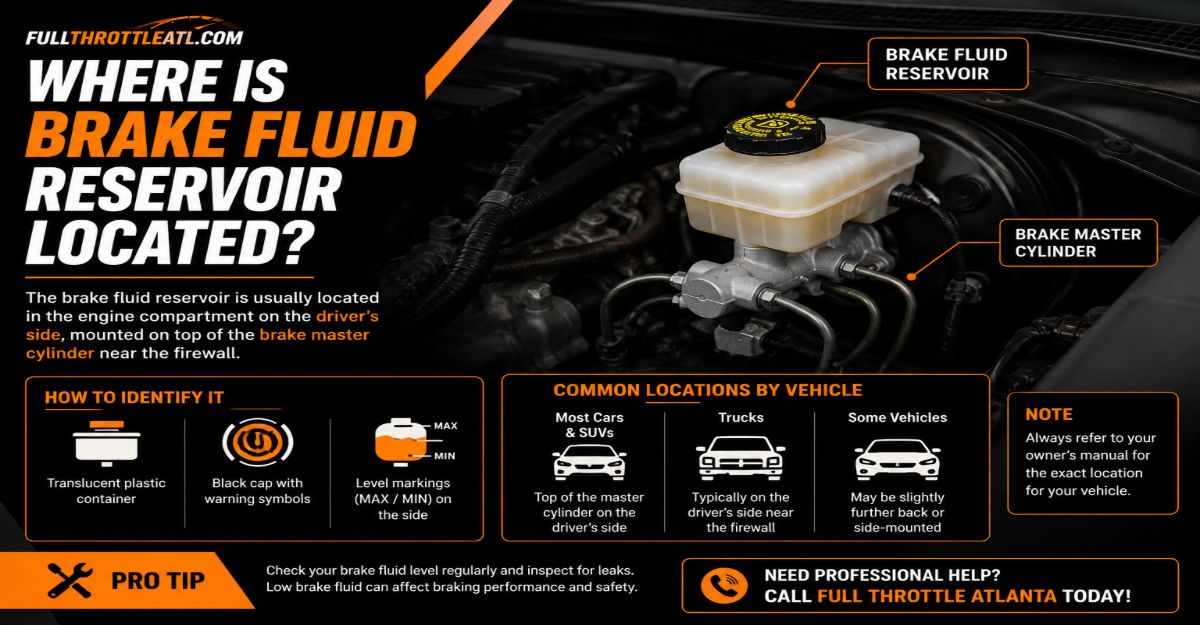
In 95% of modern passenger vehicles, the brake fluid reservoir is located in the engine bay on the driver’s side, mounted directly on top of the brake master cylinder near the firewall. It sits as a translucent plastic container roughly 2 to 6 inches in front of the metal bulkhead separating the engine bay from the cabin.
At a Glance
- Standard Placement: Driver’s side, rear of the engine bay, attached to the master cylinder.
- Appearance: Translucent white or light yellow plastic container with MAX and MIN side markings.
- Cap Markings: Black, yellow, or blue cap stamped with a circle inside parentheses $(\text{O})$ or a DOT specification.
- Non-Standard Cars: Located in the front trunk (frunk) on mid/rear-engine vehicles, or under plastic windshield cowl panels on minivans.
- Inspection Rule: Read fluid levels externally through the translucent plastic body rather than removing the cap unnecessarily.
What Does a Brake Fluid Reservoir Look Like?
A brake fluid reservoir is a translucent white or off-yellow plastic container fitted with a dark plastic screw-on cap. The reservoir features molded horizontal graduation lines on the side labeled MAX (maximum) and MIN (minimum) to allow visual fluid level inspection without opening the container.
The cap is typically 1.5 to 2.5 inches in diameter and is colored black, yellow, or blue. It displays the international brake warning icon—a circle enclosed by two curved brake shoe brackets $(\text{O})$—and often features raised lettering specifying the required fluid standard, such as “Use Only DOT 3 or DOT 4 Fluid.”
How Do You Distinguish the Brake Reservoir from Other Engine Tanks?
You can distinguish the brake fluid reservoir from other under-hood tanks by checking its cap symbol, container shape, and physical mount point. The brake reservoir is mounted directly to a metal hydraulic cylinder, whereas power steering, engine coolant, and washer fluid tanks connect exclusively to flexible rubber or plastic hoses.
| Reservoir Type | Container Appearance | Cap Symbol / Color | Mounting Location |
| Brake Fluid | Small translucent white/yellow plastic box | $(\text{O})$ symbol; Black, yellow, or blue cap | Bolted directly to metal master cylinder near firewall |
| Engine Coolant | Large pressurized plastic tank | Radiator graphic or “HOT” warning; Black or yellow | Mounted to fender rail or radiator support frame |
| Windshield Washer | Large white or opaque plastic neck | Windshield wiper spray icon; Bright blue or yellow | Mounted near the front headlamps or fender wall |
| Power Steering | Small black or dark translucent cylinder | Steering wheel icon or dipstick cap; Black cap | Bolted to engine block or accessory belt bracket |
How Far Is the Brake Reservoir from the Firewall?
The brake fluid reservoir sits approximately 2 to 6 inches (5 to 15 cm) directly in front of the firewall. It is positioned high up in the engine compartment to provide easy clearance for the brake pedal pushrod, which passes through the firewall directly into the brake booster assembly.
Because the brake master cylinder must align mechanically with the brake pedal inside the cabin, the reservoir rarely strays from this tight 6-inch envelope in conventional front-engine vehicles.
Where Is the Brake Fluid Reservoir on Right-Hand Drive (RHD) Vehicles?
On Right-Hand Drive (RHD) vehicles, the brake fluid reservoir is located on the right side of the engine bay (facing forward from the driver’s seat). Japanese domestic market (JDM) imports, British vehicles, and Australian models mirror the pedal assembly, moving the master cylinder and reservoir to the right-hand firewall.
If an RHD vehicle was converted to Left-Hand Drive (LHD) post-factory without moving the master cylinder, the reservoir will remain on the right (passenger) side. Always locate the steering column shaft; the brake master cylinder sits in direct proximity to where that shaft meets the firewall.
How Do You Find a Brake Reservoir Hidden Under a Windshield Cowl?
To locate a brake reservoir buried under a deep windshield cowl, look for a small removable plastic panel built into the cowl mesh just below the driver-side windshield wiper arm. Vehicles with steeply raked windshields—such as minivans (e.g., Pontiac Montana) or commercial vans (e.g., Ford E-Series)—position the master cylinder deep underneath the dashboard structure.
Manufacturers address this tight clearance in one of two ways:
- Access Hatch: A plastic flap or clip-in panel on the exterior cowl that unclips to reveal the reservoir cap directly beneath it.
- Remote Filler Neck: A secondary plastic neck extended forward into the main engine bay, connected by a feed hose to the remote master cylinder hidden farther back.
Where Is the Brake Fluid Reservoir on Mid-Engine and Rear-Engine Cars?
On mid-engine and rear-engine vehicles, the brake fluid reservoir is located inside the front luggage compartment (the frunk) near the base of the windshield. Because the mechanical engine is situated behind the cabin, the hydraulic braking controls remain at the front to link directly with the foot pedals.
- Porsche 911, Boxster, and Cayman: Access the front trunk, remove the plastic trim shroud near the windshield cowl, and the translucent reservoir sits on the driver’s side.
- Classic Volkswagen Beetle: The reservoir sits inside the front trunk area, positioned high on the firewall bulkhead or mounted directly behind the spare tire well.
Why Is the Clutch Connected to the Brake Fluid Reservoir?
In many modern European manual-transmission vehicles, the clutch hydraulic system shares the brake fluid reservoir to eliminate the need for a separate clutch fluid container. A rubber supply hose branches off a dedicated high-level nipple on the side of the brake reservoir to feed the clutch master cylinder.
This shared design incorporates an internal baffle system as a safety measure. The clutch supply hose attaches higher on the reservoir body than the main brake lines. If the clutch hydraulics suffer a severe leak, the clutch will lose fluid first and stop operating, preserving a reserve volume below the baffle dedicated exclusively to stopping the vehicle.
Where Is the Brake Reservoir on Older, Luxury, or Cabover Vehicles?
When standard engine bay searches fail, your vehicle employs an alternative engineering layout based on chassis frame constraints or cabin filtration housings.
| Vehicle Type / Scenario | Reservoir Location | Access Procedure |
| Pre-1970 Classic Cars | Mounted below the floor pan on the inner frame rail | Raise the car on jack stands or lift the driver-side carpet to access an inspection plate |
| Cabover Trucks & Vans | Hidden inside the dashboard structure | Open the driver door and unclip the plastic panel on the side end-cap of the instrument panel |
| BMW & Mercedes-Benz (Select Models) | Sealed inside the cabin air filter plenum | Unclip and lift out the driver-side cabin air filter box housing near the rear firewall |
| Custom Hot Rods / Kit Cars | Fender well or custom firewall mounting | Trace the hard lines backward from the front brake calipers to find the remote tank |
Why Is Brake Fluid Low If There Are No Visible Leaks?
Brake fluid levels drop naturally over time due to normal friction material wear on your brake pads and rotors. As the brake pad friction material wears thinner, the caliper pistons must extend farther outward to push the pads against the rotor surface. Fluid flows out of the reservoir to occupy the additional volume inside the expanded caliper pistons.
If the fluid level sits near or slightly above the MIN line and there are no wet fluid spots on the inner tires or driveway, your brake pads are likely near the end of their service life. Inspect pad thickness before pouring in fresh fluid; replacing the worn pads forces the caliper pistons back in, which pushes the fluid back up into the reservoir.
Is It Safe to Drive When the Brake Fluid Drops Below the MIN Line?
No, it is not safe to drive when the brake fluid level falls below the MIN line. Operating a vehicle with depleted reservoir fluid allows air bubbles to get sucked into the primary master cylinder ports, causing sudden loss of hydraulic pressure, a soft pedal that sinks to the floorboard, and extended stopping distances.
If the fluid drops below MIN, perform the following safety checks immediately:
- Inspect the ground beneath all four wheels and along the chassis frame lines for clear, oily fluid drops.
- Check the inside faces of the tires for fluid weeping from caliper or wheel cylinder seals.
- Top off the reservoir to the MAX mark with the correct specification (DOT 3, 4, or 5.1) before driving to a service station.
- If the pedal feels spongy or sinks when pressed, tow the vehicle—do not attempt to drive.
What Happens If You Accidentally Pour the Wrong Fluid into the Reservoir?
If you pour petroleum-based fluids (such as engine oil, power steering fluid, ATF, or WD-40) into the brake reservoir, do not turn the key or depress the brake pedal. Petroleum products aggressively attack the ethylene-propylene rubber (EPDM) seals throughout the master cylinder, ABS valves, and calipers, causing them to swell, soften, and disintegrate within hours.
Petroleum Fluid Added -> Rubber Seals Swell & Dissolve -> ABS Module & Calipers Fail -> Total Brake Failure
If the brake pedal has not been touched, siphon the contaminated fluid out of the top reservoir using a clean syringe before it enters the lower lines. If the pedal was depressed, the entire hydraulic braking system must be towed to a repair facility, completely disassembled, flushed with isopropyl alcohol or fresh brake fluid, and rebuilt with new rubber seals.
Can You Open the Brake Fluid Reservoir Cap to Check the Level?
You should avoid opening the brake fluid reservoir cap solely for routine visual inspections. Modern brake fluid is highly hygroscopic, meaning it actively absorbs water vapor directly out of the ambient humidity whenever the cap is removed.
Dissolved water content degrades brake system performance in two ways:
- Lowers Boiling Point: Moisture reduces the boiling threshold of DOT 3 fluid from roughly 401°F (205°C) dry down to 284°F (140°C) wet, risking vapor lock under heavy braking.
- Accelerates Internal Corrosion: Absorbed water settles into low points in the ABS hydraulic valves and calipers, rusting metal pistons from the inside out.
Inspect the fluid level strictly through the clear plastic body from the outside. Only unscrew the sealed cap when you are prepared to pour fresh fluid or test the fluid’s moisture content with an electronic probe.
Which Brake Fluid Type (DOT 3, 4, 5, 5.1) Should You Use?
You must use the specific DOT fluid rating stamped on your reservoir cap or detailed in your owner’s manual. Fluid types differ based on chemical base, boiling point thresholds, and system compatibility.
| Fluid Grade | Chemical Base | Dry Boiling Point (Min) | Wet Boiling Point (Min) | Key Compatibility Rules |
| DOT 3 | Glycol Ether | 401°F (205°C) | 284°F (140°C) | Mixable with DOT 4 and DOT 5.1; standard for older domestic vehicles |
| DOT 4 | Glycol / Borate Ester | 446°F (230°C) | 311°F (155°C) | Standard for modern European and Asian cars; higher thermal resistance |
| DOT 5 | Silicone | 500°F (260°C) | 356°F (180°C) | NEVER mix with any other fluid. Non-hygroscopic; ruins ABS systems |
| DOT 5.1 | Glycol / Borate Ester | 500°F (260°C) | 356°F (180°C) | High-performance formulation; mixable with DOT 3 and DOT 4 |
How Do You Safely Add Brake Fluid to the Reservoir?
To add brake fluid safely, clean the cap exterior, pour slowly to the MAX line using sealed fresh fluid, and immediately wipe off any exterior spills.
1.Clean the Reservoir Exterior:Crucial step to prevent particulate contamination.
Wipe down the reservoir cap and surrounding plastic top with a clean shop rag. Preventing dirt, sand, or debris from dropping into the hydraulic fluid during refill is critical to protect internal ABS valves.
2.Open a Fresh Sealed Bottle:Do not use open bottles stored longer than 12 months.
Unseal a new container of the correct DOT-rated brake fluid. Never use fluid from an uncapped bottle that has sat open on a shelf, as it has already absorbed ambient moisture.
3.Pour Carefully to the MAX Mark:Do not overfill past the top graduation line.
Remove the cap and pour fluid steadily through a clean funnel until the fluid level sits precisely at the MAX line stamped on the translucent side wall. Leave room for the fluid level sensor float attached under the cap.
4.Seal Cap and Clean Spills Instantly:Brake fluid aggressively strips automotive paint finish.
Screw the cap back on securely until it clicks or seats firmly against its rubber gasket. If any fluid drips onto painted engine bay surfaces, spray the area immediately with brake cleaner or soapy water and wipe it clean; glycol fluid strips clear coats quickly.
The Bottom Line
In almost all passenger vehicles, your brake fluid reservoir is mounted on the driver-side firewall on top of the master cylinder. If it is missing from that area, check under plastic cowl panels beneath the windshield wipers or inside the front trunk on mid-engine vehicles.
Always check fluid levels through the translucent side walls without removing the cap, and remember that a low fluid level usually points to worn brake pads rather than an immediate leak.