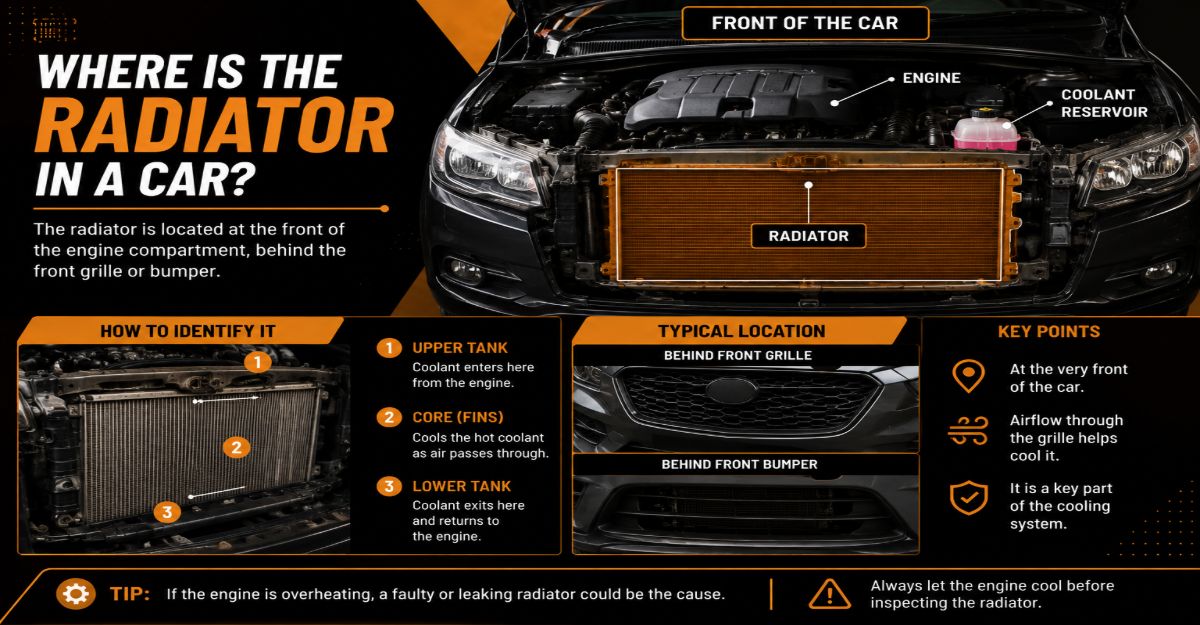
The car radiator is almost always located at the very front of the engine bay, directly behind the main grille and in front of the engine block. This forward placement maximizes exposure to high-speed airflow as the vehicle moves forward, facilitating efficient heat exchange for the engine cooling system.
At a Glance:
- The standard car radiator sits 2 to 6 inches behind the front grille assembly.
- It is part of a “cooling module” stacked behind the A/C condenser and in front of the electric cooling fans.
- Mid-engine and rear-engine vehicles often use long underfloor plumbing connected to front-mounted radiators.
- Opening a warm radiator cap is dangerous due to 14 to 16 PSI of pressure causing instant boiling steam explosions.
- A completely cold bottom hose paired with an overheating engine indicates a blocked core or stuck thermostat.
What is the exact physical layout and spacing of a car radiator?
The car radiator is engineered within precise mechanical dimensions and clearances inside the front-end assembly. It sits typically 2 to 6 inches behind the front bumper fascia and grille assembly. Behind the radiator core, there is usually a gap of 4 to 8 inches between the cooling fan shroud and the front accessories of the engine block.
In 95 percent of standard passenger vehicles, the radiator is mounted in a perfectly vertical orientation at a 90-degree angle relative to the ground. However, low-profile sports cars often tilt the radiator forward or backward between 15 and 30 degrees to optimize aerodynamics and hood slope. The core thickness of a standard modern passenger car radiator ranges from 0.625 inches to 1.25 inches, whereas heavy-duty towing applications utilize thick cores measuring up to 3 inches.
How do I tell the difference between the radiator and the A/C condenser?
You can differentiate the radiator from the A/C condenser by inspecting the attached fluid lines and hose diameters. The radiator features two thick, flexible rubber hoses measuring roughly 1.5 to 2 inches in diameter that channel engine coolant. Conversely, the A/C condenser uses thin, rigid aluminum lines or hard braided fittings under 0.5 inches in diameter that carry high-pressure refrigerant.
The A/C condenser is also mounted directly in front of the actual radiator as part of the front cooling module sandwich. Mistaking the condenser for the radiator is a common error because both components feature similar finned aluminum matrix designs.
Why can’t I see the radiator when I open my car hood?
Opening the hood of a modern vehicle often reveals only plastic shrouds and engine covers due to component stacking and aerodynamic design. Modern cars feature sealed under-engine shields, known as belly pans, which completely hide the lower radiator tanks and mounting brackets from view.
Furthermore, the radiator is buried inside a tight cooling module. Looking down from the engine bay, you first encounter the upper plastic core support, followed by the A/C condenser, the radiator itself, and finally the electric cooling fan shroud mounted directly to the rear face. Accessing or viewing the core directly often requires removing several plastic push-pins and under-vehicle splash guards.
Can I open the metal cap on top of the radiator while the engine is warm?
You must never open the radiator cap or a pressurized expansion tank cap while the engine is warm. The automotive cooling system operates under heavy pressure, typically maintaining 14 to 16 PSI to raise the boiling point of the coolant.
Removing the cap while pressurized causes an instant drop in pressure, forcing the hot liquid to flash-boil into tracking steam and violently erupt outward. This results in severe third-degree burns. Professional mechanics advise waiting at least 30 to 45 minutes until the upper radiator hose feels completely cool and soft to the touch before attempting to open the system.
Why is my radiator cold at the bottom but hot at the top?
A radiator that is hot at the top and noticeably cooler at the bottom is operating according to its baseline thermal design. Hot coolant enters the upper radiator tank directly from the engine and transfers its heat into the ambient air as it flows downward through the core channels.
However, if the bottom half of the radiator is freezing cold while the engine continues to overheat, it signals a functional failure. This thermal discrepancy indicates either a severely blocked internal core choked with mineral scale or a thermostat stuck in the closed position, which prevents proper coolant circulation through the lower block.
Where is the radiator located in rear-engine or mid-engine sports cars?
Rear-engine and mid-engine vehicles alter the traditional cooling layout because the heat source is moved away from the front nose. Cars like the Porsche 911 and the Chevrolet Corvette Stingray (C8) keep their primary radiators mounted in the front bumper fascia to capture high-speed airflow, utilizing 10 to 15 feet of long aluminum plumbing running beneath the passenger cabin floor to link the rear engine.
In contrast, exotic mid-engine supercars like various Ferrari or Lamborghini models mount dual radiators in the rear quarter panels or side pods, pulling air through massive side scoops to manage thermal loads efficiently without long underfloor pipe networks.
Which vehicles do not have a radiator at all?
Classic vehicles equipped with air-cooled engines completely lack a radiator, coolant hoses, water pumps, and liquid antifreeze. Historic models such as the original Volkswagen Beetle, older Porsche 911 variants up to the 993 generation, and early Chevrolet Corvairs rely exclusively on atmospheric air passing over finned cylinder heads and engine-driven blowers to dissipate combustion heat.
These vehicles use engine oil as a secondary thermal transfer medium rather than a closed water-glycol coolant loop.
Is the plastic translucent bottle with bright fluid the radiator?
The translucent plastic reservoir containing brightly colored fluid is the coolant overflow expansion tank, not the radiator itself. Because liquid expands significantly when heated, the radiator must remain completely full without internal air pockets, venting excess fluid into this external plastic holding bottle as temperatures rise.
You should check fluid levels and add 50/50 coolant mixtures directly into this overflow container rather than opening the radiator cap, unless the entire system has been drained and refilled from bone-cold status.
Why do race cars and off-road buggies relocate their radiators to the rear?
Off-road buggies, demolition derby cars, and short-course racing trucks frequently relocate their cooling systems away from the front end to protect them from unavoidable debris, mud packs, and front-end impacts.
By mounting the radiator in the rear trunk space or securing it inside the rear roll-cage frame behind the driver, builders protect the fragile aluminum core from puncture. These rear setups rely on high-flow electric auxiliary fans and custom ducting or roof scoops to force adequate airflow through the relocated core.
How do I know if my car radiator is clogged or failing?
A failing or internally clogged radiator manifests through specific thermal and visual warning signs. The primary symptom is localized engine overheating during highway driving or idling, paired with a noticeable temperature differential across the core matrix when checked with an infrared thermometer.
Externally, a failing radiator displays greenish-pink crusty residue or wet puddles along the plastic end-tanks where the aluminum core crimps to the headers. Internal scale buildup restricts fluid flow, reducing overall heat rejection capacity.
How often should a car cooling system and radiator be flushed?
A car radiator and cooling system should be completely drained and flushed every 30,000 to 50,000 miles, or approximately every 3 to 5 years, depending on the coolant formulation used. Traditional green inorganic acid technology (IAT) coolants require changes every two years, whereas modern long-life organic acid technology (OAT) formulations-such as Dex-Cool-last up to 5 years or 100,000 miles.
Failing to flush old coolant causes corrosion inhibitors to deplete, leading to internal electrolysis, aluminum pitting, and radiator core blockage.
What happens if road debris punctures the front grille and damages the radiator?
An impact from road debris or a stone penetrating the front grille directly punctures the thin aluminum fins and water tubes of the radiator, causing an immediate, pressurized coolant leak.
When a core tube is ruptured, coolant sprays out rapidly, triggering an instant drop in system pressure and a fast climb on the dashboard temperature gauge. Continuing to drive a vehicle with a punctured radiator causes catastrophic engine warping, blown head gaskets, or total engine seizure within minutes.
How much does a radiator replacement cost on average?
Replacing a standard passenger car radiator costs between $450 and $900 for total parts and labor at a professional repair facility. The radiator unit itself typically ranges from $150 to $400, while labor accounts for 2 to 4 hours of shop time depending on how deeply buried the cooling module is beneath front bumper fascias and support braces.
Luxury vehicles, European imports, or models with complex active grille shutters and integrated transmission coolers can push total replacement costs between $1,000 and $1,800.
What type of coolant should be added to the radiator overflow tank?
You must add the exact type of coolant specified by your vehicle manufacturer-typically hybrid organic acid technology (HOAT) or organic acid technology (OAT)-diluted to a 50/50 ratio with distilled water. Mixing incompatible coolant chemistries, such as combining traditional green inorganic coolant with modern red or orange organic formulations, causes chemical reactions that drop out silicates, forming a thick gel that plugs the radiator core.
Always check the owner’s manual for specific fluid certifications before topping up the system.
What should I do immediately if my temperature gauge spikes while driving?
If your vehicle’s temperature gauge spikes into the red zone while driving, turn off the air conditioning immediately to reduce engine load, turn the cabin heater to maximum heat with the blower on high to draw thermal energy away from the block, and safely pull over to the side of the road.
Shut off the engine immediately to prevent catastrophic internal thermal damage. Never open the hood or attempt to inspect the cooling system until the engine has cooled down completely for at least 45 minutes.
The Bottom Line
The car radiator is anchored at the front of the engine bay behind the grille to capture high-speed airflow, though engineering variations like rear-engine placement or multi-layer cooling module stacking often complicate visual identification. Recognizing the heavy-duty rubber hose connections and understanding internal thermal gradients helps technicians and vehicle owners accurately isolate and troubleshoot cooling system failures without risking pressurized steam burns.