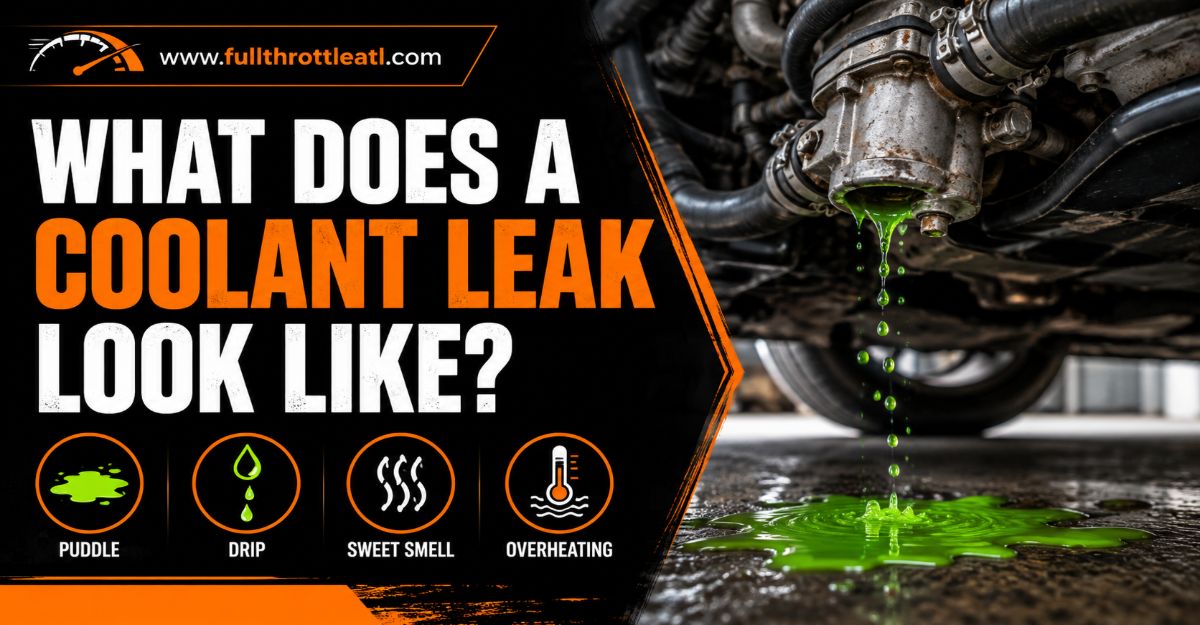
A coolant leak typically looks like a bright, watery puddle of green, orange, pink, or blue fluid beneath your engine bay, accompanied by a sweet, syrup-like smell. Unlike engine oil or transmission fluid, automotive engine coolant has a watery viscosity of 1.0 to 1.1 mPa·S and leaves zero greasy residue on concrete.
At a Glance: Core Coolant Leak Facts
- Coolant feels watery and non-greasy, matching the viscosity of water at room temperature.
- Modern coolant colors designate chemical formulations: green for IAT, orange/pink for OAT, and blue for HOAT.
- Slow leaks often leave no puddles due to aerodynamic undertray traps or instant evaporation into crusty white or green residue.
- Internal leaks do not hit the ground; instead, they turn engine oil into a frothy, light-brown “milkshake” consistency.
- A sweet maple syrup odor inside the cabin signals a failing heater core leaking onto passenger floorboards.
What colors and textures indicate a coolant leak?
Coolant fluid features a completely non-greasy, watery texture and comes in distinct bright colors determined by its chemical additive technology. Traditional Inorganic Additive Technology (IAT) used in pre-2000 vehicles appears bright green or yellow. Organic Acid Technology (OAT), utilized by General Motors, Volkswagen, and Toyota, appears orange, red, or pink. Hybrid Organic Acid Technology (HOAT), common in BMW, Mercedes-Benz, Honda, and Subaru, appears blue or purple.
If you touch the fluid with a clean white paper towel, it will soak in like water without leaving an oily smear. If the fluid feels slick or slippery like heavy oil, you are likely looking at a power steering or transmission fluid leak instead of an engine cooling system failure.
How big is a typical coolant leak puddle?
Coolant leak puddle sizes range from minor seeps under 2 inches in diameter to catastrophic pools exceeding 12 inches within minutes of parking.
Puddle dimensions directly correlate with the severity of the breach:
- Minor Seep: Spotting under 2 inches in diameter after sitting overnight, typically caused by a slightly loose hose clamp or minor gasket weep.
- Active Leak: Puddles between 2 and 6 inches in diameter, indicating a cracked radiator seam, aging hose, or failing water pump seal that requires immediate attention.
- Catastrophic Failure: Pools exceeding 12 inches forming within minutes of parking, pointing to a completely ruptured radiator core, blown hose, or fractured expansion tank.
Why do I smell coolant if there is no visible puddle?
An evaporative leak occurs when engine coolant drips onto a scorching component-such as an exhaust manifold or hot engine block-and vaporizes instantly at temperatures above 100°C (212°F).
Because the liquid boils off before hitting the ground, drivers experience a strong, sweet maple syrup scent without finding any fluid on the driveway. Another major culprit for smell-without-puddles is the aerodynamic plastic undertray installed beneath modern vehicles. Slow leaks pool on top of this protective tray, evaporating gradually from engine heat while remaining completely hidden from plain sight.
What does a leaking heater core look like inside the car?
A failing heater core manifests as sopping wet, sticky floorboards in the passenger footwell and a heavy, greasy fog coating the inside of the windshield when the defroster runs.
The heater core functions as a mini-radiator tucked behind the dashboard that circulates hot engine coolant to warm the cabin. When it develops a pinhole leak, engine coolant drips directly onto the passenger side carpet. Passengers will notice a distinctly sweet, chemical smell inside the cabin, and turning on the climate control will instantly smear a film across the glass that is extremely difficult to wipe clean.
How do I tell the difference between a coolant leak and A/C condensation?
Air conditioning condensation is completely clear and odorless, whereas engine coolant features distinct vibrant coloring and a sweet chemical scent.
On hot, humid days, automotive air conditioning systems naturally discharge pure water near the passenger-side firewall as part of normal operation. Drivers frequently mistake this healthy puddle for a coolant leak. To verify the fluid type, press a clean white paper towel against the puddle. If the paper towel reveals zero color tint and zero odor, the moisture is harmless A/C condensation. If the paper shows green, pink, orange, or blue pigmentation, your vehicle has an active cooling system leak.
What does an internal coolant leak look like on the oil dipstick?
An internal coolant leak turns engine oil into a thick, frothy, light-brown fluid resembling a chocolate milkshake.
When a head gasket fails or an internal engine block crack develops, engine coolant breaches the oil passages and mixes directly with the circulating motor oil. This mixture will never show up as a puddle beneath your car. Instead, mechanics and drivers spot it by pulling the engine oil dipstick or inspecting the underside of the oil filler cap, where a creamy, emulsified sludge replaces clean amber oil. Operating an engine with this milkshake mixture destroys bearings rapidly.
Why does a coolant leak leave a crusty white or green powder instead of a puddle?
Coolant leaves behind a chalky, crusty white, pink, or green residue when anti-corrosion mineral inhibitors bake onto hot engine components and dry out instantly.
Rather than pooling on the ground, slow leaks around high-temperature areas-such as thermostat housings, radiator seams, or the water pump weep hole-evaporate continuously while running. This leaves behind distinct mineral crust deposits. Mechanics look for these colorful chalky trails as definitive diagnostic markers of chronic, slow-leaking connections that have not yet turned into major drips.
Is leaking coolant toxic to dogs and cats?
Traditional engine coolant containing ethylene glycol is extremely toxic and lethal to dogs, cats, and wildlife, even in microscopic quantities of less than a tablespoon.
Ethylene glycol possesses a naturally sweet taste that aggressively attracts domestic pets and urban wildlife. While modern formulations frequently incorporate bittering agents like denatonium benzoate to discourage ingestion, any outdoor coolant spill must be washed down thoroughly with copious amounts of water or cleaned up with absorbent material immediately to prevent animal poisoning.
Can I drive my car if it is leaking coolant?
Driving with a coolant leak depends entirely on the leak rate and your dashboard temperature gauge behavior.
If the vehicle experiences a minor seep under 2 inches overnight and the temperature gauge stays locked firmly in the normal operating zone (typically 90°C to 105°C / 195°F to 220°F), short drives to a repair shop are permissible while keeping the reservoir topped off. However, if the puddle is large, the fluid level drops rapidly, or the temperature needle climbs toward the red zone, driving must stop immediately. Aluminum engine blocks can warp, crack, and destroy themselves within 60 seconds of severe overheating.
At what engine temperature does a coolant leak become catastrophic?
An engine cooling system failure becomes catastrophic the moment cylinder head temperatures exceed 120°C (250°F).
Modern internal combustion engines rely entirely on pressurized coolant circulating at roughly 13 to 15 PSI to raise the boiling point of water. Once coolant leaks out, system pressure drops, and localized boiling occurs around the combustion chambers. If the dashboard temperature gauge crosses into the upper red threshold, aluminum cylinder heads warp, head gaskets blow out, and piston rings score against cylinder walls, leading to total engine failure costing thousands of dollars.
How do mechanics find hidden coolant leaks?
Professional technicians utilize specialized diagnostic equipment to uncover hidden coolant leaks that leave no obvious puddles.
The two primary diagnostic techniques include:
- Pressure Testing: A manual hand pump attaches directly to the radiator filler neck to pressurize a cold cooling system to 13–15 PSI. This forces fluid out of hidden hairline cracks or failing hose clamps without requiring the engine to run.
- UV Dye Inspection: A concentrated fluorescent dye is poured directly into the coolant reservoir. After driving the vehicle for a standard commute, the technician shines a ultraviolet blacklight across the engine bay, causing the escaped fluid to glow a bright neon color.
Do cooling system stop-leak products actually work permanently?
Pour-and-pray stop-leak products provide temporary emergency fixes for small radiator or gasket leaks, but they never offer a permanent repair.
These chemical sealants contain suspended metallic particles, ceramic fibers, or sodium silicate that harden when exposed to the air at a leak site. While effective for getting a stranded vehicle home or buying time before a professional service appointment, excessive stop-leak usage clogs narrow passages inside modern aluminum radiator cores, heater cores, and thermostat valves, creating severe secondary cooling blockages.
How often should coolant be replaced to prevent leaks?
Standard engine coolant should be completely flushed and replaced every 30,000 to 50,000 miles for traditional green formulations, or up to 100,000 miles for modern long-life OAT coolants.
Over time, anti-corrosion additives in the fluid break down, turning the fluid acidic. This acidic breakdown eats away at aluminum radiator cores, rubber hose interiors, and water pump gaskets, creating the exact structural weaknesses that cause premature leaks. Adhering to manufacturer replacement intervals preserves the integrity of internal cooling system seals.
What is the average repair cost for different types of coolant leaks?
Coolant leak repair costs vary widely depending on the failed component, ranging from minor DIY fixes to major engine overhauls.
Repair estimates break down across common failure points:
- Hose Clamp or Radiator Hose Replacement: 150 to 350 dollars.
- Thermostat Housing Replacement: 200 to 450 dollars.
- Water Pump Replacement: 500 to 1,200 dollars (often requiring timing belt labor).
- Radiator Core Replacement: 600 to 1,000 dollars.
- Heater Core Replacement: 800 to 1,800 dollars (due to extensive dashboard removal).
- Blown Head Gasket Repair: 1,500 to 3,500+ dollars.
The Bottom Line
A coolant leak presents as a bright, watery puddle of green, orange, pink, or blue fluid beneath your engine bay accompanied by a sweet, syrup-like smell. However, modern vehicles frequently mask leaks through aerodynamic undertrays, evaporative crusting on hot engine blocks, or internal oil mixing. Always verify fluid color and monitor your dashboard temperature gauge closely to prevent catastrophic engine damage from minor cooling system failures.