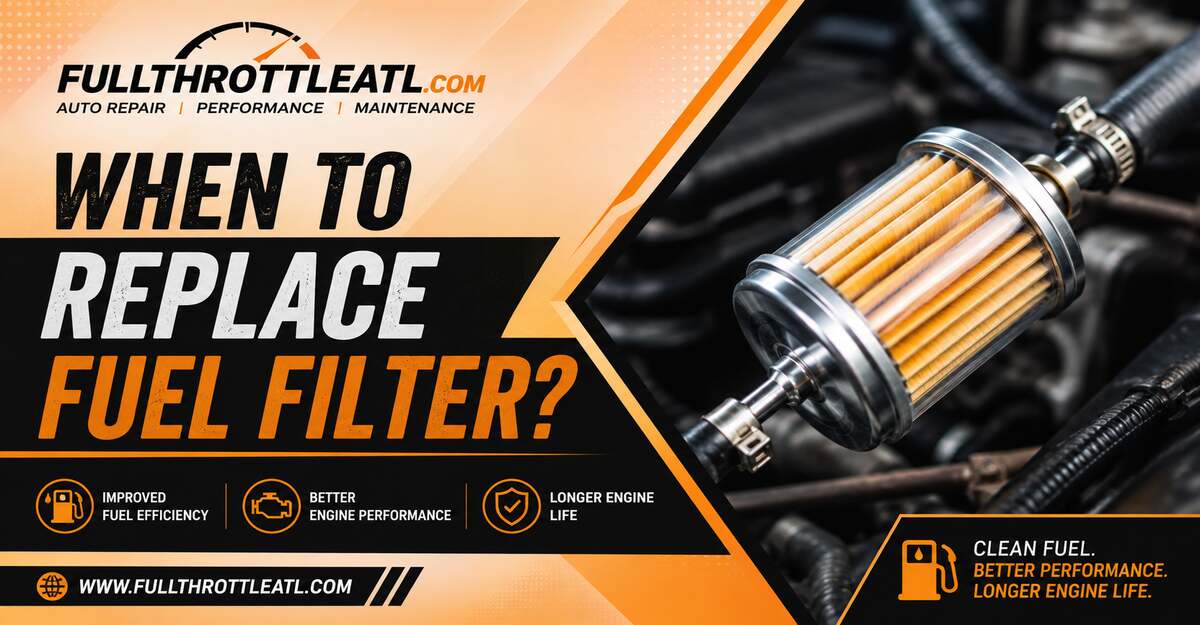
Replace a serviceable inline fuel filter every 20,000 to 40,000 miles or every two years to maintain optimal engine performance. Modern vehicles with in-tank “lifetime” filters typically require replacement only when the fuel pump fails, usually between 60,000 and 100,000 miles. Diesel engines demand strictly scheduled replacements every 10,000 to 15,000 miles.
At a Glance
- Inline fuel filters on pre-2005 gas vehicles require replacement every 20,000 to 40,000 miles.
- In-tank fuel filters on post-2005 vehicles are designed to last the lifetime of the fuel pump.
- Diesel fuel filters must be changed every 10,000 to 15,000 miles to prevent catastrophic injector failure.
- Loss of power on inclines and whining fuel pumps are primary physical indicators of a clogged filter.
- Ignoring a restricted fuel filter routinely causes premature and expensive fuel pump burnout.
How do you know if your car has a serviceable fuel filter?
You can determine if your vehicle has a serviceable fuel filter by checking the maintenance schedule in your owner’s manual. If the manual omits the fuel filter entirely or labels it a “lifetime” component, the filter is integrated into the in-tank fuel pump assembly and is not routinely serviceable.
Conversely, if a specific mileage interval is listed (such as every 30,000 miles), the vehicle utilizes a replaceable inline filter. Mechanics also perform a quick visual inspection: checking beneath the vehicle near the driver’s side rear door for a small, metal canister spliced into the fuel line confirms the presence of an external, serviceable filter.
Where is the fuel filter located?
A fuel filter is located either underneath the vehicle along the frame rail or directly inside the gas tank attached to the fuel pump. The location depends entirely on the age and fuel system design of the vehicle.
Older gas vehicles (pre-2005) and most modern diesel trucks use external inline filters. These are typically mounted on the chassis beneath the driver-side floorboards, along the firewall inside the engine bay, or tucked behind a protective plastic shield near the rear tires. Modern gas vehicles with “returnless” fuel systems almost exclusively position the filter inside the fuel tank, permanently encased within the plastic fuel pump module.
Can a fuel filter be cleaned instead of replaced?
No, an automotive fuel filter cannot be cleaned and must be completely replaced. The internal filtration media consists of tightly pleated cellulose or synthetic paper designed to trap microscopic contaminants permanently.
Attempting to back-flush or blow compressed air through a used fuel filter only forces embedded rust, dirt, and water deeper into the paper fibers, tearing the delicate media. Once the internal paper is compromised, the filter allows abrasive particulate matter to flow directly into the fuel injectors. Because a new inline filter costs only $15 to $30, replacing the unit is the only mechanically sound option.
How often do older gas vehicles need a new fuel filter?
Gasoline vehicles manufactured before 2005 require a new inline fuel filter every 20,000 to 40,000 miles. Because these external metal or plastic canisters trap all debris traveling from the fuel tank to the engine, they clog progressively over time.
Mechanics treat this interval as highly strict. Older steel gas tanks are prone to internal rust flaking, which accelerates filter clogging. Replacing an inline filter on older vehicles is considered cheap insurance against sudden loss of fuel pressure. If you purchase a used vehicle from this era with an unknown maintenance history, assume the fuel filter requires immediate replacement.
When do modern vehicles with lifetime filters need replacement?
Modern vehicles equipped with “lifetime” in-tank fuel filters require replacement at 60,000 to 100,000 miles, or exactly when the fuel pump module fails. Automakers label these filters as “lifetime” because they are engineered to outlast the factory warranty period, not the actual physical lifespan of the vehicle.
In reality, once a modern vehicle approaches 100,000 miles, the integrated filter becomes heavily restricted by tank sediment. Because the filter cannot be separated from the pump assembly in most modern returnless systems, owners must drive the vehicle until fuel pressure drops or the pump motor burns out, at which point the entire $300 to $800 assembly is replaced.
What is the fuel filter replacement schedule for diesel engines?
Diesel engines require a fuel filter replacement every 10,000 to 15,000 miles without exception. Heavy-duty applications, such as off-road use or frequent towing, shorten this requirement to every 5,000 to 10,000 miles.
Diesel fuel systems are fundamentally different from gasoline systems. They operate at extreme pressures—often exceeding 30,000 PSI at the injector tip—making them hypersensitive to particulate matter and water contamination. Most modern diesels feature a primary filter that acts as a water separator and a secondary filter for microscopic debris. Failure to adhere strictly to this short interval commonly results in catastrophic fuel injector destruction, resulting in repair bills exceeding $4,000.
How do ethanol (E85) conversions change fuel filter intervals?
Converting an older vehicle to run on E85 ethanol requires replacing the fuel filter at least twice within the first 1,000 miles of driving. E85 possesses aggressive solvent properties that strip years of accumulated varnish, sludge, and rust from the walls of older fuel tanks and lines.
This sudden release of dissolved debris flows directly into the fuel filter, clogging a brand-new unit in a matter of days. Performance mechanics recommend installing the first new filter during the E85 conversion, running the vehicle for 500 miles, and then installing a second new filter to catch the remaining scrubbed contaminants before resuming a standard 15,000-mile maintenance schedule.
When should you change the fuel filter on a car that has been sitting?
You should change the fuel filter on a vehicle that has sat unused for six months or longer immediately after burning through the first fresh tank of gasoline. Stagnant fuel degrades rapidly, oxidizing into a thick, sticky varnish that coats the tank interior.
When fresh fuel is finally introduced to the dormant vehicle, it dissolves that varnish and pushes it into the fuel lines. Changing the filter before running the vehicle wastes the new filter, as the initial tank of fresh gas will instantly clog it with loosened sludge. Run one complete tank of fresh fuel through the system to clean the lines, then replace the filter.
What are the symptoms of a clogged fuel filter?
The most common symptoms of a clogged fuel filter include engine hesitation under heavy load, a whining noise from the rear of the vehicle, and unusually long cranking times during startup.
- The Uphill Struggle: The vehicle idles and cruises perfectly on flat ground, but violently sputters or loses power when climbing a steep hill or towing a trailer. The filter flows enough volume for low demand but chokes under high fuel demand.
- Whining Fuel Pump: A loud, high-pitched humming or whining noise emanating from the gas tank indicates the electric fuel pump is straining against a severe blockage.
- Hard Starts: The engine cranks for five to ten seconds before firing because a restricted filter prevents the fuel pump from instantly pressurizing the fuel lines.
Will a bad fuel filter trigger a Check Engine Light?
A bad fuel filter will indirectly trigger a Check Engine Light by causing the engine to run lean or misfire. Modern vehicles do not feature a dedicated “clogged fuel filter” sensor, so the dashboard will never explicitly warn you of a filter issue.
Instead, the restricted fuel flow prompts the Engine Control Module (ECM) to register secondary diagnostic trouble codes. The most common is Code P0171 (System Too Lean), which triggers when the oxygen sensors detect excessive air and insufficient fuel in the exhaust. Severe clogs will trigger Code P0300 (Random/Multiple Cylinder Misfire) because the injectors are physically starved of gasoline.
What happens if you ignore a dirty fuel filter?
Ignoring a dirty fuel filter will force the electric fuel pump to overwork, eventually causing it to overheat and fail prematurely. The fuel pump relies on a steady flow of cool gasoline passing through it to manage its internal operating temperature.
When a filter becomes clogged, flow decreases, and backpressure increases. The pump motor runs significantly hotter while simultaneously drawing more electrical amperage to push fluid through the blockage. Over months of ignored maintenance, the internal windings of the pump melt or short out. Delaying a $20 filter replacement directly causes a $400 to $800 fuel pump failure.
How much does a fuel filter replacement cost?
A fuel filter replacement costs between $50 and $150 for an inline filter, while replacing an in-tank filter assembly costs between $300 and $800. The massive price discrepancy stems directly from labor times and parts integration.
For inline filters, the part costs roughly $15 to $30, and professional labor takes barely half an hour. For in-tank lifetime filters, the filter itself cannot be purchased separately. You must buy the entire fuel pump module ($200–$400), and mechanics must physically drop the vehicle’s gas tank or remove the rear interior seating to access it, resulting in two to four hours of billed labor.
Can you replace a fuel filter yourself?
You can replace an inline fuel filter yourself using basic hand tools, but you should leave in-tank filter replacements to professional mechanics. Servicing an inline filter takes approximately 15 to 30 minutes for a DIYer.
The primary safety requirement for DIY inline replacement is relieving fuel system pressure. This is accomplished by pulling the fuel pump fuse and cranking the engine until it stalls out. Without taking this step, disconnecting the filter will spray highly pressurized gasoline directly into your face. In-tank modules, however, involve draining the gas tank, handling heavy equipment under the vehicle, and dealing with delicate vapor lines, making it unsuitable for driveway mechanics.
What tools are required to change an inline fuel filter?
Changing an inline fuel filter requires line disconnect tools, flare nut wrenches, a flathead screwdriver, safety glasses, and a drain pan. The specific tools depend on the vehicle manufacturer’s fitting style.
Ford and GM vehicles primarily use “quick-disconnect” fittings that require a specialized, inexpensive plastic or metal scissor-style disconnect tool to release internal locking springs. Japanese and European imports commonly rely on threaded banjo bolts or compression fittings, which require properly sized flare nut wrenches (usually 14mm or 16mm) to avoid rounding off the soft brass fuel line nuts. A drain pan is universally required to catch the residual fuel that leaks during swap.
The Bottom Line
Replacing your fuel filter hinges entirely on your vehicle’s engineering. Pre-2005 vehicles and diesel trucks require strict, proactive replacements every 15,000 to 40,000 miles to prevent sudden power loss and mechanical damage. Conversely, drivers of post-2005 gas vehicles with in-tank systems only need to address the filter when experiencing lean codes, uphill hesitation, or an outright fuel pump failure. Regardless of your vehicle type, ignoring the warning signs of a clogged filter is guaranteed to cause cascading damage to your fuel delivery system.