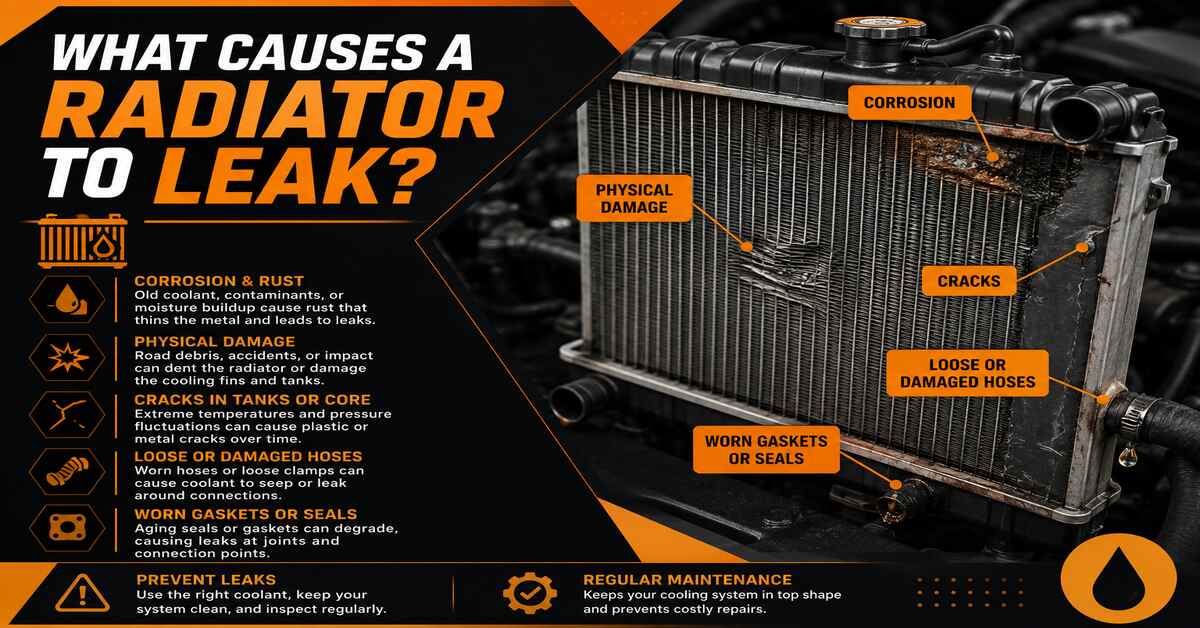
Radiator leaks are primarily caused by physical degradation, chemical imbalances, or extreme thermal stress, with most failures occurring in vehicles exceeding 100,000 miles or radiators older than eight years. These failures stem from a breakdown of internal metal barriers, aged rubber components, or cracked plastic end tanks that can no longer withstand standard system pressure.
At a Glance
- Healthy engine coolant maintains an alkaline pH level between 8.5 and 9.5 to prevent internal metal corrosion.
- Standard automotive cooling systems operate under 13 to 16 PSI of pressure; faulty caps failing to vent blow weak seams.
- Internal transmission cooler failures can mix transmission fluid with coolant, creating a destructive brown slurry.
- The “cold leak” paradox causes radiators to leak exclusively in freezing temperatures due to differential material shrinkage.
- Stop-leak additives only provide temporary relief and risk clogging critical 0.04-inch heater core passages.
How does coolant pH cause internal radiator corrosion?
Acidic coolant with a pH level below 7.0 strips away protective oxidation layers inside the metal core, allowing rust to eat directly through aluminum or brass walls. Healthy engine coolant sits strictly between 8.5 and 9.5 pH.
When coolant ages, its corrosion inhibitors deplete, turning the fluid acidic. This chemical imbalance accelerates internal electrochemical degradation. Over thousands of operating hours, this acidic fluid carves microscopic pits into the core until pinhole leaks form, releasing coolant under pressure.
What is galvanic corrosion and how does it destroy radiators in 60 days?
Galvanic corrosion occurs when stray electrical currents use liquid coolant as a conductive path to the vehicle chassis, creating micro-currents as low as 0.10 volts. This stray voltage aggressively strips aluminum ions from the radiator core.
Unlike standard chemical corrosion that requires a decade to compromise a cooling system, an ungrounded alternator or loose engine ground wire can completely destroy a brand-new aluminum radiator in less than 60 to 90 days. Diagnosing this requires measuring voltage directly inside the coolant reservoir using a digital multimeter.
How does cavitation erosion puncture radiator walls from the inside?
Cavitation erosion happens when the water pump impeller spins at high RPMs, creating tiny vapor bubbles in areas of localized pressure drops. When these vapor bubbles travel and collapse against internal radiator walls, they generate microscopic shockwaves exceeding 100,000 PSI.
Despite using clean, properly mixed coolant, this relentless physical hammering drills pinholes straight through the metal from the inside out. It typically targets the inlet tubes and core corners where fluid velocity and directional changes are most extreme.
How does thermal stress crack plastic radiator end tanks?
Constant thermal cycling between 190°F and 220°F forces the materials comprising modern radiators to repeatedly expand and contract. Because aluminum cores and plastic end tanks expand at different rates, the mechanical joints connecting them endure immense shear stress.
After thousands of heating and cooling cycles, the high-temperature nylon-composite plastic loses its elasticity. It becomes brittle, leading to structural cracks along the crimp seams where the core meets the tank.
What PSI level causes a cooling system to over-pressurize and blow seams?
Standard automotive cooling systems are engineered to operate safely at 13 to 16 pounds per square inch (PSI). When a radiator cap’s internal spring seizes or clogs with debris, it fails to release excess pressure into the overflow reservoir.
Once system pressure exceeds the rated threshold, the weakest link gives way. This over-pressurization blows out aged gasket seals, expands crimped header plates, or ruptures weak points in the radiator core.
Why do low-mileage vehicles suffer from plastic end tank embrittlement?
Vehicles driven infrequently in high-ozone urban environments or extreme climates suffer from atmospheric plastic embrittlement rather than heat-induced fatigue. Environmental ozone attacks the polymer chains in plastic radiator tanks, causing structural failure in under 30,000 miles.
Even if the engine never overheats, constant exposure to atmospheric pollutants weakens the plastic molecular structure until it fractures under standard operating pressure.
What is the “strawberry milkshake of death” transmission cooler leak?
Most automatic vehicles route transmission fluid through a specialized internal heat exchanger tank located inside the main radiator housing. When this internal metal barrier cracks, the 150+ PSI transmission pump forces oil directly into the 15 PSI cooling system.
This contamination creates a thick, brown, milky slurry resembling a chocolate or strawberry milkshake. This cross-contamination ruins engine cooling efficiency while destroying internal transmission clutches simultaneously.
Why does a radiator leak only in freezing temperatures or when cold?
The “cold leak” paradox occurs when a vehicle holds pressure perfectly at operating temperature, yet leaves a puddle exclusively after sitting in freezing conditions overnight. Aluminum cores and plastic end tanks shrink at different mathematical rates when temperatures drop below 32°F.
The mechanical crimp seam opens up exclusively at low temperatures and seals itself shut once engine heat causes thermal expansion. Mechanics often miss this during standard hot pressure tests.
Why does my car leak coolant only when the air conditioning is on?
Turning on the air conditioning dumps massive amounts of ambient heat from the condenser directly into the front face of the radiator, raising local core temperatures by 20°F to 30°F. This sudden thermal spike forces open micro-cracks that remain tightly sealed during normal low-load driving.
If your vehicle only loses coolant or leaves puddles after highway driving with the AC active, look closely for thermal expansion leaks along the front core face.
How long can I drive with a leaking radiator? Zero miles.
A modern aluminum engine can warp its cylinder head or score its cylinder walls within 60 seconds of complete coolant loss. If you must move a leaking vehicle to a safe location off the roadway, monitor the temperature gauge constantly and shut the engine off immediately if it climbs past 230°F.
Never attempt long-distance driving with a compromised cooling system.
Can I use stop-leak additives as a permanent radiator fix?
No, stop-leak additives cannot serve as a permanent repair. Products utilizing liquid glass (sodium silicate) or ceramic fibers temporarily clog holes by hardening when exposed to air and heat.
However, they do not fix structural seam failures, they fail to stop cross-contamination leaks, and they frequently plug tiny 0.04-inch heater core passages. This leaves the vehicle without cabin heat and ruins the entire cooling network.
Is it better to repair or replace a leaking radiator?
Replacing a leaking radiator is universally recommended over attempting repairs. Modern automotive radiators feature plastic tanks mechanically crimped onto aluminum fins using specialized industrial equipment that cannot be reliably re-sealed outside a factory.
Because brand-new replacement units are widely available, repairing aged, brittle radiators is rarely cost-effective or durable.
How much does it cost to replace a car radiator?
Replacing a car radiator typically costs between $300 and $900 total, depending heavily on the vehicle make and model. The standalone replacement radiator part costs between $100 and $300 for standard passenger cars, while professional labor adds $200 to $600 to account for system draining, hose inspection, and coolant bleeding.
The Bottom Line
Radiator leaks stem from chemical imbalances, high-pressure surges, or thermal expansion strains that degrade metal cores and plastic end tanks over time. Identifying the exact source requires looking beyond standard green puddles to check for internal cross-contamination and temperature-dependent seam gaps. Because modern cooling systems operate under high stress, replacing a failing radiator is always safer and more cost-effective than relying on temporary stop-leak products.