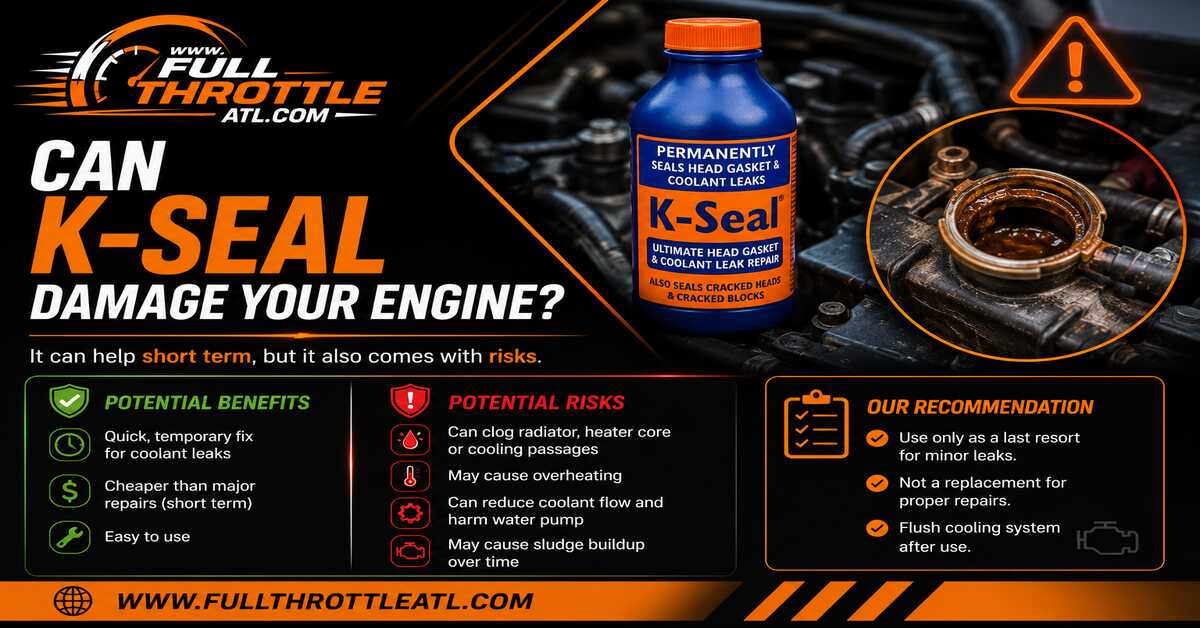
No, K-Seal will not damage a healthy engine block or cylinder head, but it can restrict coolant flow in compromised cooling systems by clogging narrow passages like heater cores or jamming thermostats. Unlike older sodium silicate “liquid glass” formulas that permanently harden across all internal surfaces when exposed to heat, K-Seal utilizes suspended ceramic microfibers and copper particles that only bond where a pressure drop occurs at the exact site of a leak.
Key Facts at a Glance
- Chemical Base: Proprietary blend of ceramic microfibers and copper particles; entirely free of sodium silicate.
- Sealing Capacity: Seals cracks up to 0.254mm (0.01 in) wide and holes up to 0.635mm (0.025 in) in diameter.
- Standard Compliance: Certified to pass through an 0.85mm filter element per ASTM D3147 standards.
- Primary Risks: Heater core blockage and thermostat fouling if pre-existing scaling, rust, or heavy casting sand is present.
- Oil Contamination Limit: Ineffective if engine oil has leaked into the coolant, creating an emulsion (“milkshake”) that coats particles.
How Does K-Seal Differ Chemically From Older Sealers?
K-Seal avoids traditional engine damage by omitting sodium silicate, the primary compound found in legacy liquid glass head gasket sealers. Sodium silicate remains liquid until it hits high-temperature zones (250∘F−300∘F), where it chemically reacts with carbon dioxide and metal to form a hard, glass-like silicate matrix. If misapplied or left unflushed, sodium silicate coats the entire interior of the cooling system, seizing water pump impellers, clogging radiator tubes, and locking thermostats open or closed.
K-Seal relies on a suspension fluid carrying microscopic ceramic fibers and metallic copper flakes. These particles circulate freely through the high-flow, high-pressure environment of the water pump and radiator without adhering to clean metal surfaces. They only aggregate when escaping coolant encounters an atmospheric pressure drop at a crack or blown gasket seam. At that exact point, the pressure differential forces the fibers together, weaving a durable mesh that cures under ambient engine operating heat (190∘F−220∘F).
Can K-Seal Clog Your Heater Core or Radiator?
K-Seal can restrict or completely block a heater core if the cooling system is already contaminated with heavy rust, scale, casting sand, or organic sludge. Modern automotive heater cores feature microscopic internal channels-often measuring less than 1mm in width-designed to maximize heat transfer into the cabin.
While K-Seal passes the ASTM D3147 standard test (successfully flowing through an 0.85mm screen), pre-existing debris narrows these channels further. When the suspended microfibers encounter an already restricted heater core tube experiencing a localized pressure restriction, they can catch on the debris, accumulate, and shut off coolant flow entirely. This results in an immediate loss of cabin heat. To prevent this, vehicle owners with pre-existing rust or weak cabin heat should back-flush the cooling system or temporarily bypass the heater core before introducing the product.
What Happens if K-Seal Reaches the Thermostat?
K-Seal can occasionally jam a thermostat if particles settle out of suspension during prolonged idling or if the cooling system contains high concentrations of mineral deposits. The wax pellet inside a standard automotive thermostat relies on precise thermal expansion to push the valve open against a return spring. If heavy particulate matter or thick cooling system sludge coats the sliding pin and spring coils, the thermostat can stick in the closed position, causing the engine to rapidly overheat.
To mitigate this risk during major repairs, mechanics frequently remove the thermostat housing entirely during the initial treatment cycle, run the engine to allow the sealer to bond at the primary leak site, flush the system, and then reinstall a fresh thermostat. While not strictly mandated for standard consumer applications, removing the thermostat eliminates potential mechanical interference.
Why Does K-Seal Fail on Head Gaskets With Heavy Back-Pressure?
K-Seal fails to seal combustion-related head gasket leaks when high-pressure cylinder compression blows the product out of the crack before the ceramic fibers can knit together and cure. A blown head gasket between a combustion cylinder and the cooling jacket experiences explosive cylinder pressures exceeding 150 psi to 500 psi during the power stroke. This outward blast continuously flushes the microscopic fibers away from the breach.
The Spark Plug Isolation Procedure
- Identify the Leaking Cylinder: Perform a combustion leak test (block tester) or cylinder compression/leak-down test to pinpoint the exact cylinder failing under compression.
- Disable the Cylinder: Remove the spark plug and disconnect the fuel injector electrical connector for that specific dead cylinder.
- Run the Engine: Add K-Seal to the cooling system and run the engine on the remaining active cylinders for 20 minutes.
- Allow Sealing Without Blow-by: Eliminating the combustion explosion stops the outward gas pressure, allowing normal cooling system pressure (12 psi−16 psi) to push K-Seal into the crack and form a permanent ceramic bond.
- Restore Operation: Reinstall the spark plug and reconnect the injector after the vehicle cools down.
Can K-Seal Fix Oil Leaks or Coolant-Oil Mixtures?
K-Seal cannot repair a leak where engine oil is actively mixing into the cooling system (turning the coolant into a brown or tan frothy emulsion). Engine oil coats the ceramic microfibers and copper particles, altering their surface tension and preventing them from making direct contact with metal surfaces. Without clean metal-to-metal contact and a clean water-glycol suspension medium, the particles cannot cohere or cure.
If your oil dipstick displays a milky-white fluid or your coolant reservoir contains floating oil sludge, chemical sealers will fail. You must physically replace the failed component-such as an oil cooler gasket, intake manifold gasket, or cracked cylinder head-and perform a thorough multi-stage chemical flush before refilling the system.
Product Line Comparison: Which K-Seal Formula Is Safe for Your Engine?
Choosing the correct variant ensures maximum efficacy without introducing excess solids into undersized cooling circuits.
| Product Variant | Container Size | Target Application | Sealing Threshold | Primary Risk Factor |
|---|---|---|---|---|
| K-Seal (Standard) | 8 oz (Blue Bottle) | Passenger cars up to 8 cylinders; minor radiator & external gasket drips. | Standard microfibers; holes up to 0.635mm. | Mild heater core restriction if neglected. |
| K-Seal Ultimate | 16 oz (Yellow/Gold Bottle) | Passenger cars and light trucks with head gasket or porous block leaks. | 33% higher density formulation optimized for high-stress areas. | Higher solid concentration requires clean fluid channels. |
| K-Seal HD | 16 oz (Orange/Grey Bottle) | Heavy-duty commercial trucks, tractors, and large displacement diesel engines. | Designed for cooling systems exceeding 20 to 50+ quarts capacity. | Over-concentration if used in small passenger vehicle systems. |
Frequently Asked Questions
Do I need to flush K-Seal out of my engine after it stops the leak?
No, K-Seal is designed to remain permanently suspended in your antifreeze mixture without requiring a flush. Because the active ceramic microfibers stay in liquid suspension until they encounter a pressure drop, the remaining fluid poses no risk to normal engine operation as long as the cooling system is maintained at correct fluid intervals.
Can K-Seal damage water pump seals or bearings?
K-Seal will not damage a healthy mechanical water pump seal, but it can accelerate wear on a water pump that is already failing. The abrasive nature of suspended metallic particles can penetrate pitted ceramic seal faces on old water pumps, causing weeping or weeping-hole leaks to worsen over time.
Is K-Seal compatible with all types of antifreeze?
Yes, K-Seal is chemically compatible with all standard ethylene glycol and propylene glycol coolants, including conventional green (IAT), OAT (orange/red), and HOAT formulations. It does not react adversely with standard corrosion inhibitors or additives already present in commercial coolants.
How long does a K-Seal repair typically last?
A K-Seal repair can last anywhere from several months to the remaining operational lifespan of the vehicle (often multiple years), provided the engine does not experience severe overheating events that thermally stress the newly formed ceramic patch. It is best evaluated as a permanent mechanical fix for older vehicles or an effective roadside emergency measure.