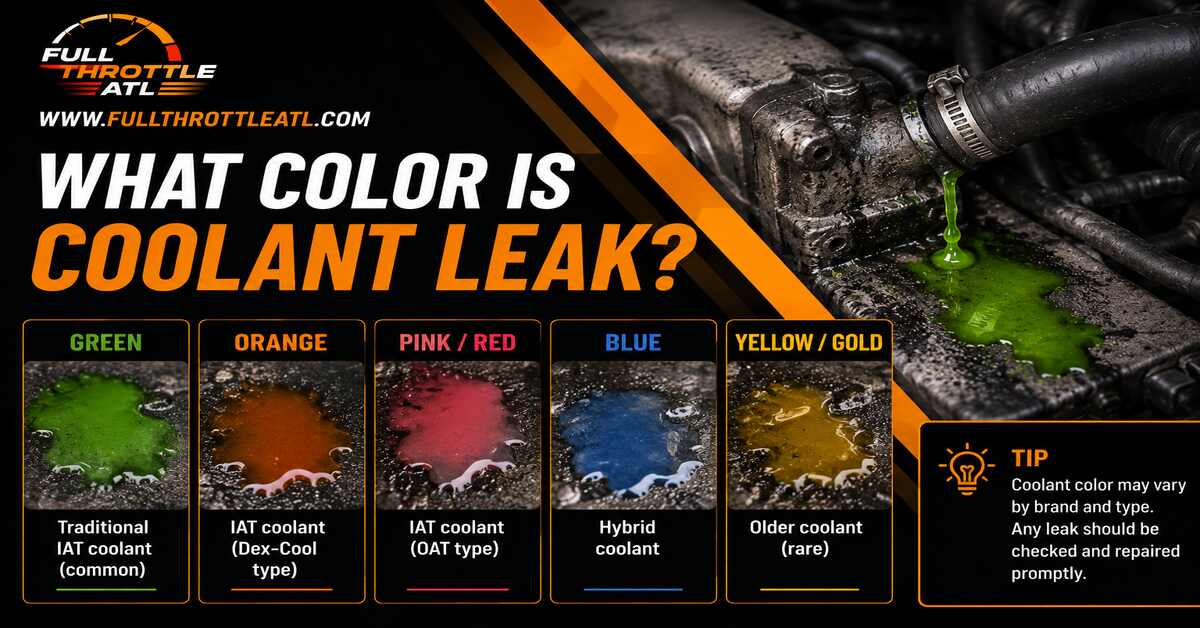
A coolant leak can be bright green, orange, pink, yellow, blue, or purple, depending entirely on the chemical formulation and vehicle make. Because modern automotive manufacturers dye their antifreeze to distinguish chemical families, identifying a leak solely by color can be misleading without verifying texture, odor, and location.
At a Glance: Essential Coolant Leak Facts
- Standard factory coolants are dyed bright green (IAT), orange/pink/red/blue (OAT), or yellow/purple (HOAT).
- Neglected or oxidized OAT/HOAT coolant transforms from bright pink into a thick, muddy brown.
- Internal head gasket failures turn coolant into a frothy, light-brown “milky shake” visible under the oil cap.
- Small external leaks evaporate instantly on hot engine components, leaving a chalky white or colored crusty residue.
- Mixing incompatible coolant types triggers chemical gelation, blocking radiator tubes and causing engine overheating.
What Are the Standard Coolant Colors by Chemical Type?
Coolant manufacturers intentionally dye their products to prevent dangerous chemical mixing and distinguish between three primary manufacturing technologies.
| Coolant Type | Common Colors | Primary Chemistry | Key Vehicle Applications |
| Inorganic Additive Technology (IAT) | Bright Green | Silicates and phosphates | Older vehicles built before the mid-1990s and classic cars. |
| Organic Acid Technology (OAT) | Orange, Pink, Red, Bright Blue | Azoles and organic acids | GM (Dex-Cool), VW/Audi (G12/G13), Honda, Toyota. |
| Hybrid OAT (HOAT) | Yellow, Turquoise, Gold, Purple | Silicates/phosphates + organic acids | Ford, Chrysler, and European makes like BMW and Mercedes. |
Why Does Coolant Turn Muddy Brown?
Coolant turns muddy brown when organic acid technology (OAT) or hybrid coolant is exposed to trapped oxygen or neglected past its service life, causing severe fluid oxidation. When air enters a pressurized cooling system or rust mixes with the fluid, it loses its vibrant factory pigment and shifts from bright orange or pink into a dark, murky brown that mimics contaminated engine oil or muddy water.
What Are Universal Aftermarket Coolants?
Universal aftermarket coolants are multi-vehicle formulations typically dyed pale yellow or amber designed to blend into almost any cooling system without triggering chemical reactions. While convenient for top-offs, this neutral yellow or amber shade makes identifying fresh leaks exceptionally difficult because the fluid easily blends with clean engine oil, automatic transmission fluid, or brake fluid on a garage floor.
Why Does Blue Fluid Often Cause Confusion?
Blue fluid can indicate Honda long-life coolant, but it is frequently mistaken for automotive windshield washer fluid or specific European low-viscosity brake fluids. To differentiate between them, check the location of the puddle and the fluid’s physical properties: washer fluid evaporates completely without leaving a sticky residue, whereas blue coolant leaves a sweet, syrupy film.
What Causes the “Milky Shake” Internal Leak?
An internal engine coolant leak caused by a blown head gasket results in a milky, light-brown, frothy mixture that resembles a chocolate milkshake. This happens when pressurized coolant breaches the combustion chamber or oil gallery, mixing directly with engine oil. Mechanics verify this condition immediately by checking for frothy residue under the oil cap or a pale, opaque fluid level on the engine dipstick.
Why Do Small Leaks Leave Chalky White Powder?
Small, slow coolant leaks leave a dry, chalky white or crusty pink powder residue rather than a fluid puddle because the liquid hits a hot exhaust manifold or engine block and evaporates instantly. Modern coolants contain ethylene glycol combined with bittering agents and rust inhibitors that leave behind solid mineral and dye deposits once the water content flashes off into steam.
Why Do Slow Leaks Look Like Black Engine Oil?
Slow coolant leaks look like black engine oil when a tiny, persistent weep drips onto the ground over several weeks, allowing road grime, dirt, and carbon dust to mix with the puddle. The heavy layer of environmental contaminants completely masks the underlying bright factory dye, creating a dark, oily smudge that frequently misleads vehicle owners into thinking they have a sump or oil pan gasket leak.
How Can I Definitively Prove a Fluid Is Coolant?
- Perform the Smell Test: Check if the fluid has a distinct, sweet, syrup-like odor when hot, which is characteristic of ethylene or propylene glycol.
- Perform the Touch Test: Rub a drop between your fingers; unlike greasy engine oil, water-based coolant feels slightly slimy but washes off easily with plain water.
- Use the UV Dye Method: Pour a small bottle of automotive UV leak detection dye into the expansion tank, run the engine, and scan the engine bay with a blacklight to find the fluid glowing a brilliant fluorescent yellow-green.
What Happens If I Mix Two Different Colors of Coolant?
Mixing incompatible coolant colors-such as combining traditional green IAT with orange OAT-causes chemical gelation, where the distinct additive packages react and drop out of solution. This reaction forms a thick, gel-like sludge that chokes radiator tubes, blocks the heater core, and restricts water pump flow, resulting in rapid engine overheating and potential engine damage.
Can a Coolant Leak Be Completely Clear Like Water?
A coolant leak appears completely clear only if a previous owner repeatedly flushed and topped off the cooling system with plain water instead of a proper 50/50 chemical mixture, diluting the factory dye completely. However, if clear water is dripping directly underneath the passenger-side firewall on a hot summer day, it is normal condensation draining from the air conditioning evaporator box, not a cooling system failure.
Where Are the Most Common Leak Locations Based on Puddle Position?
- Front-Center Puddle: Typically indicates a failing radiator core, cracked radiator plastic end tanks, or a damaged lower radiator hose.
- Front-Passenger Side Puddle: Usually points to a leaking water pump, loose thermostat housing gasket, or failing intake manifold gasket.
- Passenger-Side Interior Footwell Puddle: Signals a leaking heater core or failing heater hose connection inside the dashboard HVAC box.
When Is a Coolant Leak an Emergency vs Safe to Drive?
A coolant leak is an immediate emergency requiring engine shutdown if the temperature gauge spikes into the red zone, white steam billows from under the hood, or the oil dipstick shows a milky froth. If the vehicle maintains normal operating temperature and you only notice a small puddle or low reservoir warning light, you can top off the system with compatible fluid and drive short distances directly to a repair shop.
How Long Does It Take for a Coolant Leak to Dry on Concrete?
On a dry concrete garage floor, a standard two-ounce coolant puddle typically takes between 12 to 36 hours to form a sticky, viscous skin, and several days to dry completely depending on ambient humidity and garage ventilation. Unlike motor oil that sinks deep into concrete pores, coolant remains on the surface as a tacky, syrupy film unless washed away with detergent and hot water.
How Much Does It Cost to Repair a Coolant Leak?
| Repair Component | Average Cost Range (Parts & Labor) |
| Hose Replacement (Upper/Lower) | $150 – $350 |
| Thermostat & Housing Gasket | $200 – $450 |
| Radiator Replacement | $450 – $900 |
| Water Pump Replacement | $500 – $1,200 |
| Head Gasket Replacement | $1,500 – $3,500+ |
The Bottom Line
While a coolant leak is most commonly bright green, pink, or orange, relying solely on color is risky due to oxidation, aftermarket universals, and fluid contamination. Always cross-reference the fluid’s sweet odor, water-soluble texture, and puddle location against your vehicle’s specific maintenance history. Verifying these traits early prevents misdiagnosis and protects your engine from catastrophic overheating.