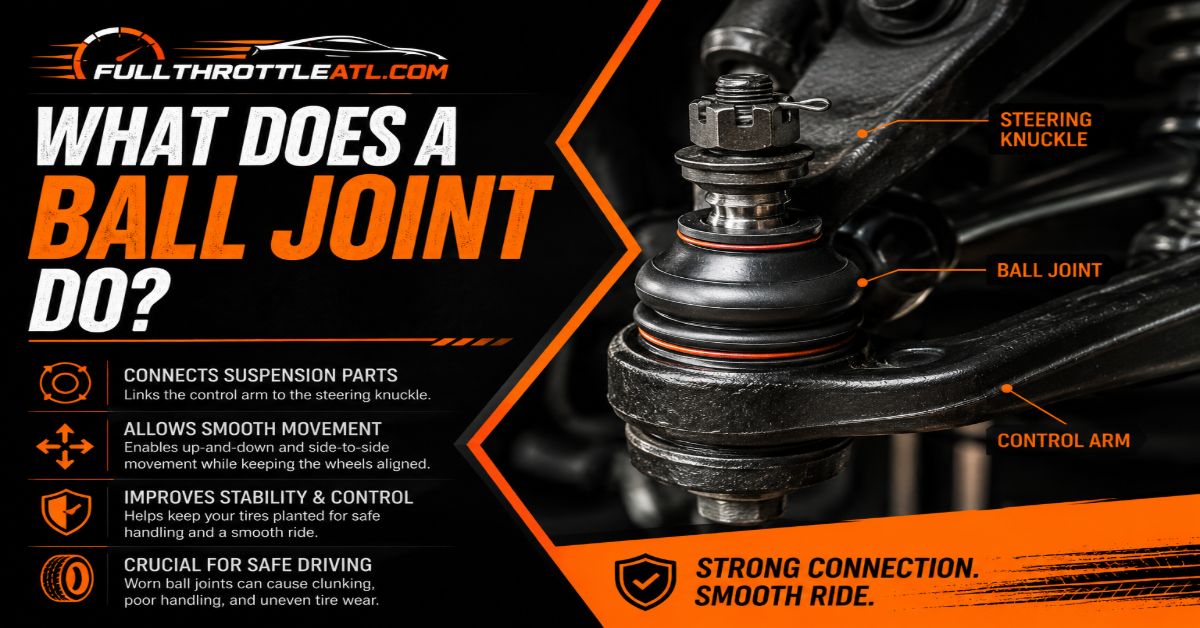
A ball joint is a spherical bearing enclosed in a steel housing that connects a vehicle’s steering knuckles to the control arms. It acts as a structural pivot point, allowing the suspension to move up and down while simultaneously enabling the wheels to turn left and right.
At a Glance
- Ball joints replicate the omnidirectional movement of a human hip joint.
- Standard passenger car ball joints handle an angular sweep of 15 to 25 degrees.
- Front ball joints on mid-sized SUVs regularly withstand static vertical loads of 2,000 to 4,000 pounds.
- Allowable internal play in a healthy joint measures between 0.000 and 0.050 inches.
- Ball joints are categorized primarily into load-carrying and follower configurations.
- Suspension ball joints typically last between 70,000 and 150,000 miles under normal driving conditions.
How do ball joints work mechanically in a car suspension?
Ball joints manage extreme dynamic forces by securing the wheel assembly to the vehicle frame while accommodating multi-axis movement. Inside the metal housing, a polished steel ball stud moves against a low-friction polymer race or socket made of Teflon or Delrin.
This mechanical design provides two essential degrees of freedom simultaneously. It allows rotational movement for steering input and angular oscillation for vertical suspension travel over bumps. During operation, standard passenger car joints tolerate an angular sweep between 15 and 25 degrees of articulation. Off-road vehicle joints can exceed 35 degrees of range. A typical front ball joint on a mid-sized SUV regularly withstands 2,000 to 4,000 pounds of vertical load, with force spikes reaching up to 10,000 pounds during high-speed pothole impacts.
What is the difference between load-carrying and follower ball joints?
Suspension setups utilize two distinct configurations based on where vehicle weight is applied: load-carrying joints and follower joints.
Load-carrying joints are positioned on the control arm where the spring or torsion bar seats. These joints suspend the actual weight of the vehicle, remaining under constant tension or compression. Because they continuously manage massive vertical weight loads, load-carrying joints wear out faster than other suspension components.
Follower joints, also known as idler joints, are found on the opposite control arm, typically the upper arm in a double-wishbone setup. Follower joints do not support the static weight of the vehicle. Instead, their primary job is to guide the steering knuckle and maintain precise wheel alignment geometry during cornering and braking forces.
How do MacPherson struts change ball joint function?
Most MacPherson strut suspensions do not use a load-carrying ball joint because the heavy strut assembly directly carries the vehicle weight. In this specific configuration, the lower ball joint acts purely as a follower.
Because the strut handles the vertical load of the car, the lower ball joint is subjected primarily to lateral forces and articulation during steering. This distinction changes how technicians diagnose wear. While a traditional load-carrying joint requires proper spring compression to test accurately, a MacPherson strut lower ball joint behaves differently under physical load tests, requiring specific positioning to detect early radial play.
What are zero-play performance ball joints and when should you use them?
Zero-play performance ball joints replace traditional greased ball joints with solid spherical bearings, often called Heim joints. These components eliminate all internal compliance to deliver absolute steering precision on the racetrack.
You should use zero-play spherical bearings exclusively for dedicated track cars or competitive race vehicles. They are entirely unsuited for daily-driven street vehicles for two primary reasons. First, solid metal bearings transmit extreme road harshness and vibration directly into the cabin. Second, because they lack protective rubber boots, road grit and salt quickly destroy the unsealed bearing races, leading to rapid failure within months of street exposure.
Why do ball joints prematurely fail on lifted trucks?
Modifying a truck with a suspension lift changes the static resting angle of the upper control arm. This geometric alteration pushes the ball joint to its maximum angular limit, often exceeding 20 degrees of articulation even when the vehicle is parked on flat ground.
When a lifted truck travels over bumps, the upper control arm quickly reaches the physical end of its travel range. This causes mechanical binding, tears the protective rubber dust boot, and forces the steel stud against the housing edge. Without corrective aftermarket upper control arms designed to restore proper geometry, lifted truck ball joints suffer from accelerated wear and catastrophic stud snapping within thousands of miles.
How often should you grease ball joints and can you over-grease them?
Modern factory ball joints are predominantly sealed for life, meaning they are maintenance-free and completely lack grease zerk fittings. If a factory joint is sealed, you should never attempt to force a grease needle through the rubber boot.
For older or aftermarket heavy-duty ball joints equipped with zerk fittings, you should pump fresh chassis grease into them every oil change or roughly every 5,000 miles. However, you must avoid over-greasing. Pumping too much grease into the joint builds extreme internal pressure, which balloons, stretches, and ultimately ruptures the rubber dust boot. Once the boot bursts, ambient road moisture and grit contaminate the internal race, destroying the joint prematurely.
How do you properly test a ball joint for play without making the pry bar error?
Mechanically testing a ball joint requires using a pry bar to check for radial and axial movement, but doing this incorrectly results in a dangerous false negative. The most common mistake is testing a load-carrying joint while the suspension is hanging freely on an automotive lift.
When a vehicle is lifted by its frame, the internal suspension spring tension locks the ball joint tight. The joint will feel completely solid under a pry bar even if the internal socket is entirely worn out. To test correctly, the suspension must be properly loaded or unloaded by placing a floor jack directly underneath the lower control arm, neutralizing the spring tension before applying pressure with a pry bar.
Can a bad ball joint fail silently without making any noise?
Ball joints can and frequently do fail completely without making any audible warning noises. While a snapping, popping, or creaking sound during low-speed turns usually indicates advanced failure, drivers should never rely on sound alone for safety.
If the internal polymer lining wears down evenly without rusting or metal-on-metal contact, the joint will exhibit massive, dangerous play without making a single sound. The steering may feel vague or wander across the lane, yet the suspension remains entirely quiet until the worn stud pulls completely out of its housing.
How long do ball joints typically last before replacement?
Quality ball joints typically last between 70,000 and 150,000 miles under normal driving conditions. However, actual longevity depends heavily on environmental factors, road quality, and vehicle usage.
Lifespan drops significantly if you frequently drive on rough, unpaved terrain or salt-treated winter roads that corrode protective components. Furthermore, installing oversized, heavy aftermarket off-road tires increases rotational mass and leverage forces, cutting ball joint lifespan in half. Regular inspection during routine tire rotations is the only reliable way to catch wear before failure occurs.
What happens if a ball joint fails completely while driving?
If a ball joint fails completely while driving, the steel stud snaps or pulls entirely out of its socket housing. This causes the steering knuckle to detach instantly from the control arm.
When detachment happens, the wheel loses all structural guidance and folds outward or inward into the vehicle fender. This results in an immediate, catastrophic loss of steering control, severe body damage, and a high risk of a rollover accident, especially if the failure occurs at highway speeds.
Why must you replace ball joints in pairs?
You must replace ball joints in pairs across the same axle, changing both the left and right sides simultaneously. If one ball joint has reached its structural wear limit, the opposite side has experienced identical mileage, road conditions, and stress cycles.
The untouched side is statistically near failure as well. Replacing only one ball joint leaves an unbalanced suspension setup, causing uneven tire wear and unpredictable handling behavior during emergency braking. Additionally, replacing both sides at once saves money on labor and ensures you only need to pay for one mandatory wheel alignment.
Can you replace just the rubber boot if it tears?
You can replace just the rubber dust boot, but only if you catch the damage immediately after it occurs. If a routine inspection reveals a torn boot and the grease trapped inside remains completely clean and free of debris, you can install a replacement boot and repack the joint with fresh grease.
If the grease contains any gritty dirt, or if the joint can be moved easily by hand with zero mechanical resistance, the internal race is already scored and damaged. In this condition, patching the boot is useless, and the entire ball joint assembly must be replaced immediately.
What are the early warning signs of a failing ball joint?
Early warning signs of a failing ball joint include vague steering response, a vehicle that wanders across lanes on the highway, and uneven tire tread wear concentrated on the inside or outside edges of the front tires.
Drivers may also notice a faint clunking or thudding noise when driving over sharp bumps, speed bumps, or when turning into a driveway. As the internal clearance widens beyond factory tolerances, the wheel assembly shifts slightly out of alignment, creating unstable handling long before total mechanical separation happens.
How much does it cost to replace suspension ball joints?
Replacing suspension ball joints typically costs between $250 and $650 per side, including both parts and professional labor. The final price varies based on the make, model, and whether the ball joint is bolted, riveted, or pressed directly into the control arm.
If the ball joint is pressed into the control arm, mechanics require specialized hydraulic press tools, which adds labor time. In many modern vehicles, individual ball joints are not sold separately, requiring the replacement of the entire control arm assembly, which shifts total repair costs closer to $500 to $1,000 per axle.
Do you need a wheel alignment after replacing a ball joint?
You must perform a professional four-wheel alignment immediately after replacing any front suspension ball joint. Disassembling the steering knuckle and control arm alters the critical suspension geometry, camber, and toe settings.
Skipping a wheel alignment after ball joint replacement causes rapid, severe tire cupping, steering pull, and unstable high-speed handling. Aligning the front end restores proper handling angles and protects your investment in new suspension components and tires.
The Bottom Line
A ball joint serves as the crucial structural pivot point connecting your vehicle’s steering knuckles to the control arms, managing massive vertical loads while allowing smooth steering articulation. Because they wear down gradually over 70,000 to 150,000 miles, routine physical inspections using properly loaded suspension jacks are essential to catch play before catastrophic failure occurs. Replacing worn joints in pairs and following up with a professional wheel alignment ensures safe, predictable vehicle handling for years to come.