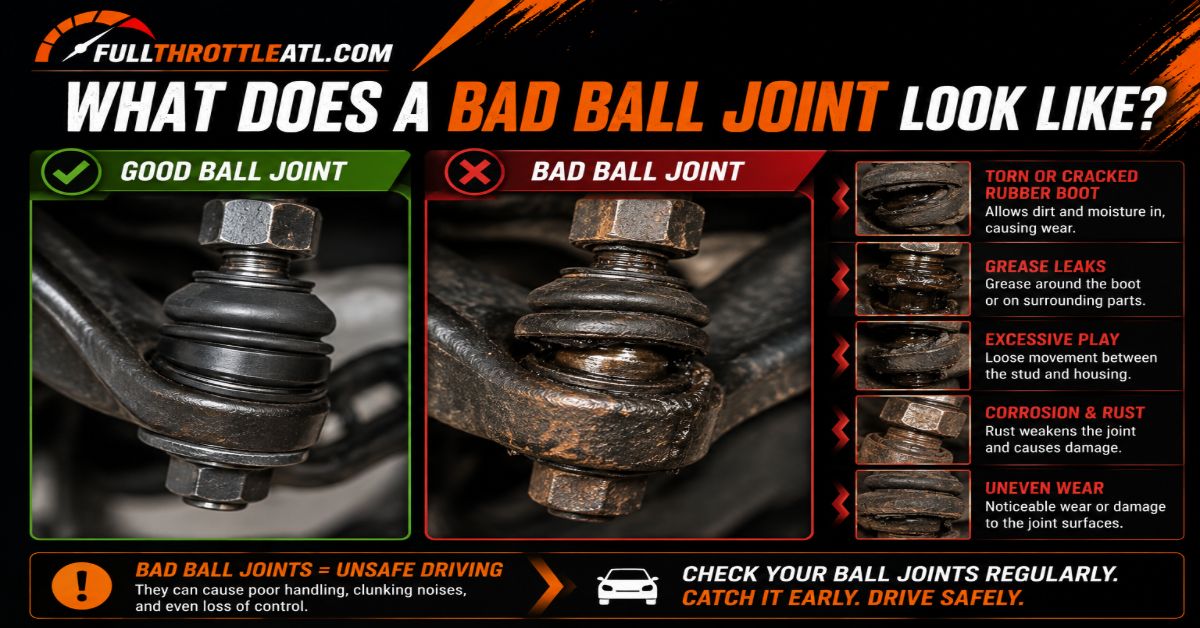
A bad ball joint typically looks like a torn rubber boot leaking dark grease, an unevenly sitting stud, or metal shaving damage on the control arm. However, many failing joints appear completely normal to the naked eye and can only be diagnosed by measuring microscopic movement with a dial indicator during a physical pry test.
At a Glance: Key Ball Joint Facts
- Visual damage includes torn rubber boots, leaked grit, and off-center metal studs.
- Safe axial play must generally remain under 0.50 mm depending on vehicle design.
- Standard 12-and-6 o’clock tire shakes can hide failed joints if suspension is loaded.
- Ball joints almost always require replacement in axle pairs.
- Driving on a clicking joint risks sudden catastrophic wheel separation.
What are the visual indicators of a bad ball joint?
When inspecting a vehicle suspension, a failing ball joint typically exhibits one or more physical traits, including a torn or collapsed dust boot, dark grease contamination, or polished metal shavings. The protective rubber boot may be cracked, ripped, or entirely missing, which exposes the internal ball and socket to water and grit. Dark, gritty grease often leaks out, or alternatively, the joint is completely dry and caked with road debris.
Mechanics also look for shiny patches on the housing or control arm, which indicate that the loose joint is rubbing against adjacent components. The ball stud itself may rest at an unnatural angle or sit deeper in the socket than usual. If an orange-brown ring of rust powder bleeds out from the rim of the boot, it signals internal moisture corrosion that destroys the internal bearing surface.
What are the specific diagnostic tolerances and measurements for ball joint play?
Visual inspection serves as only the first step, because true identification of a bad ball joint relies on precise measurements using a dial indicator during a physical pry test. Axial play, which is up and down movement, must remain between 0.00 mm and 0.50 mm on standard passenger cars, while any measurement exceeding 0.76 mm indicates a failing component. Radial play, which is side to side movement, must stay between 0.00 mm and 0.25 mm, with values exceeding 1.00 mm requiring immediate replacement.
| Measurement Type | Acceptable Range (Healthy) | Failing Threshold (Bad) | Diagnostic Method |
|---|---|---|---|
| Axial Play (Up/Down) | 0.00 mm to 0.50 mm | > 0.76 mm (0.030 in) | Pry bar lifting the wheel or control arm |
| Radial Play (Side/Side) | 0.00 mm to 0.25 mm | > 1.00 mm (0.040 in) | Rocking the tire at the 12 and 6 o’clock positions |
| Boot Integrity | 100% Sealed | Any tear > 0.1 mm | Visual check for hairline cracks or punctures |
Technicians always verify factory service manuals because heavy-duty trucks can tolerate up to 1.5 mm of axial play before replacement is mandatory.
What are the exceptions and edge cases like load-bearing versus follower joints?
Suspension systems do not all behave the same way, and certain design variations defy standard inspection rules. In a Short Long Arm suspension setup, one ball joint carries the vehicle weight while the other simply maintains alignment. The load bearing joint supports the chassis, whereas the follower joint stays under tension. A follower joint will feel completely loose if tested while the suspension is loaded, which masks its true condition unless the control arm is properly supported during the test.
Wear-indicator joints on older domestic vehicles feature grease fittings that act as physical indicators. If the outer collar of the fitting recedes flush with or inside the housing base, the joint is bad, even if there is zero visible movement during a pry test. Modern vehicles often use self-lubricating nylon or Teflon cups inside the socket, and these materials wear down internally without bleeding grease, causing the joint to bind and freeze rather than loosen.
Why does standard jack and wiggle advice fail for ball joint inspection?
Standard do-it-yourself advice states that jacking up the car, wiggling the tire at the 12 and 6 o’clock positions, and checking for movement will reveal a bad ball joint, but this method fails in several critical scenarios. On a McPherson strut suspension, jacking the car up by the frame leaves the spring tension pushing hard against the ball joint, and this tension completely hides massive amounts of internal play. To prevent this, technicians must jack underneath the lower control arm to unload the joint.
Another major trap is the frozen joint phenomenon, where a ball joint fails by seizing instead of loosening. Wiggling the tire will show zero play in this scenario, but the joint is dangerously bound and can snap the steering knuckle during a tight turn. Finally, a loose wheel bearing produces identical tire movement, meaning that if you do not visually isolate the ball joint socket while wiggling, you might replace a perfectly good joint when the hub bearing is actually the culprit.
Can I drive with a clicking or popping ball joint?
No, you cannot safely drive with a clicking or popping ball joint because those noises indicate that the ball is lifting completely out of its socket and slamming back down. A popping sound is the auditory warning sign of imminent mechanical separation. If the joint separates entirely while driving, the wheel will fold outward, tearing your brake lines and axle loose at highway speeds and resulting in an immediate loss of vehicle control.
Should I replace ball joints in pairs?
Yes, you should always replace ball joints in pairs because they experience identical mileage, road salt exposure, and pothole impacts throughout their operational lifespans. If the driver-side ball joint has failed, the passenger-side joint is almost certainly fatigued and nearing the end of its structural integrity. Replacing them together saves on expensive wheel alignment costs, as suspension teardowns require recalibration regardless of whether one or two parts are changed.
Do I need an alignment after replacing a ball joint?
Yes, an immediate professional wheel alignment is mandatory after replacing a ball joint. Even a factory-specification replacement joint will slightly alter camber and toe angles due to manufacturing tolerances and component positioning. Driving without a professional alignment afterward will rapidly destroy your front tires through accelerated, uneven tread wear and can cause the vehicle to pull severely to one side.
How much does it cost to replace a bad ball joint?
Replacing a bad ball joint typically costs between $150 and $400 per side for parts and labor combined on standard passenger vehicles. The physical part itself is relatively inexpensive, usually ranging from $30 to $100, but labor rates vary significantly based on vehicle design. Some vehicles feature bolt-in ball joints that take a mechanic less than an hour to swap, while others require pressing the old joint out of a forged control arm or replacing the entire control arm assembly, which increases labor time and total cost.
How long do ball joints typically last before failing?
Ball joints typically last between 70,000 and 150,000 miles, depending heavily on driving habits, road conditions, and climate. Vehicles driven frequently on unpaved roads, through heavy winter road salt, or over severe potholes may see ball joint failure as early as 50,000 miles. Conversely, highway driven vehicles in mild climates can easily see ball joints survive past 150,000 miles without losing structural tolerances.
What tools do I need to test a ball joint at home?
Testing a ball joint at home requires a hydraulic floor jack, heavy-duty jack stands, a long pry bar, and a dial indicator with a magnetic base for precision measurements. You will also need a flashlight to inspect the rubber boot integrity and a torque wrench if you plan to disassemble any suspension components. Safety glasses and wheel chocks are also mandatory tools to ensure the vehicle remains stable while elevated.
How do I know if the problem is a bad ball joint or a bad wheel bearing?
You can differentiate a bad ball joint from a bad wheel bearing by observing the noise and movement characteristics during inspection. A bad wheel bearing produces a constant humming or roaring noise that intensifies when turning the steering wheel at highway speeds, and it often triggers ABS warning lights due to sensor air-gap changes. A bad ball joint produces low speed clunking, snapping, or popping noises over bumps, accompanied by vertical play when a pry bar is applied directly beneath the control arm.
What happens if a ball joint snaps while driving?
When a ball joint snaps while driving, the steering knuckle disconnects from the control arm, causing the affected wheel to collapse and drag at an uncontrolled angle. The vehicle will immediately dip on that corner, and the driver will lose all steering control of that wheel. This catastrophic failure frequently shreds the inner CV axle, severs brake lines, destroys the inner fender well, and can easily cause a rollover or collision at high speeds.
Can I grease a bad ball joint to fix the noise?
No, you cannot fix a bad ball joint by adding grease if the internal joint has already developed physical play or structural wear. While grease fittings on greaseable ball joints require regular maintenance to prevent premature wear, pumping grease into a joint with a worn-out socket or torn boot only provides a temporary masking effect. Once metal components have begun grinding together inside the socket, grease will not restore lost tolerances.
How do aftermarket ball joints compare to OEM parts?
Aftermarket ball joints vary widely in quality, ranging from cheap economy parts that fail quickly to heavy duty aftermarket upgrades that outperform original equipment manufacturer parts. Premium aftermarket ball joints often feature grease fittings for ongoing maintenance, whereas many modern OEM parts are permanently sealed and non-greaseable. Choosing reputable brands with forged housings and sintered bearings usually ensures durability that matches or exceeds factory specifications.
What is the difference between upper and lower ball joint failure symptoms?
Lower ball joints absorb the majority of the vehicle’s vertical weight and road shock, meaning their failure typically manifests as severe clunking over bumps and direct steering instability. Upper ball joints primarily maintain wheel alignment and camber stability during suspension travel, so their failure often results in wandering steering, erratic highway tracking, and rapid outer tire shoulder wear rather than dramatic vertical separation.
The Bottom Line
Identifying a bad ball joint requires looking beyond simple visual cues like torn rubber boots and utilizing precise dial indicator measurements during a properly unloaded pry test. Because suspension components work under immense load, ignoring early warning signs like clunking noises or steering wander can lead to dangerous mechanical failure. Always inspect suspension joints carefully, replace them in axle pairs, and schedule a professional wheel alignment immediately after installation.