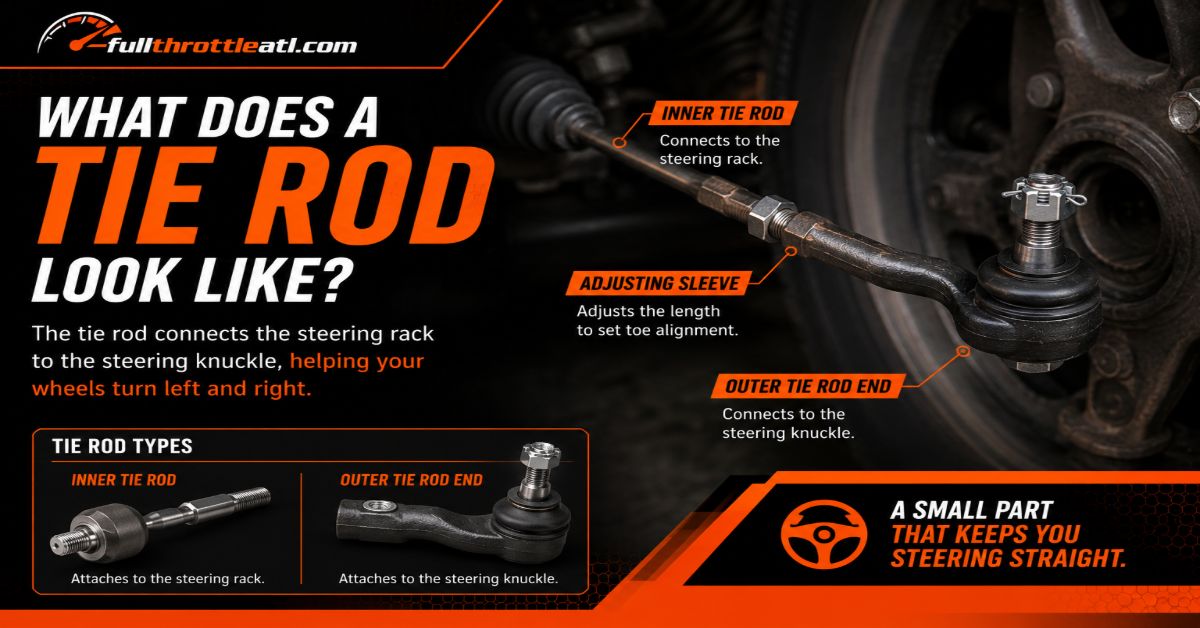
A tie rod looks like a slender, cylindrical metal rod featuring a pivoting ball joint at one or both ends, serving as the critical steering linkage that connects a vehicle’s steering gear to the wheel knuckles. The entire assembly consists of an inner tie rod, an adjustment sleeve, and an outer tie rod, bridging the gap between the steering rack and the front wheels.
At a Glance
- Outer tie rods feature an integrated ball joint encased in an accordion-style rubber dust boot.
- Inner tie rods are completely hidden beneath a long rubber bellows boot connected to the steering rack.
- A standard passenger car tie rod measures between 15 and 40 centimeters in total length.
- Heavy-duty trucks use massive, solid steel drag links instead of standard rack-and-pinion tie rods.
- Internal component wear can make a tie rod fail completely even when the outer appearance looks brand new.
What Does the Outer Tie Rod Look Like?
The outer tie rod is the visible, accessible portion of the steering linkage located directly behind the front brake rotors. It appears as a thick, rigid metal arm that is often curved or bent to clear surrounding suspension components. At its tip sits a circular socket housing an integrated ball joint, from which a threaded metal stud protrudes vertically to bolt into the wheel knuckle.
A black, flexible rubber or polyurethane dust boot shaped like a small accordion encases this ball joint and keeps internal grease contained. Typically measuring 15 to 30 centimeters in length and up to 2.5 centimeters in thickness, the outer rod is manufactured from forged steel or heavy-duty cast iron, usually finished in a raw grey, matte black, or silver anti-corrosion coating.
What Does the Inner Tie Rod Look Like?
The inner tie rod is a long, perfectly straight metal shaft that remains completely hidden from external view. One end features male threads that screw into an adjustment sleeve or directly into the outer tie rod, while the opposite end features a large, bulbous inline pivot ball housing that connects securely to the steering rack.
Measuring between 25 and 40 centimeters in length, the inner rod is longer than its outer counterpart. A large, elongated rubber steering rack bellow protects this entire inner mechanism from road debris and moisture, meaning you must peel back or slide off this rubber boot to inspect the inner joint directly.
What Does a Bad Tie Rod Look Like Visually?
A bad tie rod often displays visible signs of physical degradation, including a torn, cracked, or completely missing rubber dust boot. When the protective boot splits, dark, gritty road grime mixes with the internal grease, creating a messy buildup around the ball joint socket.
Severe rust or orange corrosion bleeding through the seams of the joint indicates that moisture has breached the internal seal. Additionally, if the threaded adjustment sleeve shows signs of heavy galvanic corrosion, the entire assembly may be fused together and incapable of standard wheel alignment adjustments.
Why Do Tie Rod Boots Crack and Fail?
Tie rod boots crack primarily due to continuous thermal cycling, constant mechanical flexing, and environmental exposure to road salt, ozone, and petroleum oils. Rubber and synthetic polyurethane lose their natural elasticity over time, becoming brittle and prone to splitting under high suspension stress.
Once a microscopic crack forms in the accordion folds, high-pressure road water and abrasive grit enter the joint, washing away the factory lubrication and accelerating mechanical wear until the joint completely binds or separates.
How Can a Tie Rod Fail While Looking Normal?
A tie rod can fail internally despite looking completely clean and brand new on the outside due to internal core fatigue, dry joint binding, or thread seizure. The outer rubber boot might remain entirely intact, but the internal steel ball and socket can suffer from excessive metal fatigue, creating dangerous structural play that compromises vehicle handling.
Conversely, the “dry joint” phenomenon occurs when microscopic boot tears let moisture wash away grease without causing external looseness, causing the internal ball to rust solid and snap without warning during sharp turns.
What Do Heavy-Duty and Truck Tie Rods Look Like?
Heavy-duty trucks and solid-axle vehicles like the Jeep Wrangler or Ford F-250 do not utilize standard light-duty rack-and-pinion tie rods. Instead, these vehicles feature a massive, straight steel drag link spanning the entire width of the front axle, often exceeding 100 centimeters in length and 4 centimeters in thickness.
Replaceable heavy-duty tie rod ends thread directly into both sides of this solid bar, utilizing oversized greasable ball joints designed to withstand high-stress off-road conditions and heavy towing loads.
How Do You Test a Tie Rod by Hand for Play?
Testing a tie rod for play requires lifting the vehicle off the ground and performing the standard 3-and-9 o’clock wheel shake test. Grasp the front tire firmly at the three o’clock and nine o’clock positions and forcefully rock the wheel back and forth while an assistant observes the inner and outer tie rod joints.
Any immediate looseness, delayed steering response, or visible clunking movement at either end of the tie rod assembly indicates that the ball joint is worn out and requires immediate replacement.
What Are the Driving Symptoms of a Failing Tie Rod?
Driving with a failing tie rod produces a loose or dead feeling in the steering wheel accompanied by wandering on straight roads. Drivers frequently hear a distinct clunking, popping, or snapping noise when turning the steering wheel at low speeds or pulling into parking spaces.
Rapid, uneven tire wear along the inner or outside edges of the front treads also points directly to alignment shifts caused by a loose steering linkage.
Can You Drive With a Broken Tie Rod?
Driving with a broken or severely worn tie rod is extremely dangerous and strictly prohibited. If a tie rod separates completely while the vehicle is in motion, the affected front wheel instantly loses all steering connection and flops outward or inward independently.
This causes an immediate, catastrophic loss of vehicle control, frequently resulting in high-speed accidents or severe lane departures.
Should You Replace Inner and Outer Tie Rods Together?
Replacing both inner and outer tie rods simultaneously is highly recommended by professional mechanics whenever labor overlaps make access convenient. While inner and outer rods wear at independent rates, replacing the entire assembly prevents secondary failure down the road.
Because accessing either component requires removing the wheel and outer hardware, doing both at once saves significant labor costs during a single alignment service.
Do You Need an Alignment After Replacing a Tie Rod?
A professional wheel alignment is required 100% of the time immediately following any tie rod replacement. Even when a technician carefully matches the thread count of the new part to the old component, microscopic manufacturing variances alter the front-end toe angle.
Skipping this vital step causes severe steering pull and rapidly destroys expensive front tires within a few hundred miles of driving.
How Much Does a Tie Rod Replacement Cost?
A professional tie rod replacement typically costs between one hundred and fifty and three hundred and fifty dollars per side, including both parts and labor. The replacement parts themselves are relatively inexpensive, usually ranging from thirty to eighty dollars, with the majority of the total bill coming from labor hours and the mandatory post-installation wheel alignment service.
The Bottom Line
Recognizing what a tie rod looks like—from the visible outer ball joint to the hidden inner shaft—helps you catch wear before it compromises vehicle safety. Pay close attention to torn rubber boots, steering play, and unusual low-speed noises. Addressing worn tie rods promptly and following up with a professional wheel alignment ensures safe handling and extends the lifespan of your front tires.