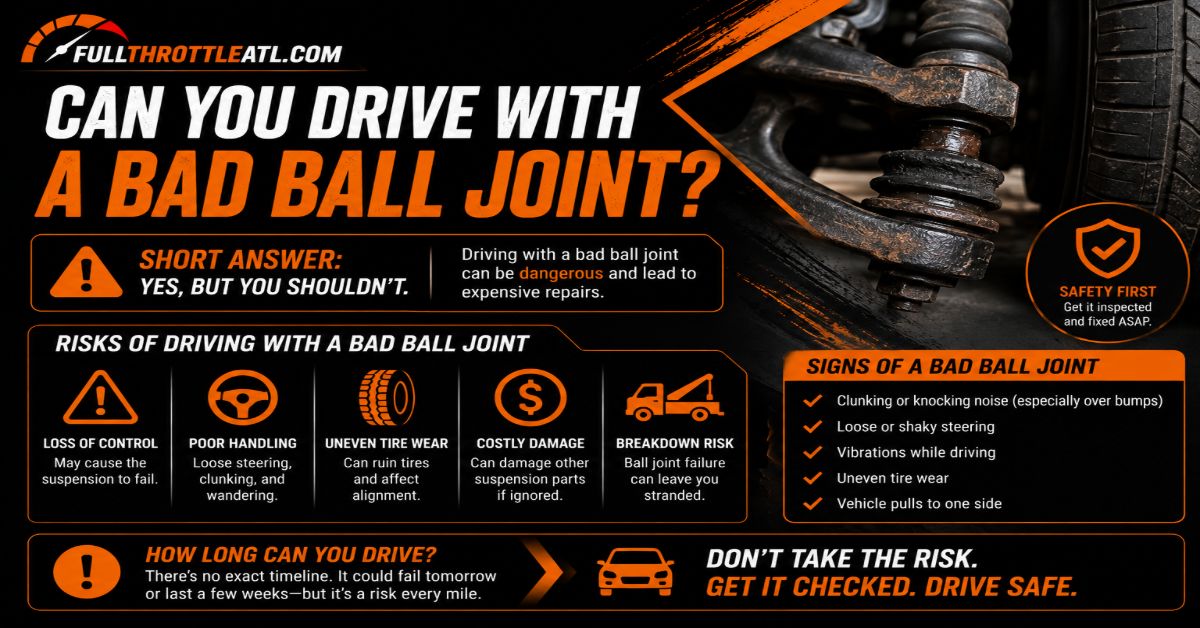
No, you should never drive a vehicle with a significantly worn or failing ball joint, as it poses a severe safety risk that can lead to catastrophic wheel separation while moving. While a vehicle might physically roll forward with a degraded ball joint, doing so risks a complete loss of steering control. If the joint fails entirely, the control arm drops, the wheel folds outward or collapses into the fender, and the vehicle can crash instantly.
At a Glance: Critical Ball Joint Facts
- 0 Days / 0 Miles: The safe driving limit once a mechanic diagnoses a loose, clicking, or binding ball joint.
- 0.050 Inches: The maximum manufacturer allowance for axial or radial play before immediate replacement is required.
- 30+ MPH: The dangerous velocity threshold where a ball joint failure turns into a high-speed rollover or fatal accident.
- $2,000 to $5,000+: The cost of secondary damage if a joint separates, compared to a simple $100 tow truck fee.
What Are the Primary Symptoms of a Failing Ball Joint?
Recognizing early warning signs prevents unexpected mechanical failures on the road. The most common symptoms include a repetitive clunking, popping, or snapping noise when turning the steering wheel or driving over bumps and speed bumps. Drivers often notice a loose or wandering steering wheel that requires constant minor corrections to keep the car traveling straight. Additionally, uneven front tire wear, specifically on the inner or outer edges, frequently points to excessive suspension play caused by a degraded joint.
How Long Can You Drive Once a Ball Joint Starts Making Noise?
You have virtually zero safe driving time once a ball joint starts making audible noise. An audible pop, clunk, or creak means the internal metal ball is actively bouncing around or grinding inside a severely compromised socket. At this stage, the joint has advanced past normal wear and can separate at any moment. Limping the vehicle even a short distance to a driveway puts immense strain on the remaining metal housing. If noise is present, arrange for a flatbed tow truck immediately rather than risking a highway collapse.
What Is the Maximum Allowable Play in a Ball Joint?
The standard manufacturer allowance for axial or radial play in a ball joint ranges strictly between 0.020 and 0.050 inches. Anything exceeding 0.050 inches or roughly 1.27 millimeters of physical movement requires immediate replacement. Professional mechanics use a dial indicator mounted to the control arm to measure this vertical or horizontal play precisely. Even a microscopic amount of excess movement accelerates rapidly under vehicle weight, turning minor looseness into a total structural failure within a short timeframe.
How Much Does It Cost to Replace a Bad Ball Joint?
Replacing a bad ball joint typically costs between $150 and $400 for parts and labor combined, depending on your vehicle make and model. If the ball joint is pressed into the control arm, a mechanic may recommend replacing the entire control arm assembly, which raises the price to $300 or $700 per side. While paying for repairs feels inconvenient, it is vastly cheaper than the $2,000 to $5,000+ in secondary damage caused by a total joint separation, which ruins fenders, axles, brake lines, and steering racks.
Can I Replace Just One Ball Joint or Both?
Technically, you can replace a single failed ball joint, but industry best practice strongly recommends replacing them in pairs. Because both the left and right sides of your vehicle travel the exact same mileage and endure identical road conditions, the opposite side is usually close to failing as well. Replacing both front ball joints at the same time saves you money on labor costs in the long run. Furthermore, suspension components directly affect wheel alignment, and replacing both sides ensures you only need to pay for one professional alignment afterward.
Will a Bad Ball Joint Trigger a Dashboard Warning Light?
Ball joints will never trigger a dashboard warning light because they are purely mechanical suspension components. Modern vehicles feature no electronic sensors inside the steering knuckles to monitor physical joint wear or socket degradation. The only time an electronic warning light appears is after a catastrophic failure occurs. When a joint snaps, the swinging wheel often rips out the anti-lock braking system speed sensor wire, immediately triggering the ABS and traction control lights on your instrument cluster.
What Happens to the Rest of the Car if It Breaks While Driving?
If a ball joint separates while the vehicle is moving, the wheel violently tears away from the vehicle centerline. This extreme movement instantly snaps the constant velocity axle shaft and rips open flexible rubber brake lines, causing an immediate loss of hydraulic braking pressure. The violent shift also destroys the steering tie rods and crushes the outer body fender down directly onto the spinning tire. At highway speeds, this sudden mechanical seizure makes the vehicle nearly impossible to control.
Is It Safe to Drive with a Torn Ball Joint Boot?
If the rubber dust boot is cracked or torn, but a dial indicator shows zero physical play inside the socket, the vehicle is temporarily safe to drive short distances. However, a compromised boot fails to retain grease and allows road dirt, water, and salt to contaminate the internal bearing surfaces. This lack of lubrication destroys the joint rapidly, usually turning a healthy joint into a loose, dangerous hazard within a few weeks. Inspect torn boots weekly and schedule prompt replacements before physical play develops.
How Do Load-Carrying Joints Differ from Follower Joints?
Many trucks and SUVs use an independent front suspension system featuring a load-carrying lower ball joint and a follower upper ball joint. Lower load-carrying joints bear the heavy weight of the vehicle and push downward constantly, making them critical safety hazards that fail catastrophically when worn. Upper follower joints experience less vertical load and primarily guide wheel alignment angles. While a worn follower joint still requires urgent attention, it is slightly less likely to collapse instantly than a worn load-carrying lower joint.
What Is the Emergency Limp Protocol for a Stranded Vehicle?
If you become stranded in a dangerous or remote area with zero cell service and discover a failing joint, use an extreme emergency limp protocol to reach safety. Drive at a maximum speed of 5 to 10 miles per hour with your hazard lights activated, avoiding all bumps, potholes, and sharp turns. This high-risk maneuver should only be used as an absolute last resort to escape freezing weather, unsafe neighborhoods, or active highway shoulders where stopping poses an immediate mortal threat.
Why Do Some Ball Joints Snap Without Making Warning Noise?
High-performance, sealed, or heavily greased ball joints can occasionally suffer from severe metal fatigue or internal manufacturing defects without making a single sound. Unlike traditional joints that wear out gradually and develop loose play accompanied by clunking, these fatigued units can snap cleanly under sudden stress. This silent failure mode often catches drivers by surprise, occurring instantly the moment the vehicle encounters an unexpected stress point like a deep pothole at highway speeds.
How Do Seized or Binding Ball Joints Affect Vehicle Handling?
Ball joints usually loosen over time, but they can also dry out entirely and seize inside their sockets. A binding joint will not clunk over bumps; instead, it causes heavy steering stiffness or memory steer, a dangerous condition where the steering wheel fails to return to the center automatically after completing a turn. Drivers must fight the steering wheel to keep the vehicle tracking straight. This resistance mimics the high danger level of a loose joint while exhibiting completely different mechanical symptoms.
How Do Potholes and Sudden Impacts Trigger Total Separation?
A ball joint that feels completely fine during smooth highway driving can instantly separate the moment the suspension undergoes sudden extension and compression. Hitting a minor pothole, driving aggressively over a speed bump, or curbing a tire while parking creates massive shock loads. This sudden kinetic spike exceeds the structural limits of a worn socket wall, pulling the metal stud straight out of its housing and causing immediate, catastrophic wheel collapse.
How Can You Test a Ball Joint at Home?
You can test a ball joint at home by safely lifting the vehicle with a hydraulic floor jack and securing it on sturdy jack stands. Grab the top and bottom of the tire and rock it back and forth to check for loose play. Next, place a long pry bar underneath the tire and gently lift upward while watching the lower ball joint area. Any visible vertical movement or play between the control arm and the steering knuckle indicates that the ball joint is worn out and requires immediate replacement.
The Bottom Line
Driving with a bad ball joint is an extreme safety hazard that risks sudden steering loss and catastrophic wheel separation at any speed. Once a ball joint develops physical play exceeding 0.050 inches, starts making audible clunking noises, or exhibits binding symptoms, the vehicle must not be driven. Prioritize immediate professional repair or flatbed towing to protect yourself, your passengers, and other motorists on the road.