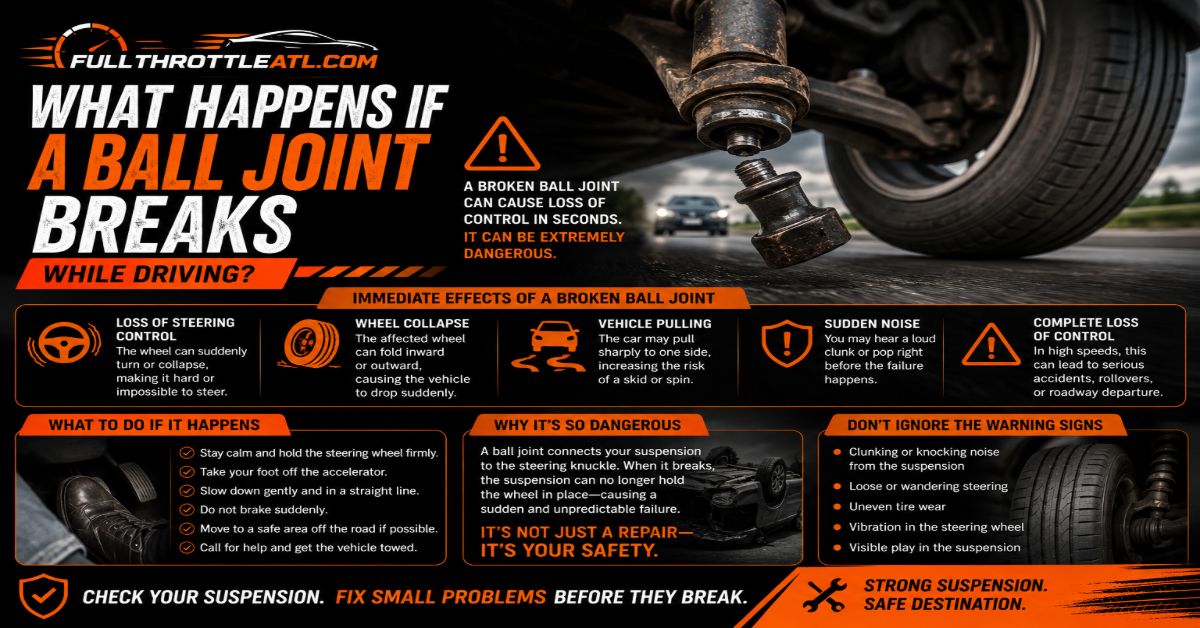
When a ball joint breaks while driving, the wheel instantly detaches from the vehicle steering system, causing the suspension to collapse and the tire to pitch violently outward or inward. At highway speeds, this mechanical failure leads to an immediate, catastrophic loss of directional control, forcing the vehicle into an uncontrollable skid or rollover.
At a Glance
- Steering control over the affected wheel drops to zero percent instantly, eliminating roughly seventy percent of front-axle steering authority.
- Standard foot brakes frequently fail because the violently separating wheel snaps flexible hydraulic brake lines.
- Warning signs always precede total failure, including loud clunking noises over bumps and severe steering wander.
- Repairing the subsequent secondary damage to fenders, CV axles, and suspension components often costs between $2,500 and $6,000.
- Driving on a clicking or popping ball joint is unsafe because total structural separation can happen at any moment.
Will I get any warning signs before a ball joint snaps?
Ball joints rarely snap without warning unless you impact a massive pothole, curb, or road debris at high speed. For weeks or months leading up to structural failure, you will hear a distinct metallic clunk, snap, or popping noise when driving over speed bumps or turning the steering wheel. You will also experience steering wander where the vehicle drifts left and right across the lane, alongside highly uneven wear on the inside or outside edges of your front tires.
Mechanically, these symptoms occur because the internal grease seal has torn, allowing moisture and road grit to contaminate the spherical bearing. The metal-on-metal friction creates internal play. Once that play exceeds structural tolerances, the ball slips out of its socket. Ignoring these acoustic warnings transforms a predictable component replacement into an emergency road hazard.
What specific sounds differentiate upper versus lower ball joint failure warnings?
Upper and lower ball joints produce distinct acoustic signatures based on the physical load vectors acting upon them during daily driving maneuvers. Lower ball joints, which bear the primary vertical weight of the vehicle, typically produce a heavy, dull clunk or thud whenever the suspension drops into a pothole or rises over a speed bump. This sound originates from the control arm slamming against the internal housing as the worn stud rattles vertically.
Upper ball joints, which primarily manage wheel alignment and stability rather than pure vehicle weight, generate a sharper, higher-pitched metallic click or pop. This sharper sound usually occurs when you turn the steering wheel while parking or pulling out of a driveway. Recognizing whether the noise originates from the top or bottom of the wheel hub helps technicians diagnose which specific component requires immediate replacement.
How long can I safely drive on a noisy ball joint?
You can drive zero miles safely on a clicking, popping, or clunking ball joint. A noisy ball joint indicates that the internal polymer seat has disintegrated and the metal ball is loose inside its housing. Under normal driving loads, such as executing a sharp turn or braking hard on the highway, the stud can pull completely out of the socket without further warning.
Professional mechanics treat worn ball joints as severe safety hazards. If your vehicle exhibits suspension clunking, schedule an immediate inspection. Continuing your daily commute on a compromised suspension risks sudden wheel detachment, which places your life and the lives of other motorists in extreme danger.
What physical inspection steps can a driver perform to test ball joint play?
You can perform a basic driveway inspection of your ball joints using a reliable floor jack, jack stands, and a long pry bar. First, safely elevate the vehicle until the front wheel hangs completely free off the ground. Place your hands at the 12 o’clock and 6 o’clock positions on the tire and rock the wheel inward and outward to check for vertical play.
Next, place a sturdy pry bar underneath the tire, resting it on the garage floor, and gently lift the tire upward while observing the ball joint housing. Any visible vertical movement or play exceeding one millimeter indicates that the joint is worn out. If you notice any rubber boot tearing coupled with grease leakage, the joint has failed internally and must be replaced immediately.
What is the phase-by-phase timeline of a ball joint breaking at highway speed?
The mechanical destruction caused by a ball joint failure unfolds in milliseconds, leaving the driver almost no time to react through traditional driving inputs. Understanding this exact timeline clarifies why the incident feels so violent.
- The Instant of Failure (0 to 1 Second): The ball-and-socket design snaps, completely disconnecting the steering knuckle from the control arm. Gravity and centrifugal force push the wheel assembly outward, turning the tire perpendicular to the car. The vehicle frame drops instantly onto the exposed tire, acting as an asymmetric brake.
- The Kinetic Aftermath (1 to 5 Seconds): The spinning wheel rips through the inner fender liner, tears flexible brake lines, and snaps the constant velocity axle. The vehicle yaws violently toward the side of the broken joint because that dragging wheel creates massive mechanical drag.
Why does standard defensive driving advice fail during a ball joint failure?
Standard driving instruction dictates that if you lose control, you should firmly apply the brakes and steer into the skid. This standard advice fails completely during a ball joint failure due to three overlapping mechanical hazards.
First, as the wheel flops outward, it violently stretches and snaps the flexible rubber brake hose, causing hydraulic fluid to spray out and leaving the brake pedal sinking straight to the floorboards. Second, steering into the skid causes the intact wheel to turn sharply while the broken wheel acts as an unguided anchor, triggering an immediate rollover. Third, high-speed counter-steering mechanics do not work because the physical geometry of the front axle is completely deformed.
If a ball joint breaks, should I use the emergency brake?
Yes, you must use the emergency brake, but you must apply it very gently. Because a broken ball joint frequently severs your primary hydraulic brake lines, your foot brake pedal will provide zero stopping resistance. You must rely on the mechanical or electronic emergency brake to slow the vehicle down.
Apply the parking lever or switch gradually. Yanking a mechanical handbrake aggressively at high highway speeds will lock the rear wheels instantly, causing the vehicle to spin out of control on top of an already compromised front suspension. Gradual engagement brings the car to a safe, controlled stop on the shoulder.
How do upper versus lower ball joint failures structurally differ?
In traditional short-long arm suspensions, the lower ball joint acts as the primary load-bearing component that supports the weight of the vehicle. If a lower ball joint breaks, the suspension collapses instantly, dropping the car frame directly onto the asphalt.
Conversely, if an upper ball joint breaks, the wheel tilts wildly out of alignment into a severe positive camber position, but the lower joint and spring may temporarily keep the wheel assembly somewhat contained inside the wheel well. This slight structural delay gives the driver a few extra seconds to safely slow down before complete collapse occurs.
How do McPherson strut systems react differently compared to traditional SLA suspensions?
Most modern front-wheel-drive cars utilize McPherson strut suspensions where the upper strut assembly acts as the upper pivot point. These vehicles feature only a single lower ball joint per side.
When a McPherson lower ball joint snaps, there is no secondary upper link or control arm to hold the top of the wheel stable. The entire wheel assembly immediately flops outward from the top, causing the fender to drop onto the tire instantly. This lack of structural redundancy makes front-wheel-drive failures particularly abrupt and severe.
How does vehicle weight distribution in modern electric vehicles alter the severity of a snap?
Modern electric vehicles carry heavy battery packs mounted low in the chassis, resulting in a significantly higher gross vehicle weight rating compared to traditional internal combustion sedans of a similar size. When a ball joint fails on a heavy electric vehicle, the increased kinetic energy and downward load magnify the destructive forces acting on the suspension.
The heavier vehicle mass causes the dragging tire to dig deeper into the asphalt surface, creating a much stronger yaw moment. This increased mechanical resistance shortens the time window for the driver to recognize the failure and makes high-speed spin-outs significantly more violent and difficult to manage.
How do after-market heavy-duty ball joints compare to OEM parts in failure modes?
After-market heavy-duty ball joints often feature greasable fittings, thick alloy housings, and sintered metal bearings designed to outlast factory original equipment manufacturer parts. However, these upgraded components introduce different maintenance requirements and potential failure modes.
While factory ball joints are typically sealed for life and wear out gradually through silent plastic degradation, after-market greasable joints require regular lubrication every oil change. If a vehicle owner neglects to grease an after-market heavy-duty joint, the internal bearings dry out rapidly, leading to catastrophic binding and an unexpected structural fracture.
What is the total financial cost of secondary damage after a ball joint failure?
Replacing a worn ball joint proactively costs between $150 and $400 for parts and labor. However, letting that same joint snap while driving multiplies your repair bills significantly through secondary mechanical destruction.
The average cost of secondary damage repair ranges from $2,500 to $6,000 or more in combined parts and labor. This high price tag stems from the fact that a single broken joint routinely destroys fenders, inner wheel wells, constant velocity axles, brake calipers, steering knuckles, control arms, and alloy wheels.
Can car insurance deny a claim if an accident is caused by a broken ball joint?
Standard collision and comprehensive auto insurance policies generally cover accidents caused by sudden mechanical failures, provided the policyholder maintains active coverage. However, insurance investigators and forensic adjusters inspect crash scenes for evidence of negligence.
If an insurance claims adjuster discovers that a vehicle owner ignored severe, documented suspension clunking noises for months or bypassed mandatory inspection advisories, the insurer may classify the crash as the result of deferred maintenance rather than an accidental event. Documented preventive maintenance protects both your physical safety and your financial coverage.
The Bottom Line
When a ball joint breaks while driving, the immediate loss of steering control and suspension collapse creates a high-risk emergency situation. Recognizing early warning signs like clunking noises or steering wander allows you to replace worn components proactively. Maintaining your suspension system prevents catastrophic failures, protects your vehicle from thousands of dollars in secondary damage, and ensures safe daily driving.