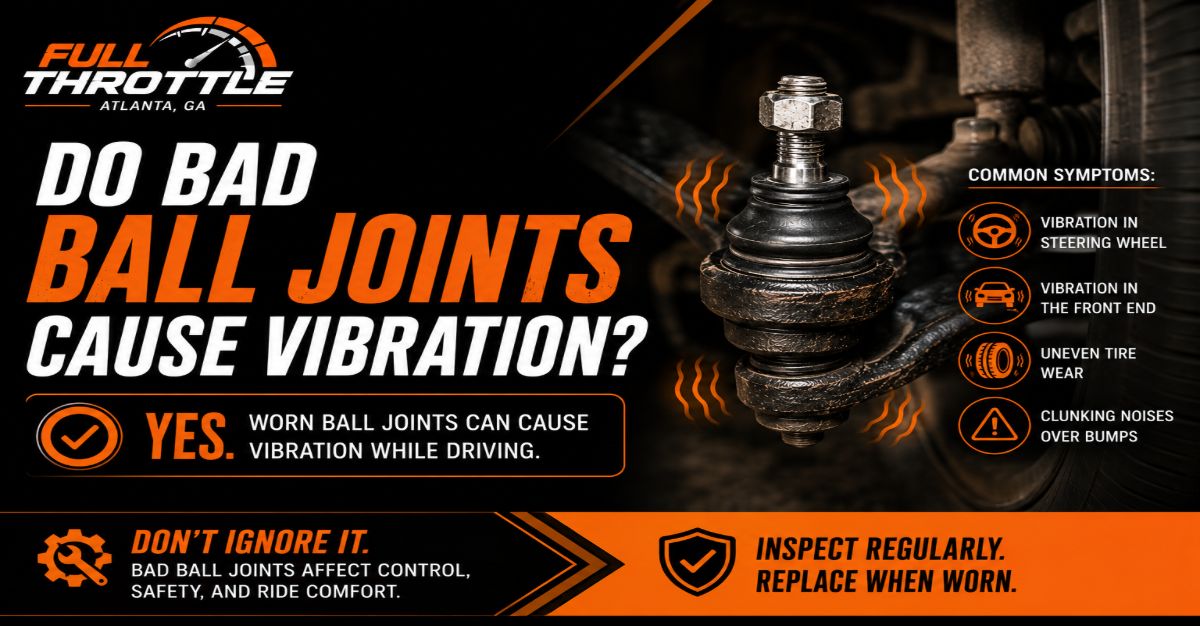
Yes, bad ball joints cause significant vibrations. While they do not generate vibration themselves, they lose their tight tolerances and allow the wheel, tire, and control arms to violently wobble, oscillate, and shake at speed. This is most commonly felt as a rapid side-to-side shimmy in the steering wheel or a low-frequency floorboard rumble.
At a Glance: Key Suspension Facts
- Speed Threshold: Vibrations typically manifest between 45 mph and 70 mph (72 to 112 km/h).
- Mechanical Frequency: Low-frequency oscillations measure between 10 Hz and 20 Hz, matching highway tire rotation.
- Wear Limits: Any axial or radial movement exceeding 0.020 to 0.050 inches (0.5 to 1.27 mm) requires immediate replacement.
- Average Lifespan: High-quality joints last 70,000 to 100,000 miles (112,000 to 160,000 km) depending on road quality.
- Diagnostic Rule: If a road vibration persists after a professional wheel balance, inspect the ball joints and tie rods.
What Speed Range Triggers Ball Joint Vibrations?
Ball joint vibrations typically manifest between 45 mph and 70 mph (72 to 112 km/h). Below 40 mph, the centrifugal forces and rotational momentum of the wheel assembly are not strong enough to force a rapid mechanical oscillation through the loose socket.
Above 75 mph, extreme aerodynamic and centrifugal forces can sometimes temporarily lock the worn ball into a single shifted position via physics-driven tension. This high-speed tension can momentarily mask the vibration, tricking drivers into thinking the vehicle cleared the issue when it actually entered a more dangerous state of structural stress.
What Frequency Do These Mechanical Vibrations Operate At?
Suspension-induced vibrations from a failing ball joint operate at a low-frequency mechanical range, usually measuring between 10 Hz and 10 cycles per second up to 20 Hz. This exact frequency band perfectly matches the rotational frequency of a standard passenger tire traveling at highway speeds.
When the internal socket degrades, the spherical stud loses its preloaded tension. As the wheel spins, every minor surface imperfection on the asphalt forces the loose assembly to cycle back and forth within the millimeter of empty space left inside the metal housing, translating directly into steering wheel feedback.
What Are the Manufacturer Allowable Tolerances and Wear Limits?
A healthy, brand-new ball joint features zero inches of noticeable manual play under load or manipulation. Most vehicle manufacturers state that any axial (up and down) or radial (side to side) movement exceeding 0.020 to 0.050 inches (0.5 to 1.27 mm) requires immediate component replacement.
Exceeding these limits means the nylon bearing race or metal-on-metal seating has eroded. Once this threshold is crossed, the joint can no longer maintain proper wheel alignment angles during cornering, leading to erratic tire wear and steering instability.
What Is the Typical Lifespan of a Front Suspension Ball Joint?
Expect high-quality original equipment manufacturer ball joints to last between 70,000 and 100,000 miles (112,000 to 160,000 km) under normal driving conditions. However, lifespan varies drastically based on local road environments.
Vehicles driven frequently on unpaved roads, through deep potholes, or over salted winter highways where rubber dust boots tear open will experience premature joint failure as early as 30,000 miles. Once a dust boot rips, road grit contaminates the internal grease, creating an abrasive paste that grinds away the steel ball in thousands of miles.
Why Do Some Completely Worn Ball Joints Cause Zero Vibration?
In load-carrying ball joint configurations frequently found in heavy-duty trucks or older rear-wheel-drive cars, the heavy weight of the vehicle permanently jams the ball tightly into one side of the worn socket while moving straight. In this specific scenario, drivers will experience zero vibration during straight-line highway cruising.
Instead of vibration, these vehicles produce loud, metallic pops or clunks when the vehicle weight shifts during sharp turns, speed bumps, or heavy braking. The absence of a steering wheel shake does not mean the suspension is safe; it simply means the load geometry is keeping the loose joint pinned in one direction.
How Do Sub-Freezing Temperatures Temporarily Hide Loose Ball Joints?
In sub-freezing winter temperatures, internal chassis grease thickens drastically into a semi-solid state. This cold, dense grease fills the microscopic gaps inside a failing socket, acting as a temporary hydraulic cushion that hides the vibration for the first 10 to 15 minutes of driving.
Once friction from road movement warms up the suspension components, the grease thins back out, flows away from the bearing surface, and exposes the sloppy mechanical play. Drivers often notice that their steering shake mysteriously disappears on cold winter mornings only to return once the commute reaches the highway.
How Can Front Brake Drag Mask a Failing Ball Joint?
If a vehicle has a loose ball joint but the front brake calipers are binding slightly, the constant braking drag pulls the wheel assembly backward against its control arm pivot. This continuous backward tension stabilizes the joint completely, hiding the vibration until the driver lifts off the throttle.
When the throttle is released and braking drag equalizes, the joint snaps forward into its loose state, causing an abrupt transition from a smooth ride to sudden steering shimmy. Mechanics must check for hidden drag when diagnosing intermittent suspension complaints.
Why Does a Standard Wheel Balance Fail to Cure a Suspension Shake?
Standard advice tells drivers that if the steering wheel shakes, they should go get their tires balanced. This advice fails spectacularly when dealing with a bad ball joint because a spin-balancer isolates the wheel in mid-air.
When a tire shop places a wheel on a spin-balancer, the machine spins it freely, declares it perfectly balanced, and bolts it back onto the car. When driving away, the car still shakes violently because the wheel itself is round and true, but the hinge holding it to the vehicle chassis has a millimeter of sloppy play.
The Professional Rule
If a road vibration persists immediately after a verified professional wheel balance, stop looking at the tires and inspect the ball joints, control arm bushings, and tie rod ends.
How Do You Differentiate a Ball Joint Vibration From an Unbalanced Tire?
An unbalanced tire produces a completely consistent, rhythmic vibration that scales perfectly with vehicle speed, smoothing out or intensifying in direct proportion to how fast the wheels rotate. A bad ball joint vibration is highly erratic. It might start shaking at 60 mph, but hitting a small surface bump or gently applying the brakes will suddenly make it twice as violent or cause it to stop entirely as the joint shifts positions.
| Feature | Unbalanced Tire Vibration | Bad Ball Joint Vibration |
| Consistency | Perfectly rhythmic and constant | Erratic, changes with road input |
| Speed Dependency | Scales linearly with speed | Appears suddenly within a specific band |
| Braking Response | Unaffected by light brake pedal pressure | Frequently alters or stops when brakes are applied |
| Steering Feedback | Smooth high-frequency buzz | Low-frequency rumble or heavy shimmy |
Is It Safe to Continue Driving With a Vibrating Suspension Component?
No, driving with a vibrating ball joint presents an extreme safety hazard. A vibrating ball joint means the internal metal has already ground away, leaving catastrophic empty space inside the housing.
If the spherical stud pulls completely out of the socket while driving, the entire wheel structure will instantaneously fold outward or collapse into the fender well. This structural failure causes an immediate, total loss of steering and braking control at high speeds, frequently resulting in severe accidents.
How Can You Test for a Bad Ball Joint at Home Using a Floor Jack?
- Secure the vehicle: Engage the emergency brake, block the rear wheels, and loosen the front lug nuts slightly.
- Elevate the front end: Place a hydraulic floor jack under the manufacturer-approved front crossmember or control arm, and lift the vehicle until the front tires clear the ground by several inches.
- Position safety stands: Slide heavy-duty jack stands under the frame rails to ensure structural security before placing your hands near the wheel assembly.
- Perform the 12 and 6 check: Place your hands at the 12 o’clock and 6 o’clock positions on the tire tread and try to rock the wheel firmly inward and outward.
- Evaluate the play: If you feel distinct clicking, mechanical play, or independent vertical shifting while the control arm stays still, the ball joint is spent. Note that shaking the tire at the 3 and 9 o’clock positions tests the outer tie rod instead.
What Distinct Acoustic Warning Signs Accompany Failing Suspension Joints?
Failing ball joints produce distinct auditory warnings before or during the onset of steering vibration. Drivers typically hear a sharp, metallic click or pop when pulling out of a driveway or turning the steering wheel at low speeds while backing up.
As the internal spring or preload washer breaks down, dry metal-on-metal friction generates a low-pitched squeak or groaning noise that mimics an old rocking chair whenever the suspension compresses over speed bumps or dips in the road surface.
How Much Does Professional Ball Joint Replacement Cost?
Professional replacement of a front ball joint typically costs between $250 and $650 per side, depending heavily on vehicle make, model, and suspension design.
In modern vehicles where the ball joint is pressed into or riveted to the control arm, mechanics often replace the entire control arm assembly as a single unit, which adds labor efficiency but increases parts cost. Conversely, vehicles where the joint unbolts individually feature lower parts expenses but require specialized hydraulic press tools to swap out the physical joint.
What Structural Physics Occur When a Ball Joint Separates at Speed?
When a worn ball joint suffers complete structural separation at highway speeds, the upper or lower anchor point holding the steering knuckle in place disappears. Without this vertical restraint, the steering knuckle loses alignment control, allowing the axle shaft or steering linkage to pull the wheel outward at an extreme angle.
The tire instantly scrubs against the pavement at a 90-degree vector, generating massive friction that rips the inner fender liner apart, shears brake lines, and forces the vehicle into an uncontrollable spin or sudden directional dive toward the nearest lane edge.
Do Upper or Lower Ball Joints Play a Larger Role in Steering Feedback?
Lower ball joints bear the primary vertical load of the vehicle weight on most independent suspension layouts, making them the primary source of severe steering vibration, wandering alignment, and clunking feedback.
Upper ball joints primarily maintain the steering axis inclination and camber angles during cornering roll. While a failed upper joint is just as dangerous because it can cause catastrophic wheel separation, a worn lower joint creates the most noticeable vibration and steering wheel shimmy during straight-line highway driving.
The Bottom Line
Bad ball joints cause severe low-frequency vibrations by allowing wheel assemblies to oscillate wildly between 45 mph and 70 mph. Because standard tire balancers miss loose suspension hinges, diagnosing a steering shimmy requires checking physical play at the 12 and 6 o’clock positions with a floor jack. Replacing worn joints promptly prevents catastrophic wheel separation and restores safe vehicle handling.