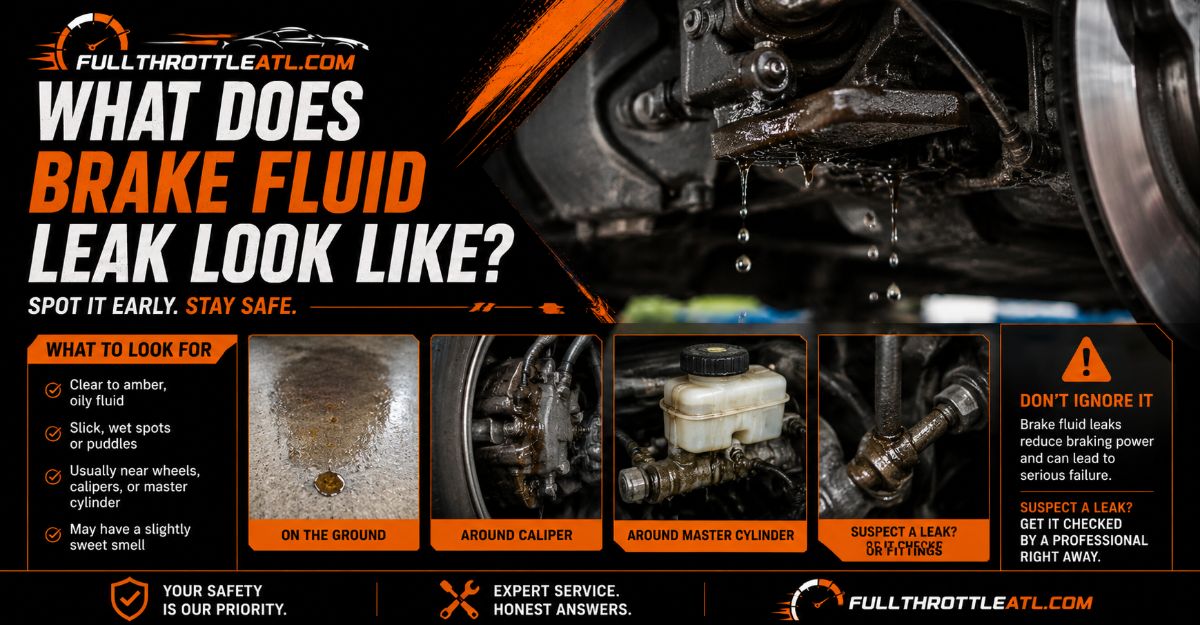
A brake fluid leak typically looks like a slick, oily puddle ranging in color from clear or light amber to dark brown or black, depending on its age and condition. It is thinner than engine oil, feels slippery between your fingers, carries a sharp chemical smell, and usually pools directly beneath the wheels, brake lines, or engine bay.
Brake Fluid Leak at a Glance
- Color: Clear to light amber when fresh; dark brown or black when old and contaminated.
- Texture: Slick, smooth, and oily, with a lower viscosity (thinner feel) than motor oil.
- Smell: A sharp, bitter chemical odor, frequently compared to fish oil or castor oil.
- Location: Found on the inner tire walls, near the wheels, along the chassis frame lines, or under the master cylinder.
- Puddle Size: Typically forms small spots ranging from 2 to 10 centimeters (1 to 4 inches) after sitting overnight.
How Can You Tell the Color and Age of Leaked Brake Fluid?
Fresh brake fluid is clear with a faint yellow-amber tint, while old or contaminated fluid appears dark brown or opaque black. Because glycol-ether-based brake fluid absorbs moisture and collects microscopic rubber debris from internal seals over time, its appearance shifts predictably as it ages.
| Fluid Condition | Visual Appearance | Age / Mileage Range | Recommendation |
| New / Unused | Completely clear to light golden-yellow | 0–12 months / <12,000 miles | Safe; leak requires repair. |
| Aged | Dark amber to medium brown | 12–36 months / 12,000–36,000 miles | Flush system during leak repair. |
| Severely Degraded | Opaque dark brown, black, or sludge-like | >36 months / >36,000 miles | Immediate flush and seal repair needed. |
Note: Some specialty European models or custom performance vehicles utilize synthetic or DOT 5 silicone fluids that feature bright blue or violet dyes, though golden-amber remains the industry standard.
What Does Brake Fluid Feel and Smell Like?
Brake fluid feels slick, slippery, and slightly greasy to the touch, but it feels noticeably thinner and less viscous than standard engine oil. It produces a sharp, harsh chemical odor that smells distinctly sour, similar to fish oil, heavy alcohol, or castor oil.
When rubbed between your index finger and thumb, brake fluid glides easily without the tacky thick residue characteristic of gear oil or transmission fluid. Because glycol-ether is a powerful solvent, touching it may leave a light warm sensation on your skin or stripping effect on painted surfaces. Always wash your hands immediately with soap and water after handling it, as brake fluid is toxic and damages vehicle paint quickly.
How Do You Perform the Water Drop Test to Confirm a Brake Fluid Leak?
To run the water drop test, wipe a few drops of the unknown fluid onto a clean white paper towel and submerge the saturated tip into a small container of clean tap water. Glycol-ether brake fluid is water-soluble and will instantly mix with and dissolve into the water, whereas petroleum-based engine oil or transmission fluid will separate and float in distinct beads on the surface.
- Dab the fluid: Press a white paper towel directly onto the puddle under your car to absorb a small sample.
- Observe the color on paper: Look at the hue against the white background to rule out brightly colored fluids.
- Dip into water: Submerge the fluid-stained portion of the paper towel into a clear glass filled with room-temperature water.
- Evaluate the solubility:
- If the fluid blends completely into the water, it is glycol-based brake fluid.
- If the fluid beads up and floats on top, it is engine oil or transmission fluid.
- If it dissolves but smells intensely sweet, it is engine coolant.
Where Under the Car Do Brake Fluid Leaks Usually Appear?
Brake fluid leaks appear near the four wheel wells, along the frame rails where hydraulic lines run, or directly under the engine bay beneath the master cylinder.
[ Front Left Wheel ]  ---- (Master Cylinder & Booster) ----  [ Front Right Wheel ]
         |                                                               |
         |--------------------- [ Hard Metal Brake Lines ] --------------|
         |                                                               |
[ Rear Left Wheel ]   -------------------------------------  [ Rear Right Wheel ]
- Near the Wheels or Tires: A puddle forming on the inside edge of a tire or spraying across the inner wheel barrel points to a failing caliper piston seal, a loose bleeder screw, or a leaking wheel cylinder (on rear drum brakes).
- Under the Engine Bay (Driver’s Side): Drops appearing beneath the firewall usually signal a leaking master cylinder reservoir or a compromised hydraulic proportioning valve.
- Along the Undercarriage: Puddles along the inner frame rails or floorboards typically stem from corroded metal brake lines or broken flex-hose fittings.
Can a Brake Fluid Leak Happen With No Visible Puddle Under the Car?
Yes, a master cylinder can leak internally into the brake booster housing without leaving a single drop of fluid on the ground. When the internal rubber piston seals fail, hydraulic fluid bypasses the piston and collects silently inside the hollow drum of the vacuum brake booster.
In this scenario, the brake pedal feels soft and slowly sinks to the floor under steady foot pressure, yet the ground under the vehicle remains completely dry. A strong vacuum pull from the engine can also suck this trapped brake fluid through the booster vacuum hose directly into the intake manifold, where the engine burns it off, producing a faint white smoke from the exhaust pipe during hard acceleration.
What Causes Brake Fluid to Form a Dry Crust Instead of a Liquid Puddle?
A tiny, slow seep at a brake bleeder valve or line fitting often dries into a chalky, powdery white or grey crust because brake fluid is hygroscopic and attracts ambient atmospheric moisture.
Because glycol-ether draws moisture from the surrounding air, minute amounts of leaking fluid mix with road dust, salt, and ambient dirt before they can form a drop. The lighter fluid components evaporate or react with dust, leaving behind a hard, crystallized residue around the threaded connections or rubber flex-hose crimps. Mechanics inspect these “crusty joints” during maintenance to catch slow line pinholes before they burst under high pressure.
How Does Rain or Water Affect the Appearance of Leaking Brake Fluid?
Rain or wet road surface water instantly dilutes leaking brake fluid, converting a distinct oil-like drop into a faint, milky white haze or a clear washed-out film that quickly vanishes.
Unlike petroleum oils—which create brilliant, rainbow-colored sheens on top of rain puddles—glycol-based brake fluid mixes homogeneously with rain. If your vehicle leaks brake fluid onto a wet driveway, the fluid dissolves into the standing water within minutes. Instead of looking for a puddle on rainy days, inspect the inner side walls of your tires and the rubber brake hoses for a slippery wet sheen that resists washing away cleanly.
How Do You Tell Brake Fluid Apart From Engine Oil, Transmission Fluid, and Coolant?
You can distinguish brake fluid from other automotive fluids by evaluating its viscosity, water solubility, smell, and primary fluid color side-by-side.
| Automotive Fluid | Primary Colors | Texture & Viscosity | Water Solubility | Characteristic Odor |
| Brake Fluid | Clear, light amber, dark brown | Slick, thin, slightly oily | Completely soluble | Sharp, chemical, sour/fishy |
| Engine Oil | Bright yellow, brown, dark black | Thick, slippery, viscous | Insoluble (Floats on top) | Deep petroleum, burnt oil |
| Transmission Fluid | Translucent red, dark pink, brown | Medium viscosity, smooth | Insoluble (Floats on top) | Sweet petroleum or burnt toast |
| Engine Coolant | Vibrant green, pink, orange, blue | Watery, slippery | Completely soluble | Very sweet, sugary, syrup-like |
Why Is the Brake Fluid Level Low If There Are No Visible Leaks?
Your brake fluid level drops naturally as your brake pads wear down, creating more space inside the caliper bodies that must be filled by fluid from the reservoir.
As the friction material on the brake pads wears thin, the caliper pistons remain extended further outward to keep the pads close to the brake rotors. This extra displacement draws fluid down from the master cylinder reservoir, causing the level to drop gradually from the “Max” line toward the “Min” line over 20,000 to 40,000 miles. A low fluid level accompanied by worn pads is normal mechanical wear; a sudden drop below the “Min” mark over a few days indicates an active hydraulic leak.
How Much Fluid Loss Causes a Noticeable Drop in the Reservoir?
A loss of just 15 to 50 milliliters (roughly 1 to 3 tablespoons) of hydraulic fluid produces a clear, noticeable drop in the master cylinder reservoir.
Most passenger vehicle master cylinder reservoirs hold between 200 and 500 milliliters of fluid in total. Because the reservoir fluid volume is relatively small, even a tiny puddle measuring 5 to 10 centimeters across on your driveway represents a significant percentage of your vehicle’s total reserve capacity. Losing 50 milliliters or more typically triggers the red brake warning light on your dashboard.
Can You Safely Drive a Car That Is Leaking Brake Fluid?
No, you should never drive a car that is actively leaking brake fluid. Automotive brakes rely on a closed hydraulic system to multiply foot force into stopping power; any leak introduces air bubbles and allows fluid pressure to vent into the atmosphere.
[ Driver Presses Pedal ]
          │
          ▼
[ Master Cylinder Pushes Fluid ] ──► ( LEAK SPOT: Pressure Escapes & Air Enters )
          │
          ▼
[ RESULT: Pedal Sinks to Floor / Brakes Fail Completely ]
When air enters hydraulic brake lines, it compresses easily under pressure while fluid does not. This causes the brake pedal to feel spongy, drop straight to the floorboard without slowing the car, and result in catastrophic brake failure. If you detect or suspect a brake fluid leak, leave the vehicle parked and call a tow truck to transport it to a certified repair shop.
What Happens to Brake Fluid Boiling Points When Moisture Enters a Leaking Line?
When a hydraulic leak breaks the airtight seal of a brake line, the fluid rapidly absorbs atmospheric water, lowering its boiling point and causing sudden vapor lock under hard braking.
- Dry Boiling Point (Fresh Fluid): Uncontaminated DOT 4 brake fluid boils around 230°C (446°F), easily handling the high heat generated by stop-and-go braking.
- Wet Boiling Point (Moisture-Contaminated Fluid): Once water content reaches just 3.7%, the boiling point drops dramatically to roughly 155°C (311°F).
When ambient air enters through a leaking fitting, the fluid boils under normal pedal friction. The liquid turns into compressible steam bubbles within the calipers, causing total pedal collapse during sudden stops or downhill mountain driving.
What Should You Do Immediately After Discovering a Brake Fluid Leak?
If you spot a brake fluid leak under your vehicle, stop driving immediately, check the reservoir level under the hood, and arrange for professional repair transportation.
- Park and turn off the engine: Place the vehicle in Park (or 1st gear for manuals) on a level surface and engage the parking brake.
- Inspect the reservoir: Open the hood and locate the translucent brake fluid reservoir near the driver’s side firewall. Check if the fluid sits below the “Min” fill line.
- Do not top off and drive: Adding fresh fluid to a leaking system will not make it safe to drive, as hydraulic pressure will force the new fluid out through the leak point as soon as you press the pedal.
- Call a tow truck: Have the vehicle safely transported to a repair facility where technicians can replace damaged lines, failing calipers, or worn master cylinders.
The Bottom Line
A brake fluid leak looks like a slick, amber-to-dark-brown fluid drop found under the engine bay or near the wheels, featuring a light oily texture and a sharp chemical odor. Unlike engine oil, brake fluid dissolves completely in water and feels noticeably thinner to the touch. Because even small leaks compromise hydraulic pressure and lead to sudden brake failure, a vehicle leaking brake fluid must be towed directly to a repair shop rather than driven.