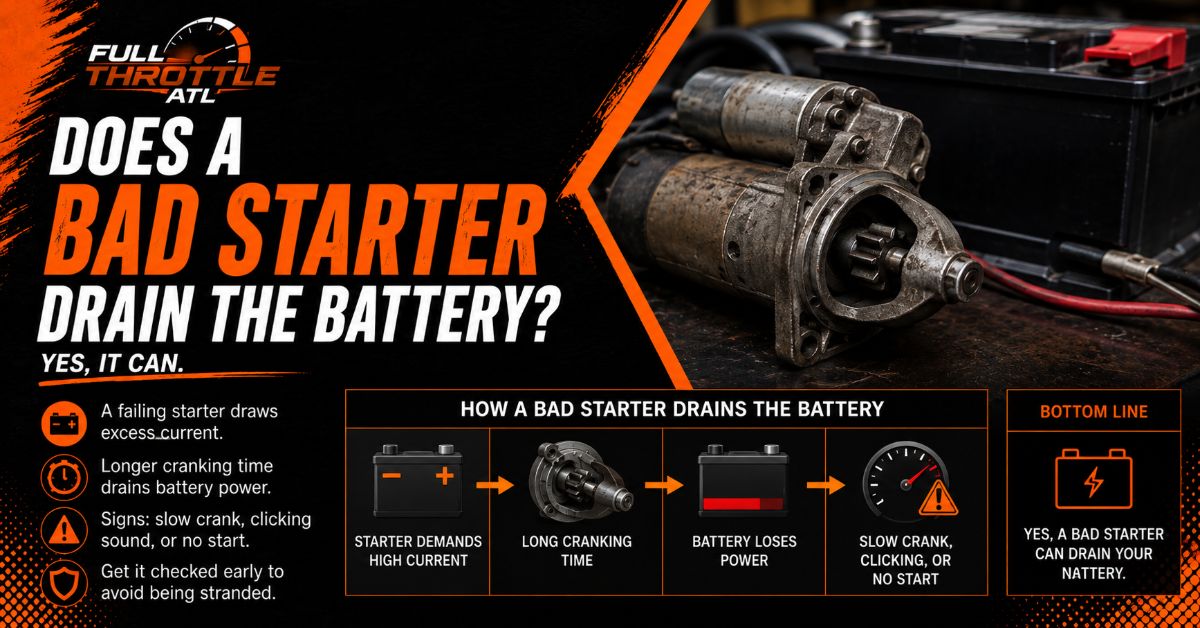
A bad starter can drain a car battery rapidly during ignition attempts or slowly over several days via an internal parasitic draw. When internal components bind or short, a failing starter motor draws excessive amperage—often double its normal operating current—draining chemical energy from the battery or collapsing its voltage in seconds.
At a Glance
- Active Drain: A shorted or seized starter draws 250A to 800A+ during cranking, draining a healthy battery in under 30 seconds.
- Parasitic Drain: Internal solenoid faults cause a constant 0.500A to 3.0A off-state draw, flattening a battery in 20 to 120 hours.
- Permanent Damage: Repeated deep discharges caused by a failing starter cause rapid plate sulfation, destroying brand-new batteries.
- Voltage Threshold: If battery voltage drops below 8.5V during cranking, the starter motor is drawing excessive current or internal resistance is too high.
- Surface Charge Trap: Dashboard lights can stay bright on a 12.6V surface charge even when the battery lacks the amperage to overcome a seized starter.
How Does a Failing Starter Drain a Car Battery?
A failing starter drains a car battery by converting electrical current into excess heat rather than mechanical energy. Under normal conditions, an ignition switch sends a low-amperage signal to the starter solenoid, which engages the starter motor pinion with the engine flywheel and draws a temporary surge of current to spin the crankshaft. When a starter fails mechanically or electrically, this process degrades into one of two failure modes:
- High-Amperage Stall Draw (Active): Worn armature bushings, misaligned bearings, or a seized starter motor shaft create physical resistance. The starter motor cannot turn, causing it to draw maximum locked-rotor amperage (Stall Current). The starter acts as a near-direct electrical short circuit, draining the battery’s available capacity within seconds.
- Parasitic Amperage Leak (Passive): Deteriorated insulation inside the starter solenoid or internal copper windings forms a continuous electrical path to the vehicle chassis ground. Even with the key removed from the ignition, current continuously flows from the battery positive terminal, through the starter, to the ground, steadily depleting the battery overnight.
How Many Amps Does a Bad Starter Draw Compared to a Healthy One?
A bad starter motor draws between 250 to over 800 amps during ignition, whereas a healthy starter motor typically draws 80 to 300 amps depending on engine size and cylinder count.
When starter motor bearings fail or internal copper armature insulation degrades, internal electrical resistance plummets while current demand spikes dramatically.
| Engine Configuration | Healthy Starter Draw (Amps) | Bad Starter Draw (Short/Seized) | Cranking Voltage Impact |
| 4-Cylinder / Compact | 80A – 150A | 250A – 400A+ | Drops below 8.5V instantly |
| V6 / Mid-Size SUV | 120A – 200A | 350A – 550A+ | Trips dashboard ECU error codes |
| V8 / Large Truck | 200A – 250A | 500A – 700A+ | Causes solenoid chatter & rapid click |
| Diesel Engines | 250A – 300A | 600A – 800A+ | Can physically warp battery plates |
How Fast Can a Bad Starter Completely Kill a Battery?
A mechanically binding or shorted starter can drain a fully charged starting battery in 15 to 30 seconds of continuous cranking effort. In a parasitic off-state fault scenario, a bad starter solenoid will drain a standard 60 Amp-hour (Ah) car battery completely dry within 20 to 120 hours.
The rate of depletion depends on whether the starter failure is an active high-amp short or a passive low-amp leakage:
- Active Cranking Failure (15–30 Seconds): When an ignition key is turned and held against a seized starter motor, the unit pulls 300A–500A continuously. A standard 12V automotive battery (rated at ~50–60Ah) loses its usable chemical charge in under half a minute of total continuous key-turn time.
- Heavy Parasitic Drain (20–40 Hours): An internal short drawing 1.5A to 3.0A continuously will pull 36 to 72 Amp-hours out of the battery over a 24-hour period, leaving the vehicle completely dead by the next day.
- Mild Parasitic Drain (70–120 Hours): A minor solenoid degradation pulling 0.500A (500mA) will drain a healthy battery down past the critical 11.8V starting threshold within 3 to 5 days of non-use.
Can a Bad Starter Drain the Battery When the Car Is Completely Off?
Yes, a bad starter can drain the battery when the engine and ignition are turned off if the starter solenoid develops an internal short or trapped moisture creates a path to ground.
The starter motor connects directly to the positive battery cable without passing through an ignition-switched relay or fuse box. Under normal circumstances, the internal contacts of the starter solenoid remain open, blocking electrical flow until the key activates the ignition circuit.
If the internal contacts weld together from electrical arcing, or if heat and age break down the internal coil insulation, a continuous electrical circuit is formed. This allows a constant parasitic draw between 0.500A and 3.0A to pull current directly from the battery 24 hours a day.
What Is Heat-Induced Starter Shorting?
Heat-induced starter shorting is a failure condition where a starter motor functions normally when cold, but develops an internal electrical short circuit once the engine bay reaches operating temperature.
This phenomenon occurs due to thermal expansion within the starter assembly:
- Thermal Copper Expansion: As heat builds up in the engine compartment (especially in starters mounted near exhaust manifolds), the copper wire windings inside the starter solenoid and field coils expand.
- Insulation Bridging: Microscopic cracks in aging varnish insulation open up as the metal expands. The bare copper wire touches the starter housing, creating a direct short circuit to ground.
- Symptom: The vehicle starts without issue in the morning. However, after driving to a store and returning to the car 10 minutes later, the starter draws massive amperage, turns slowly or not at all, and acts like a dead battery until the engine bay cools down completely.
Can a Bad Starter Drain the Battery While Driving?
Yes, a bad starter can drain the battery while driving if its solenoid contacts mechanical failure or electrical welding forces the starter drive gear to remain engaged with the spinning engine flywheel.
When a starter solenoid fails to retract the starter pinion gear after the engine fires, two severe problems occur simultaneously:
- Reverse Generator Effect: The engine spins the small starter motor armature at extreme rotational speeds (often exceeding 20,000 RPM), converting the starter into a massive electrical load and mechanical brake that fights engine rotation.
- Alternator Overload: The continuously energized starter motor pulls 100A to 200A constantly from the charging system. Because standard alternators produce between 80A and 150A at normal cruising speeds, the starter consumes 100% of the alternator’s output and forces the battery to supply the remaining current, depleting the battery while traveling at highway speeds.
Can a Bad Starter Permanently Destroy a Brand-New Battery?
Yes, a bad starter motor can permanently ruin a brand-new car battery by subjecting it to sudden deep discharges or severe thermal overload. Standard Starting, Lighting, and Ignition (SLI) lead-acid batteries are designed to deliver high current for 1–3 seconds, maintaining a shallow discharge state above 80% capacity.
[Bad Starter Fault]
       │
       ├──> High Stall Current (>400A) ──> Extreme Thermal Stress ──> Warped Lead Plates & Shorted Cells
       │
       └──> Continuous Parasitic Draw ──> Voltage Drops < 10.5V   ──> Heavy Lead Sulfation & Capacity Loss
When a bad starter pulls a battery below 10.5 volts—or drains it to 0 volts overnight—it causes two irreversible physical failure modes:
- Hard Sulfation: Deeply discharging a lead-acid battery causes lead sulfate crystals to coat the internal lead plates. If left discharged for even 24 to 48 hours, these crystals harden into an insoluble structure, permanently reducing battery cold-cranking amps (CCA) and overall storage capacity.
- Plate Buckling and Internal Shorts: Pulling 400+ amps through a cold battery forces rapid chemical conversion, generating extreme heat within the battery cells. This thermal surge warps the internal lead grid plates, tearing separator envelopes and causing internal cell shorts that ruin a new battery instantly.
Why Does a Battery Die After Only Two or Three Start Attempts?
A battery dies after two or three start attempts because a binding or shorted starter motor demands its peak “Locked Rotor Amps,” converting stored electrical energy into heat at four times the normal rate.
When a starter motor armature cannot spin due to worn bushings or mechanical seizure, counter-electromotive force (counter-EMF) drops to zero. Without counter-EMF to impede current flow, the starter acts as a continuous low-resistance copper bar across the battery terminals.
Each 5-second cranking attempt at 400A consumes roughly the chemical equivalent of 15 to 20 normal start cycles. The massive current demand causes battery terminal voltage to drop below 9.0 volts almost immediately, leaving insufficient energy to power the ignition system or engine control unit (ECU).
How Do You Tell If the Starter or the Battery Is the Real Problem?
To determine whether the starter motor or the battery is at fault, measure the battery’s rest voltage and observe its voltage drop during a start attempt using a digital multimeter set to DC Volts.
Diagnostic Decision Tree
                      [ Check Rest Voltage ]
                               │
               ┌───────────────┴───────────────┐
         [ Below 12.4V ]                 [ 12.6V or Higher ]
               │                               │
       Recharge Battery               Attempt Crank & Check
       & Re-test System                   Voltage Drop
                                               │
                               ┌───────────────┴───────────────┐
                        [ Drops < 9.6V ]                [ Stays > 10.5V ]
                               │                               │
                       High Amperage Draw              Open Circuit / Solenoid
                      (Bad Starter / Short)            (Faulty Relay or Ignition)
Diagnostic Results Matrix
| Diagnostic Step | Multimeter / Tester Result | Primary Suspect | Underlying Cause |
| Open Circuit Voltage | Reads 12.6V – 12.8V at rest | Neutral | Battery holds static charge; proceed to load test. |
| Open Circuit Voltage | Reads below 12.0V at rest | Battery / Parasitic Drain | Battery is discharged; charge to 12.6V before testing. |
| Cranking Voltage Drop | Voltage drops down to 9.6V – 10.5V | Healthy System | Starter draw is normal; check fuel/ignition system if engine won’t start. |
| Cranking Voltage Drop | Voltage collapses below 8.5V | Bad Starter | Starter armature is binding, drawing excessive stall current. |
| Cranking Voltage Drop | Voltage stays above 11.0V (No Crank) | Starter Solenoid / Relay | Control signal is missing, or solenoid internal contacts are open. |
Why Do Dashboard Lights Stay Bright If the Starter Is Draining the Battery?
Dashboard lights stay bright because light-emitting diodes (LEDs) and instrument clusters require less than 1 amp to illuminate, which a battery can easily supply using a superficial surface charge even when its main cranking capacity is exhausted.
A degraded or discharged battery can show an open-circuit static voltage reading of 12.4V to 12.6V across its terminals. This voltage easily powers low-draw cabin accessories, headlights, and digital screens.
However, when the ignition key turns to the “START” position, a shorted or binding starter demands 300 to 400 amps simultaneously. The battery’s compromised internal chemistry cannot sustain that load, causing system voltage to instantly collapse from 12.6V down to 4.0V. The dashboard lights may flicker or turn off completely at the precise moment of key turn, proving that static brightness is not an indicator of cranking amp capacity.
How Do You Perform a Parasitic Draw Test on a Starter Motor?
To perform a parasitic draw test on a starter motor, use a digital multimeter set to DC Amps connected in series with the battery’s negative terminal to measure off-state current leakage.
Step-by-Step Diagnostic Sequence
1.Prepare the Vehicle:Ensure all ignition systems and accessories are off.
Turn off the ignition, remove the key, close all doors, and wait 15 to 30 minutes for all onboard computers (ECUs) to enter sleep mode.
2.Connect the Multimeter:Place the meter in series with the negative terminal.
Disconnect the negative (-) battery cable from the battery post. Set your multimeter to DC Amps (10A port). Touch one multimeter lead to the negative battery post and the other lead to the disconnected negative terminal cable clamp.
3.Measure Baseline Parasitic Draw:Establish the current off-state leakage rate.
Read the display. A normal vehicle parasitic draw reads between 0.020A and 0.050A (20mA to 50mA). If the reading is above 0.200A (200mA), an abnormal parasitic draw is present.
4.Isolate the Starter Motor:Disconnect the main starter feed to confirm the fault.
Safely disconnect the thick, un-fused positive power cable directly from the terminal post of the starter motor solenoid (insulate the loose wire end with electrical tape).
5.Evaluate the Meter Reading:Compare the isolated reading against the baseline.
Observe the multimeter display. If the parasitic draw reading instantly drops from high amperage back down to under 0.050A, the starter solenoid or motor windings have an internal short circuit and the starter must be replaced.
What Are the Warning Signs of a Failing Starter vs. a Dying Battery?
Recognizing the distinct physical symptoms of a failing starter versus a dying battery prevents replacing functional components unnecessarily.
                    [ Vehicle Won't Start ]
                               │
       ┌───────────────────────┴───────────────────────┐
[ Starter Symptoms ]                            [ Battery Symptoms ]
  • Single loud CLICK                              • Rapid CLICK-CLICK-CLICK
  • Grinding or high whining noise                 • Dim cabin lights / slow power windows
  • Engine bay smoke or burning smell              • Jump-start resolves issue instantly
  • Hot-engine restart failure                     • Battery case swollen or leaking
- Single Loud Click (Starter): A single heavy “clunk” or “click” when turning the key usually indicates that the solenoid coil energized and pushed the starter drive gear forward, but the motor armature failed to spin due to internal brush wear or mechanical seizure.
- Rapid Clicking (Battery): A rapid, machine-gun-like “click-click-click-click” sound indicates low battery voltage. The battery has enough power to engage the solenoid plunger, but as soon as the main motor attempts to draw current, voltage collapses, releasing the solenoid, which then re-engages in a rapid loop.
- Grinding Noise (Starter): A harsh metallic grinding sound points to worn starter drive teeth, a failed starter clutch, or broken flywheel ring gear teeth rather than an electrical supply issue.
- Dimming Interior Accessories (Battery): If power windows roll down slowly, headlights appear dim, or dome lights fade when the ignition key is turned to “ON,” the battery lacks sufficient state-of-charge.
The Bottom Line
A bad starter motor will drain a car battery rapidly during starting attempts via excessive amperage draw, or slowly over several days through an internal solenoid parasitic short. While a healthy starter draws 80A to 250A temporarily, a shorted or binding starter pulls 250A to 800A+, dropping system voltage below 8.5V and damaging internal battery plates. Isolating the issue requires checking voltage drop during cranking or disconnecting the main starter feed during a multimeter parasitic draw test.