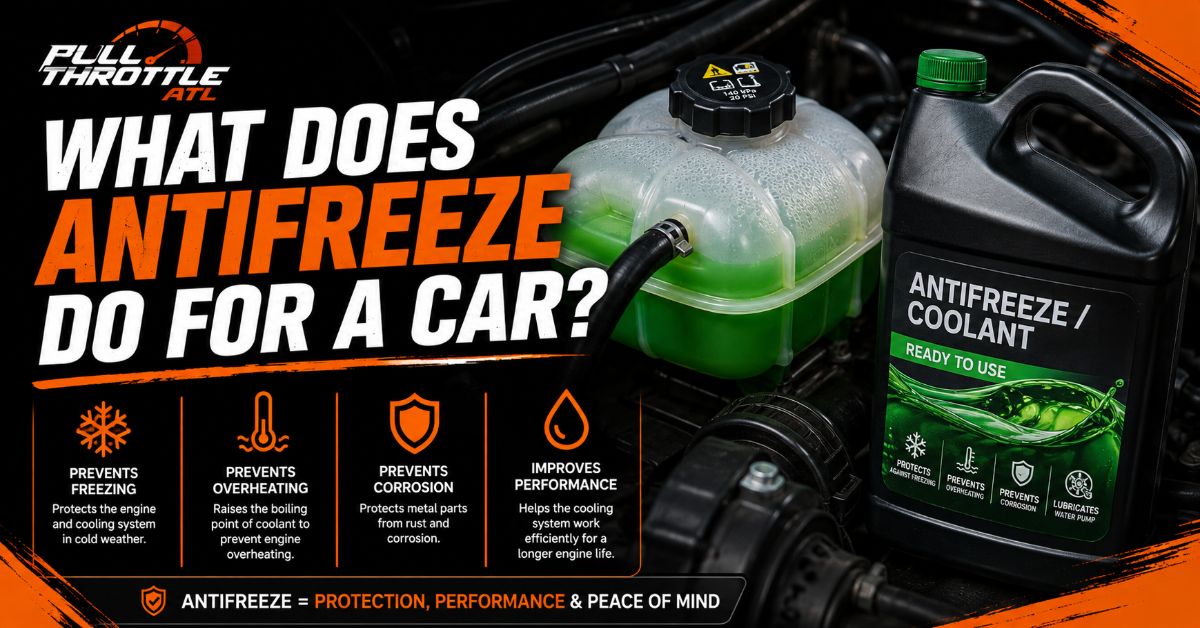
Antifreeze regulates an internal combustion engine’s operating temperature by lowering the freezing point and raising the boiling point of the cooling liquid circulating through the engine block. Combined with water, it prevents engine blocks from cracking in winter, prevents boil-overs in summer, and protects internal metallic components against rust and scale buildup.
At a Glance
- Freezing Protection: A 50/50 mixture of ethylene glycol antifreeze and distilled water lowers fluid freezing points from $32^\circ\text{F}$ ($0^\circ\text{C}$) to $-35^\circ\text{F}$ ($-37^\circ\text{C}$).
- Boiling Protection: In a pressurized system under a standard 15 PSI radiator cap, a 50/50 mix elevates the boiling threshold up to $265^\circ\text{F}$ ($129^\circ\text{C}$).
- Corrosion Control: Chemical inhibitors shield iron, aluminum, and copper cooling components from oxidation and mineral scale deposits.
- Pump Lubrication: Glycol formulations lubricate internal water pump seals to prevent friction wear and mechanical seal failure.
- The 70% Limit: Exceeding a 70% antifreeze-to-water ratio paradoxically degrades freeze protection and decreases heat transfer capacity.
How Does Antifreeze Protect an Engine from Freezing and Boiling?
Antifreeze protects an engine by altering the thermodynamic properties of water through colligative elevation and depression, while the sealed cooling system uses pressure to expand the liquid’s stable operating range.
+----------------------------------------------------------------------------------+
|                             COOLING SYSTEM FLUID MATRIX                          |
+------------------------------------+-----------------------+---------------------+
| Fluid / Pressure Condition         | Freezing Point        | Boiling Point       |
+------------------------------------+-----------------------+---------------------+
| Pure Water (0 PSI)                 |  32°F (0°C)           | 212°F (100°C)       |
| 50/50 Glycol + Water (0 PSI)       | -35°F (-37°C)         | 220°F (104°C)       |
| 50/50 Glycol + Water (15 PSI Cap)  | -35°F (-37°C)         | 265°F (129°C)       |
| Pure 100% Ethylene Glycol (0 PSI)  |  10°F (-12°C)         | 387°F (197°C)       |
+------------------------------------+-----------------------+---------------------+
Standard internal combustion engines maintain an ideal thermal range between $195^\circ\text{F}$ and $220^\circ\text{F}$. Pure water freezes at $32^\circ\text{F}$ ($0^\circ\text{C}$) and boils at $212^\circ\text{F}$ ($100^\circ\text{C}$), leaving zero safety margin for engine heat generation or winter weather. Mixing ethylene glycol with water breaks down water’s crystalline lattice structure, dropping the freezing point of a standard 50/50 mixture to $-35^\circ\text{F}$ ($-37^\circ\text{C}$).
To manage high heat, the system relies on the radiator cap pressure multiplier. Every pound per square inch (PSI) of pressure exerted on the fluid raises its boiling point by roughly $2.5^\circ\text{F}$ to $3.0^\circ\text{F}$. Under a functional 15 PSI radiator cap, the atmospheric boiling point of $220^\circ\text{F}$ rises to $265^\circ\text{F}$ ($129^\circ\text{C}$), preventing vapor pockets and localized head warping before the dashboard gauge enters the red zone past $230^\circ\text{F}$.
What Is the Difference Between Antifreeze and Coolant?
Antifreeze refers to the concentrated chemical product (typically ethylene glycol or propylene glycol), while engine coolant is the operational liquid mixture of concentrated antifreeze diluted with water.
  [ Concentrated Antifreeze ]  +  [ Distilled Water ]  =  [ Engine Coolant ]
      (Ethylene/Propylene)           (50% Volume)           (Ready-to-Use)
In automotive terminology, mechanics use the terms interchangeably, but they represent two distinct fluid states:
- Antifreeze: A concentrated raw chemical compound containing glycol base stock, rust inhibitors, anti-foaming agents, and dyes. It cannot be poured directly into an engine without water unless pre-mixed by the manufacturer.
- Engine Coolant: The final solution circulating through your radiator and engine block. It consists of antifreeze diluted with water—ideally at a 50/50 ratio—combining water’s superior heat transfer capability with glycol’s temperature extremes and corrosion protection.
What Happens If You Use 100% Pure Antifreeze Without Water?
Using 100% pure antifreeze degrades your engine’s cooling efficiency, increases running temperatures, and worsens freeze protection due to a phenomenon called the diminishing returns loop.
Pure water has twice the specific heat capacity of pure ethylene glycol, meaning water absorbs and transfers engine heat twice as fast as pure antifreeze. If you fill a radiator with pure glycol, the liquid fails to shed heat efficiently at the radiator core, causing engine head temperatures to surge.
Furthermore, pure ethylene glycol freezes at a relatively mild $10^\circ\text{F}$ ($-12^\circ\text{C}$). Water molecules are required to disrupt the glycol solution’s molecular bonding; without water, the fluid crystallizes at much warmer temperatures. The optimal protection envelope stops at a 70% antifreeze ratio ($-84^\circ\text{F}$ freeze protection). Exceeding 70% causes protection metrics to reverse rapidly.
Can You Use Pure Tap Water in an Engine Cooling System?
You can use plain tap water only as a temporary emergency measure to reach a repair facility, but doing so long-term will cause severe corrosion and thermal insulation damage.
Tap water contains dissolved minerals such as calcium and magnesium. When subjected to cylinder head temperatures exceeding $200^\circ\text{F}$, these minerals precipitate out of the liquid, forming a hard mineral scale over internal cooling passages. This scale acts as a thermal blanket, trapping heat inside engine metals while the gauge reads normal.
  [ Tap Water Used ] ──> [ High Engine Heat ] ──> [ Calcium/Magnesium Scale ]
                                                            │
  [ Cylinder Head Warping ] <── [ Heat Trapped ] <──────────┘
Additionally, water lacks chemical rust inhibitors. Within days of running pure water:
- Iron water pump impellers begin oxidizing, eroding the blades until fluid circulation drops.
- Aluminum cylinder heads experience galvanic corrosion.
- The lack of freeze protection risks cracking the engine block in sub-freezing temperatures.
If emergency water is used, perform a full system flush and replace it with a distilled water and glycol mix as soon as possible.
How Does a Broken Radiator Cap Cause Overheating?
A broken radiator cap causes overheating by releasing system pressure, dropping the boiling point of your coolant back down to atmospheric pressure limits.
The spring-loaded seal in a radiator cap acts as a pressure relief valve that holds the cooling loop between 13 and 16 PSI. If the rubber gasket degrades or the internal spring weakens, the system drops to 0 PSI (atmospheric pressure).
Under 0 PSI, a standard 50/50 coolant solution’s boiling point drops instantly from $265^\circ\text{F}$ down to $220^\circ\text{F}$. An engine running at its normal operating temperature of $215^\circ\text{F}$ will instantly boil the low-pressure fluid. This converts liquid coolant into steam vapor pockets, which cannot absorb heat, causing sudden engine overheating despite a full coolant reservoir.
What Happens If You Mix Different Types or Colors of Antifreeze?
Mixing different chemistry types or colors of antifreeze causes a chemical reaction that creates a gel-like sludge, clogging radiator passages and causing cooling failure.
Color is no longer a reliable indicator of fluid compatibility, as manufacturers use cosmetic dyes across different chemistries. Modern antifreeze falls into three core chemical formulations:
| Technology Type | Primary Additives | Typical Service Life | Chemistry Profile |
| IAT (Inorganic Additive) | Silicates & Phosphates | 2 Years / 24,000 Miles | Fast-acting protection; wears quickly; common in vintage cars. |
| OAT (Organic Acid) | Organic Acids (No silicates) | 5 Years / 150,000 Miles | Extended-life protection; common in modern aluminum engines. |
| HOAT (Hybrid OAT) | Organic Acids + Silicates | 5 Years / 100,000 Miles | Combines fast aluminum protection with long service life. |
When traditional IAT chemistry (containing silicates) is mixed with OAT chemistry (containing organic acids), the additives clash and fall out of solution. They form a thick, mud-like sediment that settles inside the radiator core, heater core, and fine cylinder pass-throughs, cutting off coolant flow and destroying internal water pump seals.
Why Is a Car Losing Coolant with No Visible External Leaks?
If your car loses coolant without leaving puddles on the ground, the engine is consuming the fluid internally through a breached seal or cracked internal casting.
When there are no external hose or radiator drips, fluid escapes into the engine’s internal chambers via three main pathways:
- Blown Head Gasket: A rupture between the engine block and cylinder head allows pressurized coolant to enter the combustion chamber. The fluid burns during combustion and exits the tailpipe as thick, white, sweet-smelling steam.
- Cracked Cylinder Head or Block: Microscopic heat fractures open under thermal expansion, allowing coolant to seep into cylinders or mix directly with engine oil, turning the oil into a frothy, milky-brown emulsion.
- Leaking Intake Manifold Gasket: On select engine designs, coolant channels pass through the intake manifold. A failing gasket draws coolant directly into the intake runners to be burned without external dripping.
What Are Waterless Coolants, and Why Do They Make Engines Run Hotter?
Waterless coolants are synthetic glycol solutions containing zero water that feature an ultra-high boiling point ($375^\circ\text{F}$), but they cause engines to run hotter due to reduced heat transfer efficiency.
Formulations like Evans Waterless Coolant rely entirely on propylene glycol and ethylene glycol blends. Because they contain no water, they eliminate system vapor pressure and prevent cavitation rust.
  PROS:  Boiling point up to 375°F (191°C)  |  Zero system vapor pressure
  CONS:  30–40% lower thermal efficiency   |  Engines run 20°F–40°F hotter
However, replacing water removes the primary heat conductor from the loop. Synthetic waterless coolants have a 30% to 40% lower specific heat capacity than standard water mixes. As a result, cylinder head temperatures run $20^\circ\text{F}$ to $40^\circ\text{F}$ higher under load. While the fluid itself will never boil over, internal engine components run hotter than they would on a standard 50/50 distilled water mix.
Why Do Racing Tracks Ban Glycol Antifreeze?
Racetracks ban glycol-based antifreeze because spilled glycol creates an extremely slick, oil-like hazard on asphalt that is difficult to clean up during events.
If a race car ruptures a hose at high speed, glycol covers the track surface, causing severe traction loss for following vehicles. As a result, governing bodies require track vehicles to run 100% distilled water combined with specialized friction-reducing additives.
- Surface Tension Reducers: Products like Red Line WaterWetter are added to pure distilled water to break surface tension, preventing vapor bubble formation on hot cylinder walls.
- High-Pressure Radiator Caps: To make up for the lower boiling point of pure water ($212^\circ\text{F}$), race teams install high-pressure radiator caps rated at 21 to 30 PSI, pushing pure water’s boiling threshold past $250^\circ\text{F}$ without using glycol.
Is Antifreeze Toxic to Pets, and Are Safer Alternatives Available?
Standard ethylene glycol antifreeze is toxic to pets and wildlife, but propylene glycol formulations offer a less dangerous alternative.
Ethylene glycol has a sweet taste and smell that attracts dogs, cats, and wild animals. Once ingested, the liver metabolizes ethylene glycol into toxic oxalic acid, forming calcium oxalate crystals that cause irreversible kidney failure. Less than a tablespoon can be fatal to a medium-sized dog.
If you service vehicles around pets or livestock, choose Propylene Glycol antifreeze (often labeled as non-toxic or low-toxicity coolant). Propylene glycol provides comparable thermal protection but requires significantly higher ingestion volumes to cause harm, providing a wider safety margin against accidental spills.
How Do You Test Your Engine’s Antifreeze Concentration?
You test antifreeze concentration using a hydrometer or optical refractometer to measure fluid density and verify freeze/boiling protection levels.
                       MEASUREMENT TOOL COMPARISON
  +-----------------------------------+-----------------------------------+
  |          HYDROMETER               |           REFRACTOMETER           |
  +-----------------------------------+-----------------------------------+
  | • Inexpensive plastic tool        | • Precision optical instrument    |
  | • Uses floating indicator discs   | • Measures light refraction angle |
  | • Affected by fluid temperature  | • Temperature compensated         |
  | • Good for quick DIY checks       | • Professional shop standard      |
  +-----------------------------------+-----------------------------------+
Testing Procedure
1.Cool the Engine Down:Safety Prerequisite.
Never open a cooling system reservoir or radiator cap while the engine is hot. Wait at least 45 minutes after driving until upper radiator hoses are cool to the touch.
2.Draw a Fluid Sample:
Remove the reservoir cap and insert the sampling tube of your hydrometer or refractometer directly into the fluid. Draw enough coolant to fill the test chamber without introducing air bubbles.
3.Read the Specific Gravity Scale:
Hold the tester level. For hydrometers, count the floating plastic discs or read the pointer scale. For refractometers, look through the eyepiece toward a light source to view the freeze-point line on the ethylene/propylene scale.
4.Adjust Fluid Concentration:
If freeze protection reads above $0^\circ\text{F}$ (too weak), siphon out fluid and add concentrated antifreeze. If it reads below $-50^\circ\text{F}$ (too dense), top off with distilled water to restore the 50/50 balance.
The Bottom Line
Antifreeze regulates engine heat by lowering freezing points to $-35^\circ\text{F}$ and enabling boiling points up to $265^\circ\text{F}$ under pressure. Always maintain a 50/50 mix of distilled water and the correct chemistry type (IAT, OAT, or HOAT) specified in your owner’s manual—never mix colors or exceed a 70% concentration. Inspect your radiator cap and fluid levels regularly to protect your engine against thermal deformation and internal corrosion.